Quick Answer
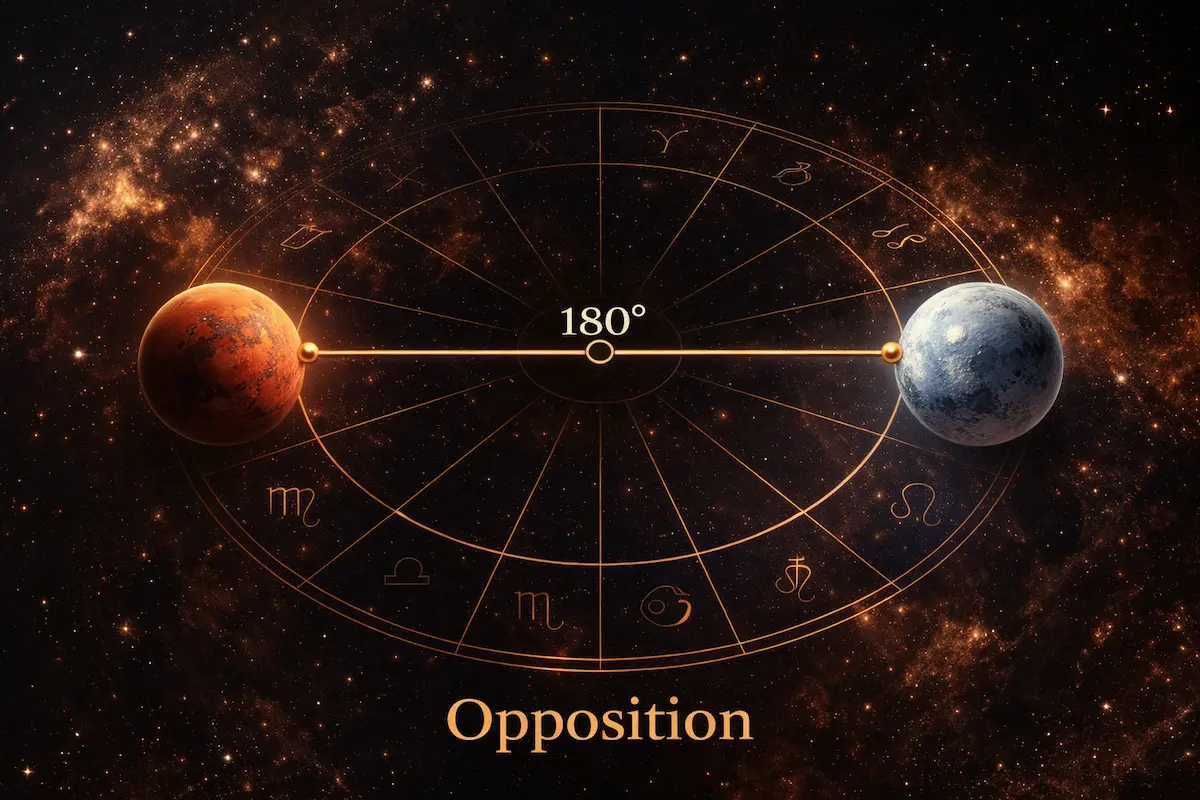
In astrology, an opposition is a 180° aspect between two planets or chart points. The opposition meaning in astrology is rooted in polarity, externalisation, contrast, and the need to balance two forces that often feel incompatible at first. Oppositions are traditionally classed as dynamic or hard aspects, but their deeper purpose is awareness: they show what you see clearly, what you project, and what you must eventually integrate.
On This Page
What an Opposition Really Is
The opposition meaning in astrology begins with geometry. Two planets stand across from each other at roughly 180°, creating a direct line through the centre of the chart. This makes the opposition one of the most visible and conscious aspects. You usually know both sides exist. The problem is not invisibility. The problem is tension, splitting, over-identification, and difficulty holding both principles together without swinging from one extreme to the other.
A conjunction fuses. A trine flows. A square presses. An opposition confronts. It shows the psyche meeting itself across a mirror. It frequently describes inner division expressed through outer life: other people, circumstances, conflict, attraction, frustration, or repeated relational patterns. In traditional aspect doctrine, the opposition is one of the major Ptolemaic aspects, and broader background on aspect theory can be found in resources such as Wikipedia’s overview of astrological aspects and Britannica’s entry on astrology.
| Aspect | Symbol | Angle | Suggested Orb | Core Dynamic | Main Task |
|---|---|---|---|---|---|
| Opposition | ☍ | 180° | about 6–8° | Polarity, mirroring, projection, confrontation | Integrate both poles without splitting into extremes |
Opposition, Projection, and the Shadow
The strongest psychological layer of the opposition meaning in astrology is projection. Rarely do people live both ends of an opposition with equal maturity at the same time. Usually one side is claimed as “me” while the other is experienced as “them”. That is why oppositions so often show up through partners, rivals, authority figures, recurring relational dramas, and encounters with people who seem to carry the disowned function.
A Sun opposite Saturn person may identify with vitality, identity, visibility, or creative will, yet repeatedly encounter Saturn through criticism, inhibition, external rules, delay, judgment, or hard authority. A Venus opposite Uranus person may think of themselves as loving and open, yet keep meeting freedom, unpredictability, emotional distance, or disruption through others. The outer situation is real, but the chart suggests that part of the tension is internal and has not yet been fully integrated. In modern psychological astrology, this is one of the most useful ways to understand the opposition meaning in astrology.
Core principle: the opposition becomes more workable the moment you stop asking “Why does the world keep doing this to me?” and start asking “Which part of this polarity am I outsourcing to the outside world?”
How to Identify the Projected Side
One of the most practical ways to work with the opposition meaning in astrology is to identify which planetary function you tend to project. Oppositions are rarely lived in a balanced way from the start. The psyche usually chooses one pole as familiar and treats the other as disruptive, excessive, threatening, or “belonging to other people”.
- If one side of the opposition appears mostly through other people, that side is likely under-owned.
- If a certain kind of person repeatedly irritates, fascinates, or destabilises you, look at the symbolism they embody.
- If you feel the world is constantly forcing a quality on you, that quality may be part of your unfinished inner work.
- Mastery begins when you consciously reclaim the planetary function you had delegated to the “other”.
- If you feel a strong, repeated charge, whether positive or negative, toward a certain type of person, that charge often points to the projected pole of an opposition.
The Six Polarity Axes
Sign oppositions do not just describe “difference”. Each axis carries a core dilemma and a mature point of balance. The opposition meaning in astrology becomes much more precise when you read the axis itself instead of treating all oppositions as interchangeable.
| Axis | Central Dilemma | Point of Balance |
|---|---|---|
| Aries–Libra | Identity versus otherness | The courage to be fully yourself without abandoning relational harmony |
| Taurus–Scorpio | Matter versus intensity | Tangible security joined with emotional depth and honest exchange |
| Gemini–Sagittarius | Fact versus meaning | Curiosity for details guided by a coherent larger truth |
| Cancer–Capricorn | Care versus structure | Nurturing private life while building something durable in the world |
| Leo–Aquarius | Individual radiance versus collective purpose | Shining personally in a way that still serves the wider whole |
| Virgo–Pisces | Logic versus surrender | Precision in the visible world held inside a wider intuitive awareness |
Common Planetary Combinations in Oppositions
The opposition meaning in astrology changes considerably depending on the planets involved. Some oppositions feel relational, some ideological, some structural, and some existential. The table below shows how different combinations tend to express the axis of tension and integration.
| Opposition | Typical Tension | Mature Integration |
|---|---|---|
| Sun opposite Moon | Conscious will versus emotional need | Inner cooperation between identity and feeling |
| Sun opposite Saturn | Vitality versus inhibition, confidence versus judgment | Authority that is internal, stable, and not based on fear |
| Mercury opposite Jupiter | Detail versus worldview | Thinking that is both precise and meaningful |
| Venus opposite Mars | Receptivity versus pursuit, attraction versus friction | Desire integrated with reciprocity and timing |
| Venus opposite Pluto | Attachment versus control, love versus power intensity | Intimacy without possession or emotional coercion |
| Venus opposite Uranus | Closeness versus freedom | Relationships with both intimacy and breathing space |
| Moon opposite Saturn | Need for care versus emotional restraint | Reliable containment without shutdown |
| Mars opposite Neptune | Drive versus confusion, effort versus diffusion | Directed action guided by inner clarity |
| Mars opposite Saturn | Impulse versus restraint, frustration versus discipline | Controlled, patient, effective action |
| Jupiter opposite Saturn | Expansion versus contraction, optimism versus realism | Sustainable, balanced growth |
| Sun opposite Neptune | Identity diffusion, idealism, confusion, blurred boundaries | Discernment with spiritual clarity instead of self-loss |
| Mercury opposite Saturn | Serious or inhibited thinking, communication blocks, mental heaviness | Structured, credible, carefully grounded expression |
Applying vs Separating Oppositions
Applying and separating matter. An applying opposition usually feels more immediate, forming, or developmentally active. The psyche is still moving into the full awareness of the tension. A separating opposition often describes a pattern that has already manifested strongly and is now being processed, integrated, or repeated in more recognisable ways.
This is not a simplistic rule, but in technical interpretation it helps answer an important question: is the opposition still building pressure, or is the person already learning how to live with its consequences? In serious chart work, this distinction can refine the opposition meaning in astrology considerably.
Orb Theory for Oppositions
Orb matters because not every opposition is felt with the same force. The closer the aspect is to exact, the stronger and more immediate it usually becomes. The opposition meaning in astrology is often easier to recognise when the aspect is tight, but wider oppositions can still operate strongly, especially when the Sun, Moon, or chart angles are involved.
| Opposition Type | Suggested Orb | Interpretive Note |
|---|---|---|
| Sun or Moon opposition | up to 8–10° | Luminaries often work with wider orbs |
| Planet-to-planet opposition | about 6–8° | Usually clearer when tighter |
| Transit opposition | often strongest within 1–2° | Most intense near exactness |
| Angle opposition (ASC/MC etc.) | about 2–3° | Very strong when close |
Cardinal, Fixed, and Mutable Oppositions
Modality changes everything. Because oppositions occur between signs of the same modality, the style of tension follows a clear pattern. The opposition meaning in astrology is not identical in Cardinal, Fixed, and Mutable signs.
| Modality | How the Opposition Tends to Feel | Main Challenge |
|---|---|---|
| Cardinal | Active, initiating, conflict-prone, quickly externalised | Learning cooperation without losing momentum |
| Fixed | Enduring, stubborn, psychologically entrenched, intense | Releasing control and softening rigid identification |
| Mutable | Mental, shifting, diffuse, interpretive, sometimes scattered | Avoiding fragmentation and maintaining coherent direction |
Dignities: Which Side Has More Weight?
Dignity can determine the power balance inside an opposition. Two planets may be equally visible, but they are not always equally resourced. A planet in domicile or exaltation will often have more stability, coherence, or expressive force than one in detriment or fall. This matters because the more dignified side can dominate the lived experience unless the weaker side is consciously strengthened.
For example, in a Sun in Leo opposite Moon in Aquarius pattern, the solar principle may initially feel more confident, central, and self-authorising, while the lunar side may require more conscious effort to feel emotionally embodied and fully heard. The chart does not say one side should win. It says the less supported side often needs deliberate development.
Conversely, a Moon in Taurus opposite Venus in Scorpio may show emotional steadiness on one side and relational intensity on the other. The integration task is not to eliminate either pole, but to let stability hold intensity without collapse, control, or emotional overreaction. This is one more reason the opposition meaning in astrology cannot be reduced to a simple “good” or “bad” label.
Out-of-Sign Oppositions
An opposition does not always need to happen in exact opposite signs to be operative, especially when orb and geometry are strong. An out-of-sign opposition can still function if the planets are close enough in degree to form the 180° relationship. These cases often feel especially nuanced because the geometry says “opposition” while the sign symbolism adds complexity rather than perfect polarity.
In practice, this means the astrologer must weigh both the degree relationship and the sign context. The aspect may be real, but the style of expression can be less clean, less symmetrical, and sometimes harder to integrate.
Why Oppositions Show Up So Strongly in Relationships
The opposition meaning in astrology is strongly relational because the aspect itself is dialogical. One side becomes aware of itself through the other side. That is why oppositions are so often activated through attraction, disagreement, dependency, comparison, rivalry, and mirroring. The other person seems to hold a piece of the psyche that feels missing, irritating, compelling, or unfinished.
This is also why oppositions are not just conflict aspects. They are awareness aspects. They can produce some of the most psychologically rich and transformative relationships in a chart, provided the axis is not reduced to blame or chronic projection. Readers interested in broader relational symbolism can also compare this with the historical use of aspects in Western astrology through sources like AstroWiki.
The Opposition in the ZodiacRoots 8 Roots Method
At ZodiacRoots, we do not read the opposition as a deadlock. We read it as an axis of integration. The Western chart defines the core psychological polarity, the orb, the planets involved, and the houses where the tension becomes concrete. But the full meaning deepens when other symbolic systems confirm, complicate, or redistribute that same opposition.
The Vedic layer adds a crucial perspective because planetary aspect is also understood as sight, direction, and energetic attention. A 180° relationship reinforces the idea of mutual watching, pressure, and mirroring. The Chinese root helps identify whether the temperament naturally resolves conflict through bold confrontation, strategic withdrawal, emotional adaptation, or disciplined structure. The Mayan root shows whether the person is meant to learn through friction, reflection, transformation, or energetic contrast. The Celtic root reveals whether the opposition behaves more like containment, flexibility, endurance, or transition. The Egyptian guardian adds mythic emphasis: whether the axis becomes a struggle for order, sovereignty, rebirth, discernment, or sacred responsibility.
When the same polarity repeats across systems, that is no longer a minor technical feature. It becomes a core life axis. This is where the 8 Roots method becomes especially useful: it shows whether an opposition is merely local in the chart or whether it is echoed across the wider symbolic architecture of the person. This layered approach is the same method we apply to the square, the trine, and every major aspect in the ZodiacRoots library. In that sense, the opposition meaning in astrology becomes richer when it is tested across multiple symbolic layers rather than read in isolation.
How to Read an Opposition in a Birth Chart
- Identify the two planets or points involved.
- Check the orb and whether the aspect is applying or separating.
- Read the sign axis to understand the core dilemma.
- Read the houses to see where the polarity becomes lived experience.
- Assess planetary dignity to understand which side may dominate.
- Ask which side is owned and which side is projected.
- Only then decide whether the opposition is being lived as conflict, attraction, compensation, or integration.
The Point of Resolution: the Midpoint
In more advanced astrology, an opposition can often be understood through its midpoint — the exact degree halfway between the two planets. This midpoint acts like a hidden point of release, concentration, or mediation inside the axis. It does not erase the tension, but it shows where the tension may be integrated more consciously.
If a third planet aspects that midpoint by sextile or trine, it can function like a mediator, translator, or bridge between the two poles. If no such planet exists, the person may need to create that bridge intentionally through a practice, craft, relationship model, philosophy, or disciplined habit that allows the two opposing principles to coexist in a third form.
Advanced reading principle: an opposition is not only solved by choosing one side more wisely. Very often it is resolved by creating a third space that can hold both.
Opposition vs Square vs Trine
Compared with the square meaning in astrology, an opposition is less about pressure to act and more about pressure to see. Compared with the trine meaning in astrology, it is far less fluent and far more conscious. A trine often describes natural ease. A square describes friction that demands effort. An opposition describes polarity that demands balance and psychological honesty.
| Aspect | Angle | General Feeling | Main Task |
|---|---|---|---|
| Trine | 120° | Harmony, ease, flow | Refine and use the talent consciously |
| Square | 90° | Compression, friction, pressure | Act under tension and develop strength |
| Opposition | 180° | Polarity, mirroring, relational tension | Integrate opposites without splitting |
None of these aspects is inherently superior. What matters is whether the person uses the energy consciously. That broader comparative perspective also helps clarify the opposition meaning in astrology for readers who are moving through the full aspects cluster.
Related Astrology Guides
- Astrology Aspects Explained
- Trine Meaning in Astrology
- Square Meaning in Astrology
- How to Interpret a Birth Chart
- Astrology Houses Meaning
Frequently Asked Questions
What does an opposition mean in astrology?
An opposition is a 180° aspect that symbolises polarity, mirroring, contrast, projection, and the need to balance two forces in the chart.
Is opposition a bad aspect?
No. It is a demanding aspect, but not automatically negative. It often produces self-awareness, relational insight, and deep psychological growth.
Why is the opposition linked to projection?
Because people often identify with one side of the axis and experience the other through partners, rivals, authority figures, or repeated situations.
What is the difference between an opposition and a square?
A square creates friction that pushes action, while an opposition creates polarity that pushes awareness, negotiation, and integration.
Can an opposition work if it is out of sign?
Yes, if the degree relationship is strong enough. In those cases, the geometry supports the aspect even when the sign symbolism adds extra complexity.
How do oppositions work in synastry?
In synastry, oppositions often create strong attraction and awareness, but also tension. The two people may see each other clearly yet struggle to find stable common ground. Growth comes from learning to complement rather than oppose.
Can an opposition ever be easy?
Rarely in the beginning. Oppositions are dynamic by nature. But with maturity, they can become less conflictual and more complementary, acting as a source of perspective rather than division.