
How ZodiacRoots Handles Birth Time Uncertainty
Birth time matters in astrology, but not every part of a reading depends on it equally. At ZodiacRoots, we treat birth time uncertainty as a real interpretive limit, not as something to hide behind vague language.
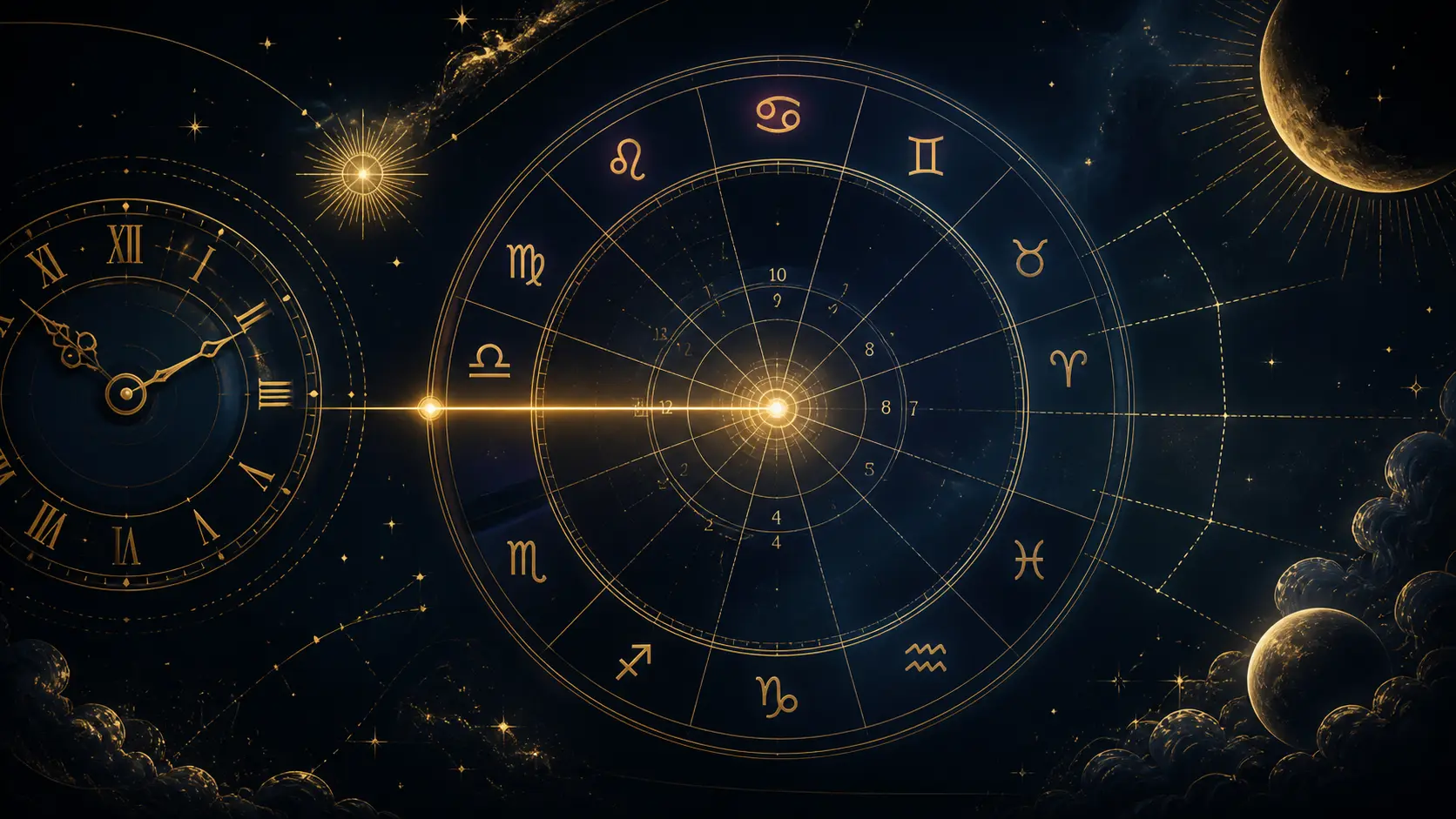
Exact birth time affects the Ascendant and houses. Strong astrology writing should separate verified data from provisional interpretation.
Our approach is simple: use strong data confidently, treat time-sensitive factors carefully, and be transparent about what becomes more tentative when exact birth time is unknown.
Quick Answer: What Is Birth Time Uncertainty in Astrology?
Birth time uncertainty means the exact recorded time of birth is missing, approximate, disputed, or unreliable. In astrology, this matters because the Ascendant, houses, and several time-sensitive chart factors depend on the local horizon at birth. ZodiacRoots still allows meaningful interpretation when birth time is uncertain, but we reduce certainty around Ascendant and house-based claims.
On This Page
This guide explains how ZodiacRoots handles birth time uncertainty, what remains reliable without exact birth time, what becomes conditional, and why editorial transparency matters.
Some Data Stays Strong
Several symbolic layers remain useful even when birth time is unknown.
Some Data Becomes Conditional
Ascendant and house-based interpretation depend much more directly on exact timing.
Transparency Matters
ZodiacRoots does not present estimated birth-time factors as if they were fully verified facts.
Interpretation Stays Possible
A reading can still be rich and meaningful without pretending to be more certain than the data allows.
How Reliable Is My Birth Time?
Use this quick diagnostic to estimate how much confidence you should place in your Ascendant, houses, and time-sensitive chart details.
Select one option above. Your result will explain how ZodiacRoots would treat your birth time in interpretation.
This tool is educational. It does not verify records; it helps you understand how much interpretive caution is appropriate.
Why Birth Time Matters in Astrology
Birth time matters because astrology is partly based on the changing relationship between the sky and the horizon at the moment of birth. Some chart factors move slowly enough that the date and place already provide strong symbolic information. Other factors change much more quickly and depend directly on the exact recorded time.
This is why two people born on the same day in the same place may share some chart layers but still differ in important ways if they were born at different hours. In practice, the most sensitive factors are usually the Ascendant and the house structure, because those depend on the local horizon and rotate through the zodiac across the day.
At ZodiacRoots, this is not treated as a technical footnote. It is part of our editorial method, because strong interpretation requires clear awareness of which symbolic elements are more secure and which become more conditional when time is uncertain.
For general background, compare this with the wider concept of the Ascendant in astrology and the historical overview of astrology as a symbolic tradition.
What Usually Remains Reliable Without Exact Birth Time
- Sun sign, except near sign-boundary cases
- Many date-based symbolic systems
- Chinese Zodiac
- Mayan Seal
- Celtic Tree symbolism
- Egyptian symbolic layer
- Much of the broader thematic reading when framed responsibly
What Becomes More Uncertain Without Exact Birth Time
- Ascendant sign
- House placements
- House emphasis in interpretation
- Some timing-sensitive technical details
- Parts of the chart that depend on fast local rotation
- Interpretive confidence in outer style if based only on estimated birth time
Fast-Changing Chart Factors: Why a Few Minutes Can Matter
Birth time uncertainty is not equally important for every astrological factor. Some factors change slowly, while others can shift dramatically during the day. This is why ZodiacRoots separates stable date-based roots from clock-sensitive chart structure.
| Factor | Approximate Speed | Why It Matters | Confidence Without Exact Time |
|---|---|---|---|
| Sun sign | About 30 days per sign | Usually stable for the birth date, except near sign changes. | Usually high |
| Moon sign | About 2.5 days per sign | Can change sign on the birth date, especially near a lunar transition. | Medium to high, depending on date |
| Ascendant | Roughly 2 hours per sign | Highly dependent on exact local birth time and place. | Low without reliable time |
| Houses | Continuously shifting through the day | House placements depend directly on the Ascendant and local horizon. | Low without reliable time |
| Midheaven / angles | Time-sensitive | Career/public image interpretation becomes weaker without exact time. | Low without reliable time |
These are practical interpretive guidelines, not rigid laws. Exact movement depends on date, place, latitude, house system, and calculation method.
Birth Time Certainty: A Practical Data Hierarchy
Not all birth data has the same interpretive value. ZodiacRoots uses a practical hierarchy so the language of a reading matches the strength of the data.
| Birth Time Status | How ZodiacRoots Treats It | Interpretive Confidence |
|---|---|---|
| Verified exact time | Ascendant, houses, and time-sensitive factors can be interpreted more directly. | Higher confidence |
| Approximate time | Ascendant and houses may be used with careful qualification. | Moderate confidence |
| Unknown time | Date-based layers remain useful, while Ascendant and houses are reduced or excluded. | Conditional confidence |
| Disputed time | Time-sensitive claims are avoided unless clearly marked as provisional. | Low confidence for time-based factors |
How ZodiacRoots Responds When Birth Time Is Unknown
When exact birth time is unavailable, ZodiacRoots does not pretend that nothing changes. Instead, we adjust the interpretive weight of the reading. Factors that remain structurally strong continue to be interpreted with confidence. Factors that depend more directly on clock time are either qualified carefully or presented with reduced certainty.
In premium readings, this may mean using more careful phrasing around the Ascendant and house-based themes. In public articles about celebrities or historical figures, it may mean excluding Ascendant-based claims entirely or marking them clearly as provisional when the time source is weak, disputed, or estimated.
This is a deliberate editorial choice. We believe a reading becomes more trustworthy when it acknowledges uncertainty instead of hiding it.
How to Read a Chart Without the Ascendant: A Practical Tutorial
A missing Ascendant does not make a reading useless. It simply changes the method. The safest approach is to build the interpretation from stable layers first, then clearly mark anything that depends on time as provisional.
- Start with the Sun sign. Use it for identity, direction, vitality, and the basic symbolic tone of the birth date.
- Check whether the Moon changed sign that day. If the Moon remained in one sign all day, it can be interpreted with more confidence. If it changed sign, explain both possible emotional patterns.
- Use date-based roots. Chinese Zodiac, Mayan Seal, Celtic Tree symbolism, and Egyptian guardian layers can provide structure without relying on exact clock time.
- Avoid house claims. Do not say “your career house” or “your relationship house” unless the time is reliable enough to support that claim.
- Replace Ascendant language with observable style. Instead of claiming a fixed Rising sign, describe how the person publicly appears based on biography, behaviour, or known life patterns.
- Use careful language. Say “this may suggest”, “under the estimated time”, or “if this timed version is correct” when interpreting time-sensitive details.
Estimated Birth Time Is Not the Same as Verified Birth Time
Some astrology systems and websites quietly use a default or estimated birth time when no exact hour is known. That can be useful for generating a provisional chart framework, but it should never be confused with verified chart certainty.
At ZodiacRoots, an estimated birth time is treated as exactly that: an estimate. It may help structure parts of a reading, but it does not erase the underlying uncertainty. The interpretation should reflect the difference between a confirmed Ascendant and a provisional one.
This distinction matters because the language of certainty shapes how readers understand themselves. Editorial responsibility includes making sure that chart confidence and chart speculation are not written in the same voice.
Our Rule of Thumb
- Confirmed data can support stronger interpretation
- Estimated data requires softer language
- Missing data should be acknowledged directly
- Time-sensitive claims should not be overstated
- Interpretive honesty is part of the ZodiacRoots method
How to Try to Rectify Your Birth Time: Simple First Steps
Birth time rectification is the process of trying to narrow down a likely birth time when the exact record is missing or disputed. Full rectification can be complex, but there are simple, responsible steps a reader can take before treating an estimated chart as reliable.
1. Look for official records
Birth certificates, hospital records, baby books, baptism records, or family documents can sometimes contain a more precise time than memory alone.
2. Ask more than one source
Parents, older relatives, or family friends may remember approximate timing differently. Contradictions are useful because they show where caution is needed.
3. Narrow the range
Even “before sunrise”, “after lunch”, or “around midnight” can help reduce uncertainty compared with no time at all.
4. Compare possible Ascendants carefully
If two possible times produce different Rising signs, compare them as hypotheses, not as proof. Look for repeated patterns before choosing one.
ZodiacRoots treats rectification as a cautious interpretive process. It can help, but it should not be used to turn a guess into certainty without evidence.
Comparative Example: Same Date, Same Place, Different Hours
Imagine two people born on the same date and in the same city. Their Sun sign, Chinese Zodiac, Mayan Seal, Celtic Tree, and Egyptian symbolic layer may be the same. However, if one was born in the morning and the other at night, the Ascendant and houses may be completely different.
| Birth Scenario | Likely Stable Factors | Likely Changing Factors | Responsible Interpretation |
|---|---|---|---|
| Same city, 8:00 AM | Sun sign, Chinese Zodiac, Mayan Seal, Celtic Tree, Egyptian layer | Ascendant, houses, angles, possibly Moon details | Timed chart can be interpreted if the time is verified. |
| Same city, 8:00 PM | Most date-based roots remain the same | Ascendant and houses may shift substantially | Do not assume the same Rising sign or house story. |
| Same city, unknown time | Date-based roots remain useful | Ascendant, houses, and angle-based timing cannot be used confidently | Build the reading from stable layers and disclose the limitation. |
Quick Reference: What Not to Do with an Uncertain Birth Time
Birth time uncertainty does not destroy a reading, but it does require discipline. The table below summarises the editorial standards ZodiacRoots applies when time data is weak.
| Do Not Do This | Why It Is a Problem | Better ZodiacRoots Practice |
|---|---|---|
| Claim a fixed Ascendant from an unknown time | The Ascendant changes quickly and depends on clock time and place. | Say the Ascendant is unknown or use only as a clearly marked hypothesis. |
| Interpret houses as certain | House placements rely on the Ascendant and local horizon. | Focus on signs, planetary themes, and date-based roots instead. |
| Use vague mystical wording to hide weak data | It can make an uncertain reading sound more precise than it is. | Explain what is known, what is estimated, and what is excluded. |
| Ignore a disputed birth time | Different times can produce different Rising signs, houses, and timing conclusions. | Present the chart version used and mark time-sensitive claims as provisional. |
| Reduce the whole reading to the Sun sign | A missing birth time does not erase all symbolic information. | Use the wider 8 Roots framework to preserve depth responsibly. |
How Birth Time Uncertainty Affects the 8 Roots Method
The ZodiacRoots 8 Roots Method is designed precisely to avoid overdependence on a single chart factor. That makes the framework especially useful when birth time is uncertain. The reading does not collapse just because one time-sensitive layer becomes less stable.
The Solar, Lunar, Vedic, Chinese, Mayan, Celtic, and Egyptian layers can still provide substantial symbolic depth. The main adjustment lies in how strongly the Ascendant and house-derived interpretations are emphasised. In this sense, the 8 Roots Method helps preserve interpretive richness while still respecting the limits of the available data.
This is one reason ZodiacRoots can still produce meaningful readings under imperfect data conditions without pretending that birth time uncertainty has disappeared.
How We Handle Birth Time Uncertainty in Public Figure Readings
Public figure astrology often depends on birth data that is incomplete, secondary, disputed, or widely repeated without strong sourcing. That is why ZodiacRoots treats celebrity and historical chart interpretation carefully.
When a public figure has no confirmed birth time, we may frame the article as a public birth data reading. In those cases, the site gives more weight to date-based and non-time-based symbolism, while limiting or qualifying Ascendant and house-based claims.
This protects both interpretive quality and editorial honesty. A reading should not appear more precise simply because the page is written with confidence.
Two Celebrity Examples: Disputed Time vs Unknown Time
The difference between a disputed birth time and a fully unknown birth time matters. ZodiacRoots handles those two cases differently, and the distinction can be seen in two public celebrity readings: Madonna and Mike Portnoy.
Case Study 1: Madonna — Disputed Birth Time
In the ZodiacRoots reading of Madonna’s zodiac sign and 8 Roots profile, the article uses a public timed chart version with Leo Sun, Virgo Moon and Virgo Ascendant. However, it also explains that the birth time is disputed and therefore treats the timed chart as a working version rather than an undisputed final chart.
This is a useful example of birth time uncertainty because the chart can still be interpreted, but the Ascendant, houses and angle-based timing must be written carefully. Madonna’s Leo Sun remains a strong date-based factor, while Virgo Rising belongs only to the specific timed chart version used in the article.
| Madonna Chart Factor | How ZodiacRoots Handles It | Editorial Confidence |
|---|---|---|
| Sun sign | Leo remains the stable Western zodiac sign for the birth date used. | High confidence |
| Moon sign | Used within the working chart, with awareness that Moon details should always be checked near transitions. | Moderate to high confidence |
| Ascendant | Virgo Ascendant is treated as part of the public timed chart version, not as an undisputed fact. | Conditional confidence |
| Houses and angles | Interpreted only within the timed version and not presented as universally settled. | Provisional |
Case Study 2: Mike Portnoy — Unknown Birth Time
The ZodiacRoots article on Mike Portnoy’s zodiac sign follows a stricter protocol because no confirmed public birth time is available. In that case, the article deliberately avoids claiming a fixed Ascendant, house structure, or angle-based timing.
This is the cleaner model for unknown-time readings. The article still interprets strong symbolic layers such as Taurus Sun, Virgo Moon, Vedic Rashi, Chinese Zodiac, Mayan Seal, Celtic Tree and Egyptian Guardian, but it does not invent a Rising sign just to make the chart feel complete.
| Mike Portnoy Chart Factor | How ZodiacRoots Handles It | Editorial Confidence |
|---|---|---|
| Sun sign | Taurus is interpreted as a stable Western zodiac layer. | High confidence |
| Moon sign | Virgo Moon is used where the birth date supports the calculation. | High confidence when date-based calculation is stable |
| Ascendant | Not identified because no confirmed birth time is available. | Not used |
| Houses and angles | Excluded from interpretation because they require reliable clock time. | Not used |
Together, these two examples show the ZodiacRoots editorial rule in practice: disputed time can support a clearly labelled working chart, while unknown time should exclude Ascendant and house claims unless reliable evidence appears.
What We Avoid
- Treating estimated Ascendants as proven facts
- Using the same certainty level for weak and strong data
- Hiding uncertainty behind mystical wording
- Overstating house-based conclusions without reliable time
- Letting convenience override editorial honesty
What We Aim For
- Clear data hierarchy
- Meaningful reading under real constraints
- Transparent qualification of weaker factors
- Consistent editorial framing
- Trust built through clarity rather than overstatement
The ZodiacRoots Position on Uncertain Birth Time
ZodiacRoots does not treat birth time uncertainty as a reason to abandon interpretation, and it does not treat it as something that can be ignored. It is a real limit, but it is a manageable one when the reading is structured responsibly.
Our position is therefore simple: use what remains strong, qualify what becomes weaker, and never confuse estimate with certainty.
That is how we handle birth time uncertainty: with symbolic depth, editorial honesty, and respect for what the data can genuinely support.
Sources and Editorial References
ZodiacRoots uses external references for context and separates those references from symbolic interpretation. These links are included to support transparency around astrology, Ascendant meaning, house logic, and the celebrity case studies used above.
Calculate Your 8 Roots with the Best Data You Have
Exact birth time gives the strongest result, especially for the Ascendant and house-based factors. But even if your time is unknown, ZodiacRoots can still help you explore stable symbolic layers with clearer context.
Explore Related ZodiacRoots Guides
Continue with guides that explain the chart factors most affected by birth time, the Sun–Moon layers that often remain useful without exact time, and the symbolic systems that support responsible interpretation when birth data is incomplete.
Frequently Asked Questions About Birth Time Uncertainty
Does birth time matter in astrology?
Yes. Birth time matters especially for the Ascendant, house placements, and other time-sensitive chart factors. Some symbolic layers remain useful without exact birth time, but the parts of the chart tied to the local horizon become less certain.
Can ZodiacRoots still do a reading without exact birth time?
Yes. ZodiacRoots can still produce a meaningful reading by giving more weight to stable symbolic layers and treating time-sensitive factors more cautiously. The reading remains useful, but the Ascendant and houses should not be overstated.
What becomes uncertain when birth time is unknown?
The most uncertain factors are usually the Ascendant, house placements, and interpretations that depend directly on those structures. Some Moon-related details may also need caution if the Moon changed signs on the birth date.
How fast does the Ascendant change?
The Ascendant changes quickly, often moving through one zodiac sign in roughly two hours. This is why even an approximate birth time can change Rising sign and house interpretation.
How fast does the Moon sign change?
The Moon usually spends about two and a half days in a zodiac sign. If someone was born near a Moon sign transition, the Moon sign may need to be checked carefully when birth time is unknown.
Does ZodiacRoots use estimated birth time?
In some contexts, an estimated time may be used as a provisional framework, but ZodiacRoots does not treat estimated birth time as equivalent to verified birth data. Estimated data requires softer interpretive language.
How does birth time uncertainty affect celebrity astrology articles?
When public birth time is uncertain or disputed, ZodiacRoots gives more weight to date-based and non-time-based symbolism and treats Ascendant or house claims with caution. Public figure readings should not sound more precise than the data allows.
What is the difference between Madonna and Mike Portnoy as birth time examples?
Madonna is an example of disputed birth time: ZodiacRoots can discuss a public timed chart, but labels it as a working version. Mike Portnoy is an example of unknown birth time: ZodiacRoots excludes Ascendant and house claims because no confirmed public birth time is available.
What parts of the 8 Roots Method remain useful without exact birth time?
Date-based and tradition-based symbolic layers can still remain useful, including the Sun sign, Chinese Zodiac, Mayan Seal, Celtic Tree symbolism, and Egyptian layer. The main caution applies to the Rising sign, houses, and other time-sensitive details.
Why is transparency about birth time uncertainty important?
Transparency matters because interpretive confidence should match data confidence. Clear editorial framing helps keep astrology writing more honest, more useful, and more trustworthy.