Square Meaning in Astrology: Tension, Friction, Mastery and Real Chart Interpretation
A premium technical guide to the square aspect in astrology, including modality, elemental friction, houses, natal interpretation, synastry, transits, orb strength, and the deeper path from pressure to mastery.
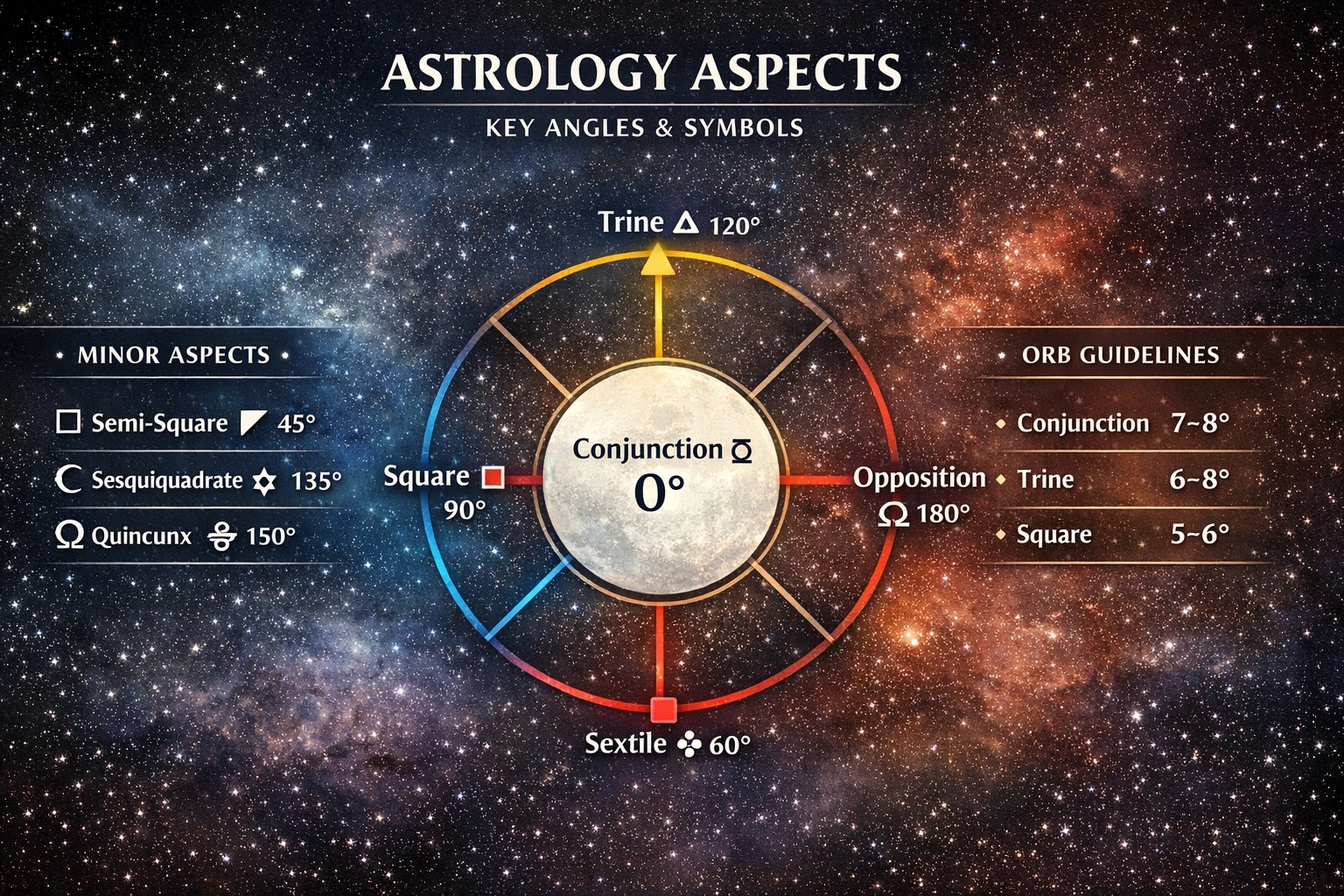
Quick Answer: The square in astrology is a 90° aspect that creates friction, pressure, blockage, and developmental tension between two planets or chart points. It is a hard aspect, but it is often one of the most productive forces in a chart because it pushes growth through challenge rather than ease.
The square meaning in astrology is one of the most important interpretive foundations in a birth chart. A square does not simply describe conflict. It describes energy that cannot remain passive. It creates a problem to solve, a contradiction to live through, or a psychological pressure point that demands adjustment, effort, and eventual structure.
The square meaning in astrology becomes clearer when we stop treating it as a flat warning and start reading it as a structured form of pressure. In serious astrology, the square meaning in astrology is less about “bad energy” and more about how tension reshapes character, behaviour, and life direction.
That is why the square aspect in astrology appears so often in charts marked by ambition, discipline, emotional complexity, endurance, or creative struggle. Squares rarely feel smooth. But they often become the place where character is forged.
At ZodiacRoots, we do not reduce the astrology square aspect to a negative keyword. We treat it as a dynamic field of pressure whose expression changes according to the planets involved, the houses, the signs, the modality, the element, the orb, and the wider symbolic logic of the chart.
Core principle: the square is not “bad energy.” It is compressed energy. It creates friction because two parts of the chart want expression, but they do not cooperate naturally. The result is pressure, frustration, movement, and, at a higher level, mastery.
Table of Contents
- What Is a Square in Astrology?
- Square at a Glance
- Why the Square Is a Hard Aspect
- The Geometric Logic of the Square
- How Modality Changes the Square
- Elemental Friction in Square Aspects
- From Tension to Mastery
- Square Meaning in the Natal Chart
- How Houses Change the Meaning of a Square
- Common Planetary Square Combinations
- Square Meaning in Synastry
- Square Meaning in Transits
- Applying vs Separating Squares
- Orb Theory for Squares
- T-Square, Grand Cross and Other Patterns
- Square vs Semi-square, Trine and Opposition
- Real-World Examples
- Square Meaning in Astrology in the 8 Roots Method
- Related Guides and External References
What Is a Square in Astrology?
A square is a 90° angular relationship between two planets, angles, or sensitive points. In classical and modern astrology alike, it is treated as a hard aspect because it describes challenge, conflict, tension, and forced development rather than easy flow.
The square meaning in astrology is not merely “difficulty.” A square describes two principles that are both active, but poorly synchronised. They press against each other. They interrupt each other. They create heat, compression, resistance, and urgency.
In practice, a square often shows:
- inner contradiction
- external pressure or repeated obstacles
- reactivity that later becomes discipline
- friction that forces movement
- a life theme that cannot remain unconscious for long
This is why the astrology square aspect is so central to chart interpretation. A square usually makes itself known. It tends to describe a domain of life where ease is unavailable, but development is unavoidable.
Square at a Glance
| Aspect | Angle | Type | What It Does | Lower Expression | Mastery Path |
|---|---|---|---|---|---|
| Square | 90° | Hard aspect | Creates pressure and activation | Conflict, frustration, reactivity | Discipline, resilience, mastery |
Why the Square Is a Hard Aspect
The square is called a hard aspect because it usually does not allow smooth cooperation. Instead, it produces friction. One part of the chart pushes in one direction while another interrupts, resists, or destabilises that expression.
That pressure can appear as:
- blocked action
- defensive behaviour
- chronic tension
- stress under responsibility
- the feeling that something must be worked out rather than simply enjoyed
But this is only the lower expression. The square meaning in astrology becomes much more interesting when we notice that hard aspects often correlate with effort, stamina, seriousness, and achievement. The square can become the engine that a soft chart lacks.
Common mistake: many beginners assume that a trine is always good and a square is always bad. In real chart work, trines can become passive, while squares often become the source of stamina, output, and hard-earned excellence.
The Geometric Logic of the Square
Most squares connect signs of the same modality. That is why the tension has a recognisable structure. The two signs are active in a similar way, but their goals, instincts, or timing clash.
| Square Type | Signs Involved | Typical Dynamic |
|---|---|---|
| Cardinal square | Aries, Cancer, Libra, Capricorn | Competing initiatives, urgency, direct confrontation, impatience |
| Fixed square | Taurus, Leo, Scorpio, Aquarius | Resistance, stubbornness, sustained pressure, entrenched will |
| Mutable square | Gemini, Virgo, Sagittarius, Pisces | Mental strain, inconsistency, over-adaptation, competing interpretations |
So the square meaning in astrology is never just “90 degrees = tension.” The angle supplies the structure, but the signs explain the style of conflict.
How Modality Changes the Square
One of the most overlooked parts of the square aspect in astrology is modality. Two squares may both be difficult, but they do not feel difficult in the same way.
Cardinal Squares
Cardinal squares are driven, immediate, and action-oriented. They tend to produce collision through initiative. The issue is often not lack of movement, but too much competing movement. These squares can feel impatient, combative, or unable to rest.
At a lower level, they produce impulsive conflict and poor timing. At a higher level, they create leadership under pressure.
Fixed Squares
Fixed squares tend to feel heavier and more entrenched. They can produce stalemate, pride, resistance, possessiveness, or refusal to bend. These are often the squares of endurance, but also of rigidity.
At a lower level, they create defensive stagnation. At a higher level, they produce extraordinary persistence and staying power.
Mutable Squares
Mutable squares often express through mental overload, changing priorities, scattered effort, overthinking, nervous strain, or difficulty sustaining one clear direction. The conflict is not always external. It is often interpretive, psychological, or adaptive.
At a lower level, they produce diffusion and inconsistency. At a higher level, they create flexibility with method.
Elemental Friction in Square Aspects
Modality explains the structural kind of pressure. Element explains the texture of that pressure. This is where authority-level interpretation deepens. A square between Fire and Earth does not behave like a square between Water and Air.
| Elemental Friction | Typical Conflict | Concrete Example | Higher Integration |
|---|---|---|---|
| Fire vs Earth | Impulse vs practicality, speed vs caution, vision vs material limits | Wanting to launch immediately but lacking structure or resources | Directed ambition, courage with structure |
| Fire vs Water | Direct expression vs emotional sensitivity, action vs protection | One part pushes forward while another retreats into self-protection | Passion with emotional intelligence |
| Fire vs Air | Urgency vs detachment, instinct vs analysis, action vs conceptual drift | Acting too fast for the mind to clarify the plan | Inspired action with strategic thinking |
| Earth vs Air | Reality vs theory, method vs abstraction, execution vs interpretation | Brilliant ideas that stall when implementation becomes necessary | Ideas that can actually be built |
| Earth vs Water | Control vs feeling, stability vs emotional flux, containment vs vulnerability | Needing security while emotion keeps dissolving the structure | Grounded care, durable emotional trust |
| Air vs Water | Analysis vs feeling, explanation vs lived sensitivity, distance vs need | Trying to explain what first needs to be felt | Emotional articulation and relational maturity |
This is one reason why natal square interpretation cannot stop at “hard aspect.” The angle tells you there is friction. The element tells you what kind of world is colliding.
From Tension to Mastery
This is the turning point that many introductory articles miss. The square does not mature by disappearing. It matures by being worked consciously. In other words, the path is not from tension to comfort, but from tension to usable strength.
The square meaning in astrology at its lowest expression is reactive conflict. At its highest expression, it becomes focused power. But each modality requires a different inner task.
How Cardinal Squares Mature
Cardinal squares mature when the person learns timing, containment, and directional clarity. The problem is rarely lack of initiative. It is misdirected initiative or competing impulses. Mastery appears when the person stops reacting instantly and starts choosing where force belongs.
How Fixed Squares Mature
Fixed squares mature when the person learns flexibility without collapse. These squares often defend themselves by resisting change. Mastery begins when the individual can release rigidity while preserving depth, loyalty, and strength.
How Mutable Squares Mature
Mutable squares mature when the person creates method. The challenge is often not a lack of intelligence or perception, but too many possible responses at once. Mastery appears when attention is structured and energy stops leaking through over-adaptation.
The deeper lesson: a square becomes more constructive when the person stops asking, “How do I make this easy?” and starts asking, “How do I make this usable?” That shift marks the beginning of mastery.
Square Meaning in the Natal Chart
In natal astrology, a square describes a built-in developmental tension. It is not a temporary mood. It is part of the core wiring of the chart.
Natal squares often indicate:
- a recurring inner contradiction
- a high-effort area of life
- a psychological pressure pattern
- frustration that becomes competence over time
- a place where character is formed under resistance
The square meaning in astrology in the natal chart is therefore central to personality interpretation. It often reveals where a person feels least relaxed, but also where they may become strongest.
Examples of Natal Squares
Sun square Mars: identity clashes with action style. This may produce impatience, irritability, competitiveness, defensiveness, or a fierce drive to prove oneself. Matured well, it becomes courage and initiative.
Moon square Saturn: emotional need meets restraint, duty, inhibition, or fear of softness. This can produce guardedness, seriousness, loneliness, or emotional self-control. Matured well, it becomes depth, steadiness, and emotional reliability.
Mercury square Neptune: thought meets ambiguity, imagination, porous boundaries, or projection. This can create confusion, idealisation, or misreading. Matured well, it supports symbolic intelligence, poetic thinking, and subtle perception.
Venus square Pluto: affection and value patterns meet intensity, control, compulsion, fear of loss, or emotional absolutism. Matured well, it becomes powerful relational honesty and psychological depth.
Mars square Saturn: impulse meets resistance. This is one of the clearest signatures of effort under pressure. At first, it may feel blocked, frustrated, delayed, or harsh. Matured well, it becomes exceptional endurance, discipline, and controlled force.
For that reason, the square meaning in astrology should always be read as a developmental pattern rather than a static flaw. A strong square in astrology often marks the exact place where frustration can become competence, and pressure can become authority.
How Houses Change the Meaning of a Square
A square does not exist only between planets. The houses involved change the field of expression completely. The same planets can produce very different lived results depending on where the pressure is happening.
| House Axis Under Pressure | Typical Life Theme |
|---|---|
| 1st and 10th | Identity vs public role, self-assertion vs duty, personal instinct vs achievement pressure |
| 4th and 7th | Private emotional security vs partnership demands |
| 5th and 8th | Romance, joy, and self-expression vs vulnerability, control, and psychological depth |
| 2nd and 11th | Personal values and resources vs group expectations, social goals, or collective belonging |
| 3rd and 6th | Mental habits and communication vs work systems, health routines, and daily obligation |
| 9th and 12th | Belief, meaning, worldview vs retreat, loss of clarity, or unseen psychological pressure |
For example, a Sun square Saturn between the 1st and 10th houses often feels like identity under judgment, authority pressure, or the need to earn legitimacy through visible output. The same aspect between the 5th and 8th houses may feel more like blocked self-expression, fear of exposure, intensity around intimacy, or pressure around creative risk.
This is why serious square meaning astrology work always asks not only which planets? but also where in life?
For house-based context, see Astrology Houses Meaning.
Common Planetary Square Combinations
Many readers arrive on a square page because they want to understand a specific planetary combination. The table below gives a quick authority-level map of some of the most common square aspects.
| Square Combination | Typical Friction | Higher Potential |
|---|---|---|
| Sun square Moon | Will vs emotional need, inner inconsistency, identity under tension | Psychological integration and self-awareness |
| Sun square Mars | Ego pressure, impatience, defensiveness, action conflict | Courage, initiative, competitive force |
| Sun square Saturn | Authority pressure, inhibition, self-doubt, harsh standards | Gravitas, endurance, earned authority |
| Moon square Mercury | Feeling vs explanation, emotional misunderstanding, mental-emotional mismatch | Emotional literacy and better communication |
| Moon square Saturn | Need vs restraint, emotional heaviness, guardedness | Emotional seriousness and reliability |
| Mercury square Mars | Sharp speech, impatience in thought, argumentative style | Mental decisiveness and verbal courage |
| Mercury square Neptune | Confusion, projection, ambiguity, porous thinking | Imagination, symbolism, poetic perception |
| Venus square Mars | Attraction with mismatch, desire tension, relational heat | Erotic vitality and relational magnetism |
| Venus square Jupiter | Excess, indulgence, inflated expectations, generosity without limits | Warmth, social ease, abundant affection with discernment |
| Venus square Saturn | Fear of rejection, guarded affection, scarcity scripts in love | Loyalty, seriousness, durable commitment |
| Venus square Pluto | Intensity, possession, fear of loss, emotional control patterns | Transformative honesty and deep bonding |
| Mars square Saturn | Blocked force, frustration, delay, pressure under effort | Discipline, stamina, controlled power |
| Mars square Uranus | Explosive reactivity, impulsiveness, disruption | Inventive courage and decisive liberation |
| Saturn square Neptune | Reality vs idealism, structure vs diffusion, duty vs escape | Embodied vision and disciplined imagination |
These combinations should always be refined by sign, house, dignity, orb, and the wider chart pattern. But as a reference structure, they help show why the astrology square aspect is far more nuanced than “tension equals bad.”
Square Meaning in Synastry
In synastry, squares are often the aspects of activation. They create heat, friction, irritation, fascination, attraction, or emotional restlessness between two people. The bond is rarely neutral.
The square meaning in astrology in relationships is not simple incompatibility. Very often, it is functional tension. Two people stimulate each other strongly, but not always comfortably.
Examples include:
- Venus square Mars: strong attraction, but mismatched desire rhythms or love languages
- Moon square Mercury: emotional experience and verbal framing fail to line up naturally
- Sun square Saturn: admiration mixed with inhibition, pressure, correction, or emotional heaviness
- Mars square Pluto: magnetic intensity, power struggle, sexual heat, dominance issues
Squares in synastry often need maturity, boundaries, and self-awareness. They can sustain a compelling relationship, but they tend to require conscious handling. They are rarely effortless.
For broader relationship context, see Zodiac Compatibility and Can Compatibility Be Judged Only by Sun Sign?.
Square Meaning in Transits
In transit work, a square often corresponds to periods of pressure, decision, confrontation, stress, or restructuring. Something is being forced into awareness.
Transit squares frequently coincide with:
- external resistance
- heightened urgency
- impatience or frustration
- events that expose weak structure
- moments when passive continuation stops being possible
A square transit meaning depends heavily on the transiting planet:
- Mars square: heat, conflict, activation, irritability
- Saturn square: pressure, delay, realism, responsibility, fatigue
- Uranus square: disruption, instability, liberation pressure, sudden course correction
- Neptune square: confusion, diffusion, uncertainty, dissolving assumptions
- Pluto square: compulsion, power struggle, deep restructuring, non-negotiable change
Transit squares are often strongest near exactness. They do not just symbolise discomfort. They often mark developmental turning points.
Applying vs Separating Squares
An applying square is moving toward exactness. A separating square has already passed exactness. This distinction matters more than many mid-level guides admit.
In natal interpretation, an applying square often feels more active, urgent, unfinished, or developmental. It may describe a tension that the person is still learning to meet consciously. A separating square can still be strong, but often feels more ingrained, familiar, or patterned through prior experience.
In transit work, the distinction is even more useful:
- Applying transit square: building pressure, approaching confrontation, growing urgency
- Exact square: peak activation, event pressure, maximum visibility
- Separating transit square: consequence phase, processing, integration, fallout, learning
So a square is not just about what the tension is. It is also about where in the cycle that tension currently sits.
Orb Theory for Squares
A serious reading of the astrology square aspect must include orb. A square is not equally strong at every distance from exactness.
| Square Type | Suggested Orb | Interpretive Note |
|---|---|---|
| Sun or Moon square | up to 8–10° | Larger orbs often remain meaningful because the luminaries illuminate wider chart dynamics |
| Planet-to-planet natal square | about 5–6° | Clearer when tighter, but still meaningful within standard orb |
| Transit square | often strongest within 1–2° | Usually felt most intensely near exactness |
| Angle square (ASC/MC) | about 2–3° | Very strong when close and often event-linked |
An exact square usually feels more unavoidable. A wide square may still matter, but its expression is often less concentrated or less dominant.
For broader technical context, see Astrology Aspects Explained.
T-Square, Grand Cross and Other Patterns
Authority-level chart interpretation cannot stop at isolated aspects. Many of the most researched square structures are actually configurations.
| Pattern | Structure | Meaning |
|---|---|---|
| T-Square | Two squares + one opposition | Concentrated pressure, high drive, chronic activation, need for purposeful release |
| Grand Cross | Four points in square/opposition structure | Complex tension, overload, endurance, pressure from multiple directions |
| Square to a Stellium | One planet squaring a concentrated cluster | One area of life repeatedly destabilises a strongly focused part of the chart |
T-Square
A T-square is one of the most important square patterns in astrology. It concentrates pressure around an apex planet or point, which often becomes the obvious release channel. These charts can feel driven, unstable, ambitious, or permanently activated.
Grand Cross
A Grand Cross intensifies the logic of the square by multiplying the number of active pressure points. This often creates a person who feels pulled in multiple directions at once, yet may also develop extraordinary endurance, problem-solving strength, and survival capacity.
These patterns are some of the most searched square formations because they show how the square evolves from a single friction point into a wider energy architecture.
Square vs Semi-square, Trine and Opposition
Comparative framing helps refine the square meaning in astrology. Not all tension aspects operate the same way.
| Aspect | Angle | General Feel | Typical Effect |
|---|---|---|---|
| Semi-square | 45° | Low-grade irritation | Inner friction, subtle agitation, persistent pressure |
| Square | 90° | Direct conflict and compression | Strong challenge, activation, forced development |
| Trine | 120° | Ease and harmony | Flow, natural talent, less resistance |
| Opposition | 180° | Polarity and contrast | Relational awareness, projection, balancing extremes |
The semi-square often feels like background irritation. The square is more direct and undeniable. The opposition is more reflective and polarised. The trine is easier, but not always more productive.
Real-World Examples
Public-chart examples can help anchor theory, but they should be used carefully. No serious astrologer should reduce a life to one aspect. The value of public examples is to illustrate a structural principle, not to claim total explanation.
Michael Jordan: widely used public chart data is often cited in discussions of hard aspects and competitive pressure. He is a useful example of how tension signatures can correlate with relentless performance standards, not merely conflict.
Madonna: public astrological discussions of her chart often focus on hard-aspect intensity and reinvention. She is a useful example of how pressure can become control, output, and repeated self-reconstruction.
Mars–Saturn archetype in public life: one of the most classic hard-aspect signatures in astrology is Mars under Saturnian pressure. In lived experience, it often appears in people known for extreme discipline, frustration tolerance, severe work ethic, or mastery earned through resistance rather than ease.
Interpretive caution: if you use public figures as square examples, always source the chart carefully and keep the claim modest. Authority comes from precision and restraint, not from forcing biography to fit a single aspect.
Square Meaning in Astrology in the 8 Roots Method
At ZodiacRoots, the square meaning in astrology begins with a technical fact: a 90° relationship creates friction, compression, and developmental pressure. But the 8 Roots method does not stop at naming that tension. It asks what layer of the person is under pressure, how that pressure is experienced, and which symbolic systems confirm or complicate the same pattern.
This is what makes the 8 Roots method different from a standard one-layer reading. A conventional interpretation may say that a square shows conflict. The 8 Roots framework asks a more precise question: is this conflict showing up in identity, emotional life, outward behaviour, karmic patterning, instinctive reactions, symbolic timing, or relational mythology? The square stays the same, but the interpretive depth changes.
How the 8 Roots method reads a square
- Start with the Western technical structure. Identify the square by planet, degree, orb, sign, house, and whether it is applying or separating. This establishes the factual framework of the aspect.
- Locate the pressure in the Core Triad. If the square involves the Sun, Moon, or Ascendant, the tension is central to identity, emotional response, or outward style. In the 8 Roots method, this is treated as a foundational pressure pattern, not a secondary detail.
- Check whether the Vedic layer confirms or redirects the meaning. A square that looks psychological in Western astrology may also describe karmic tension, duty, inner unrest, or a repeated lesson when read through Rashi logic.
- Read the symbolic temperament layers. Chinese, Mayan, Celtic, and Egyptian correspondences do not replace the square. They refine the atmosphere around it. They help show whether the pressure tends to act like force, protection, reinvention, loyalty, survival, or initiation.
- Synthesise the result into one practical interpretation. The final question is not “what does a square mean in theory?” but “how is this specific square lived by this person across multiple symbolic layers?”
What the 8 Roots method adds to square interpretation
| Reading Layer | What It Adds to the Square |
|---|---|
| Western chart structure | Shows the exact aspect, orb, houses, signs, and technical pressure pattern |
| Sun / Moon / Rising triad | Shows whether the square affects identity, emotional regulation, or outer behaviour most strongly |
| Vedic layer | Adds karmic, duty-based, and inner-pattern nuance to the tension |
| Chinese symbolic layer | Refines instinctive temperament, reaction style, and behavioural tone |
| Mayan / Celtic / Egyptian layers | Add symbolic timing, mythic pattern, archetypal pressure, and deeper narrative texture |
So in the 8 Roots method, the square meaning in astrology is never flattened into a generic sentence like “you have tension.” Instead, the square is treated as a structured developmental pressure that can be tracked across multiple symbolic systems. This makes the reading more precise, more layered, and more usable.
For example, a Mars–Saturn square may be read in standard Western terms as blocked action, frustration, or forced discipline. In the 8 Roots method, that same square can be analysed as a conflict between will and restraint in the natal chart, a karmic pressure pattern in the Vedic layer, and a broader archetype of endurance, initiation, or disciplined survival in the symbolic layers. The result is not vaguer. It is more specific.
This is the real purpose of the 8 Roots framework: not to decorate a chart with extra traditions, but to test whether a pressure pattern repeats across systems. When it does, the interpretation gains weight. When it does not, the reading becomes more careful and more honest.
8 Roots interpretation key: in ZodiacRoots, the square meaning in astrology is read first as a technical 90° aspect, then as a pressure pattern distributed across identity, emotion, behaviour, karmic emphasis, and symbolic temperament. That layered reading is what distinguishes the 8 Roots method from a standard one-system interpretation.
Quick Glossary
| Term | Meaning |
|---|---|
| Hard aspect | An aspect that tends to produce tension, pressure, conflict, or activation |
| Orb | The distance from exactness within which an aspect is considered active |
| Applying aspect | An aspect moving toward exactness |
| Separating aspect | An aspect that has already passed exactness |
| Modality | The sign quality: cardinal, fixed, or mutable |
| Dignity | The strength or condition of a planet by sign placement and traditional rules |
Related Guides and External References
- Astrology Aspects Explained
- How to Interpret a Birth Chart
- Astrology Houses Meaning
- Birth Time Uncertainty
- Zodiac Compatibility
- Can Compatibility Be Judged Only by Sun Sign?
- Astro.com — widely used chart calculation and aspect tables
- Astrotheme — public chart database and aspect references
- Robert Hand — respected astrological author and technical reference point
- Planets in Aspect by Robert Pelletier — classic reference work on aspect interpretation
If you want to understand the square meaning in astrology properly, do not ask only whether the aspect is difficult. Ask what kind of pressure it creates, where it shows up, how exact it is, and whether that tension is already being used consciously.
Final Insight
The square meaning in astrology is not comfort, softness, or immediate agreement. It is pressure, contradiction, effort, and developmental heat. But precisely because of that, it is often one of the most consequential factors in a serious chart.
The square is where life says: you will work for this. And that work, not the ease you wanted, becomes who you actually are.
Frequently Asked Questions
What does a square mean in astrology?
A square is a 90° aspect that usually indicates tension, friction, conflict, and developmental pressure between two planets or chart points.
Is a square always bad in astrology?
No. A square is difficult, but it is often one of the main engines of growth, discipline, resilience, and achievement in a chart.
Why is the square called a hard aspect?
It is called a hard aspect because the energies involved do not blend easily. They create pressure, interruption, or friction that must be worked through consciously.
What is the difference between a square and a semi-square?
A semi-square is a 45° aspect and usually feels like lower-grade irritation or background tension. A square is a 90° aspect and tends to be stronger, clearer, and more developmentally demanding.
What is the difference between a square and an opposition?
A square creates compression and friction, while an opposition creates polarity and contrast. Both are hard aspects, but the square tends to feel more pressurised and immediate.
What is the difference between a square and a trine?
A square creates growth through challenge and resistance, while a trine creates ease, flow, and natural harmony.
Do squares matter in synastry?
Yes. Squares in synastry often create attraction, irritation, activation, friction, or strong chemistry between two people.
Do square transits matter?
Yes. Square transits often mark periods of stress, pressure, conflict, acceleration, or necessary change.
How wide can a square orb be?
That depends on the planets involved, but many astrologers use about 5–6° for most natal squares, with wider orbs sometimes used for the Sun and Moon.
Are cardinal, fixed, and mutable squares different?
Yes. Cardinal squares push action, fixed squares intensify resistance, and mutable squares often show psychological or adaptive strain.
Can a square become a strength?
Yes. Many squares mature into strength because repeated friction can develop discipline, resilience, depth, and mastery.
How do I know if my square is working or just causing pain?
A square is working when you still feel the tension but can act without pure reactivity. It is mainly causing pain when the same conflict repeats without structure, learning, or greater self-awareness.