
Quick Answer
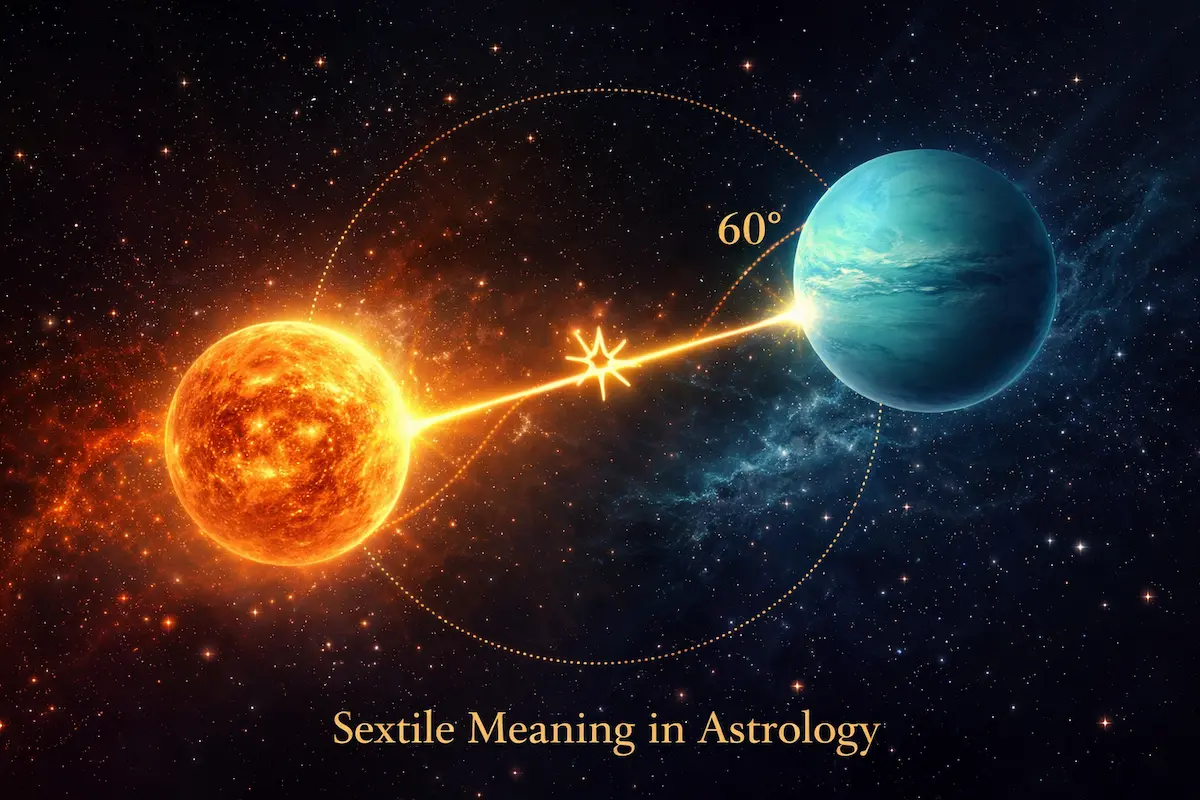
In astrology, a sextile is a 60° aspect between two planets or chart points. The sextile meaning in astrology usually involves support, compatibility, responsiveness, and constructive movement. It is a soft aspect, but not a passive one. Sextiles often show openings, possibilities, and strengths that become more valuable when they are used intentionally.
On This Page
What a Sextile Really Is
The sextile meaning in astrology begins with a 60° relationship between two planets or chart points. Traditionally, the sextile is considered a harmonious or soft aspect because the two bodies cooperate more easily than in a square or opposition. But the sextile is not identical to the trine. It is smoother than a hard aspect, yet it usually asks for more participation than a trine does.
If the trine can feel like a natural current already flowing, the sextile often feels like a door that opens when you actually walk toward it. It describes potential support, mutual usefulness, responsiveness, and helpful connection between two functions of the chart. In classical aspect doctrine, it belongs to the major Ptolemaic aspects, and general background on aspect theory can be found in sources such as Wikipedia’s overview of astrological aspects and Britannica’s overview of astrology.
| Aspect | Symbol | Angle | Suggested Orb | Core Dynamic | Main Task |
|---|---|---|---|---|---|
| Sextile | ⚹ | 60° | about 4–6° | Opportunity, compatibility, responsiveness, useful flow | Recognise and activate the available potential |
For detailed orb guidelines by planet and transit type, see the Orb Theory section below.
Opportunity, Not Guaranteed Delivery
One of the most important corrections to make when explaining the sextile meaning in astrology is this: support does not mean automatic results. Sextiles often describe abilities that become valuable through use, not simply by existing in the chart. They are usually easier than hard aspects, but they still require response, choice, practice, or timing.
This is why sextiles are often linked with talent that can be developed, connections that become useful, or capacities that can be sharpened into real skill. A person may have a strong sextile and still underuse it. In that case, the aspect remains present, but its promise stays partially dormant. For example, a Mercury sextile Saturn aspect may not feel as exciting as a trine, but with regular study and disciplined repetition it can become a highly reliable foundation for structured thinking and credible communication.
Key principle: a sextile is often less dramatic than a square or opposition, but it may become one of the most useful features in a chart because it can be built into competence.
Common Planetary Combinations in Sextiles
The sextile meaning in astrology changes according to the planets involved. Some sextiles support communication, some support emotional regulation, some support drive, and some support practical development. What unites them is constructive cooperation.
| Sextile | Typical Strength | Best Expression |
|---|---|---|
| Sun sextile Moon | Inner cooperation between will and feeling | A personality that can act without constant inner contradiction |
| Mercury sextile Venus | Social intelligence, aesthetic language, diplomacy | Pleasant, persuasive, tactful communication |
| Mercury sextile Saturn | Mental discipline and structural clarity | Credible, organised, careful thought and speech |
| Venus sextile Mars | Healthy coordination between attraction and action | Warmth, desire, timing, and relational responsiveness |
| Moon sextile Saturn | Emotional steadiness and containment | Reliable care expressed with maturity |
| Mars sextile Jupiter | Constructive enthusiasm and forward movement | Confident action supported by optimism and momentum |
| Sun sextile Saturn | Practical authority and self-respect | Steady ambition without theatrical strain |
| Venus sextile Jupiter | Generosity, warmth, social openness | Pleasure, kindness, and abundance used with proportion |
| Mercury sextile Uranus | Mental inventiveness and quick pattern recognition | Original thinking applied in useful ways |
| Sun sextile Neptune | Imagination, sensitivity, spiritual receptivity | Inspiration grounded in discernment |
| Mars sextile Saturn | Controlled effort and practical endurance | Action that is patient, effective, and sustainable |
| Moon sextile Venus | Emotional grace and relational ease | Warmth, care, and responsiveness in close bonds |
| Venus sextile Saturn | Loyalty, restraint, commitment, practical affection | Love expressed with consistency, boundaries, and durability |
Applying vs Separating Sextiles
Applying and separating still matter, even in soft aspects. An applying sextile often suggests that the available opportunity is still opening, forming, or becoming more visible over time. A separating sextile may indicate that the cooperative pattern has already been established and is now functioning in a more familiar or integrated way.
This can refine the sextile meaning in astrology in practice. Is the person still learning to trust and use the resource, or is the resource already operating as part of their normal behaviour?
Orb Theory for Sextiles
Sextiles generally use narrower orbs than oppositions and conjunctions. Because the aspect is subtler, precision matters. The sextile meaning in astrology tends to become clearer when the aspect is reasonably tight, especially in natal work.
| Sextile Type | Suggested Orb | Interpretive Note |
|---|---|---|
| Sun or Moon sextile | up to 5–6° | Luminaries can sustain a slightly wider orb |
| Planet-to-planet sextile | about 4–6° | Usually strongest when clearly within range |
| Transit sextile | often strongest within 1–2° | Subtle but useful when activated consciously |
| Angle sextile (ASC/MC etc.) | about 2–3° | Can be very relevant when close |
The Elemental Logic of Sextiles
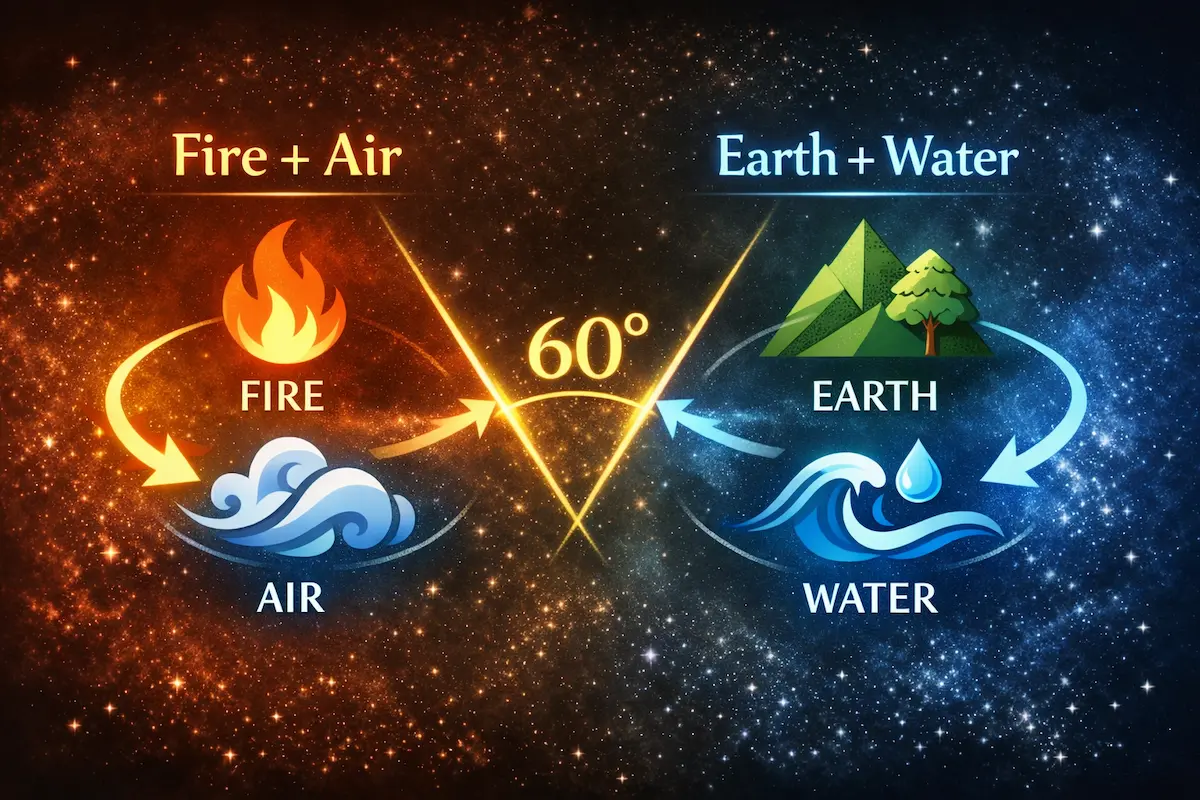
Sextiles usually connect signs of compatible but different elements. Fire sextiles Air. Earth sextiles Water. This matters because the sextile meaning in astrology is not sameness. It is cooperation between different functions that can assist one another naturally.
| Element Pair | How the Sextile Works | Typical Benefit |
|---|---|---|
| Fire + Air | Energy meets thought, action meets idea | Enthusiasm, communication, momentum, strategy |
| Earth + Water | Practical structure meets feeling and receptivity | Stability, care, embodiment, sustainable growth |
A sextile is often easiest to understand visually: it links elements that are different but cooperative. Fire and Air stimulate each other. Earth and Water support each other. The aspect does not erase difference — it creates productive dialogue between compatible temperaments.
Modality and Rhythm in Sextiles
Sextiles are not formed within the same modality the way oppositions are, but modality still affects how the available opportunity is used. Cardinal signs may activate sextiles more quickly. Fixed signs may make them more consistent and durable. Mutable signs may express them through flexibility, improvisation, or adaptation.
| Modality | How the Sextile Expresses |
|---|---|
| Cardinal | Quick activation, entrepreneurial, fast to use |
| Fixed | Consistent, durable, reliable once established |
| Mutable | Flexible, adaptive, versatile, mentally agile |
Sextiles Through the Houses
Houses show where the sextile meaning in astrology becomes lived experience. Because sextiles link areas that can help each other without full fusion, they often show productive channels between two different life departments. One area supplies context, the other supplies movement.
| House Pair | Flow of Life Theme | Typical Meaning |
|---|---|---|
| 1st and 3rd | Identity and communication | Self-expression supports learning, speaking, and mental responsiveness |
| 2nd and 4th | Resources and emotional foundation | Security, family, and material grounding reinforce one another |
| 3rd and 5th | Mind and creativity | Ideas become expressive, artistic, playful, or persuasive |
| 4th and 6th | Private life and routine | Home rhythms support health, work habits, and daily order |
| 5th and 7th | Romance and partnership | Attraction, social ease, and relationship expression cooperate naturally |
| 6th and 8th | Work systems and deep exchange | Practical discipline helps manage intimacy, crisis, and shared obligations |
| 7th and 9th | Partnership and worldview | Relationships support growth, perspective, travel, or belief expansion |
| 8th and 10th | Depth and public life | Psychological insight or shared resources can strengthen vocation and authority |
| 9th and 11th | Vision and community | Ideas, ideals, and long-range thinking find support in groups and networks |
| 10th and 12th | Career and inner life | Behind-the-scenes reflection can support public purpose and mature direction |
Dignities: Which Planet Uses the Sextile Better?
Dignity still matters in soft aspects. A sextile does not erase differences in strength between planets. If one planet is dignified and the other is under strain, the cooperation may still exist, but one side will usually have more confidence, stability, or expressive control.
For example, a Sun in Leo sextile Mercury in Gemini would often support articulate self-expression because both planets are operating with clarity and confidence in their respective signs. By contrast, if one planet in a sextile is weakened by sign condition, the opportunity may still be there, but it may need more conscious work to become reliable.
Conversely, a Venus in Virgo sextile Mars in Cancer may still show cooperative relational potential, but both planets can operate with less spontaneous ease or direct confidence than in stronger sign conditions. The sextile remains helpful, yet it may need more deliberate practice before it becomes fully dependable. This is why the sextile meaning in astrology should not be reduced to “easy”.
Out-of-Sign Sextiles
A sextile can still operate out of sign when the degree relationship is strong enough. These cases require care. The geometry may support a sextile, but the sign relationship may not reflect the same clean compatibility that makes sign-based sextiles so recognisable.
In interpretation, this usually means the astrologer should respect both the degree aspect and the sign context. The sextile is present, but its expression may be less obvious, more specialised, or more conditional than in a clean sign-to-sign sextile.
Sextiles in Relationships and Synastry
In relationships, sextiles often create ease without total fusion. Two people can help one another, stimulate one another, and create a sense of workable compatibility without the same intensity seen in conjunctions or oppositions. In synastry, sextiles are often underrated because they do not always feel dramatic. But over time they can become some of the most practically supportive links between two charts.
A Moon sextile Venus in synastry often supports warmth, kindness, and emotional tact. A Mercury sextile Mercury or Mercury sextile Venus can make conversation feel natural, fluid, and socially intelligent. A Venus sextile Mars often helps attraction move without the same friction found in a square. A Moon sextile Saturn can create emotional reliability and a feeling that care has structure. These are not always the aspects that create obsession, but they are often the aspects that make daily relating work.
That relational usefulness is part of the sextile meaning in astrology. The aspect often supports cooperation, timing, goodwill, and mutual responsiveness. A broader reference point for relational and technical aspect language can also be found at AstroWiki.
Synastry note: sextiles rarely carry the whole relationship by themselves, but they often provide the practical bridges that make attraction sustainable.
Aspect Patterns Involving Sextiles
The sextile meaning in astrology becomes even more important when sextiles appear inside larger aspect patterns. These patterns are often searched by more advanced readers because they show how opportunity, redirection, and structured flow behave at chart level rather than in isolated planetary pairs.
| Pattern | How Sextiles Function | Interpretive Meaning |
|---|---|---|
| Yod | Two planets in sextile both connect by quincunx to a third point | The sextile forms a resource base, but the apex demands adjustment, redirection, and specialised growth |
| Kite pattern with sextile support | A trine structure gains directional support through linked sextiles and an opposition | The sextile helps activate talent and route passive flow into practical expression |
| Mystic Rectangle | Two sextiles and two trines soften and connect two parallel oppositions | This rectangular geometry creates mediation, pattern recognition, and a structured way to work through polarity without losing the supportive channels between the planets involved |
In a Mystic Rectangle, the oppositions create the core polarity, while the sextiles and trines provide the channels through which that tension can be processed, translated, or stabilised. That is why the pattern often feels less fractured than a chart with bare oppositions alone.
In all of these, the sextile acts less like spectacle and more like architecture. It provides pathways, transitions, and access points. That is one reason advanced astrologers take sextiles seriously even when beginners focus more on harder aspects.
The Sextile in the ZodiacRoots 8 Roots Method
At ZodiacRoots, we interpret the sextile as an activation pathway. In the Western chart, it shows where two functions can support each other constructively. But in the 8 Roots framework, we also ask whether that support repeats across symbolic systems or whether it is limited to one layer of the chart.
The Vedic layer can show whether the same supportive logic appears through lunar-emotional emphasis or through a different interpretive emphasis entirely. The Chinese root helps determine whether the person uses opportunity boldly, patiently, diplomatically, or strategically. The Mayan root can indicate whether the sextile expresses as energetic flow, pattern recognition, timing, or creative alignment. The Celtic root adds a natural-symbolic layer that can show whether the support is steady, adaptive, protective, or developmental. The Egyptian guardian can reveal whether the available gift works through wisdom, sovereignty, service, renewal, or sacred order.
At ZodiacRoots, we do not see the sextile as a stroke of luck, but as a channel of competence. If the Vedic or Chinese layers confirm a resilient, strategic, or disciplined temperament, then a Mercury-Saturn sextile, for example, becomes more than a mental advantage. It becomes a practical pillar of authority. The sextile is the point where talent meets discipline and turns into mastery.
When several Roots repeat the same message of assistive growth, the sextile becomes more than a nice feature. It becomes a reliable channel of development. This layered approach is the same method we apply to the trine, the square, the opposition, and every major aspect in the ZodiacRoots library. In that sense, the sextile meaning in astrology becomes richer when it is tested across the full symbolic architecture rather than read as a simple soft aspect.
How to Read a Sextile in a Birth Chart
- Identify the two planets or points involved.
- Check the orb and whether the sextile is applying or separating.
- Look at the signs to understand the style of compatibility.
- Look at the houses to see where the opportunity becomes lived experience.
- Assess planetary dignity to judge how effectively the aspect can be used.
- Ask whether the gift is already active or still underdeveloped.
- Interpret the sextile as usable potential, not just background decoration.
Sextile vs Trine vs Square vs Opposition
Compared with the trine meaning in astrology, a sextile is usually less automatic and more dependent on participation. Compared with the square meaning in astrology, it is more cooperative and less pressurised. Compared with the opposition meaning in astrology, it is less about polarity and more about opportunity. The sextile meaning in astrology sits between effortless harmony and demanding friction: it is the aspect of opening, response, and constructive use.
| Aspect | Angle | General Feeling | Main Task |
|---|---|---|---|
| Trine | 120° | Harmony, ease, flow | Refine and consciously use natural talent |
| Sextile | 60° | Opportunity, support, constructive movement | Activate and develop the available potential |
| Square | 90° | Friction, compression, pressure | Act under tension and build strength |
| Opposition | 180° | Polarity, mirroring, relational tension | Integrate opposites without splitting |
None of these aspects is inherently superior. What matters is whether the person uses the energy consciously.
Related Astrology Guides
- Astrology Aspects Explained
- Trine Meaning in Astrology
- Square Meaning in Astrology
- Opposition Meaning in Astrology
- How to Interpret a Birth Chart
Frequently Asked Questions
What does a sextile mean in astrology?
A sextile is a 60° aspect that usually indicates opportunity, compatibility, responsiveness, and constructive support between two planets or chart points.
Why is the sextile important if it is not dramatic?
Because it often shows where a person has usable support, constructive intelligence, and development potential. A sextile may be quieter than a square, but it can become highly productive when activated.
Is a sextile always easy?
Not exactly. It is easier than a square or opposition, but it often needs conscious participation. A sextile usually works best when its potential is actively used.
What is the difference between a sextile and a trine?
A trine tends to show more natural and automatic flow, while a sextile shows an opening or resource that becomes stronger through engagement and development.
How wide can a sextile orb be?
Many astrologers use around 4–6° for natal sextiles, sometimes a bit wider for the Sun or Moon. Tighter sextiles are usually more noticeable.
Do sextiles matter in synastry?
Yes. In synastry, sextiles often create practical compatibility, cooperation, and mutual helpfulness. They may be less dramatic than hard aspects, but they can be very supportive over time.
Can a sextile be out of sign?
Yes, if the degree relationship is close enough. In such cases, the geometry may support the aspect even when the sign relationship is more complicated.