
Quick Answer
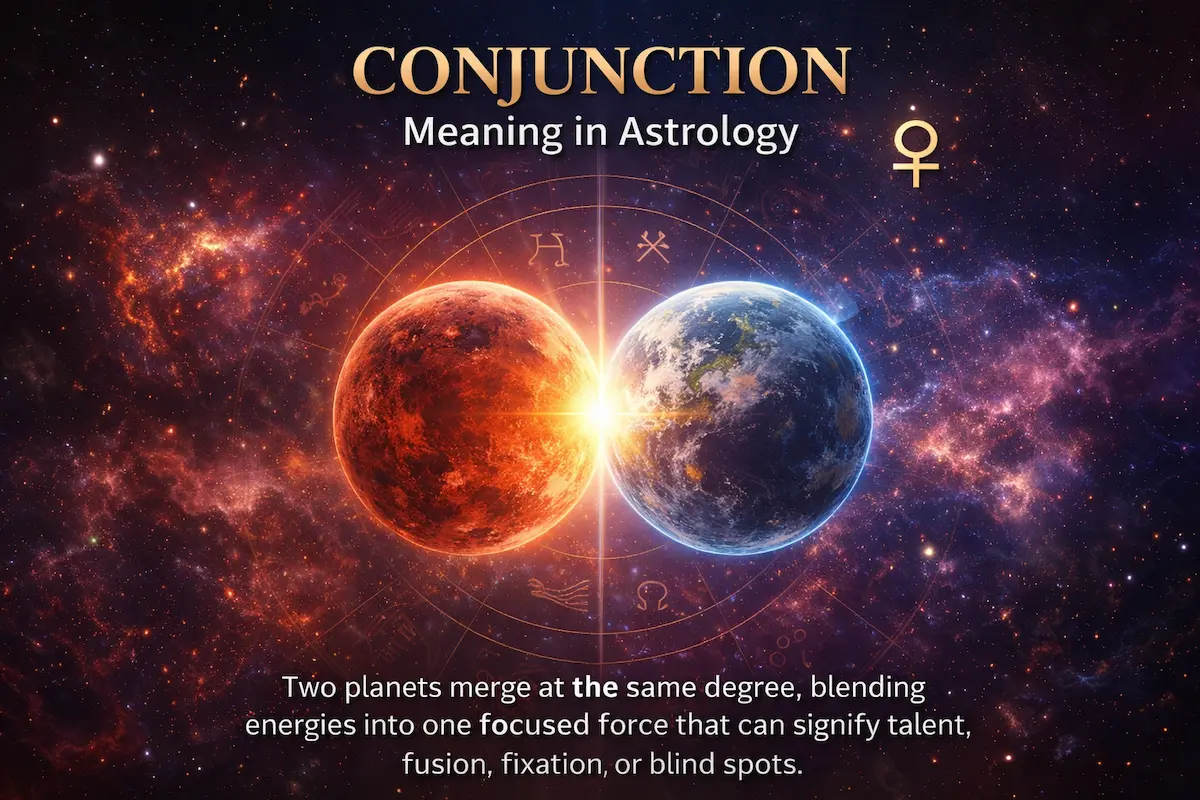
The conjunction meaning in astrology is the union of two planetary principles into one intensified expression. A conjunction can act like a gift, a pressure point, or a defining psychological signature. Its meaning depends on the planets involved, the sign, the house, the orb, whether the aspect is applying or separating, and whether the conjunction is modified by conditions such as combustion, cazimi, dignity, or aspect patterns like a stellium.
What Does a Conjunction Mean in Astrology, Technically?
The conjunction meaning in astrology is not just “two planets together.” It is a condition of symbolic compression. Two principles occupy nearly the same zodiacal degree, so they act through one channel. Instead of dialogue at a distance, there is cohabitation. That is why conjunctions often become dominant signatures in natal charts, central triggers in synastry, and major activation points in transit work.
A conjunction is classically a 0° aspect, but interpretation depends on orb, exactness, planetary condition, sign, house, and the wider chart structure. Some conjunctions feel integrated and powerful. Others feel compressed, conflicted, or over-identified. The conjunction itself does not decide whether the result is easy. It decides that the result is intense.
| Aspect | Angle | General Feeling | Main Task |
|---|---|---|---|
| Conjunction | 0° | Fusion, intensity, concentration | Direct the amplified energy consciously |
| Sextile | 60° | Opportunity, support | Activate available potential |
| Square | 90° | Friction, pressure | Act under tension and build strength |
| Trine | 120° | Harmony, ease | Refine and use natural talent |
| Opposition | 180° | Polarity, mirroring | Integrate opposites without splitting |
Why Conjunctions Feel So Strong
Conjunctions feel strong because no symbolic distance exists between the planets. A Mars-Saturn square still allows tension between two functions. A Mars-Saturn conjunction forces both functions to use the same doorway. That can produce discipline, pressure, frustration, endurance, and tightly controlled force all at once.
This is why the conjunction meaning in astrology often appears in descriptions of core identity, major life themes, repeating relationship patterns, and decisive transit periods. It creates centrality.
Conjunctions as Talent or Blind Spot
A conjunction can become one of the chart’s greatest gifts precisely because it is always active. But what is always active can also become invisible to the person. Sun conjunct Mercury may create articulate self-expression and strong perspective, but also difficulty standing outside one’s own narrative. Moon conjunct Pluto can produce emotional depth, resilience, and psychic sensitivity, but also fear of exposure, emotional extremity, or control patterns.
Key idea: a conjunction is not automatically benefic or malefic. It is concentrated. It becomes constructive when the fused energy is directed, named, and integrated.
The Sun, Combustion, and Cazimi
The conjunction meaning in astrology changes significantly when the Sun is involved. In traditional astrology, proximity to the Sun can either weaken or radically empower the other planet. This adds needed technical depth to conjunction interpretation and prevents oversimplified readings.
| Condition | Distance from Sun | Interpretive Meaning |
|---|---|---|
| Combust | Usually within about 8° | The planet may be overshadowed by solar identity, vitality, ego, or visibility. |
| Cazimi | Within about 17 arcminutes | The planet is “in the heart of the Sun,” often showing unusual clarity, strength, and focused potency. |
So a Mercury-Sun conjunction is not read the same way at 6° and at 0°10′. The first may indicate a mind partly absorbed into identity. The second may indicate a mind with extraordinary precision, authority, or brilliance. This distinction substantially improves interpretive accuracy.
How Sign and Modality Change the Conjunction
The sign determines style. The modality determines pace and behavioural pattern. A Venus-Mars conjunction in Aries is direct, hot, fast, and impulsive. In Taurus it is sensual, embodied, loyal, and possessive. In Gemini it becomes verbal, curious, flirtatious, and changeable. In Scorpio it intensifies attraction, secrecy, magnetism, and depth.
| Modality | How Conjunction Energy Tends to Work |
|---|---|
| Cardinal | Initiates, pushes, begins, acts. |
| Fixed | Intensifies, holds, persists, consolidates. |
| Mutable | Adapts, distributes, modifies, translates. |
How House Placement Changes the Reading
Houses show where the fused energy becomes visible in life. The conjunction meaning in astrology is incomplete without house context. Two planets fused in the 1st house affect presence and identity. In the 4th, roots and family dynamics. In the 7th, partnerships. In the 10th, vocation, authority, and public image.
| House Axis | Conjunction Emphasis |
|---|---|
| 1st / 7th | Self-definition versus partnership patterning |
| 2nd / 8th | Personal value versus entanglement, exchange, and vulnerability |
| 3rd / 9th | Immediate mind versus worldview and meaning |
| 4th / 10th | Private foundations versus public role |
| 5th / 11th | Creative self-expression versus collective participation |
| 6th / 12th | Daily systems versus retreat, surrender, and hidden process |
Orb Theory for Conjunctions
Orb matters because conjunctions intensify as they tighten. Wider conjunctions still count, especially with the luminaries, but exactness changes the level of compression. A 7° conjunction is not read with the same force as a 0°28′ conjunction.
| Conjunction Type | Suggested Orb | Interpretive Note |
|---|---|---|
| Sun or Moon conjunction | Up to about 8–10° | Luminaries often work with wider orbs |
| Planet-to-planet conjunction | About 6–8° | Tighter orbs create stronger fusion |
| Transit conjunction | Often strongest within 1–2° | Most intense near exactness |
| Angle conjunction (ASC/MC) | About 2–3° | Very strong when close |
Applying vs. Separating Conjunctions
An applying conjunction describes planets moving toward exact union. It often feels more building, imminent, or developmental. A separating conjunction describes a fusion that has already peaked and is now expressing itself as a pattern being lived out, processed, or integrated. In natal interpretation, this distinction is not everything, but it can add nuance to timing, psychology, and emphasis.
Dignities and Which Planet Dominates
In practice, one planet often dominates the conjunction. Essential dignity, house strength, sect, exactness, visibility, and solar condition can all alter the power balance. This matters because conjunctions are not always equal mergers. Often one principle shapes the other more strongly.
| Conjunction | Who Often Dominates? | Psychological Result |
|---|---|---|
| Sun ☌ Saturn | Saturnian restraint often shapes expression | Vitality and identity are moulded by duty, seriousness, and realism |
| Moon ☌ Mars | Mars often accelerates the emotional response | Emotions become quick, reactive, courageous, or combustible |
| Venus ☌ Jupiter | Jupiter often amplifies Venusian themes | Affection, values, pleasure, and generosity are enlarged |
Common Planetary Combinations
One of the most searched areas of conjunction interpretation is the meaning of specific planetary pairs. Below is a concise comparison table for common conjunction combinations.
| Conjunction | Typical Expression | Potential Challenge |
|---|---|---|
| Sun conjunct Moon | Integrated will and feeling | Inner confusion if not balanced |
| Sun conjunct Mercury | Articulate self-expression | Difficulty with objective distance |
| Venus conjunct Jupiter | Generosity, warmth, social grace | Overindulgence or excess |
| Mars conjunct Saturn | Disciplined force, endurance | Frustration, blocked action |
| Mercury conjunct Neptune | Imagination, poetic perception | Confusion, poor boundaries |
| Venus conjunct Mars | Strong attraction, passion | Impulsiveness in love |
| Moon conjunct Pluto | Deep emotional intensity | Control issues, fear of vulnerability |
| Sun conjunct Saturn | Serious ambition, self-discipline | Inhibition, self-doubt |
| Moon conjunct Venus | Tenderness, receptivity, emotional warmth | Over-accommodation, emotional indulgence |
| Mercury conjunct Saturn | Concentration, seriousness, precision | Mental rigidity, pessimism |
| Sun conjunct Jupiter | Confidence, largeness, faith | Inflation, excess certainty |
| Moon conjunct Saturn | Emotional endurance, containment | Reserve, loneliness, self-protection |
How a Conjunction Differs from Other Major Aspects
A conjunction differs from a square because it does not primarily create friction between separate functions. It fuses them. It differs from a trine because it does not simply flow. It concentrates. It differs from an opposition because it does not mirror from outside. It internalises the polarity into a single mechanism.
Aspect Patterns Involving Conjunctions
Conjunctions often anchor larger aspect patterns. A conjunction can serve as the apex of a T-square, the compressed core of a stellium, or the concentrated release point in a Yod. When a conjunction is part of a pattern, its energy becomes even more central to the chart’s dynamics.
A stellium is especially important here. In practical terms, a stellium is often a cluster of conjunctions: three or more planets grouped in the same sign or house. That creates a life area or psychological theme so concentrated that it can dominate the whole chart. The conjunction meaning in astrology therefore extends naturally into stellium analysis.
Out-of-sign conjunctions also deserve attention. Two planets may be close enough by degree to count as conjunct while standing in different signs. In such cases, the fusion is real, but the planets are expressing through different sign filters. This can create complexity, mixed tone, or a sense that the conjunction contains an internal seam.
Conjunction Meaning in Synastry
In synastry, conjunctions show immediate activation. One person’s planet lands directly on another’s planet or angle, creating relevance, magnetism, familiarity, intensity, or pressure. Venus conjunct Mars can generate obvious attraction. Saturn conjunct Moon can bring commitment and seriousness, but also emotional heaviness. Sun conjunct Ascendant can feel instantly personal and vivid.
A conjunction in synastry does not guarantee compatibility. It guarantees significance.
Conjunction Meaning in Transits
In transit work, conjunctions activate natal potentials. Jupiter conjunct the natal Sun may correspond with growth, visibility, optimism, or opportunity. Saturn conjunct the natal Moon may coincide with emotional maturation, loneliness, responsibility, or psychological consolidation. Pluto conjunct the Ascendant can mark a profound shift in identity, power, presentation, and life direction.
Transit conjunctions are often strongest near exactness, but the full approach and separation period matters. Slow planets, especially, can create long arcs of internal restructuring before the aspect perfects.
The Conjunction in the ZodiacRoots 8 Roots Method
At ZodiacRoots, we do not read the conjunction meaning in astrology as a flat psychological merger only. We read it as a Nucleus of Destiny. Western astrology identifies the fused force itself, but the 8 Roots method tests how that concentrated force behaves across symbolic layers.
The Vedic layer can show whether the conjunction operates through karmic emphasis, inner necessity, or even a yoga-like concentration of potential. In some charts, the conjunction is not merely a trait but a structural point of dharmic development or worldly capacity. The Chinese root helps determine whether the fused energy acts as initiative, diplomacy, patience, heat, flexibility, or strategic timing. Two people may both have Mars-Saturn conjunctions, but the wider Chinese temperament may make one express it as disciplined persistence and the other as controlled internal pressure.
The Mayan root can indicate whether the conjunction expresses as flow, transformation, alignment, timing, purification, or catalytic creative force. The Celtic Tree root adds an organic developmental logic, showing whether the conjunction behaves like protection, endurance, adaptability, rootedness, or cyclical renewal. The Egyptian Guardian root can reveal whether the conjunction is watched over as a sacred duty, a spiritual initiation, a call to leadership, or a confrontation with power and order.
This is why our interpretation goes further than standard Sun sign astrology. A conjunction may look like a simple fusion in Western terms, but across 8 Roots it can become a concentrated mission point, a karmic amplifier, or a refined gift that only fully makes sense when all layers are read together.
Related Reading
Continue with Astrology Aspects Explained, Opposition Meaning in Astrology, Trine Meaning in Astrology, Sextile Meaning in Astrology, Square Meaning in Astrology, How to Interpret a Birth Chart, and About the 8 Roots Method.
For broader technical background, see Astrological aspect, Cazimi, Combustion in astrology, and Britannica’s overview of astrology.
Frequently Asked Questions About the Conjunction Meaning in Astrology
What is a conjunction in astrology?
A conjunction is a 0° aspect where two planets or chart points occupy nearly the same degree, blending and intensifying their meanings.
Is a conjunction a good aspect?
A conjunction is not automatically good or bad. It is strong. Its effect depends on the planets involved, the sign, the house, the orb, and the rest of the chart.
How wide can a conjunction orb be?
That depends on context. Luminaries often receive wider orbs, while angles and transit conjunctions are usually read more tightly. Exact conjunctions are generally more powerful.
What is the difference between a conjunction and a stellium?
A conjunction usually refers to two planets or points close together. A stellium is a larger cluster, often three or more planets grouped in the same sign or house, creating a concentrated theme.
What does combust mean in a conjunction with the Sun?
A planet combust the Sun is so close that its expression may be overshadowed by solar identity, vitality, or visibility. This can modify the conjunction significantly.
What does cazimi mean in astrology?
Cazimi means a planet is extremely close to the centre of the Sun, traditionally within about 17 arcminutes. It is often interpreted as a condition of exceptional clarity or empowerment.
What does a conjunction mean in synastry?
In synastry, conjunctions show strong activation between two people. They often create relevance, attraction, intensity, or pressure, but not automatic harmony.
What does a conjunction mean in transit astrology?
A transit conjunction activates a natal planet or angle, often marking a period when that life theme becomes stronger, more visible, or more demanding.