Quick Answer
Astrology orbs explained simply: an orb is the number of degrees allowed between two planets or chart points for an aspect to count. Smaller orbs usually indicate stronger, clearer aspects. Wider orbs can still matter, but many astrologers treat them as background influences rather than dominant ones. In most systems, the Sun and Moon receive wider allowances, major aspects receive moderate orbs, and minor aspects are interpreted more tightly.
In this article: Astrology Orbs Explained
- What an orb is and why it matters
- Exact, tight, medium, and wide orbs explained
- Recommended orb ranges by aspect type
- Applying vs separating aspects
- How to use orbs in real chart interpretation
What Is an Orb in Astrology?
When people search for astrology orbs explained, what they usually want to know is this: how close do two planets need to be before an aspect becomes real enough to interpret?
If the Sun is at 10° Leo and the Moon is at 15° Leo, the two are 5 degrees apart. That forms a conjunction if your chosen orb allows 5°. If your method allows only 3°, then the conjunction is too wide and may be ignored. The orb is therefore not a decorative technical detail. It changes what the astrologer considers active, important, and interpretation-worthy.
At ZodiacRoots, astrology orbs explained is not just a matter of memorising a software setting. We treat orbs as a system of weighting. A very tight aspect usually deserves priority. A very wide one may still add tone, but rarely carries the same interpretive authority.
Why Orb Size Changes Interpretation
A simple way to understand astrology orbs explained is to compare how the same aspect feels at different distances from exactness. The aspect type stays the same, but the interpretive force changes.
Exact, Tight, Medium, and Wide Orbs
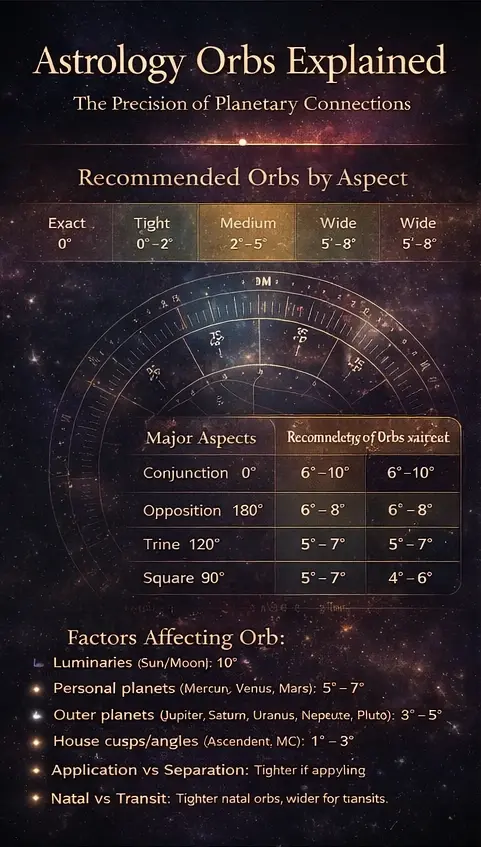
| Orb Type | Range | How It Usually Reads |
|---|---|---|
| Exact Aspect | 0° | Maximum clarity and symbolic concentration. This is usually the strongest version of the aspect. |
| Tight Orb | 0°–2° | Strong, easy to feel, and often central to the chart reading. |
| Medium Orb | 2°–5° | Relevant and interpretable, though usually less dominant than a tight aspect. |
| Wide Orb | 5°–8° or more | Weak to moderate. Some astrologers still use it; others reduce its importance, especially for minor aspects. |
Recommended Orbs by Aspect Type
There is no single universal standard, but these are widely used working ranges in contemporary astrology. Traditional astrologers and modern psychological astrologers often differ slightly, especially with conjunctions and luminaries. Any good explanation of astrology orbs explained should say that clearly.
Slide sideways to view the full comparison on smaller screens.
| Aspect | Angle | Typical Orb | Notes |
|---|---|---|---|
| Conjunction | 0° | 6°–10° | Wider for Sun and Moon; tighter for outer planets. |
| Opposition | 180° | 6°–8° | Usually treated as a major aspect with strong visibility. |
| Trine | 120° | 5°–7° | Strong enough to matter, though usually less dramatic than squares or oppositions. |
| Square | 90° | 5°–7° | Often felt strongly even when slightly wider, especially in natal work. |
| Sextile | 60° | 4°–6° | Usually kept tighter than trines and squares. |
| Minor Aspects | Varies | 1°–3° | Quincunx, semisextile, semisquare and similar aspects are generally interpreted with narrow orbs. |
What Changes the Strength of an Orb?
Good astrology is not just about memorising one orb table. Context matters. The same 5° distance can be treated very differently depending on what is involved.
- Luminaries: The Sun and Moon usually receive the widest allowances. A Sun conjunction can still be read at a broader orb than a Neptune quincunx.
- Personal planets: Mercury, Venus, and Mars often work well with medium major-aspect orbs, especially in natal work.
- Outer planets: Jupiter through Pluto are often read more tightly, particularly in minor aspects.
- Angles and house cusps: The Ascendant, Midheaven, Descendant, and IC are usually interpreted with tighter orbs because they are highly sensitive points.
- Major vs minor aspects: A wide conjunction may still matter. A wide semisextile usually does not carry equal weight.
- Partile strength: When an aspect is exact by degree, or nearly so, astrologers often prioritise it above broader patterns.
- Applying vs separating: Some astrologers give slightly more force to applying aspects, especially in dynamic reading styles.
Applying vs Separating Aspects
Any strong page on astrology orbs explained should also clarify the difference between applying and separating aspects. This matters because two aspects with the same orb are not always felt in exactly the same way.
| Type | Meaning | Interpretive Tone |
|---|---|---|
| Applying | The faster planet is moving toward exact aspect. | Often read as growing, building, approaching, or becoming more active. |
| Separating | The faster planet has already passed exact aspect and is moving away. | Often read as declining, releasing, integrating, or echoing something already activated. |
Not every astrologer gives this distinction the same weight, but many do. In timing work especially, an applying aspect is often considered more active or anticipatory, while a separating aspect may describe a process already underway or recently peaked.
Natal Orbs vs Transit Orbs
A natal chart describes your underlying structure. Because of that, natal aspects are often interpreted with slightly broader tolerance. They are part of the permanent symbolic architecture of the chart.
Transits are different. They describe timing, activation, and change. For that reason, astrologers often tighten the orb when reading transits, especially if they want to identify the period of strongest manifestation. A transit may still be active at a wider distance, but its peak is usually closest to exactness.
The same logic applies to synastry and progressions: the tighter the connection, the more confident the astrologer usually becomes in assigning interpretive priority. That is another reason astrology orbs explained properly must include context, not just a fixed table.
How to Use Orbs in Chart Reading
Start with the tightest major aspects. These usually deserve first priority in natal interpretation.
Check whether luminaries or angles are involved. These can justify slightly wider orb tolerance.
Treat wide aspects more cautiously. They may add tone, but they usually should not outrank tighter structural patterns.
Use tighter orbs for timing work. In transits, progressions, and event reading, closeness to exactness matters even more.
How ZodiacRoots Uses Orbs
At ZodiacRoots, we interpret aspects through the wider 8 Roots framework, so orb logic is part of a broader method rather than a standalone filter. A tight aspect carries more interpretive weight, but we still compare it with house emphasis, angularity, and the broader symbolic pattern of the chart.
As a practical rule, we usually treat major aspects with about 5° as a solid working standard, while allowing wider tolerance for luminaries and tighter control for minor aspects. For minor aspects, we prefer around 2° unless there is a strong technical reason to widen the range.
That means tighter orbs = more precision, while wider orbs may reveal softer patterns, background dynamics, or supporting themes rather than the central message of the chart. That practical weighting is central to how we approach astrology orbs explained across ZodiacRoots.
Related Reading
External References
For broader background on the history and technical development of astrology, see Britannica’s overview of astrology and Wikipedia’s summary of astrological aspects. These sources are not substitutes for chart interpretation, but they are useful for technical context.
Frequently Asked Questions About Astrology Orbs
What is an orb in astrology?
An orb is the degree allowance used to decide whether an aspect between two planets or chart points is close enough to count. Smaller orbs usually indicate stronger aspects.
How many degrees count as a conjunction?
Many astrologers allow roughly 6° to 10° for conjunctions, especially when the Sun or Moon is involved. Tighter conjunctions are usually considered more powerful.
Are wide aspects still valid?
Sometimes yes, but they are often treated as weaker or more background-level influences. Whether they matter depends on the astrologer’s method and on what planets or points are involved.
What is the difference between applying and separating aspects?
An applying aspect is moving toward exactness, while a separating aspect is moving away from exactness. Many astrologers read applying aspects as more active or building, especially in timing work.
Are transit orbs different from natal orbs?
Usually yes. Natal aspects are often allowed a little more space because they describe chart structure, while transit work is often read more tightly to identify timing peaks.
Do all astrologers use the same orbs?
No. Orb practice varies by tradition, software settings, and interpretive style. That is why learning the logic behind orbs matters more than memorising one rigid table.
This page is for educational purposes and explains general astrological technique. Interpretation always depends on the full chart context.