Quick Answer
The Ophiuchus zodiac question exists because the Sun appears to move through Ophiuchus astronomically. But in standard Western astrology, Ophiuchus is not an official zodiac sign. The tropical zodiac is a symbolic system of 12 equal signs, not a direct count of constellations crossed by the Sun.
Direct answer: Ophiuchus is a real constellation, but it is not the official 13th zodiac sign in mainstream tropical astrology.
On This Page
What Is Ophiuchus?
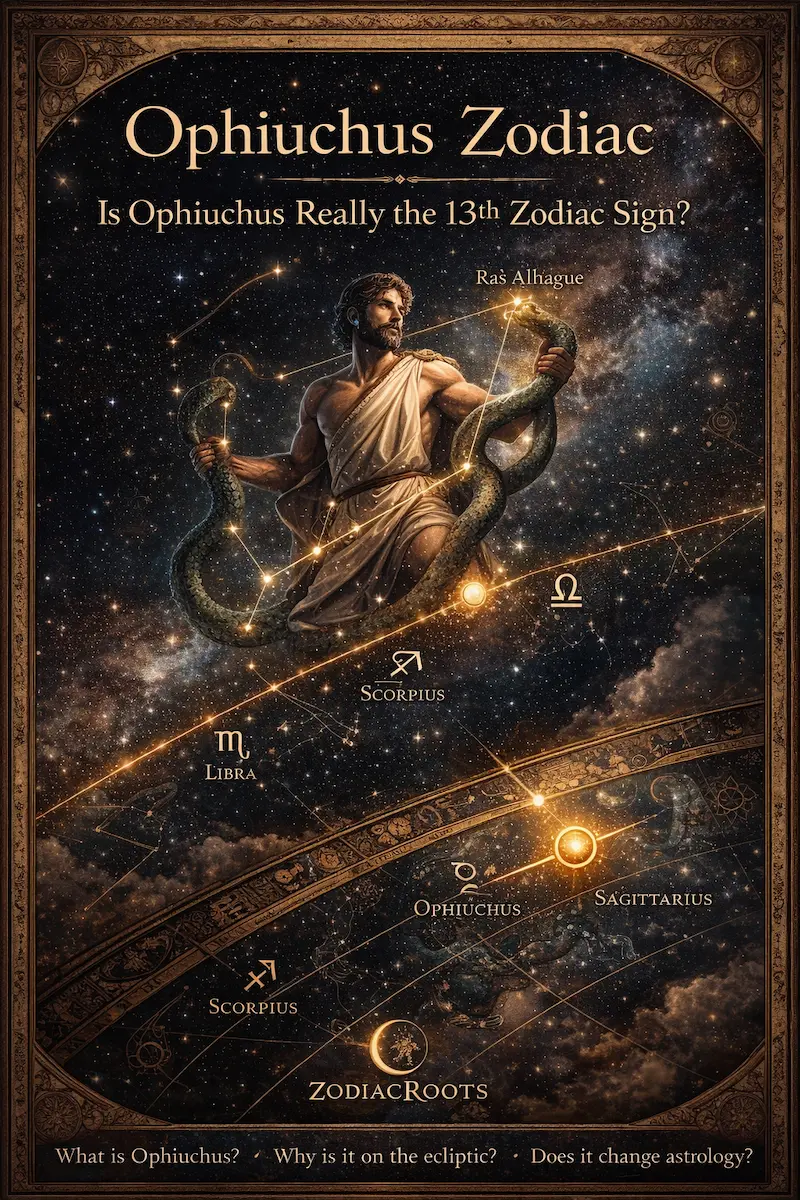
Ophiuchus is a real constellation whose name is usually translated as the Serpent Bearer. That is the starting point of the whole Ophiuchus zodiac debate. People discover that Ophiuchus lies on the Sun’s apparent path through the sky and then assume astrology must therefore contain 13 signs.
Symbolically, Ophiuchus is powerful even before astrology enters the discussion. The serpent-bearer image evokes healing, initiation, hidden knowledge, poison and antidote, and the difficult art of holding danger without being consumed by it.
Why Do People Call Ophiuchus the 13th Zodiac Sign?
People call Ophiuchus the 13th zodiac sign because the Sun appears to move through that constellation astronomically. That observation is real. The confusion begins when an astronomical fact is turned into an astrological conclusion without understanding how the zodiac is actually constructed.
The Ophiuchus zodiac debate is therefore partly a language problem. Astronomy tracks constellations. Astrology, especially tropical astrology, uses a symbolic zodiac of equal signs. The two systems overlap historically, but they are not identical.
Why Does Astrology Use 12 Signs Instead of 13?
This is the central issue. If the Sun also passes through Ophiuchus, why does astrology still use 12 signs? The answer is that the zodiac in astrology is not built by counting constellations one by one. It is built as a complete circle of 12 equal divisions of 30°, forming a 360° symbolic structure.
In tropical astrology, those 12 signs are anchored to the solar year. Aries begins at the March equinox, and the entire zodiac unfolds from the seasonal cycle created by the equinoxes and solstices. So the tropical zodiac is not simply a photograph of the constellations. It is a symbolic and geometrical system tied to seasonal order, cardinal turning points, elements, modalities, and the logic of twelvefold division.
That is why the Ophiuchus zodiac claim does not overturn astrology. Ophiuchus can be present in the sky without forcing astrology to abandon its 12-sign structure. The zodiac was designed as a coherent twelve-part system, not as a literal count of every constellation the Sun happens to cross.
Ophiuchus Was Not “Discovered” Recently
Another major misunderstanding is the idea that Ophiuchus is a recent correction to astrology. It is not. Ophiuchus was known in antiquity. Ptolemy’s Almagest, for example, listed Ophiuchus among the classical constellations. That means ancient astrologers and astronomers were not unaware of it.
This matters because it changes the tone of the argument. The standard zodiac was not formed because Ophiuchus was ignored by accident. The choice to keep the zodiac at 12 signs was deliberate, rooted in astrological structure and long tradition. The modern Ophiuchus zodiac controversy is therefore not a revelation of a hidden mistake. It is mostly a confusion between two ways of organizing the heavens.
Astronomy vs Astrology: Why They Are Not the Same
The easiest way to understand the Ophiuchus zodiac issue is to separate astronomy from astrology. Astronomy studies measurable celestial reality: constellations, coordinates, planetary motion, and the visible sky. Astrology studies symbolic meaning derived from celestial cycles, divisions, and relationships.
That means a statement can be astronomically true without forcing a change in astrological technique. Ophiuchus is a real constellation, but that fact alone does not rewrite the tropical zodiac. Astrology and astronomy are related, but they are not interchangeable systems.
Important: a constellation is not automatically the same thing as an astrological sign. That distinction explains most of the Ophiuchus zodiac debate.
Tropical vs Sidereal: Why the Question Feels Different Across Systems
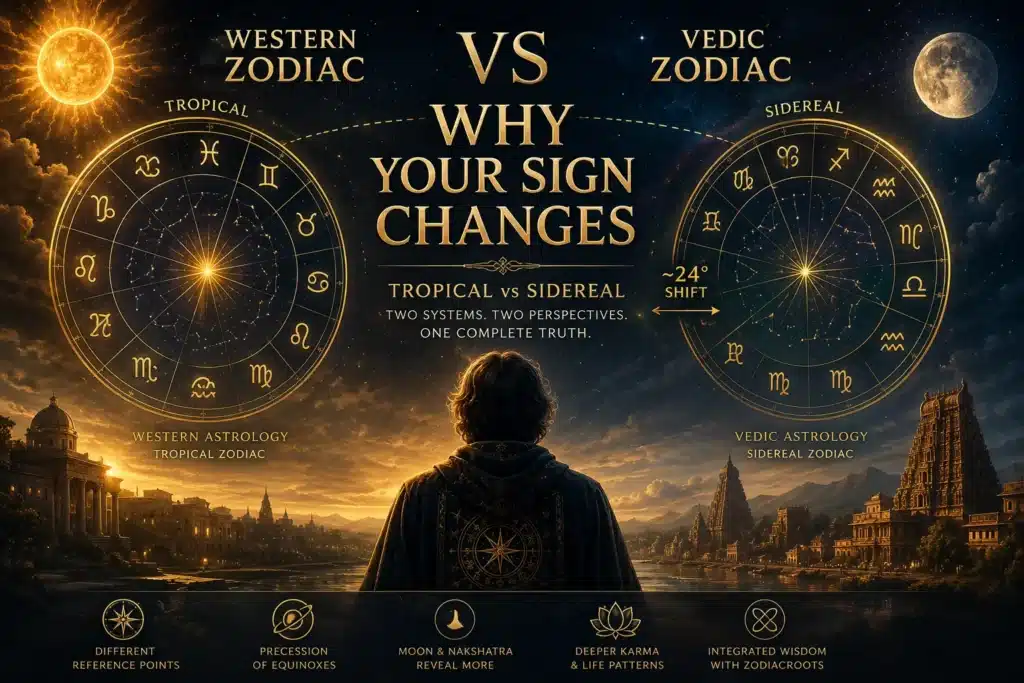
The Ophiuchus zodiac question also becomes clearer when you distinguish between tropical and sidereal zodiacs. Tropical astrology, which dominates mainstream Western astrology, is season-based. It anchors the zodiac to the equinoxes and divides the ecliptic into 12 equal signs.
Sidereal systems, including Jyotish, stay closer to the stellar background. In Vedic astrology, this is handled through an ayanamsha, a calculated correction for precession that aligns the zodiac differently from the tropical model. Even there, however, the standard remains 12 signs, not 13. So the reader’s intuition makes more sense in a sidereal context, but it still does not mean Ophiuchus becomes a standard official sign.
Is Ophiuchus Used in Western Astrology?
In mainstream Western astrology, Ophiuchus is generally not used as a formal 13th sign in chart interpretation. If someone asks whether the Ophiuchus zodiac changes their Sun sign from Scorpio or Sagittarius, the standard answer is no.
Some modern or experimental writers do use Ophiuchus symbolically, but that is not the same as the normal 12-sign tropical framework used in most astrological practice.
Ophiuchus Through the 8 Roots Lens
At ZodiacRoots, we do not treat the Ophiuchus zodiac idea as a replacement for the 12-sign zodiac. We treat it as a trans-traditional symbolic pattern. That is where the topic becomes genuinely valuable. Ophiuchus, the serpent bearer, carries themes of healing, initiatory crisis, wisdom through ordeal, and the responsibility of handling dangerous knowledge.
Through the 8 Roots framework, this becomes a pattern of threshold wisdom. In the Vedic layer, it resonates with karmic healing, dharma through ordeal, and the transformation that comes when difficulty becomes spiritual intelligence. In the Mayan layer, serpent symbolism points toward sacred power, initiation, and the disciplined handling of life force. In the Egyptian layer, it connects naturally with wisdom, medicine, writing, and the guardianship of hidden order. In the Celtic layer, it echoes initiatory crossing, liminal growth, and the hard-earned knowledge that appears after passing through a threshold.
That is why the Ophiuchus zodiac topic matters at ZodiacRoots. Not because Ophiuchus should replace Sagittarius or Scorpio, but because it helps us identify a symbolic archetype that multiple traditions recognise in different forms: the healer, the mediator, the initiate, and the one who turns poison into medicine.
The Symbolic Bridge Between Scorpio and Sagittarius
Although Ophiuchus is not an official sign, the Ophiuchus zodiac theme becomes especially suggestive near the symbolic transition between Scorpio and Sagittarius. Scorpio represents depth, shadow, crisis, and transformation. Sagittarius seeks truth, meaning, philosophy, and vision.
Ophiuchus can therefore be read as a liminal figure between them: the one who descends into intensity and emerges carrying wisdom rather than wound. It symbolizes the healing that occurs when we face the shadows of Scorpio and come out with the broader understanding of Sagittarius.
Related Reading
- Astrology Fundamentals
- How to Interpret a Birth Chart
- Astrology Houses Meaning
- Vedic Astrology
- Calculate Your 8 Roots
- Astrology Aspects Explained
External Sources
Frequently Asked Questions About Ophiuchus Zodiac
Is Ophiuchus a real zodiac sign?
Ophiuchus is a real constellation, but it is not a standard zodiac sign in mainstream tropical astrology.
Why is Ophiuchus called the 13th zodiac sign?
It is called the 13th zodiac sign because the Sun appears to pass through Ophiuchus astronomically. That does not mean the standard astrological zodiac has changed from 12 signs to 13.
Why does astrology use 12 signs instead of 13?
Because astrological signs are a symbolic 12-fold division of the ecliptic, especially in the tropical zodiac. They are not simply a direct count of constellations crossed by the Sun.
Was Ophiuchus known in ancient astrology?
Yes. Ophiuchus was known in antiquity and was listed by Ptolemy among the classical constellations. Its absence from the standard zodiac was a structural choice, not a historical oversight.
Did NASA change the zodiac to include Ophiuchus?
No. Modern astronomy can describe Ophiuchus as a constellation on the Sun’s apparent path, but that does not change the standard astrological zodiac.
Does Ophiuchus matter differently in tropical and sidereal systems?
Yes, the question feels more natural in sidereal frameworks because they stay closer to the stellar background. Even so, standard sidereal astrology still works with 12 signs rather than 13.
How does ZodiacRoots interpret Ophiuchus?
ZodiacRoots treats Ophiuchus as a symbolic archetype of threshold wisdom, healing, initiation, and transformation, not as a replacement for the 12-sign zodiac.
Read Beyond the Headlines
The Ophiuchus zodiac debate becomes much clearer when you understand how astrology actually works. Explore the structure behind the chart and the deeper symbolic layers of the 8 Roots method.
Discover More Astrology Articles You May Like
Explore related ZodiacRoots articles selected by topic first, then completed with fresh astrology reads.