
Birth Chart Visualizer: How Minutes Change Your Ascendant
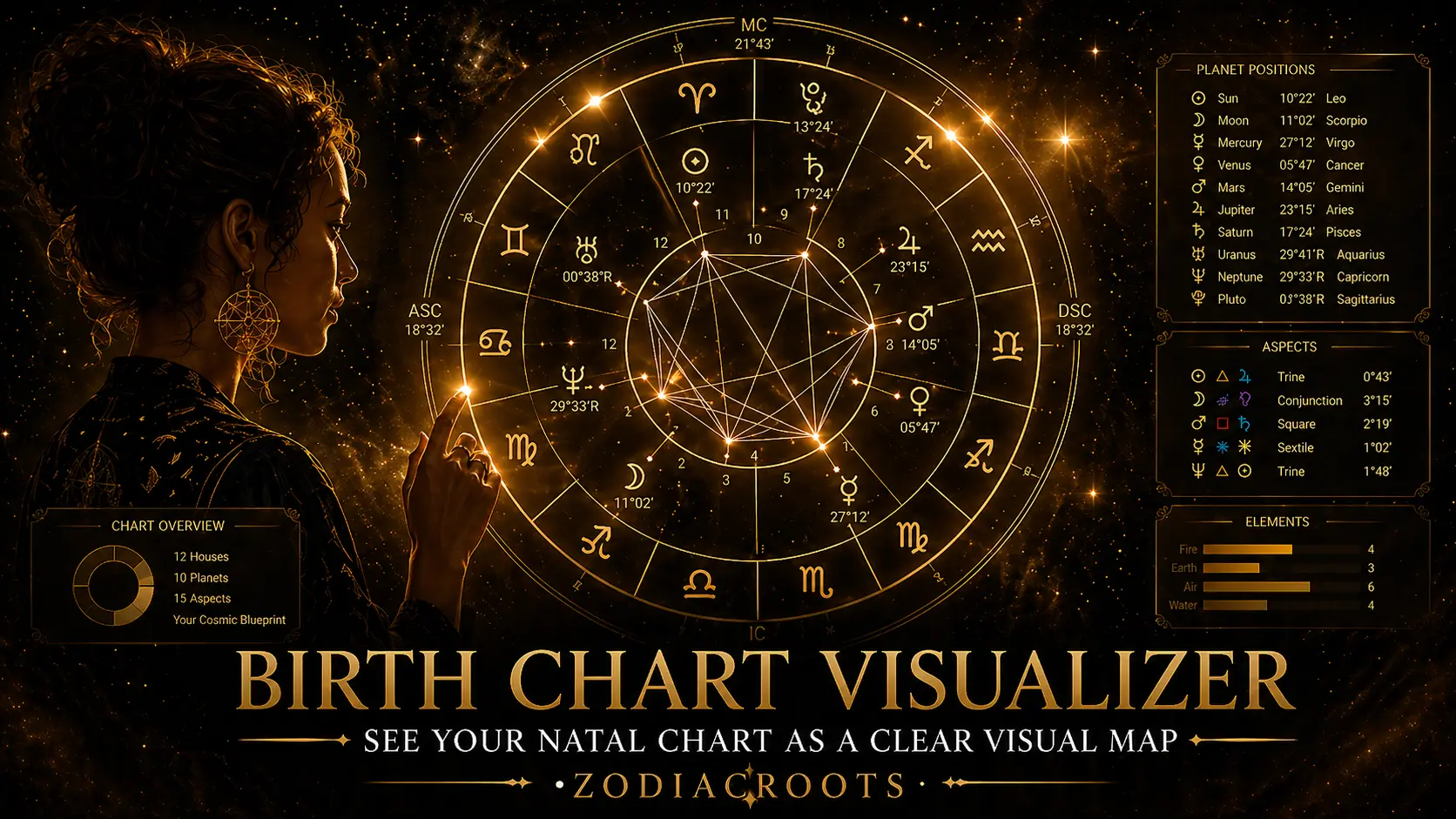
The birth chart visualizer shows why birth time matters in astrology. Move the slider to see how a few minutes can shift the Ascendant, rotate the houses and change chart emphasis while most planets remain almost unchanged.
Quick Answer: What the Birth Chart Visualizer Shows
The birth chart visualizer is an interactive astrology tool that shows how minutes of birth time can change the Ascendant, house cusps and chart emphasis. The planets usually remain almost fixed over short periods, but the chart frame can move quickly.
This matters because the Ascendant and houses depend on the exact birth time and place. If your time of birth is uncertain by even a few minutes, the symbolic emphasis of the chart may shift, especially near an Ascendant sign boundary.
At ZodiacRoots, this tool supports the wider Astrology Articles hub and helps explain why the 8 Roots Astrology Wheel treats the Ascendant as one important layer, not the whole story.
What Is a Birth Chart Visualizer?
A birth chart visualizer is a visual way to understand how an astrology chart is structured. Instead of reading only a list of signs, you can see the zodiac wheel, planets, Ascendant, houses and movement of the chart frame.
This ZodiacRoots birth chart visualizer is not a full calculator. It is a teaching tool. Its purpose is to show the principle behind birth time sensitivity: the planets may stay nearly the same, but the Ascendant and houses can shift quickly because they are tied to the local horizon.
That is why birth time matters for questions such as Rising sign, house placements, angular planets, chart emphasis and twin chart comparisons. To understand the building blocks behind this visualizer, start with conjunction meaning in astrology, sextile meaning in astrology and house cusp meaning in astrology.
Birth Chart Visualizer Tool
Use the birth chart visualizer below to adjust the birth time by minutes. The gold chart represents the original birth time. The blue chart represents the adjusted birth time.
Visual Birth Chart Comparison
Gold lines show the original chart frame. Blue dashed lines show the adjusted chart frame. The planets stay nearly fixed, while the Ascendant and houses shift as the birth time changes.
Why the Birth Chart Visualizer Matters
The birth chart visualizer matters because many people know their date of birth but do not know their exact birth time. In astrology, that distinction is important. The date gives the broad planetary background, but the time helps calculate the Ascendant and the houses.
If the birth time is uncertain, the Sun sign may still be stable, but the Rising sign, house cusps and angular planets may require caution. This is especially important when interpreting personality style, life direction, relationship patterns and vocational emphasis.
For a broader foundation, read Sun, Moon and Rising Meaning, Moon Sign Meaning and House Cusp Meaning in Astrology.
Birth Chart Visualizer and Ascendant Movement
The Ascendant, also called the Rising sign, is linked to the sign rising on the eastern horizon at the moment of birth. Because the Earth rotates continuously, the Ascendant changes quickly throughout the day.
The birth chart visualizer uses the common teaching rule that the Ascendant moves roughly 1 degree every 4 minutes. This is an approximation, not a full astronomical calculation, but it explains why exact birth time matters so much.
External reference: for a general explanation of astrology and horoscope traditions, see Britannica’s astrology overview. For astronomical background on the zodiac as a sky path, see NASA’s explanation of the zodiac.
What Changes First in a Birth Chart?
The birth chart visualizer highlights a basic but important principle: the slow planets barely move in a short time gap, but the chart frame can change quickly.
| Chart Factor | How Fast It Changes | Why It Matters |
|---|---|---|
| Ascendant degree | Roughly 1° every 4 minutes | Can shift body language, instinctive style, first impression and angular emphasis. |
| House cusps | Gradual but meaningful | May alter which life area receives the strongest expression of the same planet. See house cusp meaning in astrology. |
| Moon degree | Slow, but faster than most planets | Usually subtle in short gaps; important if the Moon is close to changing signs. Read more about Moon sign meaning. |
| Sun and outer planets | Almost unchanged in short gaps | Create the broad symbolic foundation of the chart. Start with Sun sign meaning. |
How to Use the Birth Chart Visualizer
Use this birth chart visualizer as a learning tool. It is most useful when you want to understand why birth time accuracy affects interpretation.
- Use 1–4 minutes to see subtle Ascendant degree changes.
- Use 8–15 minutes to see a more visible shift in house cusps.
- Use 30–60 minutes to understand why uncertain birth time can strongly affect Rising sign and house-based readings.
This also explains why twins born minutes apart may share almost the same planets while showing different Ascendant degrees and house emphasis. For that specific topic, read Twins Astrology: Do Twins Have the Same Birth Chart?.
Learn the Building Blocks of a Birth Chart
A birth chart becomes easier to read when you understand how aspects, houses and cusps work. These guides explain the core mechanics behind chart interpretation.
Conjunction Meaning in Astrology
Learn how conjunctions blend planetary energy, create focus and intensify chart themes.
AspectSextile Meaning in Astrology
Understand how sextiles show opportunity, cooperation, skill-building and flow.
HousesHouse Cusp Meaning in Astrology
See how house borders, rulers and life areas shape the interpretation of a chart.
Birth Chart Visualizer and the ZodiacRoots 8 Roots Method
The birth chart visualizer supports the ZodiacRoots approach because it shows why no single placement should be treated as the whole person. A chart is a layered symbolic system.
In the 8 Roots Astrology Wheel, the Ascendant is one of the central roots, but it works alongside the Western Sun, Moon, Vedic Rashi, Chinese Zodiac, Mayan Seal, Celtic Tree and Egyptian Guardian.
If the birth time is exact, the Ascendant and houses become much stronger interpretive anchors. If the birth time is uncertain, the wider 8 Roots system helps preserve meaning without overclaiming house-based details. You can also explore your own symbolic layers through What Are My Zodiac Signs? and Calculate Your 8 Roots.
Birth Time, Houses and Compatibility
Birth time can also matter in relationship astrology because it affects the Ascendant, Descendant, houses and angular planets. Two people may have the same Sun sign compatibility pattern, but different house overlays and angles can change how the relationship feels in daily life.
For relationship work, start with the Synastry Guide to Zodiac Compatibility. Then use this birth chart visualizer to understand why accurate birth time becomes especially important when comparing Ascendants, house overlays and timing-sensitive chart points.
FAQ: Birth Chart Visualizer
What does the Birth Chart Visualizer show?
The Birth Chart Visualizer shows how a change in birth time can shift the Ascendant, rotate the astrology houses and slightly move fast factors such as the Moon. Most planetary positions remain almost the same, but the chart frame can change enough to affect interpretation.
Is this an interactive astrology tool?
Yes. This is an interactive astrology tool designed to help you understand birth time sensitivity. By moving the time slider, you can see how the Ascendant, house cusps and chart emphasis respond to different birth time gaps.
Is this interactive astrology software?
It can be described as lightweight interactive astrology software because it runs as a web-based visual application. Its main purpose, however, is educational: it helps you see why birth time matters before you interpret a natal chart, Rising sign or house placement.
Is the Birth Chart Visualizer a real birth chart calculator?
No. This page is an educational birth chart visualizer, not a full natal chart calculator. It demonstrates how chart movement works, but it does not calculate a complete real birth chart from your exact birth date, time and location.
Why does birth time matter in astrology?
Birth time matters because it is used to calculate the Ascendant, house cusps, Midheaven and angular planets. These factors influence chart emphasis, personality expression and the life areas where planets become most visible.
How fast does the Ascendant move?
A common astrology teaching rule says the Ascendant moves roughly 1 degree every 4 minutes. The exact speed depends on latitude, location and the sign rising at birth, so this should be treated as a useful approximation rather than a fixed rule for every chart.
Can a few minutes change my Rising sign?
Usually a few minutes change the Ascendant degree rather than the whole Rising sign. However, if someone is born close to a sign boundary, even a small time difference may change the Rising sign and alter the way the chart is interpreted.
What changes most when birth time is wrong?
The Ascendant, Midheaven, house cusps and angular emphasis are usually the most sensitive parts of the chart. The Sun and slower-moving planets normally stay in the same sign, while the Moon may become important if it is close to changing signs.
Can uncertain birth time affect astrology houses?
Yes. If the birth time is uncertain, astrology houses and angular planets may shift. This is why house-based interpretations should be treated cautiously when the recorded birth time is approximate, rounded, missing or based on memory.
Does birth time affect the Moon sign?
Sometimes. The Moon moves much faster than most planets, so a different birth time can matter if the Moon was near the end or beginning of a zodiac sign on the day of birth. In many cases the Moon sign remains the same, but the Moon degree still changes.
Why are astrology houses sensitive to birth time?
Astrology houses are calculated from the rotation of the Earth relative to the birth location and birth time. Because the chart wheel turns during the day, a different birth time can place the same planets in different life areas.
Can I use this if I do not know my exact birth time?
Yes. The visualizer is especially useful if you do not know your exact birth time. It helps you understand which parts of a natal chart become uncertain, and why responsible astrology should avoid strong Ascendant, house or angle-based claims without a reliable birth time.
How is this different from a standard natal chart?
A standard natal chart shows one calculated chart for one specific birth moment. This Birth Chart Visualizer focuses on movement: it helps you compare how the chart frame changes when the birth time is adjusted by a few minutes or more.
Can the Birth Chart Visualizer explain twin charts?
Yes. The same principle helps explain twin charts. Twins born minutes apart may share almost the same planets, but their Ascendant degree, house cusps and timing triggers can still shift, creating subtle but meaningful differences in interpretation.
Can this tool help me understand my Ascendant?
Yes. The visualizer helps you understand why the Ascendant is one of the most time-sensitive points in astrology. It shows that the Rising sign is not only a zodiac label, but part of a moving chart frame connected to houses, angles and visible life expression.
Can this tool help beginners learn astrology?
Yes. This interactive astrology tool is beginner-friendly because it turns an abstract concept into something visual. Instead of only reading that birth time matters, you can see how the chart wheel changes as the time gap increases.
How does the Birth Chart Visualizer connect to the 8 Roots Method?
The Birth Chart Visualizer shows why ZodiacRoots avoids reducing identity to one placement. The 8 Roots Astrology Wheel reads Sun, Moon, Ascendant, Vedic Rashi, Chinese Zodiac, Mayan Seal, Celtic Tree and Egyptian Guardian as interacting symbolic layers.
Can I use this before calculating my 8 Roots?
Yes. This page is a useful introduction before using the ZodiacRoots 8 Roots calculator. It helps you understand why birth time strengthens the Ascendant layer, while the broader 8 Roots Method also includes symbolic systems that do not depend on house cusps.
How do aspects such as conjunctions and sextiles fit into this?
Aspects describe relationships between planets, while the birth chart visualizer shows how the chart frame moves with birth time. To understand those aspect mechanics, read the guides on conjunction meaning in astrology and sextile meaning in astrology.
What are house cusps in a birth chart?
House cusps are the borders between astrology houses. They are highly sensitive to birth time because they depend on the rotation of the chart frame. Read the full guide to house cusp meaning in astrology for examples and interpretation rules.
Explore Your Full 8 Roots
The Birth Chart Visualizer shows why one placement is never the whole story. Your Sun sign, Moon sign and Ascendant matter — but ZodiacRoots goes further by combining Western, Vedic, Chinese, Mayan, Celtic and Egyptian symbolic traditions into one broader interpretive system.