
Quick Answer
House systems explained simply: a house system is the mathematical method used to divide the birth chart into 12 houses. Different systems can place the same planet in different houses, which means they can change interpretation. Your zodiac signs do not change, but the house emphasis often does. That is why house systems explained properly is one of the most important technical foundations in astrology.
In this article: House Systems Explained
- What house systems are and why they exist
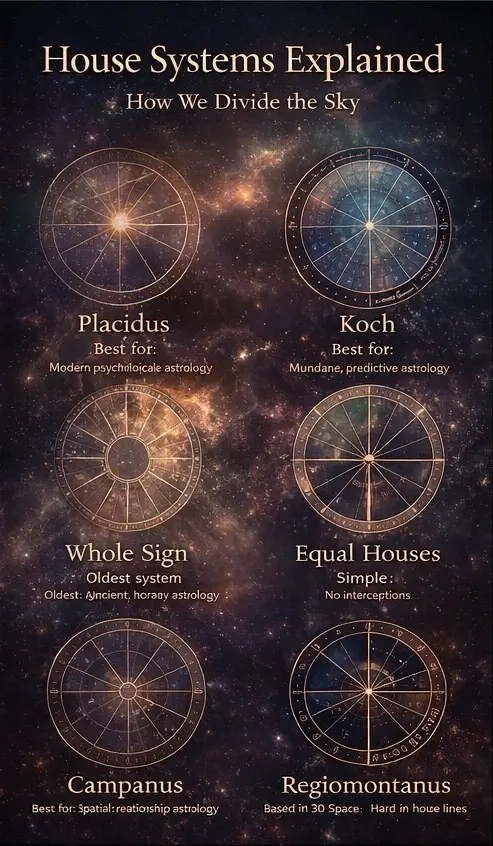
- Placidus, Whole Sign, Equal, Koch, Campanus, and Regiomontanus explained
- Comparison table with strengths and limitations
- How to choose the right system for your practice
- Frequently asked questions
What Are House Systems in Astrology?
Your birth chart is a 360° circle, but astrologers do not just read planets by sign. They also place them into houses, which describe life areas such as self, money, communication, home, relationships, career, and inner development.
The issue is that there is no single universally accepted way to divide that circle into 12 houses. Different house systems use different mathematical logic. That is why the same person can open two astrology apps and see a planet in the 9th house in one chart and in the 10th house in another.
This is the core reason people search for house systems explained: not because the concept is obscure, but because house systems can materially change how a chart is interpreted. A useful page on house systems explained must therefore show both the mathematics and the interpretive consequence.
Important: House Systems Depend on Birth Time Accuracy
House systems depend entirely on accurate birth time. Even a 15-minute error can shift house cusps.
Any serious explanation of house systems explained must begin with one key warning: if the birth time is uncertain, house placement becomes less reliable. The Ascendant, Midheaven, and house cusps can shift significantly even with a relatively small time error.
At ZodiacRoots, we treat Sun sign and many symbolic layers more confidently when birth time is unknown, but Ascendant and house-based interpretation should be handled cautiously until the recorded time is confirmed.
Why Do Different House Systems Exist?
Different house systems exist because astrologers across different eras and traditions developed different methods to project the sky onto the chart. Some systems are tied more closely to time-based motion, others to sign structure, and others to spatial geometry.
Some house systems work more smoothly in high latitudes. Some are preferred in psychological astrology. Some are favored in horary, electional, or traditional predictive work. None of this means one system is automatically false and another automatically true. It means different systems emphasize different structural logic.
That is why house systems explained should never be reduced to a vague preference. The real question is which framework gives the clearest, most coherent, and most technically consistent reading for the purpose at hand.
Why the Same Chart Can Read Differently
One of the easiest ways to understand house systems explained is to see the principle visually: the same planet can fall into different houses depending on the system used. The sign does not change. The interpretive emphasis does.
Do House Systems Change Your Chart?
They do not change your planetary signs. Your Sun remains in the same sign. Your Moon remains in the same sign. Your planetary aspects usually remain the same as well.
What changes is the house placement and sometimes the way the angles relate to the houses. A planet that appears in the 9th house in Placidus may appear in the 10th house in Whole Sign. That can shift interpretation from belief, worldview, and travel toward visibility, vocation, public life, and status.
So yes: house systems can change how a chart is structured and read, even when the underlying zodiac positions remain identical. This is one of the main reasons house systems explained has become such a common technical search topic.
Placidus
How it works: Placidus divides houses according to the time it takes degrees of the ecliptic to move from the Ascendant to the Midheaven and through the rest of the diurnal cycle.
Best known for: modern Western astrology, psychological interpretation, and mainstream chart software.
Strength: It is the most familiar default for many modern astrologers and readers.
Limitation: It can produce intercepted houses and can behave awkwardly at extreme latitudes.
In Placidus, it is common to see signs that do not appear on any house cusp. This is called interception and is often interpreted as energy that may be harder to access, express, or externalise directly.
Whole Sign Houses
How it works: The entire sign containing the Ascendant becomes the 1st house, and each following sign becomes the next house in 30° blocks.
Best known for: Hellenistic astrology, traditional methods, horary, electional work, and clean structural interpretation.
Strength: It is simple, elegant, and avoids interceptions.
Limitation: The Midheaven is not always the cusp of the 10th house, which can surprise readers trained in modern quadrant systems.
Equal Houses
How it works: Each house is 30°, beginning from the exact Ascendant degree rather than from the whole Ascendant sign.
Best known for: beginners, spiritual astrology, and readers who want simplicity without fully switching to Whole Sign logic.
Strength: It is straightforward and easy to visualise.
Limitation: The Midheaven may fall away from the 10th house cusp.
Koch
How it works: Koch is another quadrant-based system, often described as time-based and related to the Ascendant and Midheaven geometry.
Best known for: predictive and event-oriented astrology, especially in some 20th-century schools.
Strength: Some astrologers find it useful for timing and concrete life developments.
Limitation: Like Placidus, it can run into problems at extreme latitudes.
Campanus
How it works: Campanus divides the prime vertical, which makes it more explicitly spatial and geometric in three-dimensional terms.
Best known for: spatial astrology, relationship-focused work, and readers interested in astronomical geometry.
Strength: It appeals to astrologers who want a more explicitly spatial framework.
Limitation: It is less common for beginners and less familiar in mainstream modern software defaults.
Regiomontanus
How it works: Regiomontanus divides the celestial equator rather than the ecliptic itself.
Best known for: traditional horary astrology and classical question-based chart reading.
Strength: It has a strong historical role in horary practice.
Limitation: It is less widely used in everyday modern natal interpretation than Placidus or Whole Sign.
Comparison Table
Slide sideways to view the full comparison on smaller screens.
| System | Difficulty | Interceptions | Mathematical Basis | Best For | Main Limitation |
|---|---|---|---|---|---|
| Placidus | Medium | Yes | Time-based quadrant | Modern and psychological astrology | Extreme latitude issues |
| Whole Sign | Easy | No | Sign-based 30° houses | Traditional and Hellenistic work | MC not always 10th cusp |
| Equal | Easy | No | 30° from Ascendant degree | Beginners and clear structure | MC may fall outside the 10th cusp |
| Koch | Medium | Yes | Quadrant/time-based variation | Predictive emphasis | Extreme latitude issues |
| Campanus | Hard | Rare | Prime vertical division | Spatial and geometric reading | Less common for general natal use |
| Regiomontanus | Medium | Possible | Celestial equator division | Horary astrology | Less common in modern natal defaults |
How to Choose a House System
Modern psychological reading? Start with Placidus. It is the default for many contemporary resources and chart readers.
Traditional, Hellenistic, or horary work? Try Whole Sign first. It is historically important and structurally clean.
Beginner or spiritual focus? Use Equal Houses. It is intuitive and easy to visualise.
Compare 2 or 3 systems and look for the framework that produces the clearest and most coherent chart narrative, especially when birth time is reliable.
Which House System Does ZodiacRoots Use?
At ZodiacRoots, we default to Placidus because it remains the most widely used house system in modern natal interpretation and aligns with what many readers expect when they open contemporary chart software.
However, we do not treat Placidus as the only meaningful system. Whole Sign and Equal Houses can offer cleaner structural logic in some readings, especially when comparing frameworks or working with older traditions.
Our editorial position is practical: the best system is the one that produces the clearest, most coherent interpretation for the specific chart and method being used. That practical stance is central to how we approach house systems explained across the ZodiacRoots fundamentals cluster.
Related Reading
External References
For broader historical context, see Britannica’s overview of astrology and Wikipedia’s summary of astrological houses. These resources provide technical background, while this page focuses on practical comparison and chart interpretation.
Frequently Asked Questions About House Systems
What is the most accurate house system in astrology?
There is no universally accepted single most accurate house system. Different traditions prefer different systems, and each one reflects a different structural logic.
Why does my house placement change in different apps?
Because different apps may use different house systems by default. The planetary signs stay the same, but house placement can shift from one system to another.
Is Whole Sign better than Placidus?
Not automatically. Whole Sign is cleaner and structurally simpler, while Placidus remains a common modern default. The better choice depends on the interpretive framework and the chart-reading purpose.
Do house systems affect my Ascendant?
The Ascendant sign and degree itself do not usually change, but the way the houses are built from that Ascendant can change depending on the selected house system.
Can I trust house placements without a birth time?
Not fully. House cusps and angles are highly sensitive to birth time, so uncertain birth time makes house-based interpretation less reliable.
This page is for educational purposes and explains general astrological technique. Interpretation always depends on the full chart context and on birth time accuracy.