Astrology Houses: The 12 Houses Explained
Learn the astrology houses meaning, how the 12 houses in astrology work with planets and signs,
and how house placements shape identity, relationships, work, home life, creativity, and spiritual growth.
Astrology Fundamentals
hub — ZodiacRoots’ technical guide to birth charts, natal wheels, houses, aspects, orbs, and chart structure.
On This Page
What Do the Houses Mean in Astrology?
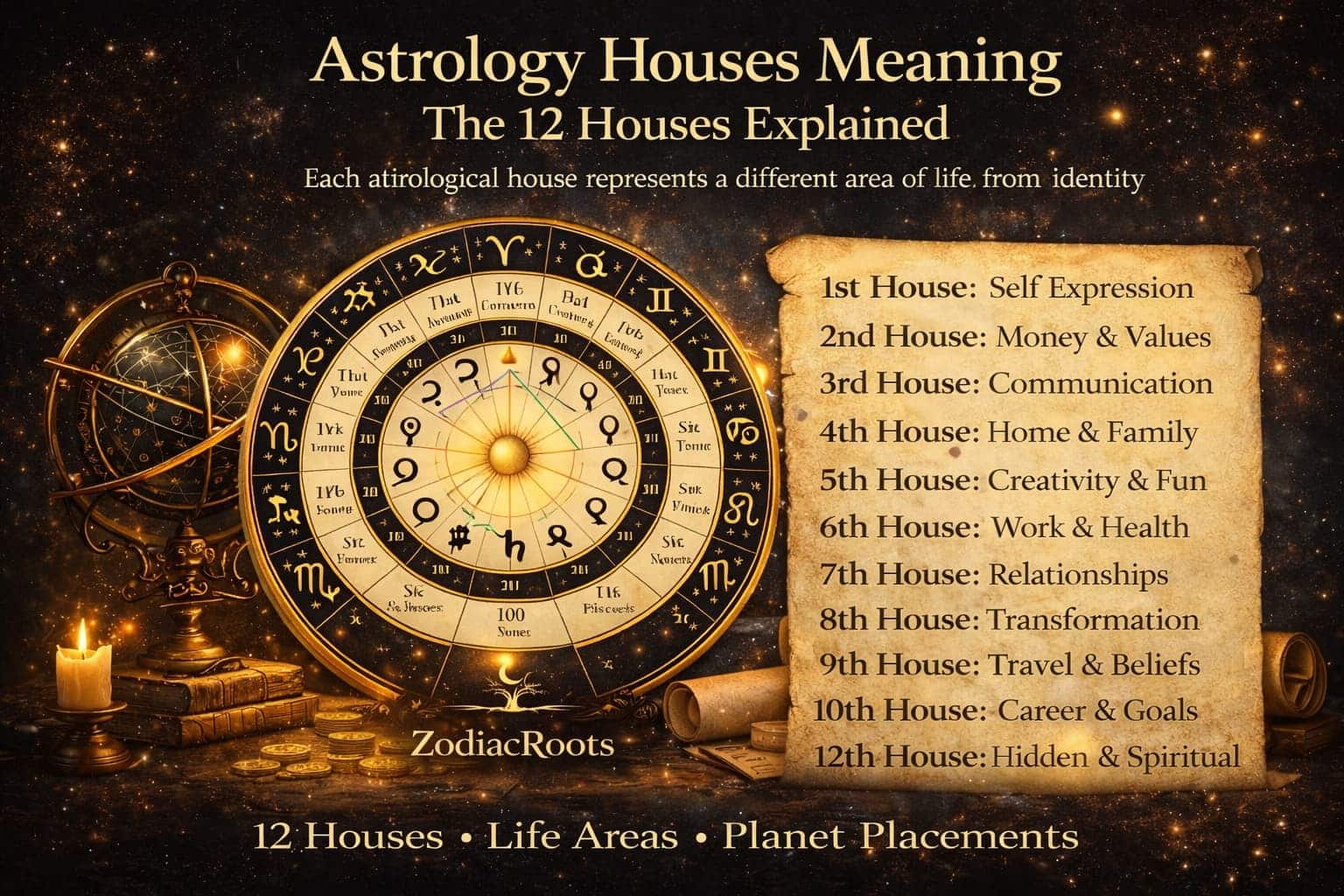
Astrology Houses at a Glance
The 12 Houses Explained
Houses as Psychological Archetypes
Angular, Succedent and Cadent Houses
Real Chart Interpretation
What Is a House Cusp?
Do Empty Houses Matter?
Why Astrology Houses Matter
FAQs
In astrology, the twelve houses represent the main areas of life experience.
If planets show what kind of energy is active, and zodiac signs describe how
that energy behaves, the houses reveal where those themes tend to manifest most clearly.
This is the foundation of astrology houses meaning in any serious birth chart interpretation.
Understanding house meanings matters because the houses show whether a planet becomes most visible
through relationships, money, family, communication, work, creativity, public reputation, or inner life.
Without the houses, astrology stays broad. With them, the chart becomes personal.
If you are new to natal astrology, start here first:
What Is a Birth Chart?
.
Then return to this guide to see how the astrology houses meaning adds context and depth to chart interpretation.
How to Read Planets, Signs and Houses Together
A simple way to read any placement is this:
Example: Venus in Libra in the 7th house
suggests harmony-seeking relationship energy expressed directly through partnership.
Astrology Houses Meaning in Historical Context
The modern language used to explain the houses is often simplified, but the system itself has deep roots.
In the classical world, horoscopic astrology developed into a structured art in which the chart was organized into meaningful sectors of life.
Over time, the houses became one of the essential frameworks of astrological interpretation.
If you want a concise reference on the general chart structure, see
Britannica’s overview of the horoscope
.
For a more technical look at house systems and house cusps, Astro.com also offers a useful reference in its
houses FAQ
.
What Do the Houses Mean in Astrology?
The astrological houses divide a birth chart into twelve symbolic sectors.
Each house corresponds to a particular field of life, from self-image and income to relationships,
career, community, retreat, and spiritual reflection.
When a planet falls in a house, that life area becomes one of the main stages where its symbolism is expressed.
For example, Venus in the 5th house may emphasize romance, pleasure, artistic expression, and joy,
while Saturn in the 10th house may point toward responsibility, discipline, ambition, and a serious public role.
In practical terms, astrology houses meaning is what makes astrology specific.
Two people may share the same Sun sign, yet live that energy in very different ways because their planets fall into different houses.
Astrology Houses Meaning at a Glance
The 12 Houses in Astrology Explained
1st House – Identity, Appearance and First Impressions
The 1st house relates to selfhood, instinctive behaviour, physical presence, and the way you meet life directly.
It is closely connected with the Ascendant and often shapes how other people first perceive you.
2nd House – Money, Values and Personal Resources
The 2nd house governs finances, possessions, self-worth, and the skills or assets you build through your own effort.
It often reveals what gives you stability and what you truly value.
3rd House – Communication, Learning and Everyday Mind
The 3rd house covers language, writing, speaking, everyday learning, siblings, local environment,
and the way you process and exchange information on a daily level.
4th House – Home, Family and Inner Foundations
The 4th house is linked to home life, ancestry, roots, emotional security, and the private base from which life unfolds.
It often describes what makes you feel safe, rooted, and inwardly anchored.
5th House – Creativity, Pleasure, Joy and Romance
The 5th house governs play, artistic expression, personal style, romance, and the desire to shine through creation.
It often shows where spontaneous joy and heartfelt self-expression emerge.
6th House – Work, Routine, Service and Wellbeing
The 6th house concerns habits, schedules, practical responsibilities, service, and the management of everyday life.
It often reveals how you work, organize yourself, and maintain functional balance.
7th House – Partnership, Commitment and One-to-One Bonds
The 7th house is associated with marriage, commitment, close partnerships, contracts, and the qualities you meet through significant others.
It often reflects how you relate, compromise, and grow through one-to-one connection.
8th House – Transformation, Intimacy and Shared Resources
The 8th house deals with deep emotional processes, shared assets, vulnerability, inheritance, endings, and regeneration.
It often points to crisis, healing, merging, and profound inner change.
9th House – Meaning, Belief, Travel and Higher Study
The 9th house relates to philosophy, religion, higher education, publishing, long-distance travel, and the search for truth.
It describes how you broaden your worldview and seek wisdom beyond the familiar.
10th House – Career, Reputation and Public Role
The 10th house governs ambition, status, visibility, achievement, and the role you build in the outside world.
It often shows how you want to be recognized and what legacy you aim to create.
11th House – Friends, Networks and Future Aspirations
The 11th house concerns friendships, communities, audiences, collective ideals, and long-range goals.
It often reveals how you connect with groups and what kind of future you want to help shape.
12th House – Solitude, Hidden Patterns and Spiritual Retreat
The 12th house is linked to the unconscious, hidden influences, retreat, surrender, healing, and spiritual depth.
It often describes what happens behind the scenes, beyond the fully conscious mind.
Houses as Psychological Archetypes
The houses can also be read as psychological archetypes. In that sense, they are not only external life departments,
but inner zones of experience.
The 1st house can be read as identity formation, the 4th as emotional rooting, the 7th as relational mirroring,
the 10th as public aspiration, and the 12th as the hidden interior world. This psychological lens adds depth without removing the symbolic or mystical dimension.
House Types: Angular, Succedent and Cadent
The houses can also be grouped by function, which adds another interpretive layer.
Astrology Houses Meaning in Real Chart Interpretation
A house placement never acts in isolation. In real chart work, astrologers interpret a combination of planet, sign, house, and aspects.
This is why astrology houses meaning is best understood as part of a wider symbolic pattern.
For example, Mercury in Gemini in the 3rd house may express itself through quick thinking, lively speech,
curiosity, and constant exchange of ideas. Mercury in Capricorn in the 10th house may be more strategic,
measured, and professionally oriented, with communication tied to status, authority, and long-term goals.
Beyond the house itself, relationships between planets also modify expression through aspects and orbs.
A planet in the 2nd house in square to a planet in the 5th house, for example, may show tension between personal resources,
values, pleasure, or creativity. This is why astrologers do not read houses in isolation: they read placement, aspect pattern, and intensity together.
What Is a House Cusp in Astrology?
A house cusp is the beginning point of a house in the chart wheel.
The sign on a cusp helps shape how that area of life is approached and interpreted.
For example, if Taurus is on the cusp of the 2nd house, themes of security, steadiness, and material consistency may color money and values.
The ruling planet of the sign on the cusp is also important, because it adds another interpretive layer.
This is one reason astrologers often look not only at planets inside a house, but also at the sign on the cusp and its ruler.
Do Empty Houses Matter in Astrology?
Yes. An empty house does not mean that part of life is absent or unimportant.
It simply means there are no natal planets placed there. Astrologers still interpret the sign on the cusp,
the ruling planet, and later activations such as transits.
Why Astrology Houses Meaning Matters
The houses are what make natal astrology specific and personal.
They reveal where planetary themes become concrete in lived experience.
Two people may share the same Sun sign and still express it differently because their houses direct that energy into different life arenas.
This is why full chart interpretation goes beyond Sun sign astrology.
The houses provide context, depth, and a map of how inner symbolism becomes outer experience.
To go deeper, continue with
How to Interpret a Birth Chart Wheel
.
If you want to understand astrology houses meaning in practice, that guide is the natural next step.
FAQs About Astrology Houses Meaning
What do the 12 houses mean in astrology?
The 12 houses represent different areas of life such as identity, money, communication, home, creativity,
work, relationships, transformation, higher learning, career, community, and spiritual retreat. This is the core of astrology houses meaning.
Are houses more important than zodiac signs?
Houses and signs are both essential. Signs describe the style of expression, while houses show where that expression becomes most active in life.
What house rules career in astrology?
The 10th house is the primary house linked with career, status, ambition, public role, and reputation.
What house rules relationships?
The 7th house is the main house of partnership, marriage, and committed one-to-one bonds.
What is a house cusp in astrology?
A house cusp is the starting point of a house. The sign on that cusp helps shape how that life area is expressed and interpreted.
Do empty houses matter in a birth chart?
Yes. Empty houses still matter. Astrologers interpret the sign on the cusp, the ruling planet, and later activations such as transits.
Explore Your Full Birth Chart
Once you understand the astrology houses meaning, the next step is to see how they interact with planets, signs, aspects, and the full chart structure.
Discover More Astrology Articles You May Like
Explore related ZodiacRoots articles selected by topic first, then completed with fresh astrology reads.