
Quick Answer
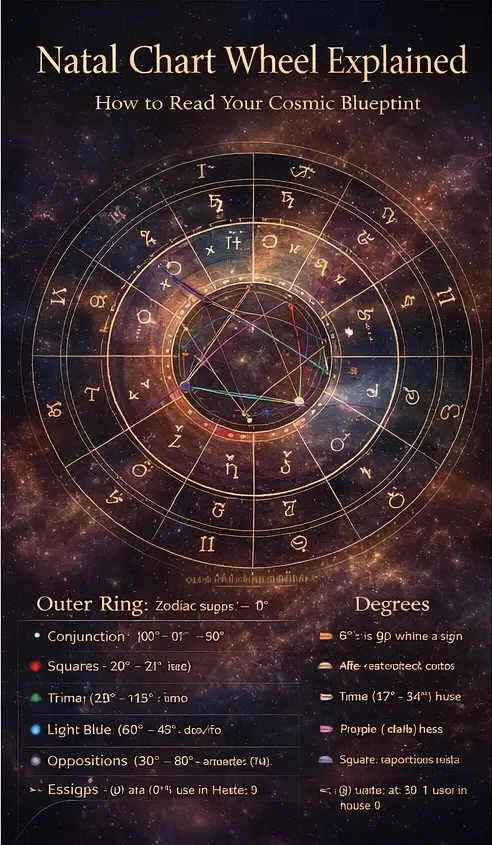
Natal chart wheel explained simply: the natal chart wheel is the circular map of the sky at the moment of birth. It shows the zodiac signs, the 12 houses, the planets, the major angles, and the aspect lines between chart points. Once you know where to look first, the wheel becomes much easier to read than it appears at first glance.
In this article: Natal Chart Wheel Explained
- What a natal chart wheel is and what it shows
- The difference between signs, houses, planets, and aspects
- How to identify angles, glyphs, and degree markers
- How to read the wheel step by step
- Frequently asked questions about chart wheels
What Is a Natal Chart Wheel?
The natal chart wheel is the most common visual representation of a birth chart. It is a circular diagram that shows where the Sun, Moon, planets, houses, and angles were positioned at the moment of birth.
Many beginners find the wheel intimidating because it contains symbols, numbers, radial divisions, and colored lines all at once. But a strong page on natal chart wheel explained should make one thing clear: you do not need to decode everything at once. You need to know what each layer represents.
At ZodiacRoots, the natal chart wheel is the visual entry point into interpretation, but the wheel alone is not the full reading. It shows the structure. The meaning comes from how those elements interact.
What the Natal Chart Wheel Shows
The easiest way to understand natal chart wheel explained is to separate the diagram into layers:
The Chart Wheel Layer by Layer
A practical natal chart wheel explained guide works best when the wheel is mentally “disassembled” into separate layers before being read as one whole chart.
This outer layer tells you the symbolic tone or style of expression.
This inner layer tells you where in life the chart energy is concentrated.
These symbols show which functions are active and where they sit in the chart.
The lines in the middle show tension, harmony, support, and dynamic patterning.
The Outer Ring: Zodiac Signs
The outer ring of the chart wheel shows the 12 zodiac signs, each occupying 30° of the circle. This is the zodiac framework through which the planets are expressed.
In a typical wheel, you will see sign symbols such as ♈ Aries through ♓ Pisces arranged around the edge. This does not tell you everything by itself, but it tells you the symbolic style in which a planet acts.
The Inner Ring: House Numbers
The inner ring shows the 12 houses. These are the life areas in which planetary energy is expressed. Houses do not describe what a planet is, but rather where it tends to manifest.
House 1 usually begins at the Ascendant, often shown on the left side of the wheel. From there, the houses continue counter-clockwise. This is one of the first structural points to recognize when learning natal chart wheel explained.
AC, DC, MC, and IC
The four main angles anchor the chart wheel:
- AC (Ascendant): the rising sign and the beginning of the 1st house.
- DC (Descendant): the opposite point, linked to partnership and others.
- MC (Midheaven): the highest point in the chart, associated with visibility, vocation, and public direction.
- IC (Imum Coeli): the lowest point in the chart, associated with roots, home, and private foundations.
Planet Symbols Inside the Wheel
Planet glyphs are the small symbols placed inside the wheel near the sign and house where each planet is located. For example, ☉ marks the Sun, ☽ the Moon, ☿ Mercury, ♀ Venus, and ♂ Mars.
In practice, natal chart wheel explained means learning to read each planet as a combination of three things at once: planet + sign + house. The planet shows the function, the sign shows the style, and the house shows the life area.
| Glyph | Planet | Quick Meaning |
|---|---|---|
| ☉ | Sun | Identity, direction, vitality |
| ☽ | Moon | Emotion, instinct, inner needs |
| ☿ | Mercury | Mind, speech, interpretation |
| ♀ | Venus | Love, taste, attraction |
| ♂ | Mars | Action, will, drive |
Aspect Lines Inside the Chart
The lines drawn across the middle of the chart show aspects between planets and points. They are the geometric relationships that create harmony, tension, polarity, or fusion.
- Squares: often shown in red, indicating friction, pressure, and challenge.
- Trines: often shown in blue or green, indicating flow, ease, and natural talent.
- Sextiles: often lighter in tone, indicating opportunity and support.
- Oppositions: usually strong straight lines across the wheel, indicating polarity and balancing tension.
- Conjunctions: may be shown by proximity rather than long lines, indicating fusion or intensification.
Degree Numbers
Each planet is placed at a specific degree within a sign, from 0° to 29°. Those numbers matter because they determine aspect exactness, house cusp proximity, and timing techniques.
For beginners, the main point is simple: degrees add precision. You do not need to master every advanced degree theory on day one, but you do need to notice that 2° Scorpio and 28° Scorpio are not the same thing.
What to Read First on Any Chart Wheel
Ascendant: start with the AC because it anchors the house structure and outward style.
Sun: identify the core identity pattern by sign and house.
Moon: check the emotional tone, instincts, and inner patterning.
Angular houses: look at houses 1, 4, 7, and 10 for the strongest structural emphasis.
Tight aspects or clusters: identify what is strongly connected or visually concentrated.
How to Read a Natal Chart Wheel Step by Step
Find the Ascendant. This gives you the Rising sign and shows where the 1st house begins.
Locate the Sun and Moon. These are usually the fastest entry points for identity and emotional patterning.
Check the houses. Which life areas are emphasized by multiple planets?
Look at the aspect lines. Where do you see tension, ease, or concentration?
Bring the layers together. A chart wheel is not read one symbol at a time but as a structured whole.
Take your own chart and find the Ascendant. Follow the horizontal line to the left side of the wheel: that is your point of entry into the chart. This one simple step makes natal chart wheel explained much easier to grasp in practice.
How ZodiacRoots Uses the Chart Wheel
At ZodiacRoots, the chart wheel is the visual foundation of interpretation, but not the final interpretation by itself. It shows the arrangement of the chart in a way the eye can grasp quickly.
We use the wheel to identify the major visual structures first: angle emphasis, house concentration, sign emphasis, and aspect geometry. From there, we interpret those patterns through the wider 8 Roots framework rather than stopping at surface-level chart description.
That means natal chart wheel explained is not just about decoding symbols. It is about learning how the wheel organizes the deeper logic of the chart. That layered reading is central to how ZodiacRoots approaches natal chart wheel explained across the fundamentals cluster.
Related Reading
External References
For broader technical background, see Britannica’s overview of astrology and Wikipedia’s summary of natal astrology. These references provide context, while this page focuses on how to read the chart wheel itself.
Frequently Asked Questions About the Natal Chart Wheel
What is a natal chart wheel?
A natal chart wheel is the circular diagram used to display the zodiac signs, houses, planets, angles, and aspects of a birth chart.
How do I find my Rising sign on the wheel?
Look for the Ascendant or AC marker. The sign on that point is your Rising sign and it usually marks the start of the 1st house.
What do the lines inside the chart mean?
Those lines show aspects between planets and points. They reveal geometric relationships such as squares, trines, sextiles, and oppositions.
Why do some chart wheels look different?
Different software uses different styles, colors, glyph sets, and house systems. The visual layout may vary, but the underlying chart data is the same.
Is the wheel enough to interpret a birth chart?
It is the starting structure, but not the full interpretation. The wheel shows how the chart is arranged; interpretation comes from understanding how those parts work together.
This page is for educational purposes and explains general astrological technique. Interpretation always depends on the full chart context and on birth time accuracy.