
Western Astrology vs Vedic Astrology: The Real Difference Explained
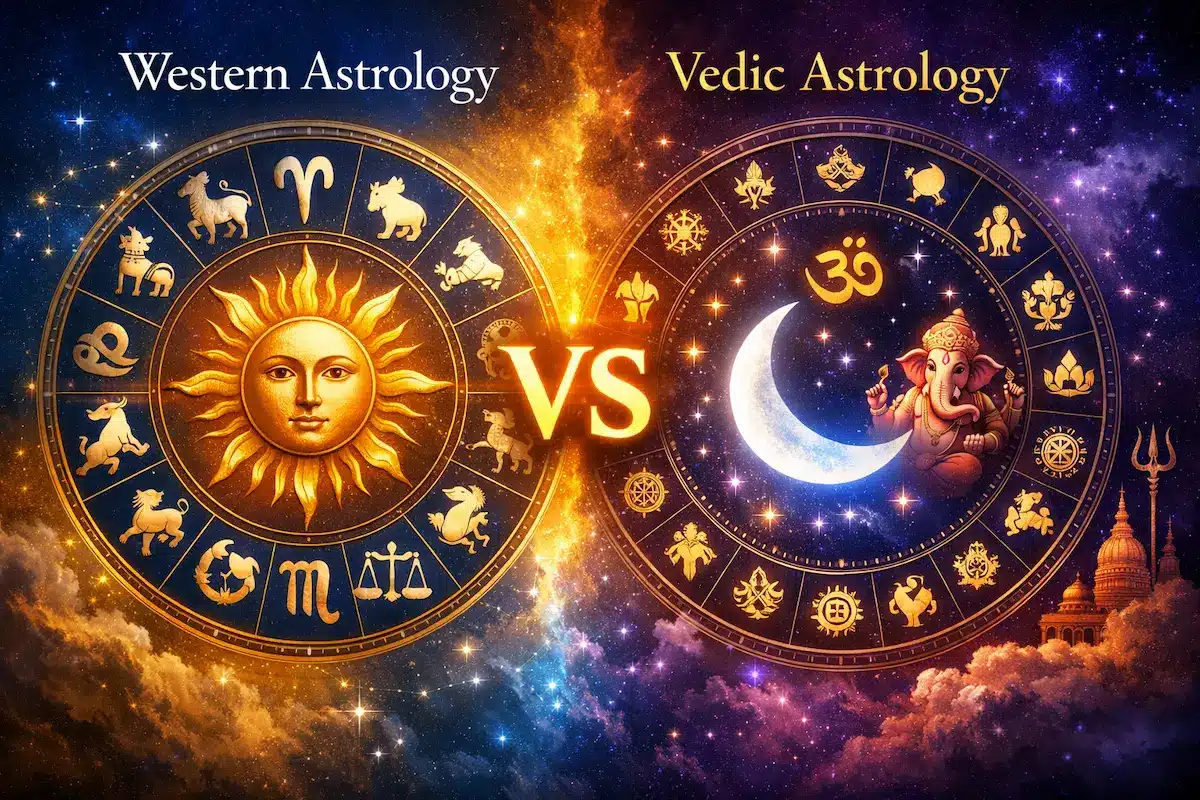
Western astrology vs Vedic astrology refers to the comparison between two major astrological systems that use different zodiacs, interpretive frameworks, and timing techniques. Western astrology is based on the tropical zodiac aligned with the seasons, while Vedic astrology uses the sidereal zodiac aligned with the fixed stars, creating a difference of approximately 23–24 degrees in planetary positions.
When comparing western astrology vs vedic astrology, the difference is structural, not superficial. It affects how your natal chart is calculated, how your personality is interpreted, and how timing is understood across your life.
Essential Summary
The core difference in western astrology vs vedic astrology lies in the zodiac system and interpretive focus. Western astrology uses the tropical zodiac and emphasizes psychological patterns, identity, and archetypal meaning. Vedic astrology uses the sidereal zodiac and focuses on karma, timing, lunar symbolism, and predictive techniques such as dashas.
Western Astrology vs Vedic Astrology: Historical Foundations
Vedic astrology (Jyotisha) is rooted in ancient Indian tradition and codified in classical texts such as the Brihat Parashara Hora Shastra, forming a continuous interpretive lineage.
Western astrology developed through Babylonian and Hellenistic traditions and later evolved into modern psychological astrology, heavily influenced by Carl Jung, whose work on archetypes reshaped how astrologers interpret personality and symbolic patterns.
Western Astrology vs Vedic Astrology: Tropical vs Sidereal Zodiac
A key distinction in western astrology vs vedic astrology is the zodiac framework:
- Tropical zodiac — based on the Earth’s seasons (Western astrology)
- Sidereal zodiac — aligned with actual constellations (Vedic astrology)
This difference exists due to the precession of the equinoxes, a slow astronomical shift in Earth’s axis. For external context, see NASA’s explanation of precession and NASA’s overview of axial precession and long-cycle orbital change.
Technical Insight: Ayanamsa (Lahiri)
The Ayanamsa is the correction used in Vedic astrology to account for this shift. The most widely used version, Lahiri Ayanamsa, currently adjusts planetary positions by approximately 23–24°.
This means a person with the Sun in Aries in Western astrology may have the Sun in Pisces in Vedic astrology.
Western Astrology vs Vedic Astrology: Detailed Comparison
| Aspect | Western Astrology | Vedic Astrology |
|---|---|---|
| Zodiac | Tropical (season-based) | Sidereal (star-based) |
| Main focus | Sun, Ascendant, personality | Moon, Lagna, karma |
| Approach | Psychological and symbolic | Predictive and karmic |
| Timing | Transits and progressions | Dashas (planetary periods) |
| Planets used | Includes Uranus, Neptune, Pluto | Visible planets + Rahu and Ketu |
| Lunar system | Secondary | Nakshatras central |
| Best for | Psychology, relationships, career analysis | Timing, life events, karmic cycles |
Western Astrology vs Vedic Astrology: Dashas vs Transits
One of the most important differences in western astrology vs vedic astrology is how time is understood. Western astrology relies on transits and progressions, while Vedic astrology uses Dashas, a structured sequence of planetary periods that indicates when specific life themes are activated.
The Four Aims of Life (Purusharthas)
Vedic astrology is deeply connected to a philosophical framework known as the Purusharthas, the four aims of human life:
- Dharma — purpose, duty, and alignment with one’s path
- Artha — material stability and resources
- Kama — desire, pleasure, and emotional experience
- Moksha — liberation and spiritual release
These concepts show that Vedic astrology is not only predictive but also existential, providing a broader life structure beyond personality analysis.
The main criticism of Western astrology from an astronomical perspective is the drift of constellations. However, the authority of the tropical zodiac does not depend on fixed stars. It is based on the Earth–Sun relationship and seasonal cycles. At ZodiacRoots, we recognize the astronomical precision of Vedic astrology and the archetypal precision of Western astrology.
How ZodiacRoots Uses Both Systems
At ZodiacRoots, we do not treat western astrology vs vedic astrology as competing systems. Instead, we integrate both through the 8 Roots method, combining Western, Vedic, Chinese, and other symbolic traditions into a unified interpretive framework.
For deeper exploration, see:
Vedic Astrology,
Moon Sign,
Ascendant,
Astrology Fundamentals.
Recommended External Reading
- Britannica: Astrology
- Britannica: Zodiac
- Britannica: Hindu Calendar
- NASA: Axial Precession and Orbital Cycles
- NASA: Precession of the Equinoxes
FAQ
Why is my Vedic sign different from my Western sign?
Because Vedic astrology uses the sidereal zodiac adjusted by the ayanamsa, while Western astrology uses the tropical zodiac.
Which system is more accurate?
Each system answers different questions. Western astrology is stronger for psychological interpretation, while Vedic astrology excels in timing.
Does Vedic astrology focus more on the Moon?
Yes. The Moon and nakshatras are central to Vedic interpretation.
Can both systems be used together?
Yes. Combining both provides a deeper and more complete reading.
What is the ayanamsa?
It is the correction between tropical and sidereal zodiacs, currently about 23–24 degrees.
Disclaimer: Astrology is not a science. This article is for educational purposes.
Author: ZodiacRoots team
Discover More Astrology Articles You May Like
Explore related ZodiacRoots articles selected by topic first, then completed with fresh astrology reads.