Ashtakoot Calculator Explained: 36 Gunas, 8 Kootas, and What This Moon-Based Vedic System Really Measures
The Ashtakoot Calculator is one of the best-known compatibility tools in Jyotisha. This guide explains the origins of the method, the meaning of the 36 gunas, the logic of the 8 kootas, and why this Moon-based system still matters for readers who already use Western synastry.
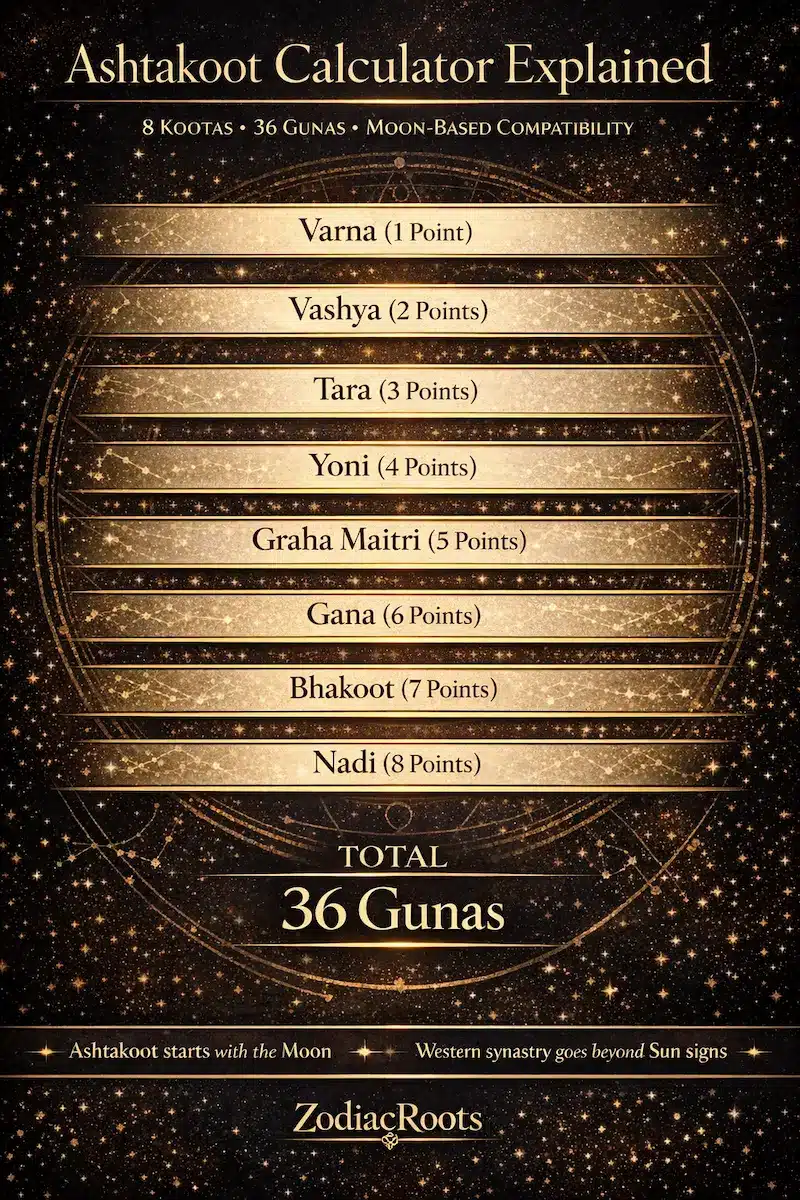
Quick Answer: An Ashtakoot Calculator is a traditional Jyotisha compatibility tool used in North Indian kundli matching. It compares two people through 8 Moon-based factors, producing a score out of 36 gunas. Its real value is not reducing love to a number, but organising compatibility into distinct dimensions — emotional fit, instinctive chemistry, temperament, family potential, and constitutional harmony. For Western readers, Ashtakoot matters because it does what serious synastry also tries to do: move beyond Sun-sign simplification and examine how two people actually function together.
On This Page
- What Ashtakoot is — and what it is not
- What 36 gunas actually means
- Where the method comes from historically
- Why the Moon matters so much in this system
- How Ashtakoot maps onto Western compatibility questions
- The 8 kootas explained one by one
- What a high or low score really means
- What an Ashtakoot calculator does well
- What it cannot tell you
- Common misunderstandings about Ashtakoot
- Why it still matters in a Western astrology context
- How to use the calculator intelligently
- FAQ
What This Article Is — and Isn’t
What this article is: A historically grounded, practically useful explanation of the Ashtakoot Calculator for readers who already know Western astrology and want to understand what this Moon-based Vedic compatibility system actually measures.
What this article isn’t: A claim that Vedic astrology is automatically more accurate than Western astrology, a promise that 36 gunas can predict the fate of a marriage by themselves, or a replacement for emotional maturity, communication, values, and real relationship work.
The strongest way to present an Ashtakoot Calculator is neither as mystical infallibility nor as decorative tradition, but as a structured compatibility architecture with a real interpretive history behind it.
What Does “Ashtakoot” Mean — and What Do 36 Gunas Actually Mean?
The term is literal. Ashta means eight, and koota means category, factor, or compatibility dimension. Ashtakoot is the system of eight compatibility factors used in North Indian kundli matching, the structured comparison of two horoscopes before marriage.
Each factor carries a specific maximum score, and together they total 36 gunas. The 36-point structure is not arbitrary: each koota has a different weighting, reflecting how seriously that factor was treated in traditional matchmaking practice.
| Koota | What it measures | Maximum points |
|---|---|---|
| Varna | Orientation and symbolic ego alignment | 1 |
| Vashya | Attraction, influence, and power dynamics | 2 |
| Tara | Auspiciousness and mutual support | 3 |
| Yoni | Intimacy and instinctive chemistry | 4 |
| Graha Maitri | Mental and emotional friendship | 5 |
| Gana | Temperament and behavioural nature | 6 |
| Bhakoot | Emotional bond, family life, and shared fortune | 7 |
| Nadi | Constitution, health, and hereditary compatibility | 8 |
Most versions of the Ashtakoot Calculator show two things: a total score out of 36 and a factor-by-factor breakdown across the 8 kootas. That breakdown matters more than many casual users realise.
Where Does the Method Come From?
The “Vedic Astrology” Misconception
The phrase “Vedic astrology” is often used too loosely. Many modern descriptions imply that every technique currently used in Indian astrology comes directly and unchanged from the earliest Vedic layer. That is not historically precise. The Ashtakoot system does not need inflated claims to be taken seriously, and in fact becomes more credible when it is placed accurately.
Vedāṅga Jyotiṣa vs Later Natal Astrology
The oldest textual layer usually associated with Jyotisha, Vedāṅga Jyotiṣa, is primarily concerned with calendrical reckoning and the timing of ritual, not with natal horoscopy in the form most people recognise today. Astro.com makes this distinction clearly when discussing how ancient Vedāṅga Jyotiṣa differs from later Indian natal astrology built around signs, houses, planets, and interpretive methods.
Marriage Matching in Classical Jyotisha
Ashtakoot belongs specifically to the tradition of vivāha mīlana or marriage matching. Its structural logic is based on comparing the Moon’s nakshatra, symbolic classifications, and compatibility patterns that were treated as relevant to marital life.
Classical Sources and the Role of Tradition
The broader literature of Hindu natal astrology is often associated with the Brihat Parashara Hora Shastra, widely regarded as one of the most important surviving compendia of Hindu astrology, even though the text itself is historically composite and layered. For a concise background reference, see Wisdom Library on the Brihat Parashara Hora Shastra.
It is also worth mentioning a more modern bridge: practitioners such as B.V. Raman helped carry classical Jyotisha into twentieth-century English-language astrology, which is one reason systems like Ashtakoot remained legible and influential outside strictly Sanskrit-reading circles.
Ashtakoot vs Dasakoota
Ashtakoot is specifically a North Indian system. South Indian traditions often use a related but distinct framework called Dasakoota, which evaluates ten factors rather than eight. Both systems address the same broad question — compatibility in the context of marriage — but through slightly different structures.
Most accurate framing: Ashtakoot is a classical Jyotisha-based compatibility system, developed within Indian astrological tradition, structured around Moon-based logic, and used specifically in the context of marriage matching.
Why the Moon Matters — and Why That Should Matter to Western Readers
Western popular astrology tends to begin with the Sun sign. The Ashtakoot Calculator begins with the Moon, specifically the nakshatra occupied by the Moon at birth. That is not an arbitrary difference. It reflects a deeper interpretive assumption within Jyotisha: when evaluating marriage compatibility, what matters most is emotional patterning, instinctive behaviour, receptivity, and the lived rhythms of shared domestic life.
For Western readers, this should not feel alien. Serious Western synastry also knows that compatibility is not fundamentally a Sun-sign matter. Astrology.com makes this point directly, describing Sun sign compatibility as only a first step and emphasising the wider role of full chart comparison in synastry.
In that sense, Ashtakoot is not opposed to Western astrology. It is another tradition’s structured response to the same enduring question: what happens when two people’s instinctive natures begin to share a life?
What Western Astrology Readers Are Really Asking
Most users of compatibility tools are not asking abstract doctrinal questions. They are asking things like: are we actually compatible, or just attracted? Will this relationship feel supportive or exhausting? Is there long-term potential here? What does the score really mean? Can a “good match” still hide serious problems?
| Western user question | Primary Ashtakoot factor(s) |
|---|---|
| Are we actually compatible, or just attracted? | Yoni, Graha Maitri, Gana |
| Will this relationship be easy or exhausting? | Gana, Vashya |
| Can I trust the long-term potential of this pairing? | Bhakoot, Tara |
| What does the score actually mean? | Full 8-factor breakdown (not just the total), with special attention to Nadi and Bhakoot |
That is one of the strengths of the Ashtakoot Calculator: its architecture maps surprisingly well onto the lived concerns that Western readers already bring to synastry.
The 8 Kootas, Explained
Note: The “Western bridge” descriptions below are analogies, not exact equivalents. They are intended to help Western readers orient themselves, not to claim that Ashtakoot and Western synastry measure identical phenomena.
1) Varna — Orientation and Ego Alignment
Varna is the lightest-weighted factor. In traditional Jyotisha, it is commonly understood to reflect spiritual refinement, symbolic hierarchy, or alignment at the level of ego orientation and general life approach. Because it carries only one point, it is rarely decisive on its own.
Useful modern framing: a symbolic measure of whether two people approach life and identity from reasonably compatible inner orientations.
Western bridge: loosely overlaps with broad ego-style alignment that a Western astrologer might begin to sense through Sun sign tone or Ascendant style, though Ashtakoot treats it as secondary background rather than primary substance.
2) Vashya — Attraction, Influence, and Power Dynamics
Vashya evaluates mutual influence, responsiveness, and relational control dynamics. This factor asks whether the pairing tends toward cooperation, natural balance, dominance, or friction over influence.
Useful modern framing: how power moves within the bond.
Western bridge: not the same as Western aspect doctrine, but it loosely parallels the kind of relational dynamics a Western astrologer might observe through strong control-oriented or asymmetrical synastry patterns.
3) Tara — Auspiciousness and Mutual Support
Tara compares the birth stars to assess the degree of auspiciousness, protection, and mutual support in the pairing. Traditional logic treats Tara as relevant to whether the union tends to sustain and uplift both partners or whether it brings subtle structural strain into the shared path.
Useful modern framing: whether the relationship has a generally supportive energetic pattern or whether it feels undercut by friction at a deeper level.
Western bridge: there is no precise one-to-one equivalent, but Tara comes close to the broad question of whether a synastry pattern feels overall helpful, draining, stabilising, or complicated.
4) Yoni — Intimacy and Instinctive Chemistry
Yoni addresses physical compatibility, sexual chemistry, instinctive attraction, and bodily resonance. In traditional matchmaking, this was not treated as trivial. Marriage was not seen only as a social or spiritual arrangement, but as something lived through the body as well.
Useful modern framing: whether two people meet each other naturally at the level of desire, instinct, and intimate responsiveness.
Western bridge: one of the easiest parallels for Western readers, loosely overlapping with Venus-Mars chemistry and erotic polarity in synastry.
5) Graha Maitri — Mental and Emotional Friendship
Graha Maitri concerns friendship of mind and feeling, psychological compatibility, and whether the two people’s habitual ways of relating naturally support one another. This is the friendship beneath romance — the part that determines whether the bond still functions once initial attraction is no longer enough.
Useful modern framing: whether the relationship has genuine relational intelligence beneath desire.
Western bridge: roughly parallels the kind of rapport a Western astrologer might explore through Moon-Moon, Mercury-Mercury, Moon-Mercury, or Moon-Venus compatibility.
6) Gana — Temperament and Behavioural Nature
Gana evaluates temperamental type through the symbolic classes Deva, Manushya, and Rakshasa. The point is not moral judgement. It is behavioural nature. Gana asks whether two baseline ways of being in the world harmonise in sustained proximity or generate chronic friction.
Useful modern framing: the compatibility of basic behavioural climate.
Western bridge: relatively close to how Western astrologers think about Moon sign tone, Ascendant temperament, and elemental or modality fit in lived personality.
7) Bhakoot — Emotional Bond, Family Life, and Shared Fortune
Bhakoot is one of the most consequential kootas in traditional interpretation. It is commonly associated with emotional bonding, family growth, prosperity, the broader arc of shared life, and the relationship’s structural capacity to support continuity. A Bhakoot dosha is taken seriously in many traditional contexts, even when the final score is otherwise respectable.
Useful modern framing: whether the bond supports emotional and family-level integration, not merely attraction or functional interaction.
Western bridge: loosely resonates with 4th-house, 7th-house, and long-term domestic bonding themes in synastry.
8) Nadi — Constitution, Health, and Hereditary Compatibility
Nadi carries the highest score and is traditionally treated as the most sensitive factor. It is associated with constitutional compatibility, vitality, health, hereditary patterning, and serious caution when mismatched. Modern explanations often connect it loosely with Ayurvedic constitutional thinking as well.
Useful modern framing: the factor most explicitly concerned with deep constitutional fit.
Western bridge: Western astrology has no close equivalent. This is one area where Ashtakoot preserves a concern that Western synastry often treats only indirectly or not at all.
On Nadi dosha: In traditional practice, a Nadi mismatch is taken seriously — but not treated as an automatic veto. Qualified practitioners contextualise it within the full chart comparison and, in many cases, consider remedial measures (upāya). A matched Nadi alone does not guarantee incompatibility any more than a perfect score guarantees success.
What Is a “Good” Ashtakoot Score?
| Score | Traditional interpretation |
|---|---|
| 31–36 | Excellent |
| 21–30 | Very good |
| 17–20 | Acceptable, mixed |
| 0–16 | Generally considered weak or inauspicious |
Note: Different Ashtakoot implementations may vary slightly in how they calculate individual koota scores — particularly Varna and Vashya. The interpretive ranges above reflect the most widely used convention, but the principle (higher is better, Nadi and Bhakoot carry extra weight) is consistent across traditional systems.
A stronger interpretive principle is this: the total informs, but the more heavily weighted factors often matter more in traditional reading.
Practical traditional insight: in traditional practice, a score of 18–20 with no Nadi or Bhakoot dosha is often accepted more readily than a score of 26–28 with a significant Nadi mismatch.
The score is context. The breakdown is substance.
What an Ashtakoot Calculator Does Well
- It names the dimensions of compatibility. Instead of a vague “good match” label, it breaks compatibility into distinct categories.
- It shifts the reader away from Sun-sign superficiality. For readers trained on Sun-sign astrology, the Ashtakoot Calculator redirects attention toward emotional and instinctive compatibility.
- It creates a structured framework for reflection. It prompts specific questions about chemistry, temperament, emotional fit, and long-term viability.
- It preserves a traditional compatibility logic. Even if one does not adopt every traditional assumption uncritically, the architecture itself remains valuable.
What an Ashtakoot Calculator Does Not Do
An Ashtakoot Calculator score is not a complete relationship analysis.
It cannot fully tell you whether two people communicate well, whether they have emotional maturity, whether they share values, whether they want the same kind of future, or whether fear, attachment patterns, avoidance, dishonesty, and timing will distort the bond.
It also cannot substitute for broader chart work. A serious relationship reading may still need fuller Vedic chart comparison, Western synastry, Moon sign comparison, Venus-Mars patterning, and wider life context.
This is why the best use of the Ashtakoot Calculator is not as a deterministic verdict, but as a traditional screening lens and structured interpretive framework.
Common Misunderstandings About Ashtakoot
“A high score means the relationship will work” — Not necessarily. It may indicate structural strengths, but no score replaces emotional maturity, communication, values, or real relational work.
“A low score means the relationship is doomed” — Also not necessarily. A weaker result may indicate real challenges, but astrology is not a substitute for life.
“The total score matters more than everything else” — No. The total is useful, but traditional interpretation pays particular attention to Nadi and Bhakoot.
“This replaces Western synastry” — It does not. Ashtakoot and Western synastry ask related but not identical questions.
“If this is traditional, it must be infallible” — Tradition is not the same as infallibility. The value lies in coherent structure and interpretive usefulness, not magical immunity from critique.
Why Ashtakoot Still Matters — Especially for Western Astrology Readers
- It corrects the central weakness of pop compatibility astrology. Most mass-market compatibility astrology is too thin to be useful. The Ashtakoot Calculator is better because it starts with layered categories rather than slogan-level sign matching.
- It is one of the clearest structured systems in astrology. Few compatibility frameworks make their logic this visible.
- It answers universal relationship questions through a non-Western lens. Every mature astrological tradition eventually confronts attraction, temperament, emotional resonance, family life, trust, continuity, and structural strain beneath chemistry.
- It complements Western synastry rather than competing with it. It can sit alongside broader compatibility reading, Sun, Moon and Rising analysis, and your cross-tradition 8 Roots method.
How to Use an Ashtakoot Calculator Intelligently
- Read the breakdown, not just the total. The 8 individual factors tell you more than the headline score.
- Pay particular attention to Nadi and Bhakoot. These carry heavy traditional weight and are often treated seriously even when the total score is respectable.
- Treat the result as a framework, not a verdict. Use the score to ask better questions, not to shut the inquiry down.
- Combine it with broader compatibility logic. Compare it with Western synastry, Moon sign comparison, and wider relationship analysis rather than treating it as a stand-alone oracle.
- Take cautions seriously without catastrophising. A dosha is not automatically a death sentence. It is a structural caution, and in traditional practice many incompatibilities are contextualised rather than interpreted as fatalistic absolutes.
- Understand the original context. Ashtakoot was developed for arranged marriage screening — a context where values, family background, and life goals were often already known. In modern Western use, it works best as one input among many, not a stand-alone filter — and particularly well when the user also brings self-awareness about attachment style, communication patterns, and what they genuinely want from a long-term relationship.
Final Takeaway
An Ashtakoot Calculator matters not because it turns love into arithmetic, but because it preserves a compatibility architecture that is much richer than most pop astrology content.
It comes from the Moon-centred logic of Jyotisha, organises compatibility into eight weighted dimensions, and speaks directly to questions that Western astrology readers immediately recognise: emotional fit, physical resonance, temperamental harmony, mental rapport, family potential, and deeper structure beneath surface chemistry.
Used intelligently — with attention to the breakdown, respect for the more sensitive factors, and honesty about what no calculator can fully capture — Ashtakoot is not a superstition machine and not a final verdict.
It is a lens. One of the oldest, most structured, and most enduring compatibility lenses in the astrological world.
And for readers who already know that Sun signs alone are never the whole story, Ashtakoot offers exactly the depth they have been looking for.
FAQ
What does an Ashtakoot Calculator actually measure?
It measures compatibility through 8 Moon-based factors used in North Indian kundli matching, producing a score out of 36 gunas. The result is best read as a structured profile rather than a simple yes-or-no answer.
Is a high Ashtakoot score enough to prove a relationship will work?
No. A high score may indicate structural strengths, but it does not replace communication, emotional maturity, shared values, or real-life compatibility work.
Why does Ashtakoot focus on the Moon instead of the Sun?
Because the method is concerned with emotional nature, instinctive response, daily cohabitation, and the lived texture of compatibility — areas where Moon-based logic is central in Jyotisha.
Can Western astrology readers still use Ashtakoot meaningfully?
Yes. It works especially well when read alongside Western synastry, because both traditions try to understand how two people’s deeper patterns interact beyond Sun-sign simplification.
Which factors matter most in traditional Ashtakoot interpretation?
Nadi and Bhakoot are often treated with particular seriousness, even when the overall score appears good.
What is Nadi dosha and is it serious?
Nadi dosha occurs when both partners share the same Nadi category. In traditional Jyotisha matchmaking it is treated with particular seriousness, but it is not considered an automatic barrier in all contexts. Many practitioners assess it within the full chart comparison and consider whether other strong factors mitigate its effect.
What is the difference between Ashtakoot and Dasakoota?
Ashtakoot (8 factors) is the North Indian system. Dasakoota (10 factors) is used in South Indian traditions. Both address marriage compatibility but through slightly different architectures. This article focuses on Ashtakoot, which is the system most commonly found in online calculators.
Suggested External References
- Drik Panchang — Kundali Match / Ashta-Kuta overview
- Astro.com — on the development of Indian astrology beyond Vedāṅga Jyotiṣa
- Wisdom Library — Brihat Parashara Hora Shastra
- Astrology.com — relationship astrology and compatibility
For ZodiacRoots internal reading, see Vedic Astrology, Zodiac Compatibility, and the 8 Roots Method.
Discover More Astrology Articles You May Like
Explore related ZodiacRoots articles selected by topic first, then completed with fresh astrology reads.