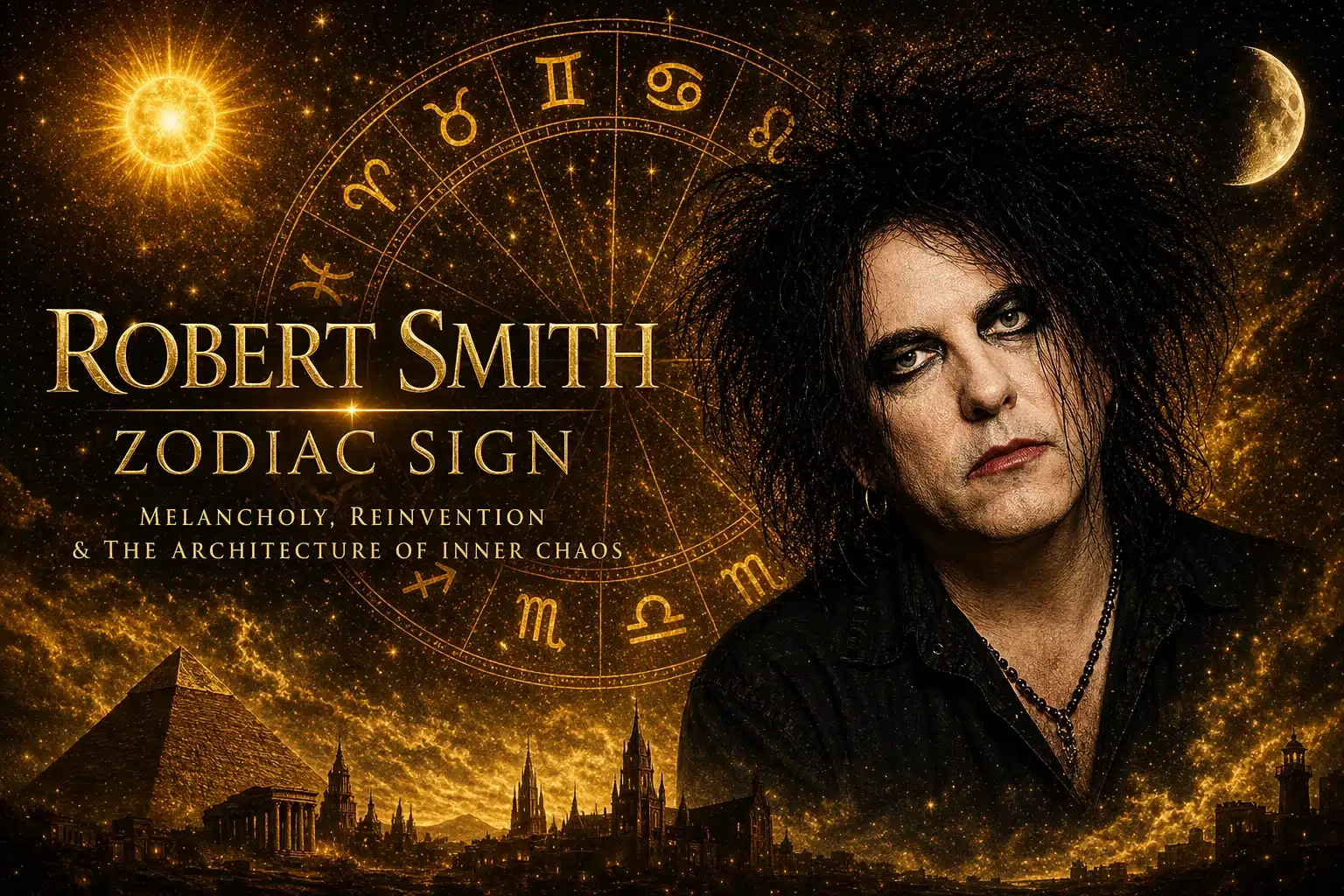
Robert Smith Zodiac Sign: Melancholy, Reinvention & the Architecture of Inner Chaos
Robert Smith built one of rock’s most enduring personas on melancholy and makeup. But beneath the smudged eyeliner and the soaring guitar lies an astrological signature that refuses to be reduced to “sad Taurus” — one shaped by elegance, inner tension, and the quiet need to keep evolving.
🌙 Libra Moon
🦁 Leo Ascendant (estimated)
📍 Blackpool, 1959
Published: April 2026 · Updated for transits through 2027
Between Stone and Storm
Robert Smith is often perceived through style, atmosphere, and musical mythology. Yet the deeper symbolic pattern suggests something more structured beneath the image: a personality built to endure, but inwardly compelled to mutate.
That paradox helps explain why his career has never been just one thing. The Cure’s official biography traces a continuous line from the band’s formation in 1976 through decades of changing line-ups, sounds, and eras, with Robert Smith remaining the unmistakable centre of gravity. This is one of the clearest real-world expressions of a fixed-sign legacy pattern: continuity without stasis.
Through the ZodiacRoots 8 Roots method, Robert Smith’s symbolism points not just to melancholy, but to elegance under pressure — a chart that builds structures strong enough to survive, then quietly revises them from within.
Birth Data & Methodology Note
For this reading, the known birth data is:
- Date: April 21, 1959
- Place: Blackpool, United Kingdom
- Time: no exact recorded birth time provided, so this reading uses 12:00 as a working estimate
This means the Ascendant and houses are provisional. They can still be used symbolically, but they should not be treated as fully time-verified in the same way as the Sun sign, Moon sign, and the ancestral roots.
Who Is Robert Smith Beyond the Public Image?
Robert Smith’s chart does not describe someone who simply “feels deeply.” It describes someone who organises feeling. That distinction matters. The public image may look dishevelled, romantic, or dreamlike, but the symbolic structure beneath it is unusually disciplined.
The Rock & Roll Hall of Fame recognises the same paradox in cultural language: Smith’s work combines emotional darkness, theatrical style, and long-term artistic coherence in a way that helped define multiple generations of alternative music. He is not simply expressive. He is architectonic.
Point 1, “Executive Summary,” Robert Smith’s ZodiacRoots Premium Report.
What Robert Smith Zodiac Sign Reveals in the 8 Roots System
- 🐂 Solar (Western): Taurus
- ⚖️ Lunar (Moon): Libra
- 🦁 Ascendant: Leo (estimated)
- 🌾 Vedic (Rashi): Virgo
- 🐖 Chinese Zodiac: Pig
- 🜃 Mayan Seal: Kab’an
- 🌿 Celtic Tree: Willow
- 𓅃 Egyptian Guardian: Horus
This is one of those profiles where the roots reinforce each other rather than cancel each other out. Taurus gives continuity, Libra gives elegance, Virgo adds refinement, Pig softens the harder edges, Willow deepens the emotional weather, Horus raises the symbolic altitude, and Kab’an becomes the destabilising inner current that stops the whole structure from turning static.
Most revealing root: Kab’an — the sign that turns emotional atmosphere into evolutionary pressure, and helps explain why Robert Smith’s work so often feels like preservation and transformation happening at the same time.
The Core Triad: Taurus, Libra & Leo
The Taurus Sun gives Robert Smith a deep instinct for substance, repetition, and durability. Taurus is not interested in novelty for its own sake. It prefers forms that can survive weather, time, and pressure. In a public chart, that often produces artistic longevity rather than transient brilliance.
The Libra Moon complicates the stereotype. This is not merely emotional softness. In a chart like this, the Libra Moon does not avoid conflict — it calculates when conflict serves beauty. It weighs tone, rhythm, and emotional proportion. That helps explain why the emotional world of The Cure so often feels carefully arranged rather than impulsively spilled.
The estimated Leo Ascendant adds the visible layer: image, silhouette, recognisability, myth. Even when the mood is inward or fractured, the outer presentation wants to be iconic. That is one reason the Robert Smith figure became so enduring in visual culture as well as in music.
Together, the triad points to a personality that does not merely express feeling. It shapes it, stylises it, protects it, and then places it before the world in a form that can last.
How the Chart Shows Up in Robert Smith’s Real Career
The chart becomes more convincing when it is tested against Robert Smith’s actual career. Taurus is visible in sheer durability: The Cure’s official history begins in 1976, and Robert Smith remains the defining creative axis across nearly five decades of sound, personnel shifts, touring cycles, and cultural reclassification.
Virgo’s precision and self-editing are just as visible. By the time of Seventeen Seconds in 1980, the band’s atmosphere had sharpened into something colder, more distilled, and more exacting. The single “A Forest” helped mark that shift. Symbolically, this looks less like chaos and more like technical curation: mood treated as craft.
Then there is Disintegration. In a 2019 Rolling Stone interview, Robert Smith described the atmosphere around the album as “somber.” That one word captures the chart beautifully: not just sadness, but atmosphere given form. Taurus supplies substance, Libra gives beauty, and Willow absorbs emotional weather until it becomes art.
More recently, Songs of a Lost World became The Cure’s first studio album of new material in 16 years, released on 1 November 2024. The project carried an unmistakable late-period gravity and became the band’s first UK No. 1 album in 32 years. That is exactly the kind of moment where legacy and reinvention stop being abstract chart language and become visible biography.
Smith also said that “I Can Never Say Goodbye” was written in connection with the death of his brother, making grief, memory, and private mourning explicitly part of the album’s emotional architecture. That is where the deeper roots — Kab’an, Willow, and Horus — become especially persuasive. The work is not merely dark. It is transformational.
Even his public argument with Ticketmaster over tour fees fits the chart more closely than people might expect. In 2023, Smith publicly pressed for refunds after describing the fees as unacceptable. That looks less like random outrage than a Libra-Willow form of conflict: not aggression for its own sake, but conflict used in defence of fairness, proportion, and the bond with the audience.
Kab’an: The Engine of Reinvention
If the Taurus Sun helps explain why The Cure endure, Kab’an helps explain why they never became emotionally or symbolically static. In the Mayan system, Kab’an is Earth in movement — not superficial change, but tectonic change: slow, deep, and irreversible.
In practical terms, Kab’an behaves like a philosophical restlessness that never lets Robert Smith settle completely into what already works. Every body of work poses a further question. Every atmosphere opens toward another emotional geography. That is one reason late-period Cure releases still feel like continuation and disturbance at the same time.
Kab’an is the part of the chart that refuses to let legacy become a museum. It pushes meaning back into motion.
That deeper pressure is why the chart reads less like nostalgic self-repetition and more like a sustained negotiation between preservation and inner movement.
Love, Relationships & Communication
In relationships, the Libra Moon seeks grace, mutuality, and emotional intelligence. But the deeper roots make that gentleness more complicated than it first appears. Willow is not just emotional depth — it can behave like emotional strategy: the ability to bend, absorb, and survive intensity without becoming emotionally crude.
The result is a relational style that values beauty, fairness, and atmosphere, but may also retreat when emotional current becomes too heavy or too blunt. The challenge here is not lack of feeling. It is learning not to hide too much of it behind refinement, distance, or artistic mediation.
This is one of the chart’s quietest contradictions: the need for harmony is real, but so is the need for enough solitude to remain internally intact.
Work Style, Legacy & Public Role
Robert Smith’s symbolic pattern strongly supports a lasting creative identity. Taurus gives continuity, recognisable form, and the instinct to build something that can endure beyond trend. Virgo adds discipline, refinement, and an editorial intelligence that keeps expression from becoming careless. Leo gives mythic visibility, helping turn a private emotional world into a public image that remains instantly recognisable across decades. Horus raises the whole pattern toward vocation, suggesting not just career longevity but symbolic stature.
This is not the chart of someone who creates impulsively and leaves the rest to accident. It is the chart of someone who understands that atmosphere needs structure. That helps explain why The Cure did not remain tied to one era alone. From the colder minimalism of Seventeen Seconds to the emotional scale of Disintegration and the late-period gravity of Songs of a Lost World, the work changes in mood and emphasis without losing its unmistakable core. The identity holds even when the emotional weather shifts.
Taurus and Virgo are especially important here. Taurus preserves essence; Virgo refines essence. One holds the line, the other edits the line. In practical terms, that suggests an artist who can return to a recognisable territory without merely repeating himself. It points to curation rather than drift, authorship rather than accident, and a long creative memory that knows what belongs and what weakens the form.
Leo adds another layer: the awareness that artistic identity is also visual, performative, and culturally legible. Robert Smith’s public role was never built on voice alone. Hair, silhouette, makeup, stage presence, and emotional atmosphere became part of the same symbolic language. In astrological terms, that is exactly the kind of move Leo understands: the self becomes an emblem, and the emblem becomes inseparable from the work.
But this same strength carries a cost. A long-established form can harden into armour. When an artistic identity becomes too iconic, it risks turning into obligation. The public begins to need the symbol as much as the artist needs the work. That is where Kab’an becomes crucial. Kab’an keeps pressing from underneath, insisting that whatever survives must still move, still evolve, still remain inwardly alive. It resists turning legacy into a museum.
In Robert Smith’s case, this may be one of the central engines of the entire career: the need to preserve emotional and aesthetic continuity without becoming trapped by his own mythology. That tension helps explain the long silences, the careful returns, and the sense that each major reappearance must justify itself artistically rather than simply extend the brand. Songs of a Lost World fits this pattern especially well: not a casual return, but a late statement heavy with memory, grief, and self-awareness.
So the real professional question in this chart is not whether Robert Smith can sustain a legacy. He clearly can. The deeper question is whether the legacy can remain porous enough to let truth keep entering it. That is the challenge of Taurus permanence under Kab’an pressure: to keep the structure intact without sealing it shut.
Point 7, “Closing Affirmation,” Robert Smith’s ZodiacRoots Premium Report.
Current & Future Dynamics
For Robert Smith specifically, the 2026–2027 transits point less toward a conventional new-album cycle and more toward a redefinition of legacy. Symbolically, the chart emphasis falls on the axis between public inheritance and personal voice: the Taurus layer wants to preserve what has already become canonical, while Kab’an continues to press for movement, revision, and deeper meaning.
Because the birth time is not confirmed, any time-sensitive references to houses or the Ascendant should be read as tentative rather than definitive. Even so, the broader symbolic pattern remains clear: this period looks less like expansion for its own sake and more like a selective re-authoring of what The Cure means in its fifth decade.
In practical terms, that may show up not through maximal reinvention but through archival releases, selective touring, a more deliberate framing of past work, or a public clarification of artistic limits and intentions. After Songs of a Lost World, the real question may no longer be whether Robert Smith can still create something meaningful, but how he wants that meaning to be curated, protected, and understood from here.
The deeper message of the chart is not that everything must change. It is that the legacy may now need to be edited with the same care that once shaped the songs themselves.
Robert Smith’s 8 Roots Table
| Tradition | Root | Degrees | Position |
|---|---|---|---|
| Solar (Western) | Taurus | 0° 36′ | 10th House (estimated) |
| Lunar (Moon) | Libra | 6° 17′ | 3rd House (estimated) |
| Ascendant | Leo | 6° 02′ | 1st House (estimated) |
| Vedic (Rashi) | Virgo | 12° 00′ | 3rd House (estimated) · Hasta (pada 1) |
| Chinese Zodiac | Pig | — | 🐖 |
| Mayan Seal | Kab’an | — | Kin 57 • 5 Overtone |
| Celtic Tree | Willow | — | Apr 15 – May 12 |
| Egyptian Guardian | Horus | — | Apr 20 – May 7 |
FAQ About Robert Smith Zodiac Sign
What is Robert Smith’s zodiac sign?
Robert Smith’s Western zodiac sign is Taurus.
Is this reading fully time-verified?
No. Because no exact recorded birth time was provided, the Ascendant and houses are treated as provisional rather than definitive.
Why does Robert Smith’s chart feel more complex than “sad Taurus”?
Because the full profile combines Taurus endurance, Libra aesthetics, Virgo refinement, Kab’an reinvention, Willow emotional depth, and a likely Leo outer style.
How does the ZodiacRoots method help here?
It shows why Robert Smith cannot be reduced to one sign alone. The 8 Roots method reads the Sun, Moon, estimated Ascendant, Vedic layer, and ancestral systems together to reveal a fuller symbolic structure.
Does Your Sun Sign Tell Your Whole Story?
A single sign is only the entrance. ZodiacRoots reveals the deeper symbolic structure through all 8 Roots — including emotional pattern, ancestral signatures, and the forces shaping your life path.
Final Reading
That is the architecture of inner chaos: not collapse, but a structure strong enough to contain contradiction — and wise enough to keep revising its own blueprints. Robert Smith does not resolve the paradox. He composes through it.
Methodology note: because Robert Smith’s exact recorded birth time is not publicly confirmed, Ascendant and house-based references are treated as symbolic estimates rather than fixed chart facts.
Discover More Astrology Articles You May Like
Explore related ZodiacRoots articles selected by topic first, then completed with fresh astrology reads.