Types of Astrology: A Comparative Guide to Western, Vedic, Chinese, Mayan, Celtic, Egyptian, and Other Systems
Astrology is not one single universal system. It is a family of symbolic traditions that emerged in different regions, used different calendars and astronomical assumptions, and developed distinct interpretive goals. Some systems are chart-based and technically continuous. Others are calendrical, archetypal, reconstructive, or modern hybrids. Understanding the main types of astrology requires comparing not only symbols, but also historical depth, internal logic, practical use, and the kinds of questions each system is best suited to answer.
The main types of astrology most often discussed today include Western astrology, Vedic astrology, Chinese astrology, and a wider symbolic field that often includes Mayan, Celtic, and Egyptian systems. These are not identical traditions. Some are based on natal astronomical calculation, some on sidereal or calendrical logic, and others on modern symbolic reconstruction.
At ZodiacRoots, we use a comparative framework that draws primarily on Western, Vedic, Chinese, Mayan, Celtic, and Egyptian layers, while explicitly acknowledging that not all systems have the same historical continuity or methodological status.
In practice, the best system depends on the question being asked. Western astrology is often the clearest starting point for natal structure, Vedic astrology for sidereal and traditional depth, Chinese astrology for archetypal temperament, and symbolic systems such as Mayan, Celtic, and Egyptian for broader narrative or mythic layers.
- Technical natal systems: Western, Vedic
- Calendrical-cultural system: Chinese zodiac
- Ritual-symbolic layer: Mayan
- Modern symbolic reception: Celtic, Egyptian
- Important distinction: not all types of astrology measure the same thing
Why There Are Different Types of Astrology
The phrase types of astrology can be misleading if it suggests that all systems are merely regional variants of one underlying method. Historically, that is not the case. Astrology developed through different astronomical practices, ritual calendars, symbolic cosmologies, and philosophical frameworks.
Western astrology emerged from the interaction of Mesopotamian celestial observation, Hellenistic horoscopy, and later Arabic and European transmission. Vedic astrology developed within the Indian tradition of Jyotisha, with its own sidereal framework and interpretive priorities. Chinese astrology is more deeply tied to cyclical time, calendar culture, and archetypal year-patterns than to natal chart mechanics in the Western sense.
Different astrology systems should not be compared only by symbol. They must also be compared by structure, calculation, historical continuity, and intended use.
That is why any serious comparative article should distinguish between systems that are technically astrological, systems that are calendrical and symbolic, and systems whose modern personality use depends heavily on later reconstruction.
Timeline of Major Astrology Traditions
Before comparing the main types of astrology in detail, it helps to see when these traditions emerged, formalized, or entered modern symbolic use. This timeline does not suggest that all systems are equivalent or historically continuous with one another. It shows, instead, that astrology developed across very different civilizational settings, including ancient Mesopotamia, the Hellenistic Mediterranean, India, China, Mesoamerica, and later modern esoteric revival movements.
Read this timeline as historical context for the article that follows. Some traditions represent technically continuous astrological systems, while others reflect ritual calendars, symbolic reinterpretation, or later reconstruction.
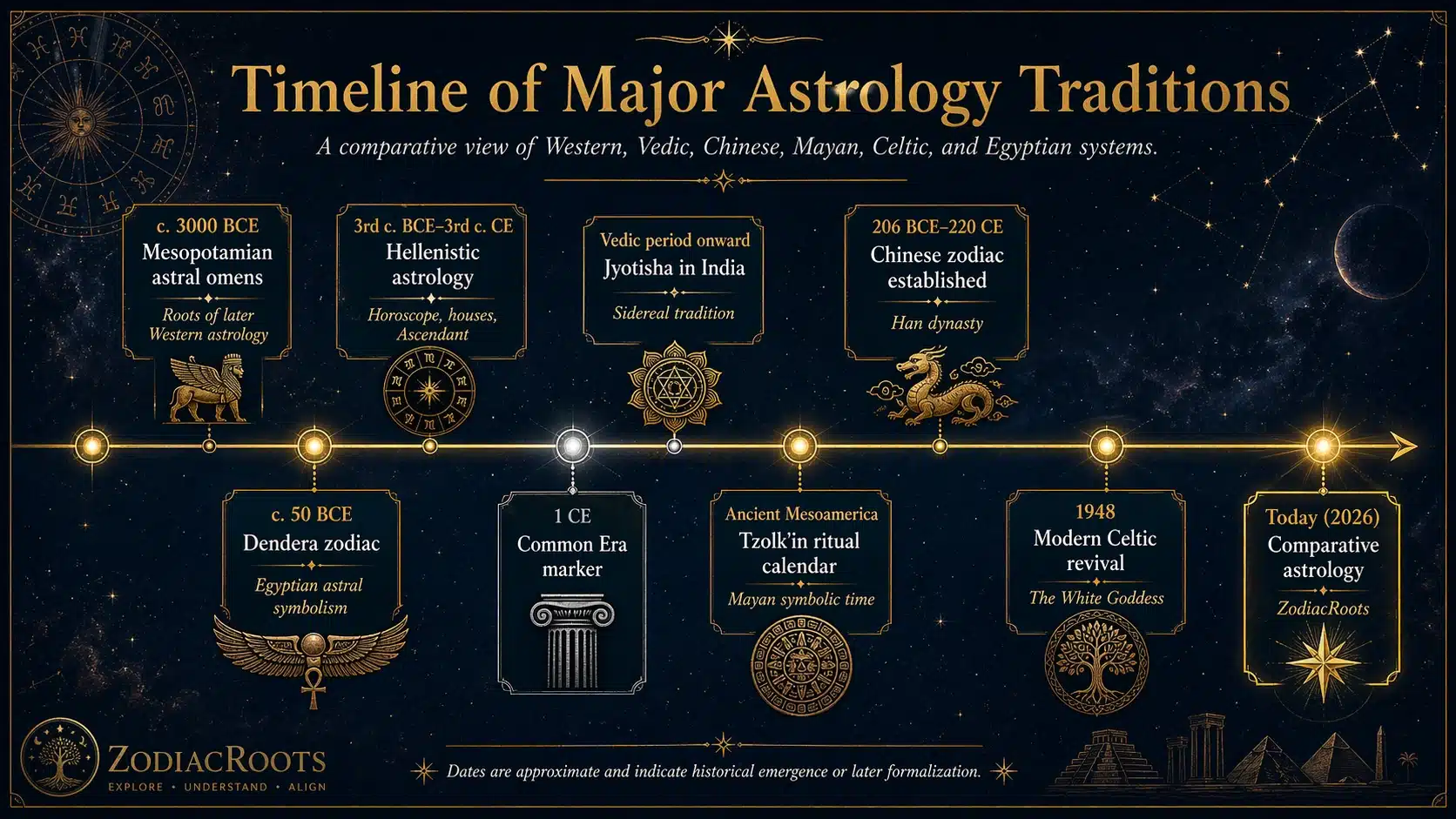
Dates are approximate and indicate historical emergence, later formalization, or modern symbolic revival.
A Comparative Overview of the Main Types of Astrology
| System | Historical Base | Main Logic | Best Use | Main Caution |
|---|---|---|---|---|
| Western Astrology | Mesopotamian + Hellenistic + later European development | Tropical natal chart, planets, houses, aspects | Identity, psychology, natal structure, relationships | Popular use often reduces it too much to Sun signs |
| Vedic Astrology | Indian Jyotisha tradition | Sidereal zodiac, Rashi, nakshatras, timing systems | Stellar orientation, karmic framing, full traditional reading | Cannot be reduced honestly to one extracted sign label |
| Chinese Astrology | Chinese calendrical and cosmological tradition | Year cycles, animals, temporal symbolism | Temperament, archetypal social style, cyclical identity | Not equivalent to a full Western natal chart |
| Mayan Astrology | Mesoamerican ritual calendar traditions | Tzolk’in cycles and symbolic day-sign logic | Symbolic identity, ritual-temporal framing | Modern personality use is an adaptation |
| Celtic Tree Astrology | Modern reception using literary and esoteric reconstruction | Date-based symbolic nature mapping | Growth metaphor, poetic developmental lens | No stable ancient technical zodiac behind most modern versions |
| Egyptian Astrology | Ancient Egyptian symbolism + later esoteric reinterpretation | Mythic deity/archetype mapping | Protective symbolism, narrative identity | Modern systems are not a continuous technical astrological lineage |
Western Astrology
Western astrology is the most globally recognizable form of astrology today. Its roots go back to Mesopotamian celestial observation, but the form most relevant to modern chart reading was systematized in the Hellenistic period, where the horoscope, houses, Ascendant, and interplanetary aspects became central.
Western astrology is particularly strong when the goal is to interpret:
- core identity and will through the Sun,
- emotional patterning through the Moon,
- social expression through the Ascendant,
- life themes through houses and aspects,
- interpersonal patterning through synastry and composite techniques.
Its main modern weakness is not internal to the system itself, but cultural: public astrology often collapses the tradition into Sun-sign shorthand, which is much thinner than full chart analysis.
For ZodiacRoots, Western astrology provides the strongest chart-structural base and remains central to any serious reading. Readers interested in that foundation can also explore our guide to astrology houses and our broader work on chart interpretation.
Vedic Astrology
Vedic astrology, or Jyotisha, is one of the most historically continuous astrology systems still in living use. It differs from most modern Western astrology in part because it relies on a sidereal zodiac aligned with fixed stars rather than a tropical zodiac aligned with seasonal reference points.
That is why one person may have one sign in a Western chart and another in a Vedic framework. The difference is not a mystical paradox but a technical consequence of using different reference systems.
Vedic astrology is especially important when discussing:
- Rashi and sidereal sign orientation,
- nakshatra-based nuance,
- timing, karma, and developmental phases,
- a chart logic that is internally complete rather than merely symbolic.
For that reason, ZodiacRoots uses Vedic astrology with caution and respect. We do not present a Vedic layer as if it could replace full Jyotisha. We use it comparatively, especially through the Rashi, while making clear that extraction is not equivalence. Our dedicated page on Vedic astrology goes deeper into that distinction.
Chinese Astrology
Chinese astrology is often encountered through the 12 zodiac animals, but that popular presentation only captures part of its broader cosmological and calendrical context. Unlike Western natal astrology, Chinese astrology is less centered on a single individualized planetary chart and more on cycles of time, patterned symbolism, and inherited archetypal rhythm.
In comparative work, Chinese astrology is especially useful for describing:
- social temperament,
- archetypal style,
- broad inherited energetic tone,
- symbolic patterns tied to cyclical identity.
It should not be confused with a full natal-chart equivalent to Western astrology. It does something different. That difference is precisely why it is valuable in synthesis: it can reveal a temperamental layer that complements chart-based systems rather than duplicating them.
Mayan Astrology
What people commonly call Mayan astrology in modern spiritual culture is usually derived from the Tzolk’in, the 260-day ritual calendar used historically in Mesoamerican ceremonial and divinatory contexts. In its original cultural setting, this was not simply a personality quiz. It was part of a broader ritual and temporal worldview.
That historical point matters. Modern interpretations of Mayan day-sign or seal identity are not identical to ancient use. They are modern symbolic adaptations of an older ritual structure.
Used carefully, the Mayan layer can still be meaningful. It is strongest when treated as:
- a symbolic identity marker,
- a ritual-temporal pattern,
- an archetypal layer that adds texture rather than false technical certainty.
At ZodiacRoots, we therefore treat the Mayan component as symbolically rich but historically non-identical to a Western-style natal technique.
Celtic Tree Astrology
Celtic tree astrology is one of the most attractive systems in modern esoteric culture because it links personality with seasonality, landscape, and natural imagery. It is also one of the systems that requires the most caution.
The main problem is historical. Most modern forms of Celtic tree astrology do not descend from a stable, continuous ancient technical zodiac in the way Western or Vedic astrology do. Much of the modern framework depends on later literary and esoteric reconstruction, especially in the 20th century.
That does not make it worthless. It changes what kind of claim can honestly be made for it.
In the ZodiacRoots framework, the Celtic layer is therefore used as a poetic and developmental anchor, not as a claim of uninterrupted ancient astrological continuity.
Egyptian Astrology
Egyptian astrology in its modern popular form usually works through deity or guardian assignment—Ra, Isis, Horus, Thoth, and related figures. Ancient Egyptian cosmology and astronomy undeniably existed, and Egyptian material was important in the broader history of astrology, especially in Hellenistic exchange. But modern “Egyptian zodiac personality systems” are not straightforward survivals of one stable priestly method.
In other words, ancient Egyptian symbolic material is real, but the modern personality system built from it is a later interpretive construct.
That makes Egyptian astrology especially useful as:
- mythic narrative framing,
- protective or sovereign archetype language,
- a symbolic amplifier of already visible psychological themes.
It is less persuasive when presented as if it were a continuous technical astrology system operating unchanged across millennia.
Tropical vs Sidereal Astrology
Any academic comparison of the main types of astrology must address the distinction between tropical and sidereal frameworks. Tropical astrology is aligned with the seasons. Sidereal astrology is aligned with the fixed stars. Because of the precession of the equinoxes, the two systems drift relative to one another.
This is one of the main reasons why Western and Vedic sign placements can differ. It is not enough to say that they “use different signs.” They use different astronomical reference frames.
From a comparative perspective, that difference matters because it shows that astrology systems are not interchangeable. They may be speaking about overlapping human reality, but they are not measuring it through identical coordinates.
A Concrete Example: How Different Astrology Systems Describe the Same Person
Comparative astrology becomes easier to understand when the same birth data is viewed through more than one system. Consider a person born on 15 August 1990. In broad popular terms, that person may be described as having a Leo Sun in Western astrology, a Cancer Rashi in Vedic astrology, and being born in the Year of the Horse in Chinese astrology.
Even before a full chart is calculated, these three systems are already emphasizing different symbolic layers:
| System | Possible Result | What It Emphasizes |
|---|---|---|
| Western astrology | Leo Sun | Visible identity, conscious style, creative self-expression |
| Vedic astrology | Cancer Rashi | Emotional orientation, inner sensitivity, alternate stellar framework |
| Chinese astrology | Horse | Temperament, social rhythm, archetypal movement and independence |
Read separately, these descriptions may seem inconsistent. Leo suggests visibility, pride, warmth, and expressive will. Cancer emphasizes protection, emotional responsiveness, and attachment to inner security. Horse symbolism adds speed, freedom, restlessness, charisma, and motion.
Read comparatively, however, the profile becomes more nuanced rather than more confused. A reader might conclude that this person presents with confidence and personal radiance, but is emotionally more protective or private than first impressions suggest. The Chinese layer then adds a temperamental pattern of movement, social energy, and resistance to confinement.
The systems are not “disagreeing” in a simple sense. They are describing different symbolic dimensions of the same life.
This example also shows why comparative astrology should be handled carefully. A Western sign is not the same kind of result as a Vedic Rashi, and neither is equivalent to a Chinese zodiac year-animal. They arise from different logics. Their value lies not in forced harmony, but in showing how identity, emotional structure, and archetypal temperament may overlap without becoming identical.
Which Types of Astrology We Use at ZodiacRoots
ZodiacRoots is built around a comparative editorial model. We primarily work with:
- Western astrology for core chart structure,
- Vedic astrology for parallel sidereal perspective,
- Chinese zodiac for archetypal temperament,
- Mayan symbolism for ritual-symbolic identity,
- Celtic tree symbolism for developmental metaphor,
- Egyptian symbolism for mythic-protective narrative.
These layers are used comparatively rather than indiscriminately. We do not claim that all six have equal historical status. Nor do we pretend they all answer the same question. The method is strongest when each system is allowed to contribute what it is best at, while its limitations remain visible.
How to Choose an Astrology System
One of the most practical questions for readers is not only what the different types of astrology are, but which system to consult for a specific purpose. The answer depends on what kind of question is being asked.
| If you want to understand… | Best system to start with | Why |
|---|---|---|
| Core personality and natal chart structure | Western astrology | It offers the clearest framework for Sun, Moon, Ascendant, houses, and planetary aspects. |
| Sidereal perspective, karmic emphasis, or traditional Indian astrology | Vedic astrology | It provides a distinct stellar framework and a fully developed traditional interpretive system. |
| Broad archetypal temperament and cyclical identity | Chinese astrology | It is especially strong for year-pattern symbolism, temperament, and social style. |
| Symbolic or ritual-temporal identity | Mayan astrology | It is useful when the reader is interested in sacred timing and symbolic day-sign logic. |
| Developmental metaphor, poetic symbolism, or nature-linked reflection | Celtic tree astrology | It works best as a symbolic growth language rather than a strict technical chart system. |
| Mythic pattern, protective symbolism, or deity-based narrative framing | Egyptian astrology | It adds narrative depth and archetypal emphasis rather than technical natal precision. |
| A layered view that compares several symbolic traditions at once | A comparative framework such as ZodiacRoots | It is useful when one system alone feels too narrow and the reader wants structured comparison. |
In practical terms, a reader who wants a technically grounded natal reading should usually begin with Western or Vedic astrology, depending on whether the preferred framework is tropical or sidereal. A reader who is more interested in symbolic archetypes, inherited temperament, or mythic pattern may find Chinese, Mayan, Celtic, or Egyptian systems more resonant.
The most balanced approach is often sequential rather than competitive: begin with the system most suited to the question, then compare it with another system only if that comparison adds real explanatory value.
Types of Astrology We Do Not Currently Use
A serious comparative platform should also say clearly which systems it does not currently use as part of its main framework.
BaZi / Four Pillars
BaZi is a major Chinese metaphysical system with its own technical depth and should not be confused with the simpler 12-animal zodiac familiar to most Western audiences. ZodiacRoots does not currently integrate full BaZi analysis into its main method because it requires a more specialized technical framework than our present comparative model.
Hellenistic astrology as a distinct separate practice
Western astrology at ZodiacRoots is informed by that lineage, but we do not currently present full traditional Hellenistic technique as a separate public methodology with its own complete reconstruction apparatus.
Arabic / Persian astrological branches as stand-alone systems
These traditions are historically crucial in the transmission of astrology, but they are not currently treated by ZodiacRoots as separate consumer-facing layers in the same way as our six main symbolic systems.
Uranian or Hamburg School astrology
Because of its specialized technical logic and very different interpretive apparatus, this is outside the present ZodiacRoots framework.
Locational astrology / astrocartography as a core layer
We recognize its relevance, but it is not currently one of the foundational symbolic layers in the ZodiacRoots model.
Non-astrological symbolic systems
Numerology, tarot, and Human Design may be interesting in comparative spiritual culture, but they are not astrology systems in the strict sense and are not part of the core ZodiacRoots interpretive structure.
This boundary matters. It shows that the site is not trying to absorb every symbolic system into one indiscriminate catalogue. Editorial restraint is part of credibility.
Methodological Limits in Comparative Astrology
Comparative astrology becomes weak when it does any of the following:
- treats all systems as historically identical,
- uses reconstructed systems as if they were continuous technical traditions,
- ignores the difference between natal calculation and symbolic assignment,
- confuses cultural borrowing with methodological rigor,
- turns contradiction into vague generalization instead of structured interpretation.
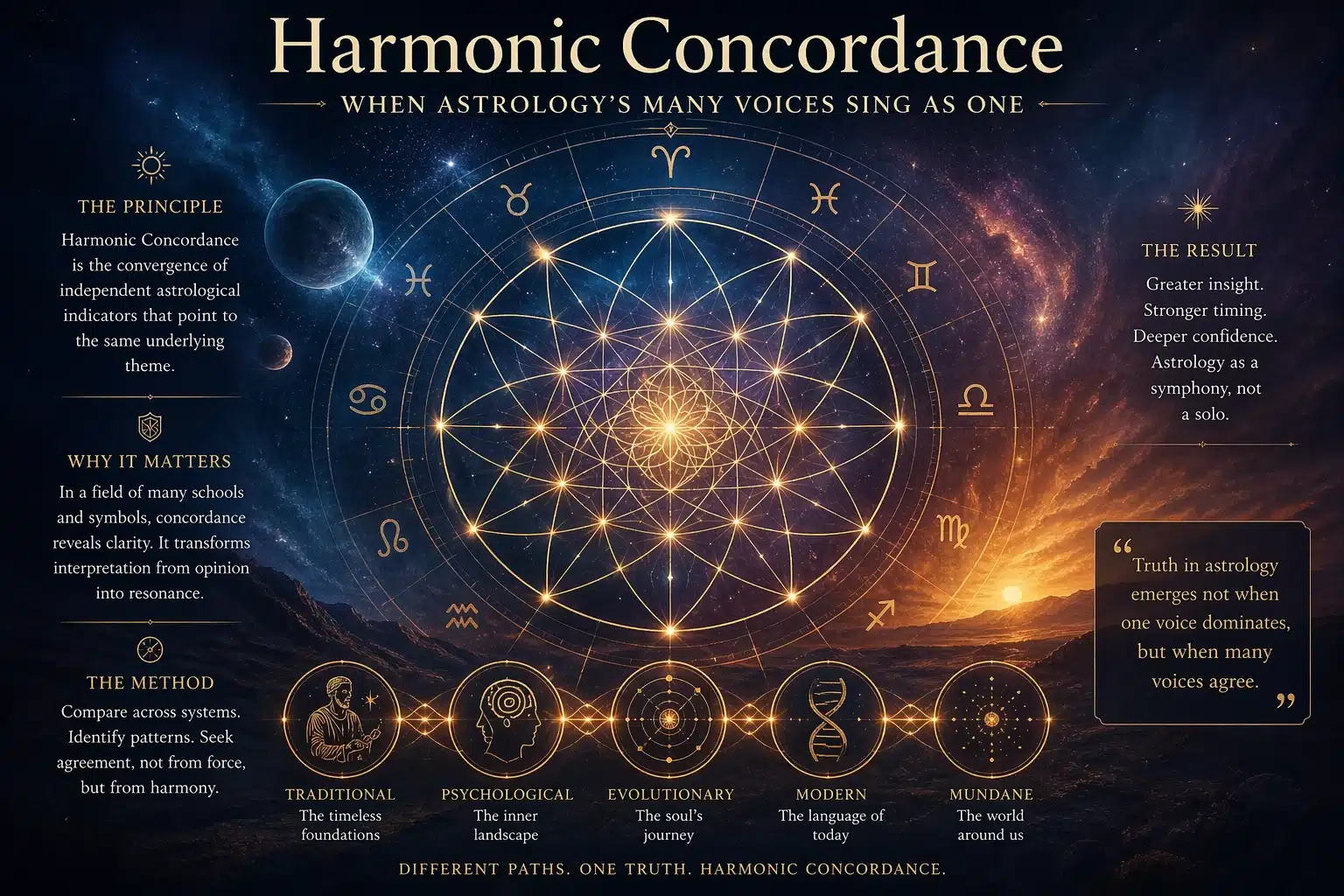
At the same time, comparison can be intellectually useful when it clarifies differences rather than hiding them. A responsible comparative model does not merge systems into sameness. It stages them side by side and asks what each one can validly contribute.
Ethical and Cultural Questions
Any article on the various types of astrology should acknowledge that symbolic reuse is not culturally neutral. Some systems emerged within ritual, sacred, or highly contextual traditions. When they are converted into modern personality language, something changes.
That is especially true for Mayan and Egyptian symbolic material, and to a lesser extent for reconstructed Celtic frameworks. The question is not simply whether modern readers “like” the symbolism. The question is whether a modern synthesis can remain transparent about what is historical, what is reconstructed, and what is editorial adaptation.
A comparative framework becomes more defensible when it distinguishes origin from interpretation and continuity from reinvention.
That is the standard ZodiacRoots tries to follow. It does not eliminate every ethical tension, but it does make the method more honest.
Conclusion
The main types of astrology are not all doing the same thing. Western astrology, Vedic astrology, Chinese astrology, Mayan symbolism, Celtic tree frameworks, and Egyptian archetypal systems each belong to different historical and symbolic environments. Some are technical natal systems. Some are calendrical. Some are reconstructive symbolic models. That difference should not be blurred.
A strong comparative approach begins by respecting those differences. It asks what each system is for, what sort of claim it can legitimately make, and how far modern synthesis can go without collapsing into confusion.
ZodiacRoots uses that comparative principle to build a more layered interpretive framework. But the framework only works when its boundaries are made explicit: what we use, what we do not use, what is chart-based, what is symbolic, and what remains historically contested.
FAQ
What are the main types of astrology?
The main types of astrology most often discussed today include Western astrology, Vedic astrology, Chinese astrology, and wider symbolic systems such as Mayan, Celtic, and Egyptian astrology or astrology-inspired frameworks.
Are all astrology systems equally historical?
No. Western and Vedic astrology have deep technical continuity. Chinese astrology has strong calendrical and cultural continuity. Mayan, Celtic, and Egyptian personality-facing systems require more caution because modern uses often involve reinterpretation or reconstruction.
What is the difference between Western and Vedic astrology?
Western astrology generally uses the tropical zodiac, while Vedic astrology uses the sidereal zodiac. This changes the reference frame and often produces different sign placements.
Is Chinese astrology the same as a Western birth chart?
No. Chinese astrology works much more through cyclical and calendrical symbolism than through the same natal planetary chart structure used in Western astrology.
Is Mayan astrology historically a personality system?
Not in the simple modern sense. The historical calendar is real, but modern personality-facing uses are an adaptation of ritual and divinatory structures.
Is Celtic tree astrology an ancient zodiac?
Not as a single, stable, technically continuous zodiac in the same way as Western or Vedic astrology. Most modern Celtic tree systems depend heavily on later reception and reconstruction.
Does ZodiacRoots use every type of astrology?
No. ZodiacRoots uses a defined comparative set of systems and also states clearly which systems are not currently part of its core method, such as full BaZi or astrocartography.
Why include systems that are partly reconstructive?
Because reconstructive systems can still be symbolically meaningful when used honestly and with explicit limits. The problem begins when reconstruction is presented as uninterrupted historical certainty.
Can different astrology systems contradict each other?
Yes. Different systems often measure different symbolic dimensions, use different calendars, or rely on different reference frames. Contradiction does not automatically mean failure.
Is astrology scientific?
No. Astrology is a symbolic and interpretive field rather than an empirically validated scientific discipline in the modern sense.
Selected Sources and Further Reading
The links below are included as normal editorial references and standard external links.
- Encyclopaedia Britannica — Astrology in the Hellenistic period
- Encyclopaedia Britannica — Hindu calendar
- Encyclopaedia Britannica — Chinese zodiac
- Encyclopaedia Britannica — Tzolkin and Maya calendar
- Encyclopaedia Britannica — Zodiac of Dandarah
- Robert Graves — The White Goddess, overview at Britannica
Explore Astrology Through a Comparative Lens
If you want to go beyond simplified zodiac labels, ZodiacRoots offers a comparative framework that keeps distinctions visible instead of flattening them.
Continue with our guides to Vedic astrology, Western chart structure, and compatibility systems.
Discover More Astrology Articles You May Like
Explore related ZodiacRoots articles selected by topic first, then completed with fresh astrology reads.