
Grahas in Vedic Astrology
The Grahas in Vedic astrology are the nine planetary forces that shape karma, timing, obstacles, opportunity, personality patterns and spiritual growth.
In Jyotish, Grahas are not seen only as physical planets. They are living symbolic influences that seize attention, direct experience and activate the deeper patterns of the birth chart. Through the Grahas, destiny becomes personal, timed and visible.
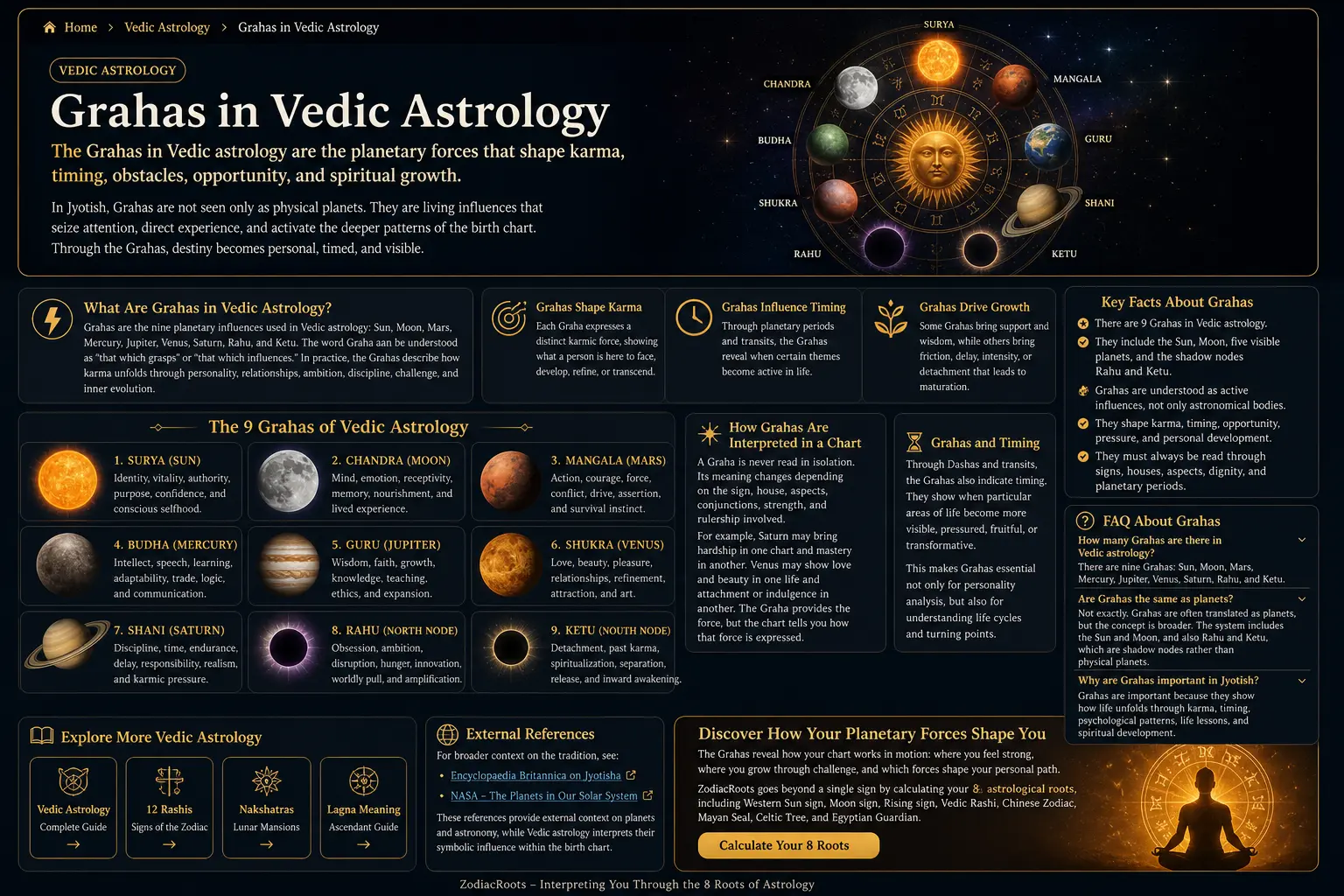
The nine Grahas — Surya, Chandra, Mangala, Budha, Guru, Shukra, Shani, Rahu and Ketu — are the core planetary forces of Jyotish.
Quick Answer: What Are Grahas in Vedic Astrology?
Grahas in Vedic astrology are the nine planetary influences used in Jyotish: Sun, Moon, Mars, Mercury, Jupiter, Venus, Saturn, Rahu and Ketu. The word Graha can be understood as “that which grasps” or “that which influences.” In practice, the Grahas describe how karma unfolds through personality, relationships, ambition, discipline, challenge, timing and inner evolution.
Grahas Shape Karma
Each Graha expresses a distinct karmic force, showing what a person is here to face, develop, refine, express or transcend.
Grahas Influence Timing
Through planetary periods, transits and chart activation, the Grahas reveal when certain themes become more visible in life.
Grahas Drive Growth
Some Grahas bring support and wisdom, while others bring friction, delay, intensity or detachment that leads to maturation.
Why the Grahas Matter
In Vedic astrology, the Grahas are central because they do more than occupy signs and houses. They actively deliver experience. Their placements show what kind of energy is strong, blocked, refined, challenged or karmically emphasised in the chart.
This is why Jyotish gives so much importance to planetary dignity, aspects, conjunctions, house rulership and Dasha periods. The Grahas are the engines through which the chart comes alive.
Grahas Are More Than Planets
Although Grahas are often translated as planets, the Vedic idea is broader. The Sun and Moon are included, and Rahu and Ketu are not physical planets at all, but powerful shadow points linked to eclipses, karma, obsession, release and spiritual redirection.
This gives the Graha system a symbolic depth that goes beyond astronomy and reaches into psychology, destiny and inner transformation.
The 9 Grahas of Vedic Astrology
Each Graha represents a distinct force in the chart, with its own symbolism, temperament, role in karmic development and way of shaping lived experience.
How Grahas Are Interpreted in a Chart
A Graha is never read in isolation. Its meaning changes depending on the sign, house, aspects, conjunctions, strength, rulership and planetary period involved.
For example, Saturn may bring hardship in one chart and mastery in another. Venus may show love and beauty in one life and attachment or indulgence in another. The Graha provides the force, but the chart tells you how that force is expressed.
Benefic, Malefic and Shadow Grahas
Vedic astrology often describes some Grahas as naturally benefic and others as naturally malefic, but these labels should not be read as simply “good” or “bad.” A benefic Graha may bring ease, support, wisdom or pleasure. A malefic Graha may bring discipline, pressure, conflict, delay or intensity. Both can support growth when understood clearly.
| Type | Grahas | Meaning |
|---|---|---|
| Natural Benefics | Jupiter, Venus, Mercury, waxing Moon | Support, growth, wisdom, comfort, learning and harmony. |
| Natural Malefics | Saturn, Mars, Sun, waning Moon | Pressure, discipline, effort, heat, separation, realism and maturity. |
| Shadow Grahas | Rahu and Ketu | Desire, disruption, karmic pull, detachment, release and spiritual redirection. |
The final interpretation always depends on the full chart, including house placement, dignity, aspects, rulerships and timing.
Grahas and Karma
The Grahas help show where karma feels supportive, where it feels demanding and where life pushes growth through tension or reward.
Some placements reveal gifts carried forward. Others point to lessons that require effort, patience, humility or inner realignment.
Grahas and Timing
Through Dashas and transits, the Grahas also indicate timing. They show when particular areas of life become more visible, pressured, fruitful or transformative.
This makes Grahas essential not only for personality analysis, but also for understanding life cycles and turning points.
Key Facts About Grahas
- There are 9 Grahas in Vedic astrology.
- They include the Sun, Moon, five visible planets, and the shadow nodes Rahu and Ketu.
- Grahas are understood as active influences, not only astronomical bodies.
- They shape karma, timing, opportunity, pressure, relationships and personal development.
- They must always be read through signs, houses, aspects, dignity and planetary periods.
- Rahu and Ketu are especially important for understanding desire, release, eclipses and karmic redirection.
Grahas in the ZodiacRoots 8 Roots Method
At ZodiacRoots, the Grahas are not treated as isolated symbols. They help explain how the wider 8 Roots profile becomes active through timing, temperament and lived experience. Your Western Sun sign, Moon sign, Rising sign and Vedic Rashi describe key identity layers, while the Grahas show how those layers are energised, challenged or refined.
This is especially important when combining Western, Vedic, Chinese, Mayan, Celtic and Egyptian symbolism. The 8 Roots method gives the broader symbolic map; the Grahas help reveal which forces move that map into action.
External References for Grahas and Jyotish
For broader background on the tradition, see the Encyclopaedia Britannica overview of Jyotisha. For the astronomical context of planetary bodies, see NASA’s guide to the planets in our solar system.
These references provide external context on astronomy and tradition, while ZodiacRoots interprets the Grahas as symbolic forces within the birth chart and the wider 8 Roots framework.
FAQ About Grahas in Vedic Astrology
What are Grahas in Vedic astrology?
Grahas are the nine planetary influences used in Vedic astrology. They describe how karma, timing, personality, opportunity, pressure and spiritual development become active in the birth chart.
How many Grahas are there in Vedic astrology?
There are nine Grahas: Surya, Chandra, Mangala, Budha, Guru, Shukra, Shani, Rahu and Ketu. In English, these correspond to Sun, Moon, Mars, Mercury, Jupiter, Venus, Saturn, North Node and South Node.
Are Grahas the same as planets?
Not exactly. Grahas are often translated as planets, but the concept is broader. The system includes the Sun and Moon, as well as Rahu and Ketu, which are shadow nodes rather than physical planets.
What does the word Graha mean?
Graha can be understood as “that which grasps” or “that which influences.” This meaning is important because Grahas are seen as active forces that seize attention and shape experience.
Why are Rahu and Ketu included as Grahas?
Rahu and Ketu are included because they are powerful karmic points linked with eclipses, desire, disruption, detachment, past patterns and spiritual redirection. They are not physical planets, but their symbolic importance in Jyotish is very strong.
Why are Grahas important in Jyotish?
Grahas are important because they show how life unfolds through karma, timing, psychological patterns, life lessons, relationships and spiritual development.
How are Grahas read in a birth chart?
Grahas are read through their sign, house, dignity, aspects, conjunctions, rulerships, strength and planetary periods. Their meaning depends on the full chart, not on the planet alone.
Explore More Vedic Astrology
Continue exploring how the Grahas connect with signs, houses, lunar mansions and the wider Vedic chart:
Discover How Your Planetary Forces Shape You
The Grahas reveal how your chart works in motion: where you feel strong, where you grow through challenge, and which forces shape your personal path.
ZodiacRoots goes beyond a single sign by calculating your 8 astrological roots, including Western Sun sign, Moon sign, Rising sign, Vedic Rashi, Chinese Zodiac, Mayan Seal, Celtic Tree and Egyptian Guardian.
Calculate Your 8 Roots