
What Do Planets in Astrology Mean?
Planets in astrology are symbolic actors. Each one describes a different layer of human experience: the Sun shows identity, the Moon shows emotion, Mercury shows communication, Venus shows love, Mars shows action, Jupiter shows growth, Saturn shows structure, Uranus shows change, Neptune shows dreams and Pluto shows transformation.
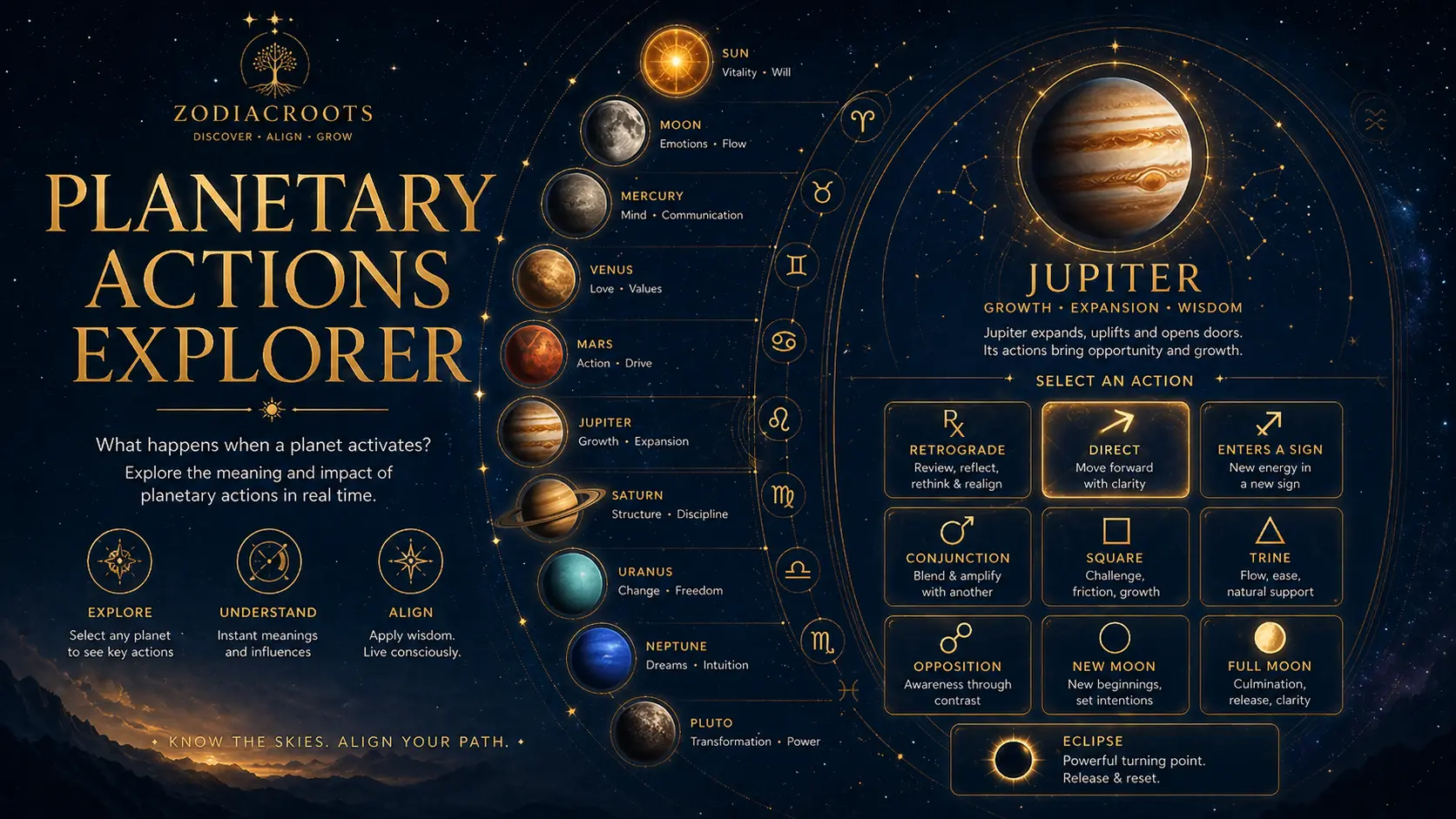
The meaning of planets in astrology becomes clearer when you look at what the planet is doing. A planet can enter a sign, go retrograde, turn direct, form a conjunction, square, trine or opposition, or become part of a New Moon, Full Moon or eclipse.
That is why ZodiacRoots created the Planetary Actions Explorer. It helps you understand not only what each planet means, but also what happens when that planet becomes active through movement, timing or aspect.
This page is part of Astrology Fundamentals. It is designed as a practical reference for beginners and intermediate readers who want a clear, visual and searchable explanation of planet meanings in astrology.
Planets in Astrology: Quick Answer
In simple terms, planets in astrology describe different parts of life and personality. The planet tells you the theme. The sign tells you the style. The action tells you what is happening.
| Planet | Core Meaning | Life Area |
|---|---|---|
| Sun | Identity, vitality and purpose. | Self-expression and direction. |
| Moon | Emotion, instinct and inner needs. | Home, memory and emotional rhythm. |
| Mercury | Thought, speech and timing. | Communication, planning and learning. |
| Venus | Love, attraction and values. | Relationships, beauty and money. |
| Mars | Action, desire and conflict. | Energy, courage and assertion. |
Explore Planets in Astrology With the Planetary Actions Explorer
Use the tool below to explore planets in astrology by action. Choose a planet, then choose what it is doing: retrograde, direct, entering a sign, conjunction, square, trine, opposition, New Moon, Full Moon or eclipse.
How to Use This Interactive Astrology Tool
Select the Sun, Moon, Mercury, Venus, Mars, Jupiter, Saturn, Uranus, Neptune or Pluto. The planet tells you the main life theme.
Select what the planet is doing: retrograde, direct, square, trine, opposition, eclipse, New Moon or Full Moon.
The software shows what tends to happen, which life areas are activated, the best use of the energy and what to watch out for.
Example: choose Mercury + Retrograde to understand communication delays, review periods and timing issues. Choose Venus + Retrograde to explore love, money, values and relationship patterns.
Planetary Actions Explorer
Choose a planet, then choose an astrological action. This visual tool explains what tends to happen when a planet goes retrograde, enters a new sign, forms an aspect, or activates a major life theme.
Choose a Planet and an Action
This tool is designed to make astrology practical. Instead of memorising technical terms, you can see what each planet does, what kind of event is happening, which life areas are activated and how to work with it.
What Each Planet Usually Activates
Sun, Moon, Mercury, Venus and Mars tend to affect identity, emotion, communication, love, desire and action.
Jupiter and Saturn show growth, limits, maturity, opportunity, structure and responsibility.
Uranus, Neptune and Pluto describe longer collective cycles: disruption, dreams, dissolution, power and transformation.
How to Use This With the 2026 Astrology Calendar
Use the 2026 Astrology Calendar to see when something happens. Use this Planetary Actions Explorer to understand what it means.
For example, when the calendar says “Mercury Retrograde”, this explorer explains the practical effect: delays, revision, misunderstandings, unfinished conversations and the need to check details.
Want to Know Which Planet Matters Most in Your Chart?
A planetary action affects everyone collectively, but it becomes personal when it touches your Sun, Moon, Ascendant or deeper ZodiacRoots structure. Discover your 8 Roots and explore the full pattern of your chart.
Planet Meanings in Astrology
The following guide explains the main planets in astrology used in modern Western astrology. The Sun and Moon are technically luminaries, but astrology treats them alongside the planets because they are central to chart interpretation.
Sun in Astrology
The Sun in astrology represents identity, vitality, creative force, confidence and conscious direction. It shows how you shine and what gives your life a sense of purpose.
When active: the Sun highlights visibility, leadership, confidence and self-definition.
Moon in Astrology
The Moon in astrology represents emotion, instinct, memory, attachment, family, safety and inner rhythm. It shows what you need in order to feel emotionally grounded.
When active: the Moon highlights feelings, habits, emotional reactions and the need for care.
Mercury in Astrology
Mercury in astrology represents thinking, speech, writing, learning, timing, trade, travel and daily communication. It shows how the mind processes information.
When active: Mercury highlights messages, decisions, documents, schedules and misunderstandings.
Venus in Astrology
Venus in astrology represents love, attraction, harmony, pleasure, beauty, money and personal values. It shows what you desire and what you consider worth choosing.
When active: Venus highlights relationships, attraction patterns, finances, taste and self-worth.
Mars in Astrology
Mars in astrology represents action, desire, conflict, courage, sexuality, anger and physical energy. It shows how you pursue, defend and initiate.
When active: Mars highlights urgency, confrontation, drive, motivation and decisive action.
Jupiter in Astrology
Jupiter in astrology represents growth, opportunity, optimism, faith, learning, travel, wisdom and expansion. It shows where life wants to become larger.
When active: Jupiter highlights possibility, confidence, generosity, teaching and excess.
Saturn in Astrology
Saturn in astrology represents time, structure, discipline, responsibility, limits, maturity and long-term work. It shows where growth requires patience.
When active: Saturn highlights commitment, pressure, boundaries, accountability and durable results.
Uranus in Astrology
Uranus in astrology represents change, awakening, rebellion, innovation, shock and freedom. It breaks patterns that have become too rigid.
When active: Uranus highlights disruption, liberation, invention, sudden shifts and independence.
Neptune in Astrology
Neptune in astrology represents dreams, imagination, compassion, spirituality, ideals, confusion and dissolution. It softens boundaries and opens symbolic perception.
When active: Neptune highlights intuition, inspiration, fog, fantasy, sacrifice and spiritual longing.
Pluto in Astrology
Pluto in astrology represents power, shadow, death and rebirth, control, intensity, regeneration and deep transformation. It exposes what cannot remain superficial.
When active: Pluto highlights endings, psychological truth, power dynamics and irreversible change.
What Happens When Planets in Astrology Go Retrograde, Direct or Form Aspects?
Understanding planets in astrology is only the first step. The second step is understanding planetary actions. A planet’s action describes how its meaning behaves in time.
Retrograde Planets in Astrology
Retrograde planets in astrology suggest review, delay, return, correction and internal processing. A retrograde does not mean disaster; it means the planet’s themes need revision.
Direct Planets in Astrology
When planets turn direct in astrology, movement becomes clearer. The planet’s themes begin to move forward again, although integration can still take time.
Aspects Between Planets in Astrology
Aspects show relationships between planets. A conjunction intensifies, a square creates pressure, a trine opens flow and an opposition reveals polarity.
Eclipses and Moon Cycles
New Moons begin cycles, Full Moons reveal and release, and eclipses intensify the pattern. They can make planetary meanings feel more urgent or fated.
How to Use Planets in Astrology in Real Life
To use planets in astrology in a practical way, combine three layers: planet, sign and action.
The planet tells you the theme: emotion, love, action, growth, discipline, change or transformation.
The sign tells you the style: bold, practical, emotional, intellectual, intense, structured or visionary.
The action tells you what is happening: beginning, review, pressure, flow, culmination or reset.
Continue Exploring Planets in Astrology
These ZodiacRoots guides help you connect planets in astrology with signs, Moon cycles, daily horoscopes and your full 8 Roots profile.
Planets in Astrology and Astronomy: A Clear Difference
Astronomy and astrology use some of the same sky language, but they are not the same discipline. Astronomy studies physical celestial bodies. Astrology interprets celestial patterns symbolically. When this page discusses planets in astrology, it is discussing symbolic meaning, not physical causation.
For astronomical background, you can read NASA’s guide to the planets and NASA’s explanation of eclipses. For broader cultural context, Britannica’s pages on astrology and the zodiac are useful references.
ZodiacRoots uses planets, signs and timing as symbolic tools for reflection, pattern recognition and personal interpretation.
FAQ About Planets in Astrology
What do planets in astrology mean?
Planets in astrology describe symbolic life themes. The Sun relates to identity, the Moon to emotion, Mercury to communication, Venus to love, Mars to action, Jupiter to growth, Saturn to structure, Uranus to change, Neptune to dreams and Pluto to transformation.
What are the planet meanings in astrology?
The main planet meanings in astrology are: Sun for identity, Moon for emotion, Mercury for communication, Venus for love and values, Mars for action, Jupiter for growth, Saturn for discipline, Uranus for change, Neptune for imagination and Pluto for transformation.
What does the Planetary Actions Explorer do?
The Planetary Actions Explorer is an interactive astrology tool that helps you understand planets in astrology by combining two choices: the planet and the action. You choose a planet such as Mercury, Venus, Mars or Saturn, then choose what it is doing, such as retrograde, direct, square, trine, opposition, New Moon, Full Moon or eclipse. The tool then explains the likely meaning, life areas involved, best use and what to watch out for.
How do I use the interactive planets in astrology tool?
Start by selecting a planet. Then select an action. For example, choose Mercury and Retrograde to understand communication delays, review periods and timing issues. Choose Venus and Retrograde to explore relationship patterns, values and money questions. The tool gives a practical explanation instead of only showing technical astrology terms.
Is the Planetary Actions Explorer a birth chart calculator?
No. The Planetary Actions Explorer is not a full birth chart calculator. It is a learning tool that explains what planets in astrology usually mean when they become active. For a personal chart reading, use the ZodiacRoots 8 Roots calculator or the Premium Report.
What is the most important planet in astrology?
The Sun and Moon are usually the most immediately important because they describe identity and emotional needs. However, the most important planet in astrology depends on the full birth chart, including the Ascendant, chart ruler, aspects, houses and repeated planetary emphasis.
What do retrograde planets in astrology mean?
Retrograde planets in astrology usually point to review, revision, delay, return and internal processing. A retrograde does not mean disaster. It means the planet’s themes need to be revisited, clarified or corrected before moving forward.
What are personal planets in astrology?
The personal planets in astrology are usually the Sun, Moon, Mercury, Venus and Mars. They describe identity, emotion, thinking, love, attraction, desire, anger, motivation and direct action.
What are social planets in astrology?
The social planets in astrology are Jupiter and Saturn. Jupiter describes growth, opportunity, faith and expansion. Saturn describes discipline, limits, maturity, structure and responsibility.
What are outer planets in astrology?
The outer planets in astrology are Uranus, Neptune and Pluto. They move slowly and describe larger cycles of change, imagination, dissolution, power and transformation. Their effects often feel generational, but they become personal when they strongly connect to your birth chart.
What are ruling planets in astrology?
Ruling planets in astrology connect each zodiac sign to a planetary principle. For example, Mars rules Aries, Venus rules Taurus and Libra, Mercury rules Gemini and Virgo, the Moon rules Cancer, the Sun rules Leo, Jupiter rules Sagittarius, Saturn rules Capricorn, Uranus is linked with Aquarius, Neptune with Pisces and Pluto with Scorpio in modern astrology.
What is the difference between planets and signs in astrology?
Planets describe what part of life is active. Signs describe how that energy behaves. For example, Mercury shows communication and thinking, while Mercury in Aries communicates directly and quickly, and Mercury in Pisces communicates more intuitively or emotionally.
What do aspects between planets mean in astrology?
Aspects between planets in astrology show how planetary energies interact. A conjunction intensifies, a square creates pressure, a trine suggests flow, and an opposition reveals polarity or tension between two life themes.
How do I know which planet affects me most?
The planet that affects you most depends on your birth chart. Important clues include your Sun, Moon, Ascendant, chart ruler, planets close to angles, repeated aspects and planets connected to major life themes.
How is this different from a daily horoscope?
A daily horoscope gives a short interpretation for your sign. A guide to planets in astrology explains the symbolic building blocks behind those interpretations, helping you understand why certain themes appear in love, career, emotions, timing and personal growth.
Which Planet Is Most Active in Your Chart?
Understanding planets in astrology is only the entrance. Your real pattern appears when the planets are read through your Sun, Moon, Ascendant and full ZodiacRoots 8 Roots structure.