
Vedic Astrology Chart: Rashi, Nakshatra, Grahas and Sade Sati Guide
A Vedic astrology chart reads birth data through the sidereal zodiac, the Moon’s Nakshatra, planetary Grahas, houses, Rahu and Ketu, and timing factors such as Sade Sati. It is one of the most technical and symbolically layered systems in the ZodiacRoots framework.
At ZodiacRoots, Vedic astrology is used as one of the deeper roots inside the 8 Roots method. It does not replace Western astrology; it adds a lunar, sidereal and karmic layer that can reveal emotional instinct, destiny patterns, inner maturity and spiritual orientation.
This guide explains the fields you may see in a Vedic chart result: Rashi, Nakshatra, Pada, Ayanamsha, whole sign houses, mean nodes, Grahas and Sade Sati.
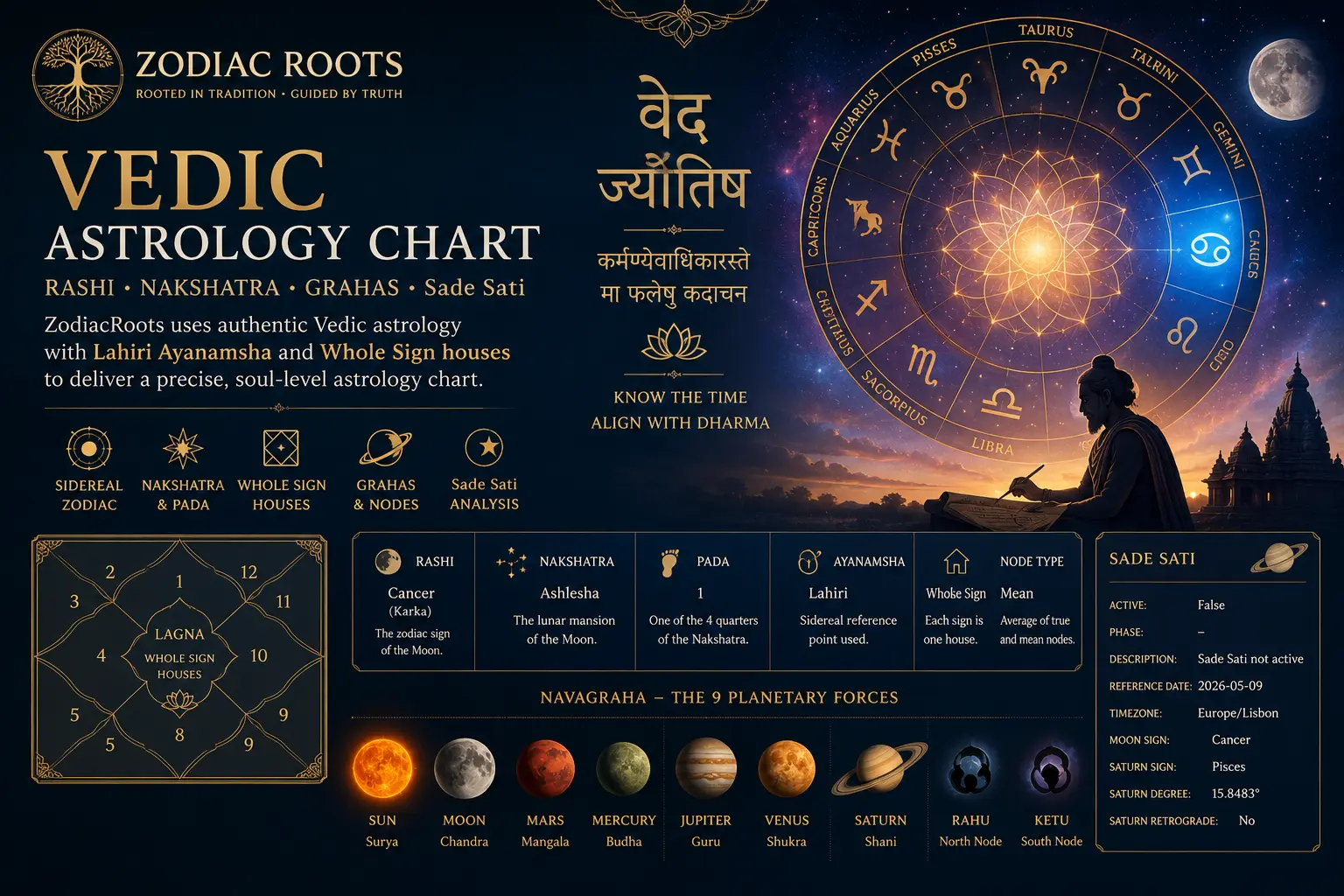
Quick Answer: What Is a Vedic Astrology Chart?
A Vedic astrology chart, also called a Jyotish chart, maps the planets through the sidereal zodiac. It pays special attention to the Moon sign, the Nakshatra, the Pada, planetary houses, Rahu and Ketu, and traditional timing patterns such as Sade Sati.
How ZodiacRoots Uses Vedic Astrology
ZodiacRoots combines Western, Vedic, Chinese, Mayan, Celtic and Egyptian traditions through the 8 Roots method. The Vedic layer is especially valuable because it brings a Moon-based, sidereal and Nakshatra-oriented perspective.
In a ZodiacRoots reading, the Vedic layer may include:
| Vedic field | Example value | How to read it |
|---|---|---|
| Rashi | Cancer | The sidereal sign. If this is the Moon sign, it describes emotional instinct and inner security needs. |
| Nakshatra | Ashlesha | The lunar mansion. It adds symbolic detail, mythic tone and psychological nuance. |
| Pada | 1 | The subdivision of the Nakshatra. It refines expression and orientation. |
| Ayanamsha | Lahiri | The sidereal correction used to convert from tropical to sidereal zodiac positions. |
| House system | Whole sign | Each zodiac sign becomes one whole house. This is a common Vedic-style approach. |
| Node type | Mean | The method used for Rahu and Ketu calculation. Nodes can be calculated as mean or true. |
| Sade Sati | Active: false | Shows whether Saturn is currently transiting the sign before, over or after the natal Moon sign. |
Example Vedic Chart Snapshot
The following example shows how a technical Vedic chart can be translated into readable layers. This is the kind of data structure ZodiacRoots can use inside a premium report.
Vedic Planets / Grahas Explained
The Grahas are not just astronomical planets. In Vedic astrology they are symbolic forces that “grasp” or influence human experience. Their sign, degree, house, Nakshatra, Pada and retrograde status all matter.
| Graha | Example position | House | Nakshatra | Reading emphasis |
|---|---|---|---|---|
| Sun | Scorpio 22.1485° | 12 | Jyeshtha · Pada 2 | Identity works through depth, withdrawal, hidden power, spiritual privacy and inner authority. |
| Moon | Cancer 17.7586° | 8 | Ashlesha · Pada 1 | Emotional life is intuitive, protective, intense and deeply aware of unseen bonds. |
| Mars | Leo 13.9711° | 9 | Purva Phalguni · Pada 1 | Drive expresses through conviction, creativity, belief, visibility and personal pride. |
| Mercury | Scorpio 1.5838° | 12 | Vishakha · Pada 4 | Mind becomes investigative, private, strategic and drawn to hidden knowledge. |
| Jupiter | Leo 16.1418° | 9 | Purva Phalguni · Pada 1 | Wisdom grows through teaching, faith, generosity, creativity and broad life philosophy. |
| Venus | Sagittarius 18.6491° | 1 | Purva Ashadha · Pada 2 | Attraction, style and affection are visible, idealistic, expansive and truth-seeking. |
| Saturn | Virgo 2.6636° | 10 | Uttara Phalguni · Pada 2 | Discipline, work and responsibility are tied to service, competence, structure and public duty. |
| Rahu | Leo 9.5698° | 9 | Magha · Pada 3 | Karmic appetite moves toward recognition, lineage, authority, belief and high visibility. |
| Ketu | Aquarius 9.5698° | 3 | Shatabhisha · Pada 1 | Karmic release concerns detached thinking, networks, technical distance and old mental patterns. |
Interactive Vedic Astrology Decoder
Select a Vedic chart concept to understand how ZodiacRoots reads each technical field inside a premium interpretation.
Rahu and Ketu
Rahu and Ketu are the lunar nodes. They are not physical planets, but they are central in Vedic astrology because they describe karmic appetite and karmic release. Rahu pulls consciousness toward hunger, ambition, novelty and unfinished desire. Ketu points toward detachment, past mastery, disinterest or spiritual release.
Sade Sati
Sade Sati is a traditional Vedic timing cycle that occurs when Saturn transits the sign before the natal Moon sign, the Moon sign itself, and the sign after the Moon. It is often interpreted as a period of maturity, pressure, responsibility and emotional restructuring.
How to Read the Example Chart as a Whole
The example chart has a Cancer Vedic Moon in Ashlesha Pada 1 in the 8th house. This immediately places emotional life in a deep, protective and psychologically intense field. Cancer seeks safety and belonging; Ashlesha detects hidden bonds; the 8th house adds transformation, inheritance, secrecy and emotional contracts.
The Sun and Mercury in Scorpio in the 12th house reinforce the hidden, private and investigative tone. The person may process identity and thought through solitude, deep research, symbolic perception or spiritual retreat. Mars, Jupiter and Rahu in Leo in the 9th house add fire, belief, visibility and a strong call toward meaning, teaching, leadership or personal philosophy.
Venus in Sagittarius in the 1st house gives a more open, idealistic and expressive face to the chart. Saturn in Virgo in the 10th house adds a serious work signature: responsibility, service, technical refinement and public competence.
Vedic Astrology in the 8 Roots Method
Vedic astrology is one root within the ZodiacRoots system. It gives a different lens from Western astrology because it uses the sidereal zodiac and pays special attention to the Moon, Nakshatra, planetary dignity, karmic nodes and timing cycles.
When combined with Western Sun, Moon and Ascendant, Chinese BaZi, Mayan Seal, Celtic Tree and Egyptian Guardian, the Vedic layer helps answer a different question: not only “what is your personality?”, but “what is the inner rhythm, karmic weather and emotional architecture of your chart?”
Want your Vedic layer inside a full 8 Roots reading?
Use the ZodiacRoots calculator to generate your 8 Roots foundation, then explore the Premium Report for a deeper synthesis of Western, Vedic, Chinese / BaZi, Mayan, Celtic and Egyptian symbolism.
Vedic Astrology Chart: Direct Answers
Short definition: A Vedic astrology chart is a sidereal birth chart used in Jyotish to interpret the Moon, Grahas, Rashi signs, Nakshatras, houses, Rahu, Ketu and timing cycles.
Main difference from Western astrology: Vedic astrology usually uses the sidereal zodiac and gives special importance to the Moon, Nakshatra and planetary timing. Western astrology usually uses the tropical zodiac and often places more emphasis on psychological identity and aspects.
How ZodiacRoots uses it: ZodiacRoots treats the Vedic astrology chart as one layer of the 8 Roots method, combining it with Western, Chinese, Mayan, Celtic and Egyptian symbolic systems.
Vedic Astrology Chart FAQ
What is a Vedic astrology chart?
A Vedic astrology chart is a sidereal birth chart used in Jyotish. It maps the Grahas, Rashi signs, houses, Nakshatras, Padas, Rahu, Ketu and timing factors such as Sade Sati. ZodiacRoots reads it as a symbolic framework for emotional rhythm, karmic direction and inner development.
How do you read a Vedic astrology chart?
To read a Vedic astrology chart, begin with the Moon sign, Nakshatra and Ascendant if birth time is known. Then study the Grahas by sign, house, degree, Nakshatra and Pada. Rahu, Ketu and Saturn cycles add timing and karmic emphasis, but no single factor should be read alone.
What is Rashi in a Vedic astrology chart?
Rashi means zodiac sign. In a Vedic astrology chart, Rashi usually refers to the sidereal sign rather than the tropical sign used in most Western astrology. The Moon Rashi is especially important because it describes the mind, emotional instinct and inner security pattern.
What is a Nakshatra in Vedic astrology?
A Nakshatra is a lunar mansion. There are 27 main Nakshatras in Vedic astrology, and each gives a more precise symbolic layer than the sign alone. In a Vedic astrology chart, Nakshatra can reveal instinct, motivation, temperament, emotional memory and mythic tone.
What is a Pada in a Vedic astrology chart?
A Pada is one of four subdivisions of a Nakshatra. It refines how the Nakshatra expresses itself. For example, two people may share the same Nakshatra but have different Padas, which can change the tone, direction and behavioural nuance of the placement.
What does Ayanamsha mean in Vedic astrology?
Ayanamsha is the correction used to calculate sidereal zodiac positions from tropical positions. The Lahiri Ayanamsha is one of the most widely used systems. A Vedic astrology chart should stay consistent with one Ayanamsha method so that signs, degrees and Nakshatras remain coherent.
What are Grahas in a Vedic astrology chart?
Grahas are the planetary forces used in Vedic astrology: Sun, Moon, Mars, Mercury, Jupiter, Venus, Saturn, Rahu and Ketu. They are read by sign, house, Nakshatra, Pada, degree and condition. Each Graha describes a specific life function, from emotion and action to wisdom, love and discipline.
What are Rahu and Ketu?
Rahu and Ketu are the lunar nodes. In a Vedic astrology chart, Rahu often represents appetite, ambition, fascination and future-facing growth. Ketu represents detachment, release, past mastery and spiritual separation. Together, they form a karmic axis of desire and liberation.
What is Sade Sati in Vedic astrology?
Sade Sati is a Saturn cycle measured from the natal Moon sign. It occurs when Saturn transits the sign before the Moon, the Moon sign itself and the sign after it. ZodiacRoots interprets Sade Sati as a symbolic period of maturity, responsibility, simplification and emotional restructuring.
Is a Vedic astrology chart different from a Western astrology chart?
Yes. A Vedic astrology chart usually uses the sidereal zodiac, while Western astrology usually uses the tropical zodiac. Vedic astrology gives special weight to the Moon, Nakshatras, Grahas, Rahu, Ketu and timing cycles. Western astrology often focuses more on psychological identity, aspects and tropical seasonal symbolism.
Do you need exact birth time for a Vedic astrology chart?
Exact birth time is important for houses, Ascendant and some timing techniques. Without a reliable birth time, the Moon sign and planetary signs may still be useful, but house-based interpretation should be treated carefully. ZodiacRoots always separates stable data from time-sensitive chart factors.
Does a Vedic astrology chart predict the future?
ZodiacRoots does not treat a Vedic astrology chart as fixed prediction. It is read as a symbolic timing and pattern language. It can describe tendencies, maturity cycles, pressure points and inner themes, but it should not remove personal agency or replace practical judgement.
Sources and Further Reading
This ZodiacRoots guide explains the vedic astrology chart from an educational and symbolic perspective. The interpretation is editorial, while the structural concepts are based on widely recognised Vedic astrology terminology such as Jyotish, Nakshatra, Grahas, Rahu, Ketu and Sade Sati.
General historical background on astrology as a symbolic and cultural system.
General overview of Vedic astrology, Jyotish, Grahas, houses and traditional chart concepts.
Background on the 27 lunar mansions used in a Vedic astrology chart.
Explanation of sidereal correction systems used in Vedic astrology calculations.