
he 36 Egyptian Decans: Meaning, History & Astrology
The 36 Egyptian Decans: Ancient Stars of Time, Sacred Astronomy, and the Origins of Astrological Faces
Before decans became ten-degree divisions inside the zodiac, they were Egyptian stellar powers: thirty-six stars or star groups used to measure the night, structure the year, and connect celestial observation with sacred order. This guide follows the decans from Sopdet and Orion to the later astrological tradition of the thirty-six zodiacal faces.
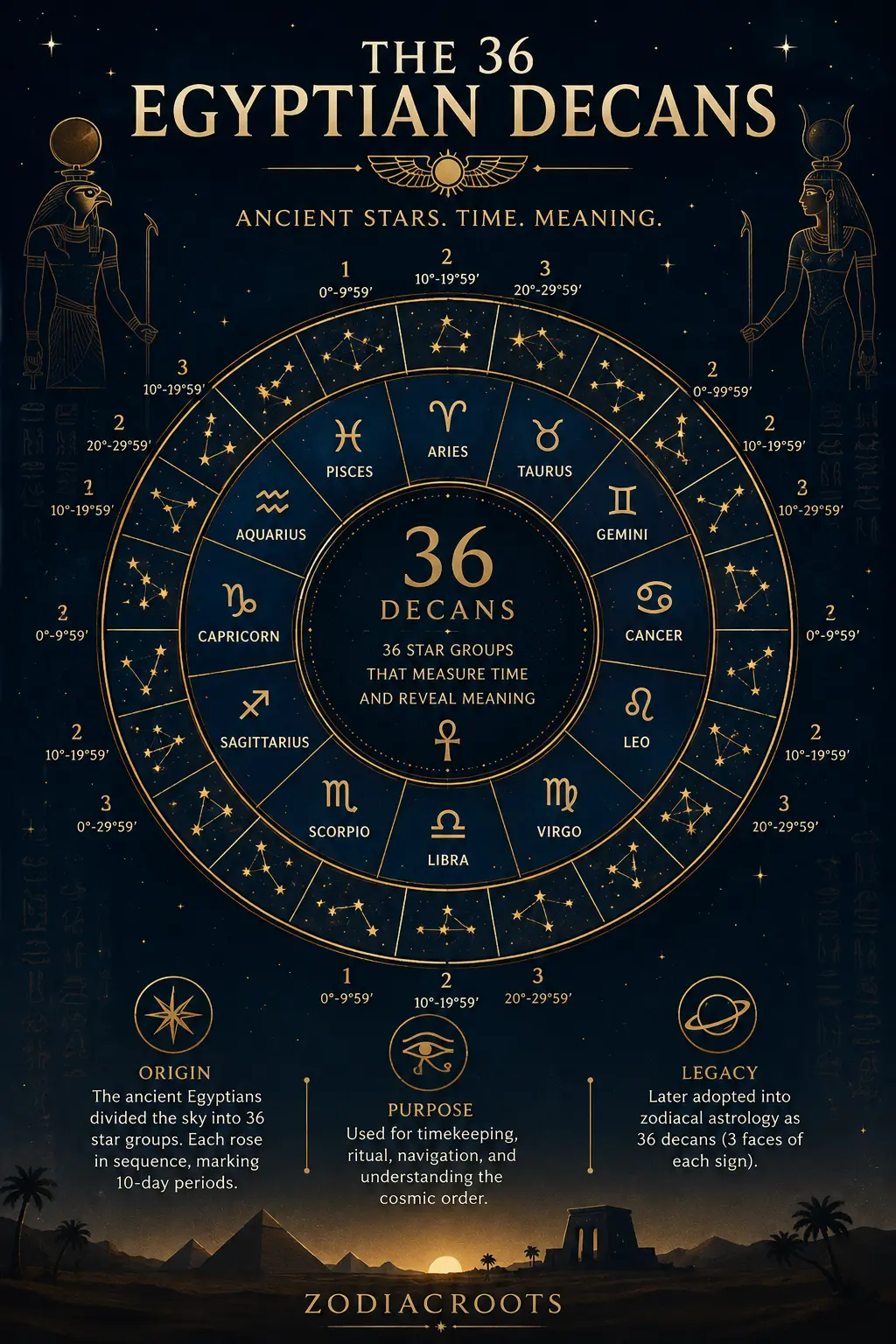
What are the 36 Egyptian Decans?
The Egyptian decans were thirty-six stars or small star groups used in ancient Egypt to track the night, organize ten-day calendrical periods, and structure sacred astronomical time. They were fundamentally stellar, not zodiacal sign divisions.
Centuries later, the concept of thirty-six celestial divisions was absorbed into Hellenistic astrology. Each of the twelve zodiac signs was divided into three ten-degree “decans” or “faces,” creating a new astrological system inspired by — but not identical to — the original Egyptian decanal tradition.
What Were the Egyptian Decans?
In ancient Egypt, the decans were not abstract mathematical slices of the zodiac. They were thirty-six stars or small star groups used to structure the passage of the night, the rhythm of ten-day periods, and the sacred organization of the year. Their appearances helped priests, observers, and ritual specialists mark time through the heavens.
Egyptological literature often refers to the decanal stars through terms transliterated as bAkti or bAktyw. Rather than treating the stars as inert points, Egyptian religious astronomy understood them as living celestial presences: beings that rose, worked, disappeared, and returned. In later Greco-Egyptian traditions, this sacred character would contribute to the decans’ transformation into astrological, protective, and symbolic powers.
The decanal system is therefore best understood as a bridge between observational astronomy and sacred cosmology. The Egyptians watched the sky with practical precision, but they also read celestial order as a visible expression of divine order.
Key distinction: Egyptian decans were fundamentally stellar, not solar zodiac signs. Their earliest role came from the observation of star risings, settings, and later meridian-based systems — long before the decans were absorbed into the twelve-sign zodiac of Hellenistic astrology.
Sopdet, Sirius, and the Beginning of the Decanal Cycle
The decanal cycle was closely tied to Sopdet, the Egyptian name and divine personification of Sirius. The heliacal rising of Sirius — its first visible reappearance in the dawn sky after a period of invisibility — became one of the most important celestial events in Egyptian timekeeping. It was associated with the beginning of the year and with the seasonal return of the Nile’s inundation.
In the traditional decanal framework, Sirius marks the great renewal point: the sky’s visible signal that one annual cycle closes and another begins. This is why ZodiacRoots treats Sopdet not merely as a “star label,” but as the symbolic threshold of rebirth, orientation, fertility, and cosmic reset.
Heliacal Rising
The first dawn reappearance of Sirius after invisibility provided a powerful seasonal marker in the Egyptian year.
Yearly Renewal
The cycle of thirty-six decanal periods led toward the return of Sopdet and the restarting of the annual sequence.
Cosmic Rebirth
Sopdet became associated with divine renewal, orientation, fertility, and the re-opening of sacred time.
The Essential Distinction: Egyptian Decans vs. Zodiacal Decans
Many modern astrology articles collapse two related but distinct systems into one. ZodiacRoots does not. The ancient Egyptian decans and the later astrological decans are connected historically, but they are not identical.
1. Egyptian Stellar Decans
A historical star-based system from ancient Egypt, linked to visible stars, nocturnal timekeeping, ten-day cycles, ritual astronomy, and sacred celestial order.
2. Zodiacal Astrological Decans
A later astrological system developed within the Hellenistic zodiacal framework, dividing each sign into three ten-degree segments for finer-grained interpretation.
ZodiacRoots editorial position: the Egyptian decans should be respected as a historical astronomical and ritual system. When we discuss decans inside modern chart interpretation, we are working with their later zodiacal adaptation — not pretending that every modern decan table is a direct, unchanged copy of a single ancient Egyptian canon.
From Star Clocks to Astrology: A Historical Timeline of the Egyptian Decans
The history of the decans is not the story of a modern zodiac technique projected backward into Egypt. It is the story of a genuinely Egyptian astronomical system that began with visible stars, sacred time, and nocturnal observation — and only much later entered the world of zodiacal astrology.
The oldest major evidence for the decans appears in Middle Kingdom coffin texts and diagonal star tables. These tables arranged decanal stars in sequences that allowed the night to be divided into hours. The decans were, at this stage, a system of stellar timekeeping: visible celestial markers rising and shifting through the darkness.
The cycle was strongly anchored to Sopdet, the Egyptian Sirius, whose heliacal rising became a major sign of annual renewal. The return of Sirius was associated with the beginning of the year and with the expected season of the Nile inundation. The Orion field, linked to Sah and later Osirian symbolism, also became central to the decanal sky.
Later Egyptian astronomical systems developed beyond the earliest heliacal-rising model. Ramesside star clocks increasingly relied on the position of stars as they crossed the body of the sky during the night, including culmination and meridian-related observation. The decans remained timekeepers, but the system became more technically refined.
Decanal figures and celestial cycles were later embedded in temple ceilings and ritual astronomical imagery. Here, the stars are not only measured; they are pictured as active participants in cosmic order. The sky becomes a sacred architecture in which time, divinity, and regeneration belong to one system.
In the Greco-Egyptian world, the decans began to interact more closely with the twelve-sign zodiac, planetary schemes, and astral theology. The Dendera Zodiac preserves this hybrid atmosphere: Egyptian imagery, zodiacal constellations, planets, and decanal figures coexist in one ceremonial sky.
Later astrologers divided the zodiac into thirty-six ten-degree segments, often called decans or faces. This was not identical to the earlier Egyptian star-clock system, but it clearly inherited the prestige of the thirty-sixfold celestial structure. The decans moved from a sacred astronomical calendar into a new interpretive role inside astrology.
The 36 Egyptian Decans as “Stars of Time”
Ancient Egyptian decanal lists are not preserved in one single, perfectly uniform canon. Scholars distinguish between different families of decan lists, and the names, order, and astronomical identifications can vary across coffins, star clocks, temple ceilings, and later texts. Even so, the surviving material preserves a powerful sequence of named stellar powers that can be read as a cycle of renewal, manifestation, decline, descent, and return.
The table below presents a ZodiacRoots editorial guide to thirty-six traditional decanal names and their symbolic reading. The names belong to the wider historical decanal tradition; the thematic interpretations are editorial syntheses designed to help modern readers understand the cycle without pretending that every phrase is a literal translation of one fixed ancient source.
Trustworthiness note: the decanal tradition is historically real and richly documented, but not every decan can be securely matched to a modern star or reduced to one universal mythological meaning. ZodiacRoots separates attested decanal naming traditions from modern symbolic interpretation.
Explore the cycle through the three seasons of the Egyptian civil year. This seasonal filter follows the ideal thirty-six ten-day structure: twelve decanal periods for Akhet, twelve for Peret, and twelve for Shemu.
| Cycle Group | Decanal Name | Core Historical / Symbolic Thread | ZodiacRoots Reading |
|---|---|---|---|
| 1. Renewal | Tepi-a Sopdet | Forerunner of Sopdet; the approach to Sirius. | Threshold, awakening, spiritual orientation. |
| 1. Renewal | Sopdet | Sirius; the great calendrical and ritual renewal star. | Birth of the cycle, fertility, sacred beginning. |
| 1. Renewal | Khery-kheped-en-Sopdet | A Sopdet-linked decanal name within the extended Sirius sequence. | Support, anchoring, foundation after emergence. |
| 2. Orion & Formation | Sahit / Sah | Associated with Orion and the Osirian celestial field. | Resurrection, structure, cosmic dignity. |
| 2. Orion & Formation | Khery-kheped-en-Sahit | An Orion-linked decanal form. | Embodiment of celestial order in earthly life. |
| 2. Orion & Formation | Kudeti | Traditional decanal name preserved in later decanal sequences. | Protection, resisting disorder, warding off chaos. |
| 2. Orion & Formation | Tepi-a Kenmet | Opening of the Kenmet sequence. | Nourishment, preparation, sheltering potential. |
| 2. Orion & Formation | Kenmet | One of the more persistent decanal names across traditions. | Primordial depth, matter before form, latent creation. |
| 2. Orion & Formation | Khery-kheped-en-Kenmet | A Kenmet-related decan named in Egyptian astronomical materials. | Stabilization, structure, physical consolidation. |
| 3. Mid-Cycle Powers | Smat | Traditional decanal name within the central sequence. | Union, balance, reconciliation of opposing forces. |
| 3. Mid-Cycle Powers | Srit | Traditional decanal name often interpreted in relation to a small or subtle star form. | Precision, attention, delicate intelligence. |
| 3. Mid-Cycle Powers | Sapt-khnum | A decanal name that evokes a Khnum-linked creative field. | Crafting form, embodiment, shaping the vessel. |
| 3. Mid-Cycle Powers | Her-ab-uaret | A barque-related decanal image. | Transition, passage, movement through thresholds. |
| 3. Mid-Cycle Powers | Shesmu | Name resonant with the deity Shesmu, associated with pressing and transformation. | Distillation, pressure, transformation through intensity. |
| 3. Mid-Cycle Powers | Kenmu | Traditional decanal name in the middle sequence. | Rhythm, vibration, coordination of forces. |
| 3. Mid-Cycle Powers | Tepi-a Semt | Opening of the Semt phase. | First fruits, results beginning to appear. |
| 3. Mid-Cycle Powers | Semt | Traditional decanal name linked here to consolidation. | Authority, consolidation, power becoming visible. |
| 3. Mid-Cycle Powers | Tepi-a Mehat | Opening of the Mehat phase. | Measurement, fairness, reckoning of consequence. |
| 4. Descent & Threshold | Mehat | Traditional decanal name read here through themes of measure and order. | Justice, cosmic balance, truth weighed against action. |
| 4. Descent & Threshold | Aryt | Traditional decanal name associated editorially with guarded passage. | Secrets, gates, protection of hidden knowledge. |
| 4. Descent & Threshold | Shetw | Traditional decanal name within the darker descent sequence. | Submerged danger, instinct, what lies beneath perception. |
| 4. Descent & Threshold | Tepi-a Khekhu | Opening of the darkness sequence. | Approach of night, withdrawal, preparation for descent. |
| 4. Descent & Threshold | Khekhu | Darkness as a regenerative cosmic state. | Void, rest, inner gestation, regeneration of light. |
| 4. Descent & Threshold | Tepi-a Akhet | Opening of the horizon sequence. | Approach to transition, the first edge of return. |
| 4. Descent & Threshold | Akhet | The horizon, a central Egyptian symbol of emergence and disappearance. | Portal, rebirth, the meeting point of worlds. |
| 4. Descent & Threshold | Tepi-a Sah | Opening movement toward the Sah/Orion field. | Preparation for ascent, dignity returning. |
| 4. Descent & Threshold | Sah | Orion-linked celestial form associated with Osirian symbolism. | Elevation, ancestral order, the soul becoming stellar. |
| 5. Final Renewal | Sapt-khnu | Traditional decanal name in the final restorative sequence. | Protection, recomposition, preservation of sacred integrity. |
| 5. Final Renewal | Hery-ab-uia | A barque-centered image within the closing cycle. | Guardianship, safe passage, defense during transition. |
| 5. Final Renewal | Son | Traditional decanal name interpreted here through connective symbolism. | Cooperation, kinship, alliance of complementary powers. |
| 5. Final Renewal | Spt | A boundary or edge motif within the final approach. | Threshold, limit, last frontier before renewal. |
| 5. Final Renewal | Khery-spt-en-Sopdet | A Sopdet-adjacent closing decan. | The immediate predecessor of renewal, expectancy, sacred tension. |
| 5. Final Renewal | Tepi-a Choandee | Traditional decanal name in the final pre-renewal movement. | Breath, stirring, animation before rebirth. |
| 5. Final Renewal | Choandee | Closing decanal current in the approach to completion. | Forward force, propulsion, the solar barque nearing horizon. |
| 5. Final Renewal | Semesh | Traditional decanal name interpreted through the idea of following. | Fidelity, continuity, obedience to inherited order. |
| 5. Final Renewal | Konmus | Final closing name in this editorial cycle. | Completion, sealing the cycle, the moment before Sopdet returns. |
How the Egyptian Decans Were Observed
The Egyptian decans were not invented as abstract geometry. They emerged from observation. Their earliest calendrical logic was linked to the heliacal rising of stars — the moment when a star first becomes visible shortly before dawn after a period hidden by the Sun’s glare.
Over time, Egyptian timekeeping also developed systems that relied on a star’s position during the night, including its passage across key points of the sky. Scholarship on star clocks shows a transition from the use of heliacal risings toward systems based on culmination and meridian-related observation, especially in later decanal clock traditions.
Heliacal Rising
A star’s first dawn reappearance after invisibility marked a new ten-day period and helped structure the annual decanal cycle.
Night-Hour Marking
Decanal stars rose in sequence during the night, allowing observers to identify the progression of nocturnal hours.
Meridian & Culmination Systems
Later star-clock systems increasingly considered stellar culmination and refined celestial positioning, not only dawn risings.
Why this matters: unlike the later solar zodiac signs, the original Egyptian decans were stellar time powers. Their logic belongs first to the observed sky, then to ritual cosmology, and only later to astrology.
The Five Epagomenal Days: The Divine Birthdays Outside the 36 Decans
Thirty-six decans multiplied by ten days account for 360 days. The Egyptian civil year, however, contained 365 days. The remaining five days were the epagomenal days — special days added at the end of the year, outside the ordinary twelve months and outside the regular thirty-six decanal decades.
In Egyptian mythic tradition, these five days were associated with the births of five major deities: Osiris, Horus, Seth, Isis, and Nephthys. This transforms the epagomenal interval into much more than a technical calendar adjustment. It becomes a liminal threshold: a sacred pause between the completion of one cosmic cycle and the renewal of the next.
Osiris
Birth of the god of regeneration, kingship beyond death, and cyclical renewal. Osiris opens the five-day threshold with the promise that endings are not final.
Horus
Birth of the falcon god of rightful succession, sky authority, and restored order. Horus introduces the principle of renewal moving toward sovereignty.
Seth
Birth of the disruptive power of storm, desert, conflict, and necessary disturbance. Seth reminds us that cosmic order is tested before it is renewed.
Isis
Birth of the great goddess of magic, healing intelligence, protection, and sacred restoration. Isis gathers what has been broken and makes wholeness possible.
Nephthys
Birth of the liminal goddess of boundaries, mourning, hidden support, and the protection of transitions. Nephthys closes the threshold before the cycle begins again.
Time Beyond the Ordinary
The epagomenal days complete the 365-day year, but symbolically they also create a charged interval outside normal time — a bridge between cosmic completion and renewal.
Editorial caution: rather than calling this a fixed “37th decan,” ZodiacRoots presents the five epagomenal days as a sacred calendrical interval outside the standard thirty-six decanal periods. This is historically clearer and preserves their unique status.
How the 36 Zodiacal Decans Work in Astrology
In zodiacal astrology, every sign occupies thirty degrees of the ecliptic. Each sign is then divided into three equal ten-degree sections:
The opening expression of the sign: direct, foundational, and closest to its core symbolic identity.
A more developed or differentiated tone, often read as adding nuance, complexity, or a second layer of motive.
The final stage of the sign, frequently interpreted as intensified, mature, transitional, or more visibly stylized.
The table below uses the traditional Chaldean-order planetary faces, a major historical system in traditional astrology. Other schools use alternate decan rulership schemes, especially triplicity-based systems. ZodiacRoots identifies the method being used instead of presenting one later convention as the only possible system.
The 36 Zodiacal Decans: Traditional Planetary Faces
This reference table is useful for understanding how the thirty-six-fold decanal structure functions inside later astrology. It does not claim that these planetary rulers are the original Egyptian star-list names; rather, it shows the astrological system that developed after the decanal principle entered zodiacal practice.
| Sign | Decan | Degree Range | Traditional Face Ruler | Interpretive Tone |
|---|---|---|---|---|
| Aries | 1st | 0°–9°59′ | Mars | Initiation, urgency, decisive will. |
| Aries | 2nd | 10°–19°59′ | Sun | Command, visibility, heroic self-assertion. |
| Aries | 3rd | 20°–29°59′ | Venus | Desire refined through attraction, value, and choice. |
| Taurus | 1st | 0°–9°59′ | Mercury | Craft, acquisition, practical intelligence. |
| Taurus | 2nd | 10°–19°59′ | Moon | Security, embodiment, fertile attachment. |
| Taurus | 3rd | 20°–29°59′ | Saturn | Endurance, consolidation, long-term structure. |
| Gemini | 1st | 0°–9°59′ | Jupiter | Expansive speech, curiosity, social intelligence. |
| Gemini | 2nd | 10°–19°59′ | Mars | Sharp wit, quick contest, argumentative speed. |
| Gemini | 3rd | 20°–29°59′ | Sun | Authoritative voice, intellectual visibility. |
| Cancer | 1st | 0°–9°59′ | Venus | Affection, protection, emotional receptivity. |
| Cancer | 2nd | 10°–19°59′ | Mercury | Memory, narration, emotionally intelligent thought. |
| Cancer | 3rd | 20°–29°59′ | Moon | Deep instinct, tides of belonging, psychic atmosphere. |
| Leo | 1st | 0°–9°59′ | Saturn | Dignity under pressure, disciplined radiance. |
| Leo | 2nd | 10°–19°59′ | Jupiter | Generosity, grandeur, magnanimous confidence. |
| Leo | 3rd | 20°–29°59′ | Mars | Dramatic courage, competitive fire, bold expression. |
| Virgo | 1st | 0°–9°59′ | Sun | Clarity, competence, visible usefulness. |
| Virgo | 2nd | 10°–19°59′ | Venus | Refinement, care, beauty through precision. |
| Virgo | 3rd | 20°–29°59′ | Mercury | Analysis, sorting, mastery of detail. |
| Libra | 1st | 0°–9°59′ | Moon | Relational sensitivity, social balance, responsiveness. |
| Libra | 2nd | 10°–19°59′ | Saturn | Commitment, justice, boundaries in partnership. |
| Libra | 3rd | 20°–29°59′ | Jupiter | Diplomacy, fairness, wider ethical vision. |
| Scorpio | 1st | 0°–9°59′ | Mars | Intensity, penetration, survival instinct. |
| Scorpio | 2nd | 10°–19°59′ | Sun | Power revealed, sovereignty through depth. |
| Scorpio | 3rd | 20°–29°59′ | Venus | Magnetism, entanglement, transformative attachment. |
| Sagittarius | 1st | 0°–9°59′ | Mercury | Teaching, travel of mind, philosophical questioning. |
| Sagittarius | 2nd | 10°–19°59′ | Moon | Vision shaped by memory, faith, and emotional meaning. |
| Sagittarius | 3rd | 20°–29°59′ | Saturn | Doctrine, discipline, responsible freedom. |
| Capricorn | 1st | 0°–9°59′ | Jupiter | Ambition with scale, strategic growth. |
| Capricorn | 2nd | 10°–19°59′ | Mars | Execution, stamina, relentless advancement. |
| Capricorn | 3rd | 20°–29°59′ | Sun | Authority, reputation, earned visibility. |
| Aquarius | 1st | 0°–9°59′ | Venus | Social elegance, unconventional connection. |
| Aquarius | 2nd | 10°–19°59′ | Mercury | Systems thinking, inventive analysis, networks. |
| Aquarius | 3rd | 20°–29°59′ | Moon | Collective feeling, humanitarian instinct, emotional distance. |
| Pisces | 1st | 0°–9°59′ | Saturn | Form given to imagination, spiritual discipline. |
| Pisces | 2nd | 10°–19°59′ | Jupiter | Compassion, faith, symbolic expansion. |
| Pisces | 3rd | 20°–29°59′ | Mars | Sacrifice, action through intuition, inspired struggle. |
Why Decans Matter in Birth Chart Interpretation
A sign alone gives a broad symbolic field. A decan adds texture. Two people may both have the Sun in Leo, yet a first-decan Leo and a third-decan Leo do not always express that solar archetype in the same way. One may radiate through dignity and restraint; another may embody Leo through bolder struggle, performance, or dramatic assertion.
Decans are especially useful when interpreting:
- Sun sign nuance: how a person’s central identity expresses the sign.
- Moon sign nuance: how emotional patterns carry a more specific tone.
- Ascendant nuance: how style, instinctive presentation, and first response are colored.
- Planetary placements: how Venus, Mars, Mercury, or other planets express themselves within a sign.
Practical reading tip: use decans as a refining layer, not as a replacement for the whole chart. Sign, house, aspects, dignity, and exact birth data remain more structurally important than a decan taken in isolation.
How to Find Your Decan
Your decan depends on the exact degree of a planet or angle within a zodiac sign. For the Sun, approximate birth dates are sometimes used in popular astrology, but this is less precise than using an actual chart degree.
Find the sign and degree
Identify whether the placement falls in Aries, Taurus, Gemini, and so on, and record its degree within that sign.
Match the degree range
0°–9°59′ is the first decan; 10°–19°59′ is the second; 20°–29°59′ is the third.
Interpret with context
Read the decan together with the planet, sign, aspects, and the wider symbolic framework of the chart.
See your symbolic profile beyond a single sign
ZodiacRoots does not reduce identity to one Sun sign. The 8 Roots Method compares your Western, Vedic, Chinese, Mayan, Celtic, and Egyptian symbolic layers inside one coherent reading.
The Dendera Zodiac and the Survival of Decanal Imagery
The famous Dendera Zodiac, created in the Greco-Roman period, preserves a complex celestial image in which zodiacal constellations, planets, and decanal figures coexist. It is not a simple “modern horoscope wheel,” nor is it a perfect observational sky map. It is better understood as a ritual, astronomical, and symbolic synthesis from a period when Egyptian and Hellenistic celestial languages were interacting intensely.
This makes Dendera important for ZodiacRoots. It shows that the decanal tradition was not an isolated curiosity. It belonged to a larger attempt to map the heavens through image, time, deity, and cosmic order.
Editorial note: the Dendera Zodiac deserves its own dedicated authority page because it sits at the crossroads of Egyptian astronomy, temple symbolism, zodiac history, and the later afterlife of the decans.
Where Egyptian Guardians Fit In
The ZodiacRoots Egyptian Guardians are a separate symbolic framework inspired by Egyptian deity traditions and used as one of the eight interpretive roots in the ZodiacRoots system. They should not be confused with the historical astronomical decans.
The two belong to the same wider editorial territory — ancient Egyptian symbolic cosmology — but they serve different purposes:
- Egyptian Decans: historical star divisions and later zodiacal decanal astrology.
- Egyptian Guardians: ZodiacRoots’ date-based symbolic Egyptian archetypes.
Explore the Egyptian Guardian Calculator or read the wider 8 Roots overview.
What Decans Add to the ZodiacRoots Perspective
Decans matter because they reveal that astrology has always contained internal layers. A sign is not a flat category. It contains phases, thresholds, tonal shifts, and symbolic substructure. The Egyptian decans teach us that celestial meaning was once inseparable from rhythm and time; the later zodiacal decans show how astrologers transformed that older thirty-six-fold logic into a subtler reading of the chart.
At ZodiacRoots, this is valuable because our work is not based on one isolated sign. The 8 Roots Method compares systems, clarifies differences, and looks for coherent patterns without erasing historical nuance. The decans reinforce one of the platform’s central principles:
Astrological meaning becomes more precise when we move from broad labels to structured symbolic layers.
Frequently Asked Questions About the 36 Egyptian Decans
What is the origin of the Egyptian decans?
The decans originated in ancient Egyptian astronomy. They are documented in decanal star lists and diagonal star tables, especially from Middle Kingdom-era funerary and astronomical contexts, and were used to structure time and celestial observation.
Were the decans originally parts of the twelve zodiac signs?
No. The original Egyptian decans were stellar groups and timekeeping markers. Their later use as thirty-six ten-degree divisions of the zodiac belongs to Greco-Egyptian and Hellenistic astrological development.
What were the bakti or baktyw in relation to the Egyptian decans?
Some Egyptological literature uses forms such as bAkti or bAktyw in connection with the decanal stars. These terms reflect the Egyptian treatment of decans as active celestial beings or working stellar powers, not merely abstract chart divisions. Their role belonged to sacred astronomy and ritual timekeeping before the later astrological decan tradition developed.
Did the Egyptian decans begin with Sirius?
The cycle was strongly anchored to Sopdet, the Egyptian Sirius. The heliacal rising of Sirius marked a major calendrical renewal and was associated with the beginning of the Egyptian year and the seasonal return of the Nile’s inundation.
Were Egyptian decans observed through heliacal rising or meridian transit?
Both kinds of logic appear across the history of Egyptian star-clock systems. Early decanal cycles are strongly associated with heliacal rising, while later systems increasingly used stellar culmination and meridian-related observation to track the night.
What happened to the five days outside the 36 decans?
The thirty-six decans account for 360 days. The Egyptian civil calendar added five epagomenal days to complete the 365-day year before the sequence renewed. These days stood outside the ordinary thirty-six ten-day periods and are essential for understanding the calendar.
Is there one definitive list of all 36 Egyptian decans?
No single list is universally definitive across all periods and documents. Egyptian sources preserve several families of decan lists with variations in names, order, and imagery. Modern scholarship recognizes this diversity, which is why ZodiacRoots distinguishes between historically attested decanal traditions and modern editorial synthesis.
What is the difference between a decan and a zodiac sign?
A zodiac sign spans thirty degrees. A decan is one of three ten-degree subdivisions within that sign. Decans refine sign interpretation rather than replacing the sign itself.
Do decans change personality interpretation?
They can refine it. Decans help explain why two people with the same Sun, Moon, or Ascendant sign may express that sign differently. However, decans should be read alongside the full birth chart.
Are Egyptian Decans the same thing as ZodiacRoots Egyptian Guardians?
No. Egyptian Decans refer to an ancient astronomical and later astrological division system. Egyptian Guardians are ZodiacRoots’ symbolic date-based Egyptian archetypes used within the 8 Roots Method.
How can I know my decan accurately?
Use a birth chart or astrology calculator that gives the exact degree of the Sun, Moon, Ascendant, or planet you want to study. Exact chart degree is more reliable than approximate birth-date tables.
Sources and Further Reading
This guide is written editorially for ZodiacRoots, but the historical framework is grounded in scholarship on Egyptian astronomy, decanal star lists, star clocks, the Dendera Zodiac, and the later transformation of decans into astrological faces.
Go Beyond One Sign
Decans show that even a single zodiac sign contains deeper layers. ZodiacRoots extends that principle further: your full symbolic profile becomes clearer when Western, Vedic, Chinese, Mayan, Celtic, and Egyptian traditions are read together instead of separately.