What Is the Dendera Zodiac?
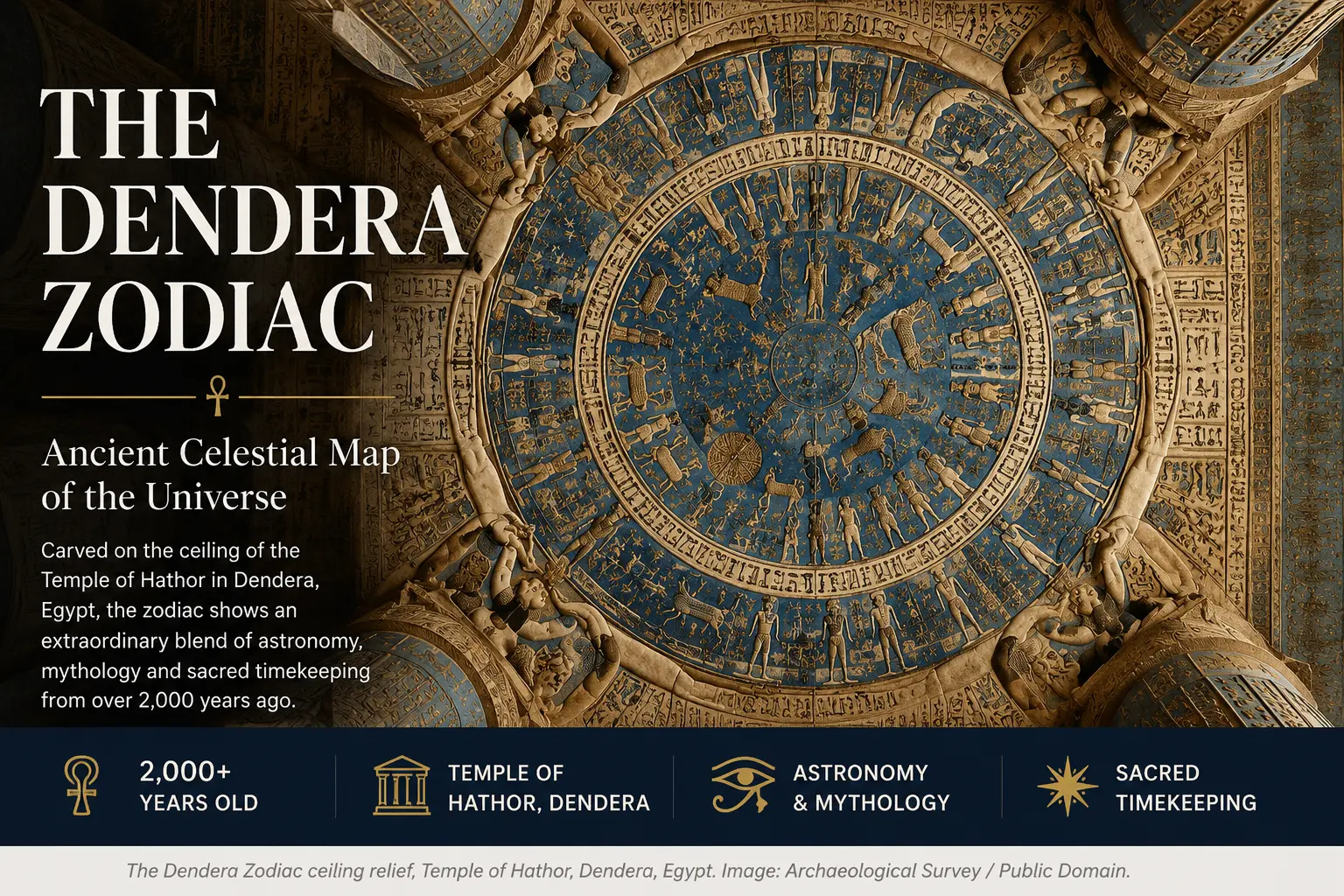
The Dendera Zodiac is a circular sandstone celestial relief
originally installed in a roof chapel dedicated to Osiris within the Temple of Hathor at Dendera, Egypt.
Today preserved in the Louvre, it depicts a sacred vision of the sky through zodiacal constellations,
decans, planetary figures and Egyptian religious imagery. It is not merely a decorative zodiac:
it is a rare material witness to how late ancient Egypt visualised cosmic order.
In This Article
2. What the Dendera Zodiac is
3. Where it was found
4. When it was created
5. Egyptian, Babylonian and Hellenistic layers
6. Historical timeline
7. How to read the relief visually
8. Planets, timing and debate
9. Dendera and the 36 Egyptian Decans
10. What it teaches modern astrology
11. Why it matters for ZodiacRoots
12. Detailed FAQ
Key Terms in Context
These concepts help frame the Dendera Zodiac historically and symbolically.
Decan
A celestial division linked to Egyptian star groups, night-time reckoning and later astrological interpretation.
In later astrology, each zodiac sign is often divided into three decans.
Osirian
Related to Osiris, the Egyptian god associated with death, renewal, regeneration and cosmic continuity.
The Dendera Zodiac belonged to an Osirian roof-chapel context.
Hellenistic
The Greek-influenced cultural world that shaped the eastern Mediterranean after Alexander the Great.
Late Ptolemaic Egypt was both deeply Egyptian and culturally connected to this wider world.
Planisphere
A circular representation of the heavens. In the case of Dendera, the term should be understood as sacred,
symbolic and astronomical rather than as a modern technical star chart.
What Is the Dendera Zodiac?
The Dendera Zodiac is a sculpted ceiling relief that presents the sky as a
circular sacred map. Its most striking feature is the central celestial disc, surrounded by
figures that hold up the heavens and filled with symbolic forms representing constellations,
zodiacal imagery, decans, planets and astral powers.
Unlike a modern horoscope wheel, the Dendera Zodiac was not designed as a personal birth chart.
It belongs to a temple environment, a ritual and theological space where astronomy, kingship,
regeneration and divine order were woven together. It speaks less about one individual’s fate
and more about the architecture of the cosmos itself.
The Louvre catalogue identifies the relief through three key visual domains:
zodiac, decans and constellations. That combination matters.
It shows that the monument is not only “Egyptian art with zodiac signs,” but an advanced celestial
composition operating at the intersection of sacred imagery and astronomical ordering.
ZodiacRoots editorial position
The Dendera Zodiac should be read as a historically grounded celestial artefact, not as proof
that every modern astrological doctrine began in one Egyptian temple. Its value is stronger:
it preserves a rare image of how the heavens were made visible in stone.
Where Was the Dendera Zodiac Found?
Its physical setting is essential to understanding its meaning.
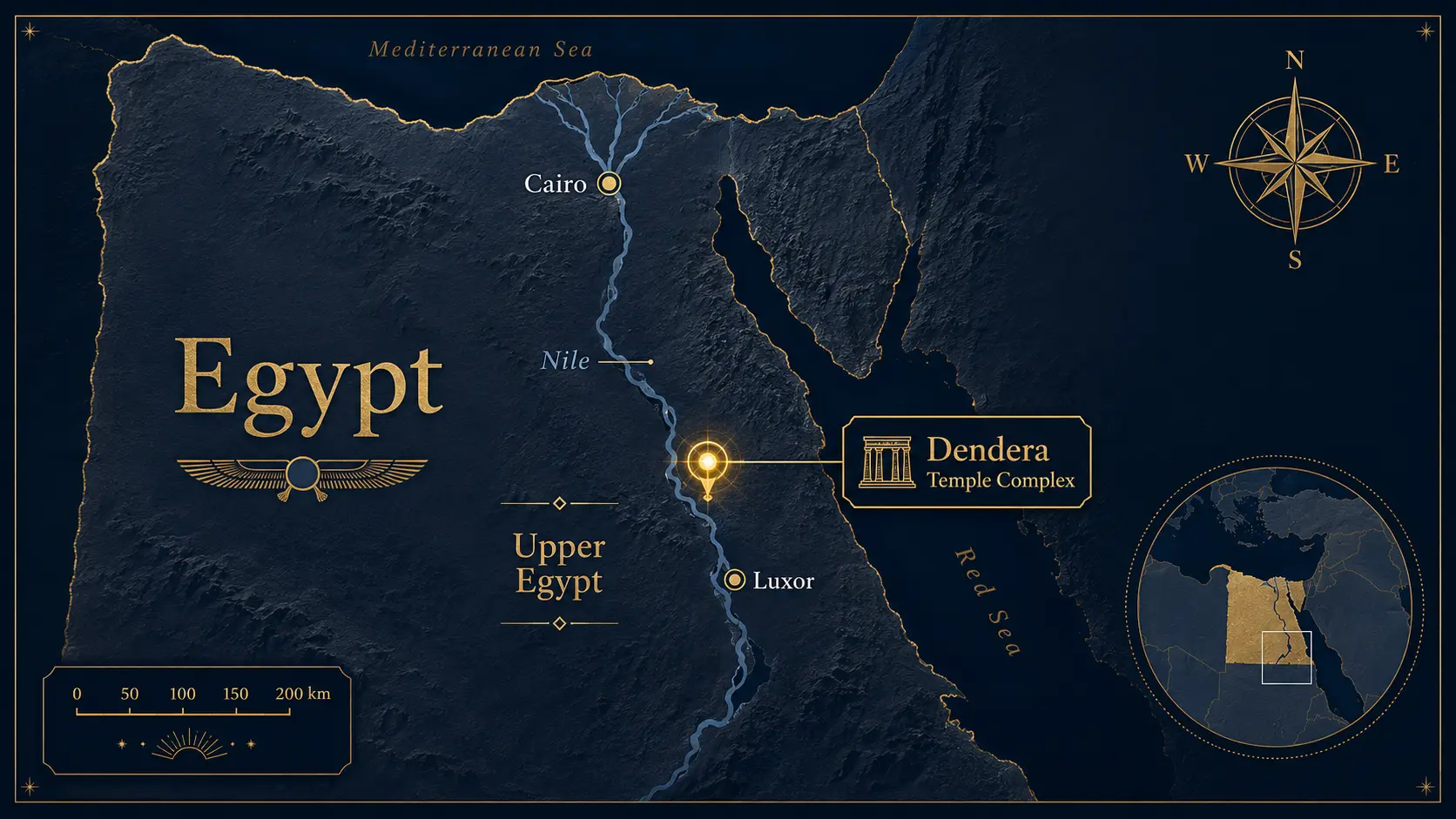
The Dendera Zodiac came from the Temple of Hathor at Dendera in Upper Egypt,
one of the great temple complexes of the Ptolemaic and Roman periods. More precisely, it belonged
to a roof chapel dedicated to Osiris, a setting deeply connected with ritual renewal,
divine rebirth and cosmic continuity.
That architectural context is essential. The zodiac was not isolated decoration. It appeared inside a
sacred temple environment where celestial order, divine cycles and the mystery of regeneration were
expressed through stone, ritual and spatial symbolism.
Original Sacred Setting
The relief formed part of an Osirian roof-chapel programme at the Temple of Hathor in Dendera,
connecting the celestial image to themes of death, restoration and eternal recurrence.
Current Museum Context
The original sandstone panel is preserved in the Louvre in Paris, while the Dendera temple setting
retains a replacement copy that preserves the architectural memory of the ceiling.
A Sky Map Inside Sacred Architecture
Dendera places celestial symbolism inside a ritual world of renewal, timing and cosmic coherence.
This makes the artefact especially important for ZodiacRoots, where ancient symbolic systems are read
in relation to identity, cycles and meaning.
When Was the Dendera Zodiac Created?
The Dendera Zodiac belongs to late Ptolemaic Egypt, a world in which Egyptian temple
traditions continued to flourish while interacting with Hellenistic astronomical and zodiacal ideas.
The Louvre dates the relief to the period of Cleopatra VII and Ptolemy XIII, commonly associated with
the middle of the first century BC.
This dating is important because the Dendera Zodiac emerged in a culturally layered environment.
Egypt retained its temple priesthood, hieroglyphic religious art and inherited cosmological language,
while also interacting with Hellenistic astronomical and zodiacal forms circulating across the
eastern Mediterranean.
Earlier European debates sometimes tried to place the zodiac thousands of years deeper in the past.
Modern scholarship is far more careful: the monument is ancient and extraordinary, but it belongs
to the late Egyptian, Greco-Roman temple world rather than to a remote prehistoric zodiac age.
From Temple Ceiling to World-Famous Artefact
The Dendera Zodiac is commonly dated to the late Ptolemaic period, in the age of Cleopatra VII and Ptolemy XIII.
The relief becomes known to European scholars during the French campaign in Egypt.
The monument is removed from Dendera, transported to France and acquired for the royal collections.
The original is held by the Louvre, while Dendera preserves the architectural memory of the ceiling through a copy.
A Meeting Point of Egyptian, Babylonian, and Hellenistic Sky Traditions
The Dendera Zodiac is not important only because it is Egyptian, nor only because it contains familiar zodiac signs.
Its deeper value is that it stands at a visible meeting point between several ancient sky traditions.
Egyptian inheritance
The Egyptian layer appears most clearly in the decans, temple context, divine figures and Osirian atmosphere.
Egypt had a long tradition of linking stars, timekeeping, ritual renewal and the order of the night sky.
Babylonian zodiacal structure
The structured twelve-sign zodiacal language spread across the ancient Near East and Mediterranean world.
Dendera does not invent that celestial belt; it integrates it into an Egyptian sacred composition.
Hellenistic exchange
Late Ptolemaic Egypt was a cultural crossroads in which Egyptian, Greek and Near Eastern celestial ideas
could interact through art, astronomy, religion and symbolic classification.
The careful conclusion is not that Dendera is the single “birth certificate” of modern astrology.
It is stronger and more precise than that: it is one of the clearest surviving monumental images
in which Egyptian decanic tradition, zodiacal imagery and Hellenistic celestial culture meet in one sacred composition.
From Egyptian Star Clocks to the Dendera Zodiac
The Dendera Zodiac did not appear from nowhere. It belongs to a long evolution of sky observation,
religious imagination and mathematical ordering. Understanding that timeline helps avoid two extremes:
reducing Dendera to “just Greek astrology in Egypt,” or exaggerating it as the source of every later astrological system.
Egyptian decans
Egyptian sky traditions developed star-linked divisions associated with night-time reckoning,
ritual calendars and cosmic order. These decans later became important in astrological interpretation.
Babylonian zodiac
The twelve-sign zodiacal belt and the mathematical division of the celestial path became central
to Near Eastern astral science, influencing later Mediterranean astrology.
Hellenistic exchange
Greek, Egyptian and Near Eastern celestial languages interacted in the Hellenistic world,
producing new combinations of astronomy, religious symbolism and astrology.
Dendera
In late Ptolemaic Egypt, the Dendera Zodiac carved this layered sky culture into stone:
signs, decans, constellations, planets and temple theology gathered into one circular celestial field.
How to Read the Dendera Zodiac: A Visual Guide
The Dendera Zodiac can feel overwhelming because it is not arranged like a modern astrology chart.
It is a sacred visual system. Its figures are not decorative filler; they help structure the heavens,
mark celestial zones and communicate a temple vision of cosmic order.
The Sky-Bearers
Around the central disc, four standing female figures and eight falcon-headed gods support the heavens.
Visually, the sky is not floating in empty space: it is ritually upheld.
The Circular Sky Field
The relief presents the heavens as a circular order rather than as a linear list of signs.
This circularity gives the image its sense of cosmic completeness.
The Zodiacal Belt
Familiar zodiacal figures appear within the composition, but they do not stand alone.
They are woven into a larger Egyptian sacred map of stars, gods and cosmic powers.
The Decanic Layer
Decanic figures link the relief to Egypt’s older star-based timing systems.
This is one reason Dendera matters beyond the twelve-sign zodiac.
The Northern Celestial Focus
Unlike a modern natal wheel centred on the individual observer, the Dendera composition draws attention to northern celestial imagery.
Some scholarly readings highlight the Bull’s Thigh, associated with the Big Dipper or Ursa Major, and a protective hippopotamus goddess figure
within this region of the sky. This matters because, for the Egyptian imagination, the imperishable northern stars were connected with endurance,
continuity and the realm that does not vanish below the horizon.
What Does the Dendera Zodiac Show?
The Dendera Zodiac does not present the sky in a modern scientific diagram, nor does it follow
a simple decorative pattern. It is a densely symbolic map of the heavens, carved with a mixture
of recognisable zodiacal motifs and distinctly Egyptian divine forms.
Zodiacal Imagery
Several figures correspond to zodiac signs that remain familiar today, including forms linked
with Taurus, Libra, Scorpio and other members of the twelve-sign celestial belt.
Egyptian Celestial Figures
Other forms follow Egyptian religious and astronomical conventions, showing that the monument
is not simply a Greek zodiac copied onto stone.
Decans
Decanic figures appear around the composition, linking the zodiac to Egypt’s long-standing
interest in star groups, nocturnal timekeeping and cyclical celestial order.
Cosmic Support
The heavenly circle is visually sustained by divine supporters, an image
of the sky as something ritually upheld rather than mechanically suspended.
The result is not one single code to be “cracked,” but a layered sacred image. It preserves astronomical
knowledge, temple theology and symbolic storytelling in a single sculpted field. That is why the Dendera
Zodiac remains so compelling: every viewer can recognise its celestial ambition, yet its full logic still
demands careful interpretation.
Do the Planets Record a Sacred Moment?
The planetary figures in the Dendera Zodiac have generated long and serious debate. Some scholars read them
as occupying astrologically meaningful positions. Others have proposed that certain details may refer to
astronomical events near the monument’s historical date, including eclipses or significant planetary placements.
The responsible conclusion is cautious: these interpretations are important, but they should not be presented
as if every detail were settled beyond debate. What they do confirm is that the relief was not carved as random
decoration. Its celestial order was deliberately constructed, and its visual language assumes that the heavens
can carry sacred, temporal and symbolic meaning.
Why this matters
For astrology, this is the deeper lesson. Dendera shows a world in which planets, stars, decans, gods,
sacred time and temple ritual belonged to a single symbolic field. It does not need to be a modern horoscope
to be astrologically important.
Is the Dendera Zodiac Egyptian, Greek, or Both?
The most accurate answer is: both, but not in equal or simplistic ways.
The Dendera Zodiac is Egyptian in its sacred setting, temple function, hieroglyphic context and mythological atmosphere.
At the same time, its zodiacal framework reflects a wider Hellenistic celestial language that had entered
Egypt during the late first millennium BC.
This makes the monument especially valuable. It shows cultural transmission without erasing local identity.
The sky represented at Dendera is not merely “Greek astronomy in Egypt,” nor is it a sealed Egyptian system
untouched by surrounding traditions. It is a late antique synthesis, built in an Egyptian temple, shaped by
Egyptian theology, and conversant with trans-Mediterranean zodiacal imagery.
Why this matters: the Dendera Zodiac is one of the clearest material examples of something
central to ZodiacRoots: symbolic systems travel, meet, adapt and acquire new meaning without losing
the depth of their origins.
The Dendera Zodiac and the 36 Egyptian Decans
The connection between the Dendera Zodiac and the
Egyptian decans
is one of the strongest reasons this artefact matters for ZodiacRoots. Decans were a major component
of Egyptian astronomical tradition: star-linked divisions that became associated with night hours,
calendrical rhythm and later astrological interpretation.
The Louvre catalogue explicitly lists decans among the defining features of the relief.
Egyptological research also discusses decanic figures distributed along the circumference of the round zodiac,
contributing to a wider Osirian mythical narrative.
This is crucial. The Dendera Zodiac does not only preserve “the twelve signs”; it holds a more intricate
sky grammar in which zodiacal order and decanic order coexist. That layered structure
creates a direct editorial bridge to the ZodiacRoots guide to the
36 Egyptian Decans.
From 12 Signs to 36 Decans
In the ZodiacRoots model, the Egyptian Decans deepen solar interpretation by adding a finer symbolic
rhythm within each sign. Dendera matters because it gives historical material weight to the presence
of decanic symbolism in Egyptian celestial thought.
What the Dendera Zodiac Still Teaches Modern Astrology
Modern astrology is often experienced through simplified Sun-sign readings, personality keywords or quick compatibility formulas.
The Dendera Zodiac reminds us that ancient sky interpretation was larger than that. It joined visible stars,
planetary figures, sacred time, ritual renewal, divine imagery and cosmic architecture.
This does not mean that a modern astrologer should read Dendera as if it were a contemporary natal chart.
It means something more useful: Dendera expands the imagination. It shows astrology as a symbolic language
of time and cosmos, not merely as a psychological label attached to a single sign.
For readers today, the artefact offers three lessons. First, astrology has always been plural:
many cultures mapped the sky in different ways. Second, the sky was not only used to predict events;
it was used to understand order, meaning, ritual and belonging. Third, serious astrology becomes richer
when it does not isolate one tradition from all the others.
This is exactly why ZodiacRoots reads ancient systems through the wider
8 Roots framework.
Western signs, Vedic perspectives, Chinese cycles, Mayan seals, Celtic trees and Egyptian guardians are not treated
as identical systems. They are placed in conversation, so that symbolic identity can be read through more than one sky.
The Dendera Zodiac and the Egyptian Guardians
The Dendera Zodiac is not the direct source of the ZodiacRoots
Egyptian Guardians
system, and it should not be presented as such. Its importance is more precise and more valuable:
it reveals how ancient Egypt imagined the heavens as a living symbolic order populated by divine,
seasonal and cosmic presences.
The Egyptian Guardians pages at ZodiacRoots interpret named guardian archetypes as symbolic layers
within the broader 8 Roots framework. The Dendera Zodiac belongs to the historical horizon that makes
such celestial imagination meaningful: a world in which sky, deity, timing and identity were not treated
as separate compartments.
This creates an editorial relationship rather than a false genealogical claim. The Guardians are a
modern ZodiacRoots interpretive layer; Dendera is a historical artefact. Together, they allow readers
to move from material history to symbolic exploration without confusing one with the other.
Why Did the Dendera Zodiac Become So Famous?
The Dendera Zodiac became famous partly because of its extraordinary appearance and partly because of
the debates it triggered in Europe after its discovery. It was documented during the French campaign
in Egypt in 1799, later removed from the temple in the early nineteenth century and incorporated into
French collections.
Its circular form fascinated scholars, artists and antiquarians. Some early interpreters believed
it proved an immense antiquity for Egyptian astronomy; others argued for a much later date. These debates
turned the object into a cultural symbol of a larger question:
how should ancient sky knowledge be interpreted?
The monument still attracts attention because it sits exactly at that intersection. It is visually beautiful,
historically documented and interpretively difficult. It invites questions about astronomy, astrology,
theology, transmission of ideas and the symbolic structure of time.
What the Dendera Zodiac Does — and Does Not — Prove
Historical artefacts become more useful when their claims are kept precise.
The Dendera Zodiac is powerful enough without exaggeration.
| It does show | It does not automatically prove |
|---|---|
| A sophisticated celestial relief combining zodiac signs, decans and constellational symbolism. | That every modern astrological meaning existed in identical form at Dendera. |
| A sacred sky image embedded in an Osirian temple context. | That the relief was designed as a personal horoscope for ordinary individuals. |
| A late Egyptian synthesis shaped by both temple theology and wider Hellenistic astronomical culture. | That Egyptian and Greek sky systems were identical or interchangeable. |
| Material evidence that decanic symbolism and zodiacal imagery could coexist in a monumental sacred composition. | That any modern “Egyptian zodiac” list can claim direct historical descent from the relief. |
| A rare physical anchor for studying how ancient cultures represented celestial order. | That Dendera is the single birthplace of modern astrology as practised today. |
This balanced view makes the Dendera Zodiac more, not less, important. It becomes a serious reference point
for the history of celestial symbolism rather than a prop for sensational claims.
Why the Dendera Zodiac Matters for ZodiacRoots
ZodiacRoots is built around a central idea: human beings have long used symbolic systems to describe identity,
cycles, temperament and meaning. Western astrology, Vedic astrology, Chinese BaZi, Mayan seals, Celtic trees
and Egyptian guardians are distinct traditions, but they share a desire to translate cosmic or seasonal order
into human insight.
The Dendera Zodiac is valuable because it gives that broader project a physical historical anchor.
It is not merely a concept, a reconstructed table or a modern diagram. It is carved stone. It is architecture.
It is celestial imagination preserved inside a temple.
For readers exploring the Egyptian branch of ZodiacRoots, Dendera offers a deeper foundation. It helps explain
why the pages on
Egyptian Decans
and
Egyptian Guardians
belong to a wider editorial universe: one concerned not only with signs, but with the many ways civilizations
have mapped the sky into meaning.
Go beyond Dendera into the Egyptian Roots
Continue through the ZodiacRoots Egyptian cluster to explore the 36 Egyptian Decans,
the Guardian archetypes and the wider symbolic architecture of the 8 Roots method.
Frequently Asked Questions About the Dendera Zodiac
What is the Dendera Zodiac?
The Dendera Zodiac is a circular sandstone celestial relief from the Temple of Hathor at Dendera,
Egypt. It combines zodiac imagery, constellations, decans, planetary figures and sacred Egyptian imagery
in a single monumental sky composition.
Where is the Dendera Zodiac today?
The original Dendera Zodiac is displayed at the Musée du Louvre in Paris, in the Department of
Egyptian Antiquities. A copy remains at the Dendera temple site, preserving the architectural memory
of the original ceiling relief.
When was the Dendera Zodiac created?
The Dendera Zodiac is generally dated to the late Ptolemaic period, commonly associated with around
50 BC and the age of Cleopatra VII and Ptolemy XIII. This places it in a culturally layered Egyptian,
Greek and Mediterranean context.
Does the Dendera Zodiac show the 12 zodiac signs?
Yes. It includes zodiacal imagery associated with the twelve-sign celestial belt. However, it is not simply
a modern horoscope chart carved in stone. The relief also contains Egyptian constellational symbolism,
decans, planetary imagery and temple cosmology.
Is the Dendera Zodiac connected to the Egyptian Decans?
Yes. Decans are one of the defining features of the Dendera Zodiac. Their presence connects the relief
to Egypt’s older star-based timing systems and makes the artefact especially important for understanding
how the twelve-sign zodiac and the 36 decanic divisions could coexist.
Is the Dendera Zodiac an astrological chart?
It is better understood as a sacred celestial map than as a personal natal chart. It expresses cosmic order
through temple imagery, astronomy, astrology, theology and ritual symbolism. It is astrologically important,
but not in the same way as a modern birth chart.
Is the Dendera Zodiac Egyptian or Greek?
It is both Egyptian and Hellenistic, but in different ways. Its setting, religious logic and divine imagery
are Egyptian. Its zodiacal language reflects broader Mediterranean and Near Eastern celestial traditions
that circulated in the Hellenistic world.
What does Babylonian astrology have to do with Dendera?
The twelve-sign zodiacal system developed in the Babylonian astral tradition before becoming part of the
wider Hellenistic astrological world. Dendera does not invent the twelve signs; instead, it shows those
zodiacal forms integrated into an Egyptian sacred and decanic framework.
What are the figures holding up the sky in the Dendera Zodiac?
Around the central celestial disc are four standing female figures and eight falcon-headed gods.
They visually support the sky, presenting the heavens as something ritually upheld and ordered rather
than merely suspended in space.
Why is the Bull’s Thigh or Ursa Major important in some readings of Dendera?
Some scholarly interpretations identify the Bull’s Thigh with the Big Dipper or Ursa Major and connect
it to northern celestial imagery. This matters because Egyptian sky symbolism often gave special importance
to the imperishable northern stars, associated with continuity and the region that does not disappear below the horizon.
Does the Dendera Zodiac record an eclipse or exact astronomical event?
Some researchers have proposed that certain details of the relief may refer to astronomical events near its date,
including eclipses or significant planetary configurations. These interpretations are debated, so they should be
presented carefully. What is clear is that the relief was deliberately organised as a meaningful celestial composition.
Why is the Dendera Zodiac important in the history of astrology?
It is important because it preserves a rare monumental image in which Egyptian sacred imagery,
zodiacal motifs, constellations, decans and planetary figures appear together. It is one of the clearest
surviving examples of ancient celestial synthesis in stone.
Did modern astrology begin with the Dendera Zodiac?
No. It would be too simplistic to call Dendera the single birthplace of modern astrology.
Its importance is more precise: it is a major surviving artefact showing how Egyptian, zodiacal and
Hellenistic celestial languages could be combined in one sacred visual system.
How does the Dendera Zodiac relate to the ZodiacRoots 8 Roots method?
The Dendera Zodiac supports the ZodiacRoots approach because it shows that ancient sky symbolism was never
limited to one simple layer. At ZodiacRoots, the 8 Roots method reads identity through multiple traditions,
including Western, Vedic, Chinese, Mayan, Celtic and Egyptian symbolic systems.
Is the Dendera Zodiac directly connected to the ZodiacRoots Egyptian Guardians?
No. The ZodiacRoots Egyptian Guardians are a modern interpretive framework, not a direct historical reconstruction
from the Dendera relief. The relationship is editorial and symbolic: Dendera provides historical depth for the idea
that Egyptian celestial imagination linked sky, deity, timing and meaning.
Sources and Further Reading
-
Musée du Louvre — Zodiaque de Dendéra
-
Gyula Priskin — The Dendera Zodiacs as Narratives of the Myth of Osiris, Isis, and the Child Horus
-
Susanne M. Hoffmann — Preliminary Observations on the Dendera Zodiac
-
Encyclopaedia Britannica — Zodiac of Dandarah
ZodiacRoots uses historical and academic sources to distinguish documented ancient celestial artefacts
from modern symbolic interpretation.
Related Reading
Explore the 36 Egyptian Decans
See how Egyptian celestial divisions create a finer symbolic rhythm within the zodiac.
Discover the Egyptian Guardian Archetypes
Move from historical celestial symbolism into the ZodiacRoots interpretive framework.
Read More Cultural Astrology Studies
Explore how different civilizations mapped cosmic meaning through their own symbolic systems.
Return to the Wider Symbolic Framework
Connect ancient celestial images with the broader foundations of astrological interpretation.
Reviewed by the ZodiacRoots editorial team
Published on: May 13, 2026
Last updated: May 14, 2026
Discover More Astrology Articles You May Like
Explore related ZodiacRoots articles selected by topic first, then completed with fresh astrology reads.