
Nakshatras in Vedic Astrology
Nakshatras in Vedic astrology are the 27 lunar mansions that add precision, symbolism, karmic tone, emotional depth and timing to the birth chart.
While the 12 Rashis show the broader zodiac framework, the Nakshatras reveal a subtler layer of interpretation. They help explain not only where a planet is placed, but how that planetary energy behaves, feels and unfolds through life.
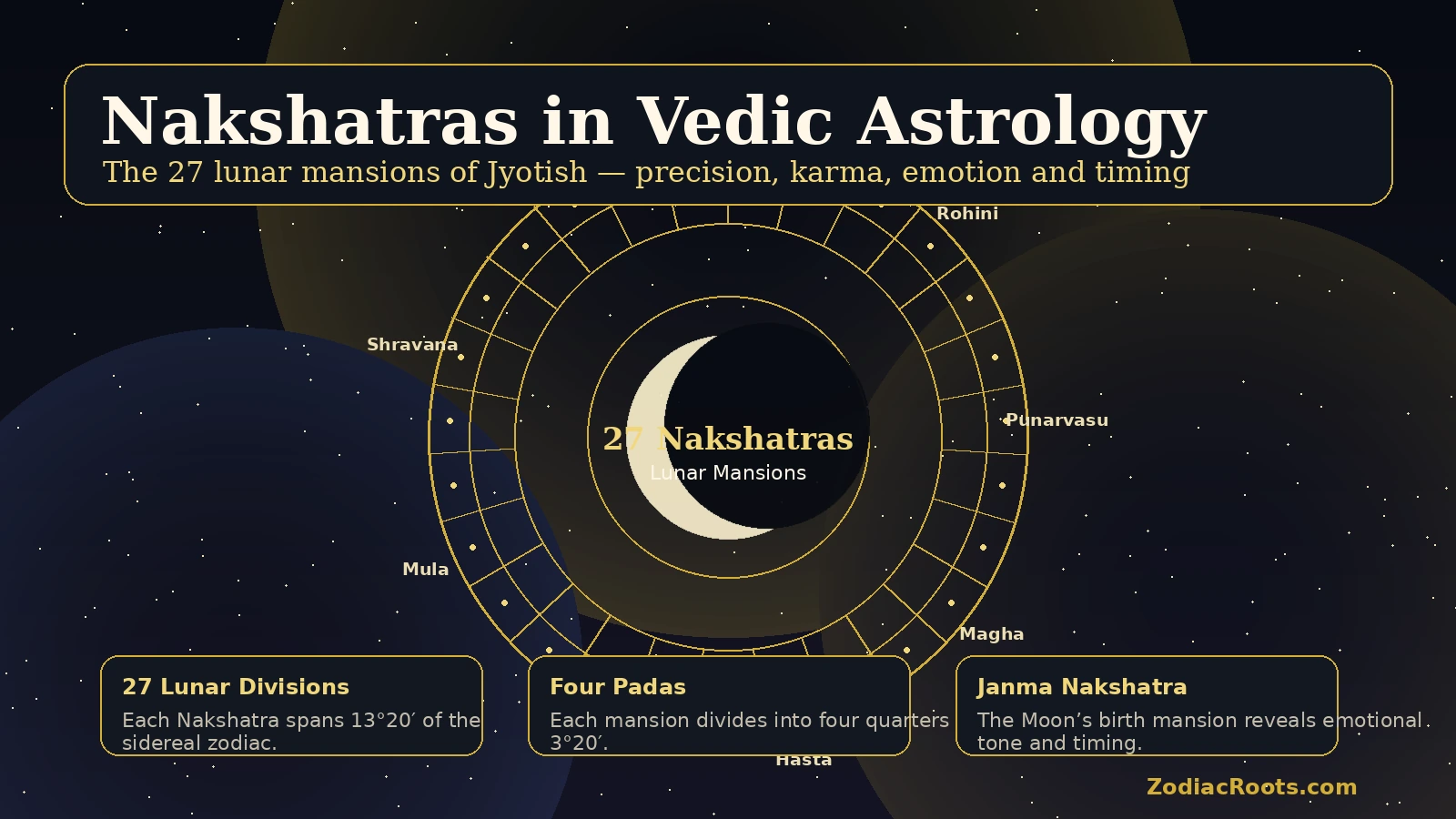
The 27 Nakshatras divide the sidereal zodiac into lunar mansions, each with its own ruler, symbol, deity and emotional tone.
Quick Answer: What Are Nakshatras in Vedic Astrology?
Nakshatras in Vedic astrology are the 27 lunar divisions of the sidereal zodiac. Each Nakshatra spans 13°20′ and carries its own symbolism, ruling deity, planetary ruler and psychological tone. In Jyotish, Nakshatras refine the meaning of the Moon, Ascendant and planets with much greater detail than zodiac signs alone.
To discover your own Moon Nakshatra, use the free ZodiacRoots Nakshatra Calculator.
Nakshatras Add Precision
They go beyond the 12 zodiac signs and show a finer level of meaning in the chart, especially for the Moon, Ascendant and personal psychology.
Nakshatras Shape the Inner Life
They are strongly linked to instinct, emotional patterning, karmic tendencies, motivation, memory and spiritual themes.
Nakshatras Help with Timing
The Moon’s Nakshatra at birth is essential for the Vimshottari Dasha system, one of the key timing methods in Vedic astrology.
Why Nakshatras Matter
If the zodiac signs describe the broad character of a placement, the Nakshatras reveal the finer atmosphere within it. They can show whether a planetary energy tends to express itself through healing, ambition, devotion, intensity, discipline, imagination, protection or transformation.
This is why Nakshatras are central to serious Jyotish practice. They bring emotional and karmic nuance that is often invisible when you look only at the sign level.
How Nakshatras Work
The full zodiac is divided into 27 equal parts, each measuring 13°20′. Every Nakshatra has its own ruler, deity, symbol and energetic quality. This gives a much more specific reading of the Moon, Ascendant and planets.
In practice, the Nakshatra helps explain temperament, relationships, instinctive drives, natural talents, recurring patterns and the deeper meaning behind planetary placements.
The Four Padas of Each Nakshatra
Every Nakshatra is divided into four Padas, or quarters, of 3°20′ each. These Padas add another layer of detail and can modify how a Nakshatra expresses itself.
This means two people with planets in the same Nakshatra can still experience that energy differently depending on the Pada, the Navamsha connection and the rest of the chart structure.
What Is Janma Nakshatra?
Your Janma Nakshatra is the Nakshatra occupied by the Moon at birth. It is one of the most important lunar indicators in Vedic astrology.
Because the Moon reflects the mind, feeling nature and lived experience, the Janma Nakshatra is often used to understand emotional tone, mental habits and karmic sensitivity.
Nakshatras and Vimshottari Dasha
The Moon’s Nakshatra at birth determines the starting sequence of the Vimshottari Dasha system, which is used to time important life periods.
This is one reason Nakshatras are not just symbolic. They are also practical tools for understanding the timing and rhythm of destiny in Jyotish.
The 27 Nakshatras by Planetary Ruler
The Nakshatras follow a repeating planetary rulership pattern that is also linked to the Vimshottari Dasha sequence.
Ashwini, Magha, Mula
Bharani, Purva Phalguni, Purva Ashadha
Krittika, Uttara Phalguni, Uttara Ashadha
Rohini, Hasta, Shravana
Mrigashira, Chitra, Dhanishtha
Ardra, Swati, Shatabhisha
Punarvasu, Vishakha, Purva Bhadrapada
Pushya, Anuradha, Uttara Bhadrapada
Ashlesha, Jyeshtha, Revati
Complete Reference Table: All 27 Nakshatras
Each Nakshatra with its ruler, deity, symbol, region and symbolic quality. Your full interpretation also depends on the Moon’s exact degree, pada and chart context.
| # | Nakshatra | Ruler | Deity | Symbol | Region | Core Quality |
|---|---|---|---|---|---|---|
| 1 | Ashwini | Ketu | Ashwini Kumaras | Horse’s head | Aries 0°–13°20′ | Initiation · Healing · Speed |
| 2 | Bharani | Venus | Yama | Yoni | Aries 13°20′–26°40′ | Creation · Endurance · Transformation |
| 3 | Krittika | Sun | Agni | Flame / razor | Aries–Taurus 26°40′–40° | Purification · Courage · Clarity |
| 4 | Rohini | Moon | Brahma | Chariot / ox cart | Taurus 40°–53°20′ | Beauty · Abundance · Magnetism |
| 5 | Mrigashira | Mars | Soma | Deer’s head | Taurus–Gemini 53°20′–66°40′ | Seeking · Sensitivity · Grace |
| 6 | Ardra | Rahu | Rudra | Teardrop / diamond | Gemini 66°40′–80° | Storm · Awakening · Transformation |
| 7 | Punarvasu | Jupiter | Aditi | Quiver of arrows | Gemini–Cancer 80°–93°20′ | Renewal · Wisdom · Resilience |
| 8 | Pushya | Saturn | Brihaspati | Lotus / circle | Cancer 93°20′–106°40′ | Nourishment · Wisdom · Protection |
| 9 | Ashlesha | Mercury | Nagas | Serpent coil | Cancer 106°40′–120° | Depth · Intuition · Magnetic Power |
| 10 | Magha | Ketu | Pitrs (ancestors) | Throne / palanquin | Leo 120°–133°20′ | Ancestral Authority · Legacy · Dignity |
| 11 | Purva Phalguni | Venus | Bhaga | Front legs of bed | Leo 133°20′–146°40′ | Pleasure · Creativity · Magnetism |
| 12 | Uttara Phalguni | Sun | Aryaman | Back legs of bed | Leo–Virgo 146°40′–160° | Service · Loyalty · Social Bond |
| 13 | Hasta | Moon | Savitar | Hand | Virgo 160°–173°20′ | Craft · Healing · Dexterity |
| 14 | Chitra | Mars | Tvashtar | Bright jewel / pearl | Virgo–Libra 173°20′–186°40′ | Beauty · Architecture · Vision |
| 15 | Swati | Rahu | Vayu | Sword / coral | Libra 186°40′–200° | Independence · Diplomacy · Adaptability |
| 16 | Vishakha | Jupiter | Indra-Agni | Triumphal arch | Libra–Scorpio 200°–213°20′ | Purpose · Ambition · Determination |
| 17 | Anuradha | Saturn | Mitra | Lotus / staff | Scorpio 213°20′–226°40′ | Devotion · Friendship · Loyalty |
| 18 | Jyeshtha | Mercury | Indra | Circular amulet | Scorpio 226°40′–240° | Strategic Power · Seniority · Protection |
| 19 | Mula | Ketu | Niritti | Bunch of roots | Sagittarius 240°–253°20′ | Root Truth · Dissolution · Liberation |
| 20 | Purva Ashadha | Venus | Apas | Fan / winnowing basket | Sagittarius 253°20′–266°40′ | Conviction · Invincibility · Purification |
| 21 | Uttara Ashadha | Sun | Vishvadevas | Tusk of elephant | Sagittarius–Capricorn 266°40′–280° | Integrity · Lasting Victory · Universal Vision |
| 22 | Shravana | Moon | Vishnu | Ear / three footprints | Capricorn 280°–293°20′ | Listening · Wisdom · Empathy |
| 23 | Dhanishtha | Mars | Ashta Vasus | Drum / flute | Capricorn–Aquarius 293°20′–306°40′ | Abundance · Rhythm · Collective Power |
| 24 | Shatabhisha | Rahu | Varuna | Empty circle / 100 stars | Aquarius 306°40′–320° | Hidden Healing · Solitude · Occult Depth |
| 25 | Purva Bhadrapada | Jupiter | Aja Ekapada | Front legs of funeral cot | Aquarius–Pisces 320°–333°20′ | Spiritual Fire · Vision · Transformation |
| 26 | Uttara Bhadrapada | Saturn | Ahir Budhnya | Back legs of funeral cot | Pisces 333°20′–346°40′ | Integrated Wisdom · Depth · Compassion |
| 27 | Revati | Mercury | Pushan | Fish / drum | Pisces 346°40′–360° | Compassion · Completion · Guidance |
The 27 Nakshatras — Individual Meanings
A concise symbolic meaning for each of the 27 lunar mansions. Use the Nakshatra Calculator to find which one belongs to your Moon.
Ketu · Aries 0°–13°20′
The first nakshatra carries the energy of pure initiation and healing. Ashwini Kumaras, the divine twin physicians, govern this lunar mansion. Those born here move fast, start boldly and carry an instinctive gift for restoration. The challenge is learning that the deepest courage sometimes means pausing rather than rushing forward.
Venus · Aries 13°20′–26°40′
Bharani sits at the intersection of pleasure and consequence, creation and dissolution. Governed by Yama, the lord of death and dharma, it carries enormous creative and reproductive power alongside moral weight. Those born here feel deeply, love fiercely and must learn to distinguish sacred burden from unconscious clinging.
Sun · Aries–Taurus 26°40′–40°
The nakshatra of the sacred flame. Governed by Agni, the god of fire, Krittika represents the purifying, clarifying force of truth. Those born here are direct, courageous and unwilling to pretend. They see through performance and value honesty above social ease. The integration is learning that fire illuminates as much as it burns.
Moon · Taurus 40°–53°20′
One of the most fortunate nakshatras — the Moon is exalted here. Brahma the creator presides, making Rohini a seat of beauty, fertility and abundance. Those born here carry natural magnetism and deep devotion. Their integration is learning to love the world without clinging to it.
Mars · Taurus–Gemini 53°20′–66°40′
The nakshatra of the eternal search. Governed by Soma — the moon deity of nectar, poetry and longing — Mrigashira combines sensitivity with drive into a personality always seeking beauty, truth and connection. The central teaching is to be present in the search itself without always needing to arrive.
Rahu · Gemini 66°40′–80°
Governed by Rudra — the fierce form of Shiva associated with storms and transformation — Ardra carries the energy of rupture, grief and radical awakening. Those born here have sharp, brilliant minds and emotional lives that run far deeper than their surface behaviour suggests. Pain processed becomes the sharpest kind of clarity.
Jupiter · Gemini–Cancer 80°–93°20′
Punarvasu means return of the light. Governed by Aditi — the boundless mother of the gods — it carries the energy of renewal, hope and innate resilience. Those born here can fall, fail and lose their way, yet always return. The integration is beginning again with full presence rather than denial.
Saturn · Cancer 93°20′–106°40′
Considered one of the most auspicious nakshatras in the Vedic tradition. Governed by Brihaspati — teacher and counsellor of the gods — Pushya carries deep, steady wisdom and the rare capacity to truly nourish others. The integration is learning to give from fullness rather than from fear, and to receive with equal grace.
Mercury · Cancer 106°40′–120°
Governed by the Nagas — serpent deities of hidden wisdom and the underworld — Ashlesha carries penetrating intelligence, magnetic power and the ability to perceive what lies beneath the visible surface. Those born here sense motivations before they are spoken. The integration is using extraordinary perception in service of truth rather than survival.
Ketu · Leo 120°–133°20′
The nakshatra of ancestral authority. Governed by the Pitrs — the ancestral spirits — Magha carries the weight and power of lineage. Those born here often radiate a quality of bearing and presence that communicates itself before a single word is spoken. The integration is leading with ancestral awareness rather than personal ego.
Venus · Leo 133°20′–146°40′
Governed by Bhaga — the deity of marital happiness, prosperity and delight — Purva Phalguni carries the energy of pleasure as a sacred force. Those born here have natural charm, warmth and creative magnetism. The integration is turning personal pleasure into creative generosity that uplifts everyone around them.
Sun · Leo–Virgo 146°40′–160°
Governed by Aryaman — the deity of friendship, social bonds and contractual duty — Uttara Phalguni represents the shift from personal pleasure to purposeful giving. Those born here are often pillars of their communities — reliable, warm and deeply committed. The integration is serving from genuine inner strength rather than from the need to be needed.
Moon · Virgo 160°–173°20′
Governed by Savitar — the solar deity of creative power and skillful action — Hasta combines emotional intelligence with practical dexterity. Those born here have an instinctive ability to make things: to take what is raw and shape it into something useful, beautiful or healing. The integration is letting the hands that shape the world also know when to rest.
Mars · Virgo–Libra 173°20′–186°40′
Governed by Tvashtar — the celestial architect and craftsperson of the gods — Chitra represents the marriage of vision and form, beauty and structure. Those born here have a highly developed aesthetic sense and a genuine drive to create things of lasting beauty. The integration is letting form serve meaning rather than merely appearance.
Rahu · Libra 186°40′–200°
Governed by Vayu — the god of wind — Swati embodies movement without fixed attachment, the capacity to bend under pressure without breaking and the social intelligence to navigate different environments with ease. The integration is discovering that true independence is not the absence of commitment — it is the freedom that comes from choosing it consciously.
Jupiter · Libra–Scorpio 200°–213°20′
Governed jointly by Indra and Agni, Vishakha combines expansive wisdom with intense, goal-directed energy. Those born here have a quality of sustained, almost inexhaustible drive. Once they identify a goal, they pursue it with extraordinary focus. The integration is learning that purpose can include others and that the greatest goals are pursued in genuine community.
Saturn · Scorpio 213°20′–226°40′
Governed by Mitra — the deity of covenants, friendship and the sacred contract between souls — Anuradha represents the kind of love that does not waver under pressure. Those born here are the friends people most want when things fall apart. The integration is letting devotion be wide enough to include oneself.
Mercury · Scorpio 226°40′–240°
Jyeshtha means the eldest. Governed by Indra — the king of the gods — it represents the psychology of the one who has survived, fought for position and now guards it with vigilance. Those born here carry hard-won authority and a quality of strategic intelligence shaped by real experience. The integration is leading through wisdom rather than dominance.
Ketu · Sagittarius 240°–253°20′
Mula means root — and yet this is the nakshatra of the great uprooting. Governed by Niritti — the goddess of dissolution — it represents the force that tears away what is false or simply finished. Those born here often experience profound disruptions that force them to find out what is actually real. The integration is trusting the clearing.
Venus · Sagittarius 253°20′–266°40′
Governed by Apas — the deity of water and purification — Purva Ashadha combines Venus’s passion with an extraordinary quality of invincibility. Those born here hold to their convictions with a force that can seem immovable. The integration is discovering that true invincibility allows bending without breaking, and conviction deep enough to include genuine openness.
Sun · Sagittarius–Capricorn 266°40′–280°
Governed by the Vishvadevas — the ten universal deities of collective virtue — Uttara Ashadha represents not the flash of conquest but the slow, lasting victory that comes from integrity and patient effort. Those born here are long-haul people: what they build tends to outlast what others built faster with more noise.
Moon · Capricorn 280°–293°20′
Shravana means hearing. Governed by Vishnu — the preserver of cosmic order — it represents one of the rarest capacities: the ability to truly listen. Those born here are often the people others trust with their most honest confessions. The integration is learning to listen to oneself with the same quality of attention given to others.
Mars · Capricorn–Aquarius 293°20′–306°40′
Governed by the Ashta Vasus — the eight elemental deities of abundance and cosmic rhythm — Dhanishtha combines Mars’s drive with a quality of musical, rhythmic intelligence unique in the Vedic system. Those born here are often highly capable organisers and builders. The integration is discovering that true wealth is created in community.
Rahu · Aquarius 306°40′–320°
Shatabhisha means a hundred healers. Governed by Varuna — the cosmic deity of the ocean, law and hidden truth — it represents deep, unconventional healing that works at the root of hidden causes. Those born here are often drawn to what others cannot look at. The integration is offering healing rather than hoarding it.
Jupiter · Aquarius–Pisces 320°–333°20′
Governed by Aja Ekapada — the cosmic fire snake of stormy elemental power — Purva Bhadrapada represents spiritual fire that burns for truth at any cost. Those born here often have an otherworldly quality, a sense of being driven by forces larger than personal desire. The integration is grounding intensity in genuine compassion.
Saturn · Pisces 333°20′–346°40′
Governed by Ahir Budhnya — the serpent of the deep, associated with the kundalini energy of the earth — Uttara Bhadrapada carries integrated wisdom: the kind that comes only from having descended fully into darkness and returned. Those born here have a quality of quiet depth immediately perceptible. The integration is bringing depth into genuine presence.
Mercury · Pisces 346°40′–360°
The final nakshatra before the cycle begins again. Governed by Pushan — the deity of safe travel, nourishment and the guardian of paths — Revati carries the energy of completion and compassionate guidance. Those born here have a natural gift for accompanying others through transitions. The integration is guiding without losing the thread of one’s own path.
Rashi vs Nakshatra: Why Both Matter
A Rashi is one of the 12 zodiac signs. A Nakshatra is one of the 27 lunar mansions. The Rashi gives the broad sign environment, while the Nakshatra gives the refined inner tone. This is why two people with the same Moon sign can still feel very different if their Moon falls in different Nakshatras.
| Layer | Structure | What It Reveals |
|---|---|---|
| Rashi | 12 zodiac signs | Broad sign quality, element, modality and general field of expression. |
| Nakshatra | 27 lunar mansions | Emotional tone, instinct, motivation, karmic nuance and subtle psychological patterning. |
Key Facts About Nakshatras
- There are 27 Nakshatras in Vedic astrology.
- Each Nakshatra spans 13°20′ of the sidereal zodiac.
- Each one has a ruling planet, deity, symbol and deeper energetic quality.
- Each Nakshatra is divided into four Padas of 3°20′ each.
- The Moon’s birth Nakshatra is called the Janma Nakshatra.
- Nakshatras are essential for emotional interpretation and Dasha timing.
- Nakshatras can be used for the Moon, Ascendant and all planets, not only the Moon.
- You can find your Janma Nakshatra using the free ZodiacRoots Nakshatra Calculator.
Nakshatras in the ZodiacRoots 8 Roots Method
At ZodiacRoots, Nakshatras are treated as part of the deeper Vedic layer inside the wider 8 Roots framework. The Western Sun sign, Moon sign and Rising sign describe major identity, emotional and behavioural patterns, while the Vedic Rashi and Nakshatra refine the symbolic texture of those patterns.
The 8 Roots method connects Western, Vedic, Chinese, Mayan, Celtic and Egyptian symbolism into one wider profile. Nakshatras add precision to that profile by showing the lunar and karmic atmosphere behind the chart.
External References for Nakshatras and Jyotish
For broader background on the Vedic astrological tradition, see the Encyclopaedia Britannica overview of Jyotisha. For astronomical context on the Moon and its movement, see NASA’s Moon overview.
These references provide external context, while ZodiacRoots focuses on how Nakshatras work symbolically inside Vedic astrology and the wider 8 Roots method.
FAQ About Nakshatras in Vedic Astrology
What are Nakshatras in Vedic astrology?
Nakshatras are the 27 lunar mansions of the sidereal zodiac. Each Nakshatra has its own planetary ruler, deity, symbol, emotional tone and karmic meaning.
How many Nakshatras are there?
There are 27 main Nakshatras in Vedic astrology. Each one spans 13°20′ of the zodiac and is divided into four Padas.
How can I find my Nakshatra?
Use the free ZodiacRoots Nakshatra Calculator to get a first indication from your date of birth. For a precise result based on your exact birth time and location, use the full 8 Roots calculator.
What is the difference between a Rashi and a Nakshatra?
A Rashi is one of the 12 zodiac signs, while a Nakshatra is one of the 27 lunar mansions. The Rashi gives a broader sign-based meaning, while the Nakshatra gives a more detailed and refined interpretation.
Why is the Moon’s Nakshatra important?
The Moon’s Nakshatra is important because it reflects the inner mind, emotional nature and karmic sensitivity. It also sets the starting pattern for the Vimshottari Dasha system.
What are Nakshatra Padas?
Padas are the four quarters of each Nakshatra. Each Pada covers 3°20′ and adds another layer of precision to interpretation.
Are Nakshatras used only for the Moon?
No. Nakshatras can be used for the Moon, Ascendant and all planets. However, the Moon’s Nakshatra is usually one of the most important in interpretation.
Why are Nakshatras important in the 8 Roots method?
Nakshatras add precision to the Vedic layer of the 8 Roots method. They help reveal emotional tone, instinctive motivation and karmic nuance behind the broader sign structure.
Explore More Vedic Astrology
Continue exploring how Nakshatras connect with the wider Vedic chart and the ZodiacRoots 8 Roots method:
Discover Your Moon Nakshatra
Find your Janma Nakshatra — the lunar mansion that shapes your emotional instincts, karmic tone and inner life — with the free ZodiacRoots Nakshatra Calculator.
For a complete symbolic profile across 8 astrological traditions — Western, Vedic, Chinese, Mayan, Celtic and Egyptian — use the full 8 Roots calculator.