
Bhavas in Vedic Astrology
The Bhavas in Vedic astrology are the 12 houses of the birth chart. They show where life themes unfold: self, wealth, communication, home, creativity, work, relationship, transformation, faith, career, gains, loss, and spiritual release.
While the signs describe how energy behaves and the Grahas show what forces are active, the Bhavas reveal where those forces play out in lived experience. In Jyotish, the houses are essential for understanding the concrete areas of life touched by the chart.
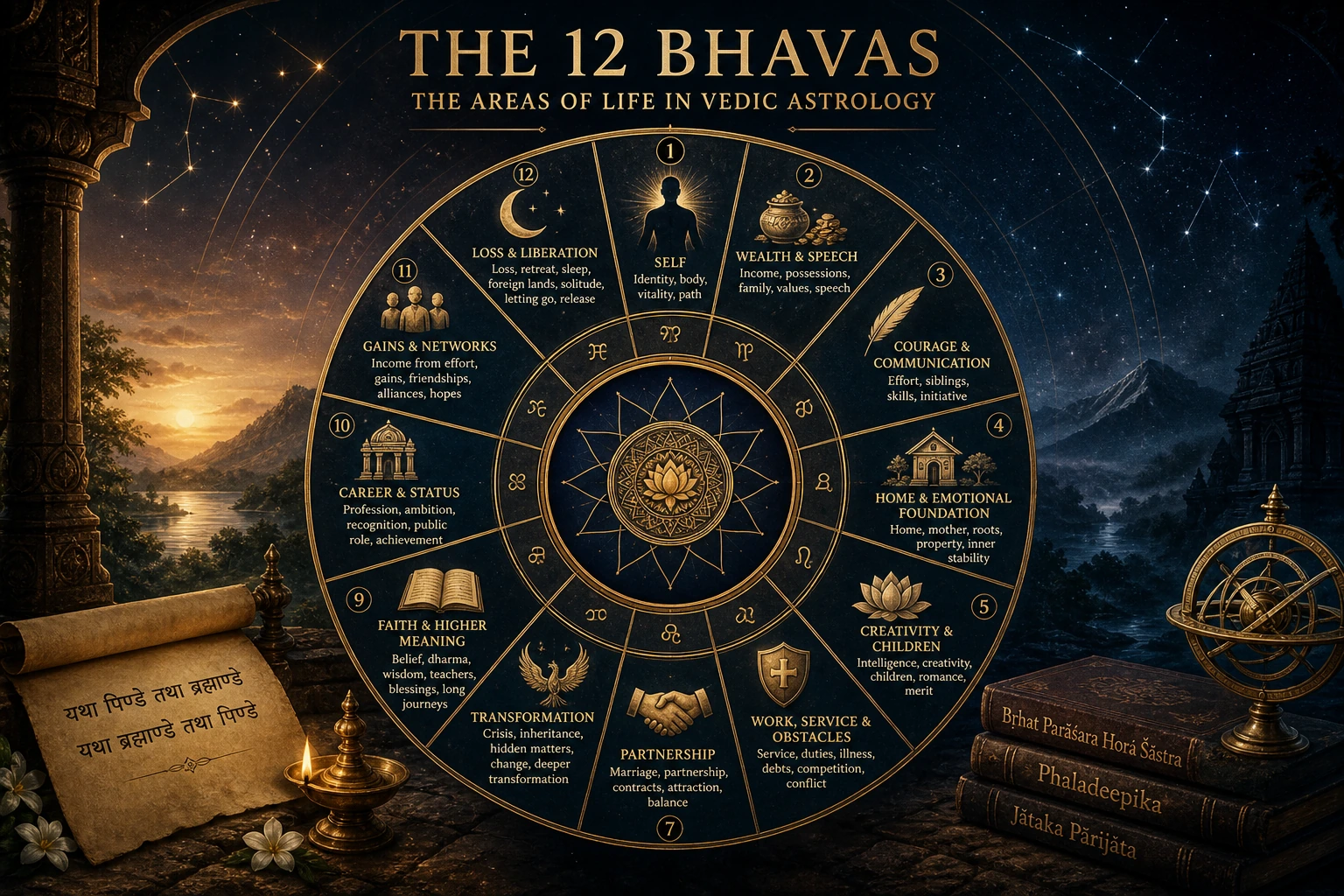
The 12 Bhavas show where the symbolic energy of a Vedic birth chart becomes visible in real life.
What Are Bhavas in Vedic Astrology?
Bhavas are the 12 houses of the Vedic birth chart. Each Bhava governs a different sphere of life, such as identity, possessions, communication, home, children, health, marriage, transformation, fortune, career, gains, and liberation. The Bhavas show where the karma of the chart becomes visible in practical life.
Bhavas Show Life Areas
They reveal which part of life is being activated, such as relationships, work, family, health, money, learning, or spiritual retreat.
Bhavas Make the Chart Concrete
Without the houses, astrology stays abstract. The Bhavas show where life is experienced in specific, practical, real-world terms.
Bhavas Work with Signs and Grahas
The sign colours the house, and the Grahas activate it. Together, they create the full meaning of a chart placement.
Why the Bhavas Matter
In Vedic astrology, the houses are not secondary details. They are one of the main structures of chart interpretation. A planet may be naturally supportive or challenging, but its practical expression depends greatly on the Bhava it occupies, the Bhavas it rules, and the strength of the chart as a whole.
This is why the Bhavas in Vedic astrology are central to reading a birth chart. They show whether the main focus of a life is likely to be self-development, family, wealth, service, partnership, achievement, wisdom, or release.
At ZodiacRoots, we treat the Bhavas as the “stage” of the chart. The signs describe the style, the Grahas describe the actors, and the Bhavas describe the setting where the story becomes personal.
Bhavas and Lived Experience
The houses describe the domains of life where karma becomes visible. They show where events happen, where lessons develop, and where attention tends to return again and again.
For example, the 7th Bhava does not only describe marriage in a narrow sense. It can describe partnership patterns, negotiation, attraction, contracts, and the way a person learns through “the other”. The 10th Bhava does not only describe a job title. It can describe responsibility, public contribution, ambition, reputation, and the kind of work through which a person becomes visible.
The 12 Bhavas of Vedic Astrology
Each house governs a core area of life and helps reveal where growth, responsibility, tension, or opportunity are likely to appear.
Bhavas at a Glance
This table gives a simple overview of the 12 houses in Vedic astrology and the life themes commonly associated with each one.
| Bhava | Main Theme | Key Life Areas |
|---|---|---|
| 1st Bhava | Self and vitality | Identity, body, appearance, temperament, life direction. |
| 2nd Bhava | Wealth and speech | Money, family, food, values, voice, accumulated resources. |
| 3rd Bhava | Effort and courage | Communication, siblings, skills, writing, short journeys. |
| 4th Bhava | Home and roots | Mother, property, emotional foundation, inner peace. |
| 5th Bhava | Creativity and intelligence | Children, romance, merit, learning, inspiration. |
| 6th Bhava | Service and obstacles | Health routines, debts, duties, competition, conflict. |
| 7th Bhava | Partnership | Marriage, contracts, business partners, attraction, negotiation. |
| 8th Bhava | Transformation | Hidden matters, inheritance, crisis, vulnerability, deep change. |
| 9th Bhava | Dharma and wisdom | Faith, teachers, ethics, higher learning, long journeys. |
| 10th Bhava | Career and public role | Profession, authority, reputation, responsibility, achievement. |
| 11th Bhava | Gains and networks | Friends, alliances, income from effort, hopes, communities. |
| 12th Bhava | Release and liberation | Solitude, retreat, sleep, foreign lands, loss, spiritual surrender. |
How the Bhavas Are Read in a Chart
A house is interpreted through several layers: the sign occupying the house, the planet ruling that sign, any Grahas placed in the house, the aspects influencing it, and the overall strength of the chart. This is why the same Bhava can look very different from one chart to another.
For example, the 10th house always relates to career and public role, but the quality of that experience depends on which Grahas occupy it, which planet rules it, and how strong or challenged those influences are.
A strong 10th Bhava may describe visibility, responsibility, ambition, or social contribution. A more difficult 10th Bhava may still bring achievement, but often through pressure, delays, authority issues, or the need to develop maturity over time.
Why the Ascendant Matters for Bhavas
The Bhavas begin from the Lagna, or Ascendant. This makes the Rising sign crucial, because it determines which signs fall into which houses.
Change the Lagna, and the whole house structure changes. That is why exact birth time is so important in Vedic astrology.
Bhavas and Karma
The houses show where karma is most likely to be experienced. Some houses feel supportive and expansive, while others bring effort, complexity, testing, or release.
Together, the Bhavas reveal where life asks for courage, patience, devotion, maturity, and transformation.
Bhavas, Grahas and Rashi: The Three-Part Reading
A practical way to understand Vedic astrology is to separate three questions:
- Bhava: where is the life theme happening?
- Graha: what planetary force is acting there?
- Rashi: how does that force express itself?
This is why a chart cannot be read from one factor alone. A planet in a house is not enough. The sign, ruler, dignity, aspects, and broader chart context all matter. The Bhavas give the location, but the full meaning comes from synthesis.
Key Facts About Bhavas
- There are 12 Bhavas in Vedic astrology.
- Each Bhava governs a distinct area of life.
- The Bhavas show where life themes play out in practical experience.
- They must be read together with signs, Grahas, aspects, and house rulers.
- The house system begins from the Lagna, or Ascendant.
- Accurate birth time is especially important because it affects the Ascendant and the house structure.
- The same planet can express very differently depending on the Bhava it occupies.
External Resources on Jyotish and Vedic Astrology
For broader historical context, you can explore the Encyclopaedia Britannica overview of Jyotisha, the traditional Indian system of astrology and astronomy. For readers who want to go deeper into classical source material, the Brihat Parashara Hora Shastra archive edition is one of the better-known traditional texts associated with Vedic astrology.
These external references are useful for context, but the ZodiacRoots approach remains practical and comparative: we use Vedic astrology as one symbolic root within a wider 8 Roots framework that also includes Western, Chinese, Mayan, Celtic, and Egyptian traditions.
FAQ About Bhavas in Vedic Astrology
What are Bhavas in Vedic astrology?
Bhavas are the 12 houses of the Vedic birth chart. They represent different life areas such as self, wealth, family, work, relationships, spirituality, and loss.
Are Bhavas the same as zodiac signs?
No. Signs describe the quality of energy, while Bhavas describe the area of life where that energy operates. They work together, but they are not the same thing.
Why are the Bhavas important?
The Bhavas are important because they show where the chart becomes real in daily life. They help explain whether karma is likely to show up through career, family, health, marriage, faith, or inner release.
Which Bhava is connected with career?
The 10th Bhava is most directly connected with career, public role, authority, recognition, and responsibility. However, work style can also involve the 6th house of service and the 11th house of gains.
Which Bhava is connected with marriage?
The 7th Bhava is traditionally associated with marriage, partnership, contracts, attraction, and important one-to-one relationships.
Why does birth time matter for Bhavas?
Birth time matters because the Bhavas begin from the Lagna, or Ascendant. If the birth time changes, the Ascendant can change, and the entire house structure may shift.
How does ZodiacRoots use Bhavas?
ZodiacRoots uses Bhavas as part of the Vedic layer of the wider 8 Roots method. They help show where a person’s symbolic patterns become visible in practical life, especially when combined with Sun sign, Moon sign, Rising sign, Rashi, and other ancestral systems.
Explore More Vedic Astrology
Continue with our guides to Vedic astrology, Lagna meaning, Grahas, and Nakshatras.
Discover Where Your Life Themes Unfold
The Bhavas reveal where your chart becomes personal: where you grow, where you struggle, where you relate, and where your deeper life themes are most active.
ZodiacRoots goes beyond a single sign by calculating your 8 astrological roots, including Western Sun sign, Moon sign, Rising sign, Vedic Rashi, Chinese Zodiac, Mayan Seal, Celtic Tree, and Egyptian Guardian.
Calculate Your 8 Roots