
Quick Answer
Astrology Fundamentals are the core principles used to read a chart: zodiac signs, planets, houses, aspects, orbs, angles, house systems, and exact birth data. If you want to understand a birth chart, the 12 houses in astrology, how planets act in a chart, or how to read a natal chart wheel, this hub gives you both the technical foundation and the interactive tools needed to learn by seeing astrology in action.
What Are Astrology Fundamentals?
Astrology can look complex from the outside, but its foundations are structured. A chart is not just a collection of signs or a loose set of personality labels. It is a symbolic map built from interlocking layers: where the planets were placed, which signs they occupied, which houses they activated, how they related to one another through aspects, and how close those aspects are through orbs.
At ZodiacRoots, we treat Astrology Fundamentals as the language beneath interpretation. These fundamentals help explain why a natal chart has depth, why a Sun sign alone is never the full story, why the Moon sign changes emotional tone, and why exact birth time matters whenever the Ascendant and houses are involved.
This page introduces Astrology Fundamentals clearly. It is not intended to replace lived interpretation, but to give you a stable framework for understanding how astrology is actually read.
Featured Guides in This Hub
These guides function as the core child pages of the Astrology Fundamentals hub. Together, they move the reader from chart structure into technical interpretation, sign meaning, planetary function, and practical daily astrology.
Interactive Astrology Tools
Astrology becomes easier to understand when you can see it in action. ZodiacRoots combines technical explanation with practical tools that let you generate a natal chart, explore the chart wheel visually, test how birth time changes the structure, study planetary meaning, and follow the major astrological timings of 2026 and 2027.
Used together, these tools create a practical learning path: generate your chart, understand its structure, explore it interactively, study the planets within it, and then follow the wider cycles that shape astrological timing.
The Core Pillars of Astrology Fundamentals
1. Zodiac Signs
Signs describe style, tone, and mode of expression. They show how a planetary function operates. Mars in Aries acts differently from Mars in Pisces, even though both are still Mars.
The 12 signs are also organized by elements and modalities. Elements describe the base energy: Fire, Earth, Air, and Water. Modalities describe how that energy acts: Cardinal initiates, Fixed stabilizes, and Mutable adapts.
To explore the signs in a practical daily format, visit the Daily Horoscope by Zodiac Sign hub, where each sign has its own daily guide. For deeper sign structure, continue with Sun Sign Meaning and Sun and Moon Sign Combinations.
2. Planets
Planets represent functions and drives: identity, emotion, thought, desire, discipline, expansion, and transformation. They show what is acting in the chart.
Traditional astrology works with the seven visible planets: Sun, Moon, Mercury, Venus, Mars, Jupiter, and Saturn. Modern astrology adds Uranus, Neptune, and Pluto, which move more slowly and often describe wider generational themes.
A natal retrograde planet often expresses itself in a more inward, unusual, delayed, or reflective way. It is not weaker by default, but it is often processed differently.
For a dedicated interactive guide, explore Planets in Astrology: Planet Meanings Explained, including planetary actions such as retrograde, direct, square, trine, opposition, New Moon, Full Moon and eclipse.
3. Houses
Houses indicate the life area where energy shows up. They answer where experience becomes concrete: relationships, work, family, visibility, belief, creativity, and more.
House positions depend on the birth time and also on the house system used. Placidus is common in modern Western astrology, while Whole Sign is widely used in traditional and Hellenistic approaches. For a deeper breakdown, see Astrology Houses: The 12 Houses Explained and House Cusp Meaning in Astrology.
4. Aspects and Orbs
Aspects describe the relationship between planets. They reveal ease, tension, friction, support, pressure, and integration. They explain how different parts of the psyche interact.
An aspect is not only about angle. It is also about orb, the distance from exactness. Smaller orbs usually indicate stronger and more immediate expression. Explore this further in Astrology Aspects Explained and Astrology Orbs Explained.
Birth Chart and Natal Wheel
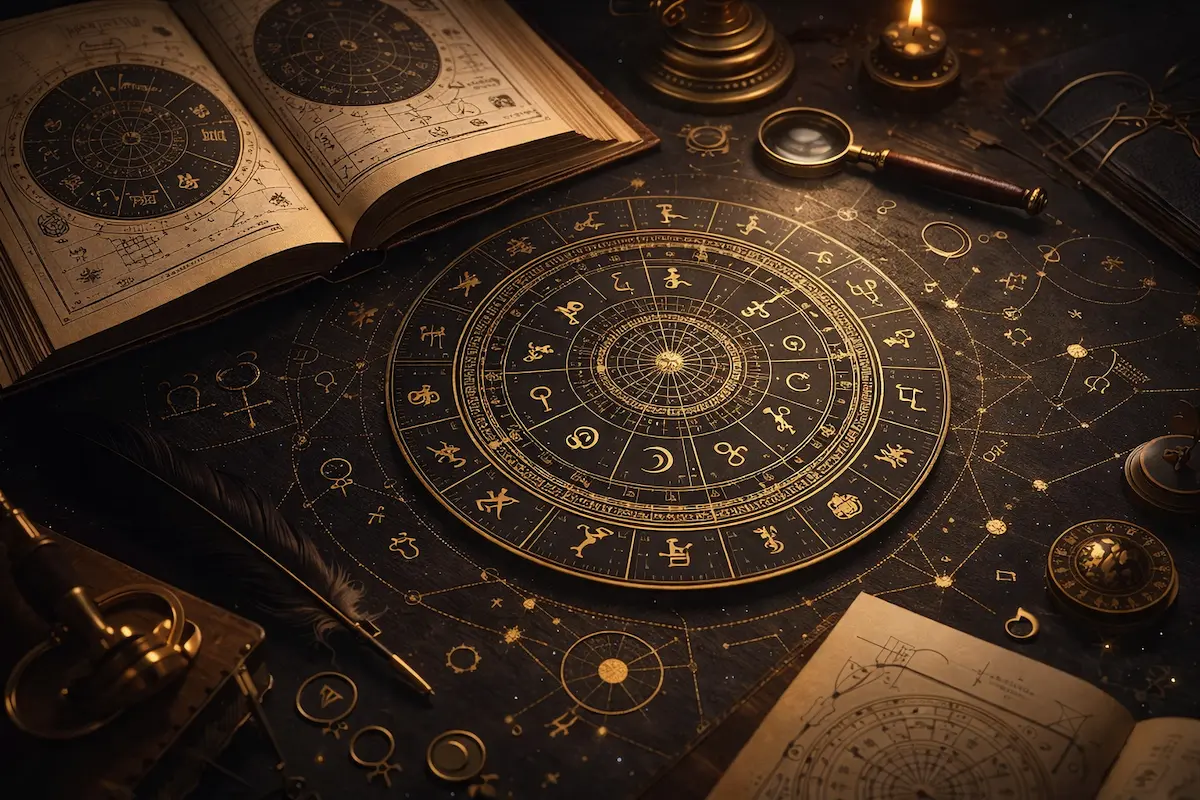
A birth chart is the symbolic map of the sky for the exact moment and location of birth. A natal wheel is the circular visual form used to display that chart. The wheel is not decoration. It is a technical layout that shows sign positions, house divisions, planetary placements, and aspect relationships in one integrated structure.
If you want a deeper practical guide, read How to Interpret a Birth Chart and Natal Chart Wheel Explained. These pages show how astrologers move from wheel structure into layered interpretation, including the Sun, Moon, Ascendant, houses, aspects, and chart patterns.
A good chart reading begins by understanding the wheel as structure, not as ornament. That is one of the central lessons of Astrology Fundamentals.
Sun, Moon, and Rising: Why They Matter
For many readers, the easiest way into astrology is through the triad of Sun, Moon, and Rising sign. These are central because they cover identity, emotional life, and outward style.
Sun
The Sun describes conscious identity, vitality, and the kind of core purpose a person tends to build around.
Moon
The Moon shows emotional patterning, instinctive response, need for safety, and the way experience is inwardly processed.
Rising
The Rising sign describes approach, presentation, and the angle through which the chart opens into lived reality.
But no serious interpretation stops there. The full chart deepens, complicates, and often corrects first impressions. For a deeper triad-based reading, see The Big 3 Astrology Triad, How Sun and Moon Signs Work Together, and Sun and Moon Sign Combinations.
The Four Angles of the Chart
The angles are among the most important structural points in a chart. They anchor the wheel and show where the chart opens into embodiment, relationships, public direction, and private roots. Their precision depends heavily on accurate birth time, which is why birth time uncertainty can materially change interpretation.
Why House Systems and Orbs Matter
House Systems
The same chart can place a planet in one house under Placidus and in another under Whole Sign. This can materially change interpretation. See House Systems Explained.
Orbs
Orbs measure how close an aspect is to exactness. Smaller orbs usually signal stronger and more active aspect patterns. See Astrology Orbs Explained.
These two topics are often underexplained in beginner content, but they are essential once you move from basic sign descriptions into real chart reading.
Astrology Fundamentals vs The 8 Roots Method
Astrology Fundamentals explains the technical language: charts, wheels, signs, planets, houses, aspects, orbs, and angles. It gives you the grammar of interpretation.
The 8 Roots Method is the ZodiacRoots framework that goes further by combining multiple symbolic traditions: Western, Vedic, Chinese, Mayan, Celtic, and Egyptian streams into one coherent interpretive approach.
In other words, this page teaches the foundations. The 8 Roots method shows how those foundations can be expanded into a broader and more layered reading. You can then move from technical basics into practical chart interpretation, Big 3 analysis, and the Premium Astrology Report.
External References
For broader technical and historical context, see Britannica’s overview of astrology, Britannica’s background on the zodiac, Wikipedia’s summary of astrological aspects, and Wikipedia’s overview of astrological houses.
For chart calculation and technical background used widely by astrologers, see Astro.com. These sources provide broader reference context, while ZodiacRoots focuses on structured interpretation and the integration of Astrology Fundamentals into the wider 8 Roots method.
Explore the Fundamentals
Frequently Asked Questions
This hub is designed to help you move from “I recognise the symbols” to “I understand how a chart is built and how to explore it”. These questions point you toward the right guide or tool depending on where you are in the learning process.
Where should I start if I am completely new to birth charts?
Start with the structure: read Natal Chart Wheel Explained, then use the Free Birth Chart Generator to create your own chart. Once you can recognise signs, houses, planets and lines, the rest of astrology becomes far easier to follow.
What is the difference between a birth chart and a natal wheel?
A birth chart is the astrological map calculated from birth data. A natal wheel is the circular visual format that displays that map. The wheel shows signs, houses, planets, angles and aspect lines in one integrated image.
Which ZodiacRoots tool helps me learn directly inside the chart?
Use the Interactive Birth Chart Software. It lets you click planets, zodiac signs, houses and aspect lines directly inside the natal wheel, so the chart itself becomes the learning interface.
Why does birth time matter so much in astrology?
Birth time affects the Ascendant, the house layout and chart angles. Even a modest time shift can change the visual and interpretive structure of the chart. See Birth Time Uncertainty and the Birth Chart Visualizer.
What should I study first: planets, signs, houses or aspects?
A strong order is: planets first, then signs, then houses, and finally aspects. Planets show what acts, signs show how it acts, houses show where it acts, and aspects show how chart factors interact. Continue with Planets in Astrology, Astrology Houses, and Astrology Aspects Explained.
Can I understand astrology through Sun sign alone?
No. The Sun is important, but it is only one layer. A fuller reading also needs the Moon, Rising sign, houses, planetary placements and aspect patterns. A useful next step is The Big 3 Astrology Triad.
Why do aspects and orbs matter in a real chart?
Aspects reveal the relationships between planets: flow, pressure, conflict, cooperation or integration. Orbs show how close an aspect is to exactness, which helps determine interpretive strength. See Astrology Aspects Explained and Astrology Orbs Explained.
Where can I follow major astrological timings in 2026 and 2027?
Use the Astrology Calendar 2026–2027 to follow Moon phases, eclipses, Mercury retrogrades and major planetary shifts. It complements chart learning by showing astrology as a living timing system, not just a natal snapshot.
How does Astrology Fundamentals connect with the 8 Roots method?
Astrology Fundamentals teaches the technical grammar of chart interpretation. The 8 Roots method expands that foundation into ZodiacRoots’ broader multi-tradition framework, combining Western, Vedic, Chinese, Mayan, Celtic and Egyptian symbolic systems.
What is the best learning path through this hub?
A practical route is: understand the natal chart wheel, create your chart with the birth chart generator, explore it with the interactive software, then deepen your interpretation through planets, houses, aspects, orbs and birth time accuracy.
Foundations First, Interpretation After
The clearer your understanding of Astrology Fundamentals, the more meaningful every chart becomes. Technical structure does not diminish mystery. It gives mystery form.
Explore More Mayan Wisdom
Go deeper into your Mayan sign, sacred seal, galactic tone and Tzolkin path.