Astrology Aspects Explained: Angles, Orbs, Techniques & Real Interpretation
A complete technical guide to major and minor astrology aspects, orb theory, aspect patterns, and practical chart interpretation.
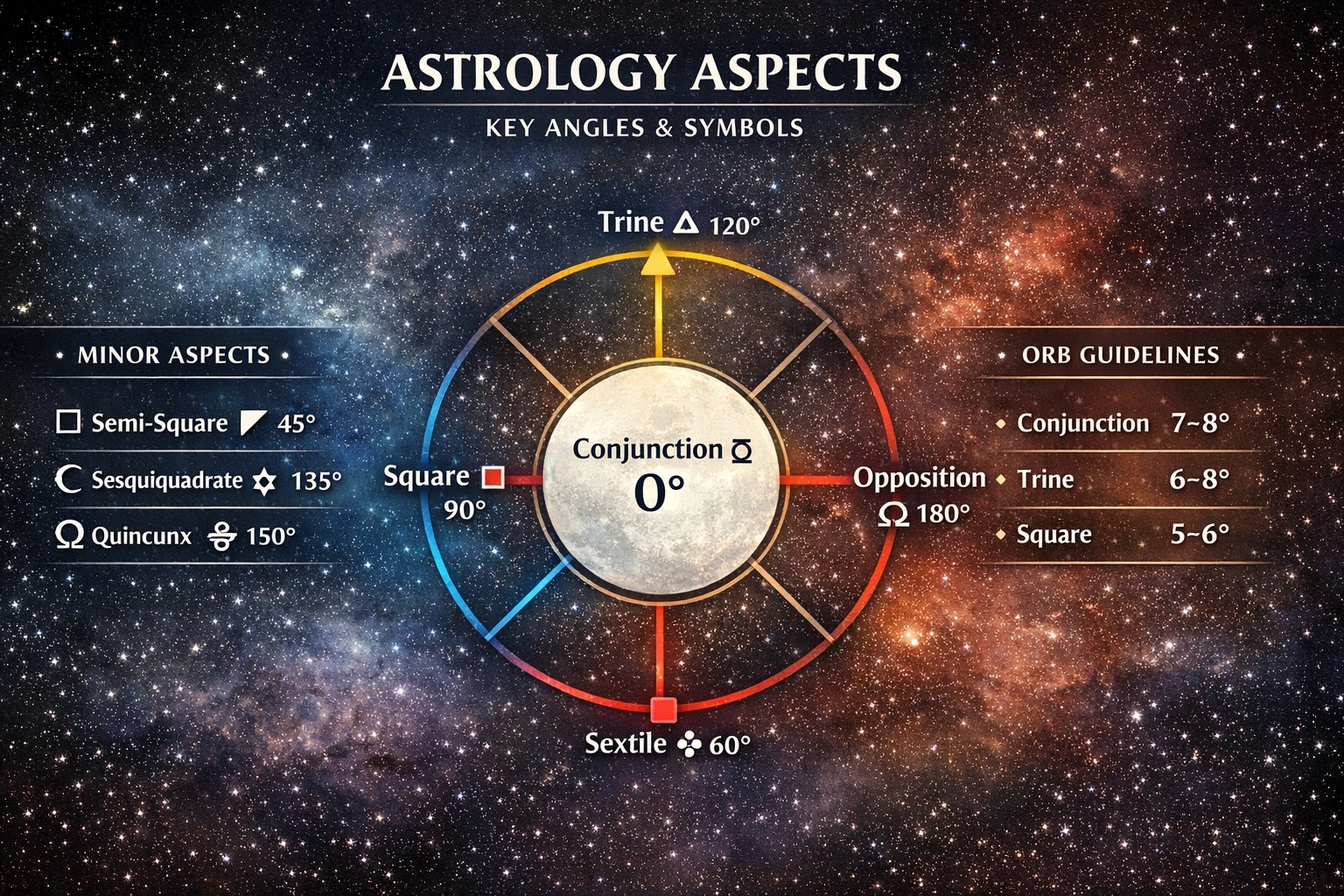
Quick Answer: Astrology aspects are the angular relationships between planets and chart points that show how different parts of a birth chart interact through harmony, tension, polarity, adjustment, or creative activation.
This astrology aspects explained guide shows how angular relationships between planets create harmony, tension, polarity, and growth in a birth chart.
Astrology aspects are one of the most important foundations of chart interpretation. Without astrology aspects, a birth chart is only a list of placements. With astrology aspects, the chart becomes a living system of pressure, talent, contrast, flow, and development.
At ZodiacRoots, astrology aspects are not read as isolated geometry. They are interpreted as part of a wider symbolic pattern, where Western technique, Vedic perspective, and elemental logic can deepen the meaning of the same angle.
Why astrology aspects matter: signs describe what an energy is, but astrology aspects describe how those energies behave together. That is why astrology aspects explained properly can transform a confusing chart into something readable and practical.
Explore This Aspect Cluster
Use this page as your central guide, then deepen your understanding through the main aspect pages and technique pages below.
Major Aspects
- Conjunction Meaning in Astrology
- Sextile Meaning in Astrology
- Square Meaning in Astrology
- Trine Meaning in Astrology
- Opposition Meaning in Astrology
Technique & Interpretation
- Astrology Orbs
- Hard vs Soft Aspects in Astrology
- Aspect Patterns in Astrology
- Quincunx Meaning in Astrology
How to Use This Guide
- Learn the five major aspects first — conjunction, sextile, square, trine, and opposition.
- Understand orb strength — exact aspects usually speak louder than wide ones.
- Read patterns before making judgments — a square inside a T-square does not behave like an isolated square.
- Use chart context — signs, houses, and planetary condition modify every aspect.
ZodiacRoots editorial priority: we prioritise major aspects first, then orb strength, then configurations, and only after that minor or harmonic aspects. This keeps chart reading practical, structured, and psychologically grounded.
What Are Astrology Aspects?
Astrology aspects are geometric relationships between planets, angles, and sometimes sensitive points such as Chiron, the Lunar Nodes, or Lilith. These angular relationships show whether energies cooperate easily, clash, compensate for each other, or require adjustment.
In simple terms, astrology aspects explained properly means understanding how planetary angles shape the flow of the entire chart.
Classical astrology formalised astrology aspects through geometry, and later harmonic astrology expanded the logic behind less common angles. For further study, see John Addey, Robert Hand, and Planets in Aspect by Robert Pelletier.
For readers who want stronger chart basics before diving deeper into astrology aspects, see how to interpret a birth chart and astrology houses meaning.
Major Astrology Aspects
One reason astrology aspects explained can feel confusing at first is that each aspect combines geometry, symbolism, orb strength, and chart context.
| Aspect | Angle | Nature |
|---|---|---|
| Conjunction ☌ | 0° | Fusion, intensity, concentration |
| Sextile ⚹ | 60° | Opportunity, activation, cooperation |
| Square □ | 90° | Tension, friction, pressure to act |
| Trine △ | 120° | Harmony, ease, natural flow |
| Opposition ☍ | 180° | Polarity, projection, complementarity |
Minor & Harmonic Astrology Aspects
| Aspect | Angle | Meaning |
|---|---|---|
| Semisextile | 30° | Subtle connection, quiet adjustment, small opening |
| Semi-square | 45° | Low-grade tension, irritation, internal friction |
| Septile | 51.4° | Mystical focus, obsession, unusual inspiration |
| Semiquintile | 36° | Refined creativity, delicate shaping force |
| Quintile | 72° | Creativity, talent, pattern-making |
| Biquintile | 144° | Advanced creative structuring, style, pattern and design |
| Sesquiquadrate | 135° | Persistent strain, recurring pressure |
| Quincunx | 150° | Mismatch, adaptation, recalibration |
The quintile family is especially important in modern harmonic work. The biquintile is usually treated as part of the same creative 5th-harmonic logic as the quintile itself.
Advanced Note: some astrologers use harmonic aspects such as the quintile, biquintile, and septile regularly, while others focus almost entirely on major astrology aspects. This reflects different schools of interpretation rather than a single universally accepted practice.
The Geometric Logic Behind Astrology Aspects
| Aspect | Underlying Logic | Interpretive Key |
|---|---|---|
| Trine | Usually links signs of the same element | Ease because energies speak the same elemental language |
| Square | Usually links signs of the same mode | Conflict because both energies push in similar but competing ways |
| Opposition | Links opposite signs | Awareness through contrast and complement |
| Sextile | Often links compatible elements | Potential that needs activation |
| Semisextile | Adjacent signs | Nearness without full compatibility |
| Quincunx | Disconnected sign logic | Adjustment without natural integration |
Sign Quality Modifies the Aspect
Cardinal squares tend to feel more explosive, immediate, and action-driven.
Fixed squares are more stubborn, entrenched, resistant, and difficult to release.
Mutable squares are more adaptive, scattered, psychologically flexible, or inconsistent.
So even when the angle is the same, the lived experience of astrology aspects changes depending on the signs involved. This is one of the biggest reasons why astrology aspects explained only by angle can sound too simplistic.
Aspect Orbs (Advanced Guidelines)
A strong astrology aspects explained approach always includes orb theory, because exact aspects and wide aspects do not act with the same intensity.
| Aspect / Point | Suggested Orb | Natal / Transit Notes |
|---|---|---|
| Conjunction / Opposition with Sun or Moon | up to 10° | Natal can be wide; transit usually read tighter |
| Conjunction (other planets) | 7–8° | Transit often strongest within 1–2° |
| Opposition | 7–8° | Transit often strongest within 1–2° |
| Trine | 6–8° | Transit often strongest within 1–2° |
| Square | 5–6° | Transit often strongest within 1–2° |
| Sextile | 5–6° | Transit usually interpreted more tightly |
| Semisextile / Semi-square / Sesquiquadrate / Quincunx | 1–3° | Usually kept tight in both natal and transit work |
| Quintile / Semiquintile / Biquintile / Septile | 1–2° | Often restricted to tight natal work |
| Chiron | 2–3° | Usually tighter in transit |
| Lunar Nodes | up to 3° | Often kept tight for meaningful work |
| Lilith | about 2–3° | Interpret with restraint and context |
| Ascendant / Midheaven | 2–3° | Very tight orbs preferred; angles receive aspects very strongly |
| Uranus / Neptune / Pluto aspects | often tighter, about 2–3° when subtlety matters | Especially important in transit timing |
Important: orb practice is partly conventional. Different astrologers use different thresholds, especially for minor astrology aspects. That means orb choice is best understood as an interpretive convention rather than a universal law.
For a more critical, data-aware perspective on Gauquelin-related statistical material and historical datasets, see the Open Gauquelin Database. The broader debate shows why technique in astrology often develops through tradition, practice, and selective replication rather than absolute consensus.
Exact, Partile, and Exact by Minute
Partile usually means the planets are in the same degree number.
Exact by minute of arc is more precise still. Since 1 degree = 60 arcminutes, an aspect at 15°30′ to 15°30′ is exact not just by degree, but by minute.
This is why astrology aspects with a very tight orb often feel much stronger than the same astrology aspects with a loose orb.
Out-of-Sign Aspects
An aspect can exist mathematically even when the planets are in different signs.
Example: 29° Aries and 1° Taurus still form a conjunction by orb, even though they are not in the same sign.
This is a common beginner mistake: assuming astrology aspects only count when the planets are in the “expected” sign relationship. In practice, degree distance comes first.
Common Mistake: a trine is not cancelled just because it looks visually messy in the signs, and a conjunction is not cancelled simply because it crosses a sign boundary. Astrology aspects are measured by longitude and orb, not by visual neatness alone.
Applying vs Separating Astrology Aspects
Applying aspect: the planets are moving toward exactness, so the aspect often feels more dynamic, developing, or future-oriented.
Separating aspect: exactness has already passed, so the pattern may feel more ingrained, habitual, or linked to prior experience.
How to Calculate Astrology Aspects Manually
Subtract one longitude from the other.
Example with degrees and minutes:
Planet A = 15°30′ Aries
Planet B = 15°30′ Leo
The distance is 120° exactly, so this is an exact trine.
Decimal shortcut: 15°30′ = 15.5°. This is useful when software displays decimal longitudes rather than degrees and minutes.
Mirror Aspects and Zodiac Symmetry
Some astrologers also note mirror relationships in the zodiac circle:
- 30° reflects 150°
- 45° reflects 135°
- 60° and 120° form a broader symmetry of compatibility and ease
This helps explain why some astrology aspects feel related, even when one is softer and the other more demanding.
Natal, Transit, and Synastry Astrology Aspects
Natal aspects describe your core inner wiring.
Transit aspects show temporary pressures, openings, cycles, and timing patterns.
Synastry aspects compare two charts and show how two people stimulate, soothe, challenge, attract, or destabilise each other.
So astrology aspects are not only for natal reading. They are essential in relationship analysis as well. If that is your main interest, see also Zodiac Compatibility and can compatibility be judged only by Sun sign?
Aspect Grid (How to Read It)
If you want astrology aspects explained in a practical way, the aspect grid is one of the fastest tools for seeing how the chart works as a whole.
The aspect grid is the fastest way to identify planetary relationships in a chart.
Mini example:
Sun □ Mars → identity clashes with action style
Moon △ Venus → emotional ease and relational softness
Moon ☍ Saturn → emotional need meets duty, restraint, or maturity
On Astro.com, you can generate a chart and then review the aspect table through the chart tools and additional table options. For software with customisable orb settings, see Astro Gold and Planetdance.
Hard vs Soft Aspects (The Real Difference)
Soft aspects such as the trine and sextile create ease, talent, and natural flow.
Hard aspects such as the square and opposition create friction, pressure, contrast, and growth.
However, this is where many beginners misunderstand astrology aspects.
Hard aspects are often the engine of success. They create friction that forces development, discipline, and action.
Soft aspects can create stagnation. When energy flows too easily, it may never be activated fully.
Common Misconception: a trine is not always “better” than a square. Many high achievers have strong square patterns because tension creates movement.
How to Read Aspects (Priority System)
If you feel overwhelmed by astrology aspects, use this reading hierarchy:
- Start with the luminaries — Sun and Moon
- Focus on the tightest orbs — the most exact aspects
- Then analyse outer planets affecting personal planets
This simple method turns astrology aspects explained in theory into a practical reading sequence.
Aspect Patterns (Geometric Configurations)
In real astrology, aspects rarely act in isolation. They form larger geometric structures that shape how energy flows across the chart.
| Pattern | Structure | Meaning |
|---|---|---|
| T-Square | Two squares + one opposition | High tension, drive, constant pressure to act |
| Grand Trine | Three trines | Natural talent, ease, but risk of inertia |
| Yod (Finger of God) | Two quincunxes + one sextile | Fated adjustment, redirection, sensitivity |
| Stellium | 3+ conjunctions | Extreme concentration of energy in one area |
These patterns often reshape the meaning of individual astrology aspects. A single square inside a T-square behaves very differently from an isolated square.
Advanced Insight: astrology aspects explained without configurations are incomplete. Real charts operate through networks of aspects, not isolated lines.
Interpretation Examples
Mars square Saturn: blocked impulse, delay, pressure, discipline, and eventual mastery through persistence.
Moon opposite Saturn: emotional need vs responsibility, often maturing into resilience, seriousness, and stronger emotional boundaries.
Real-world pattern: Mars–Saturn contacts are often associated with individuals who face early frustration and later develop formidable endurance. This is one of the clearest reminders that hard astrology aspects can become sources of mastery rather than defeat.
Mutual Reception
When two planets occupy each other’s signs, they are in mutual reception.
This can modify any aspect between them by creating a stronger feedback loop between the two energies. It often softens friction or strengthens cooperation.
In practice, mutual reception can function almost like an invisible support line. Two planets in square or opposition may still find a more workable expression because each one “knows” how to access the other’s environment.
Parallels and Contra-Parallels
These are based on declination rather than zodiac longitude.
A parallel functions somewhat like a conjunction; a contra-parallel functions somewhat like an opposition.
Many introductory articles on astrology aspects ignore them, but they matter for technical completeness.
Unaspected Planets
A planet with no major aspects can behave in a striking, independent, exaggerated, or highly concentrated way.
It may feel disconnected from the rest of the chart, which is precisely why astrologers often treat it as special.
Void of Course and the “Aspect Desert” Idea
The phrase void of course is used most often for the Moon after its last major applying aspect before changing sign. In broader traditional language, some astrologers also speak of a planet being effectively “void” if it makes no further major application before leaving its sign.
This is not a central doctrine for every modern astrologer, but it is a useful optional note for advanced readers.
Scientific Perspective and Critical Thinking
Michel Gauquelin’s work is often cited because he reported statistical correlations between certain planetary positions and professional groups, especially in the controversial Mars-effect literature. That research concerned placement patterns and angles rather than a direct validation of traditional astrology aspects, but it remains relevant as an example of astrology attracting empirical scrutiny.
Astrology Aspects in the 8 Roots Method
At ZodiacRoots, astrology aspects are not read in isolation.
A square can be psychological in Western terms, karmic in Vedic framing, or interpreted through elemental imbalance when read through a wider symbolic system. That is where the 8 Roots method adds depth: the angle stays the same, but the symbolic language around it becomes richer and more useful.
8 Roots Lens: a Mars–Saturn square in a strictly Western reading may describe frustration and endurance. In a broader ZodiacRoots interpretation, the same aspect can also be framed through karmic discipline, symbolic timing, and multi-tradition elemental imbalance. That gives astrology aspects a more layered interpretive value than a single-system reading alone.
Astrology aspects explained clearly means reading not only the angle itself, but also its orb, sign quality, and symbolic context.
Recommended Tools & Resources
- Astro.com — free charts and aspect tables
- Astro Gold — astrology software with flexible settings
- Planetdance — software/community ecosystem used by technical astrologers
- John Addey writings
- Robert Hand
- Planets in Aspect by Robert Pelletier
- Open Gauquelin Database
Related Guides on ZodiacRoots
- How to Interpret a Birth Chart
- Astrology Houses Meaning
- Zodiac Compatibility
- Can Compatibility Be Judged Only by Sun Sign?
- Birth Time Uncertainty
Final Action
Open your chart and find the most exact astrology aspect in your grid.
Write it down. Observe it consciously over the next 7 days.
Does it behave more like a challenge, a gift, a recurring tension, or a natural talent?
That is why astrology aspects explained well can turn a chart from a list of symbols into a practical map of personality, timing, and development.
Frequently Asked Questions
What is a semisextile in astrology?
A semisextile is a 30° aspect that usually indicates a subtle connection, a small opportunity, or low-level compatibility.
What is a septile in astrology?
A septile is a 51.4° harmonic aspect often associated with inspiration, obsession, unusual focus, or mystical patterning.
What is a biquintile in astrology?
A biquintile is a 144° 5th-harmonic aspect usually linked to creativity, design, shaping intelligence, or refined expressive talent.
Do aspects only count if they happen in the expected signs?
No. Astrology aspects are measured by degree distance, so out-of-sign aspects still count if they are within orb.
What does exact by minute mean?
It means an aspect is exact not only by degree but also by arcminute. One degree equals 60 arcminutes.
Are minor aspects accepted by all astrologers?
No. Some astrologers use them extensively, especially in harmonic work, while others focus mainly on major aspects.
Do astrology aspects matter in synastry too?
Yes. Synastry relies heavily on astrology aspects between two charts to assess attraction, tension, emotional resonance, and compatibility.
Is an aspect invalid if it crosses a sign boundary?
No. If the degree distance and orb are valid, the aspect still exists even when it crosses a sign boundary.
What is a T-square in astrology?
A T-square is a configuration formed by two squares and one opposition. It usually indicates strong tension, pressure, and a powerful drive to act.
Are hard aspects always bad?
No. Hard aspects often become the engine of achievement because they create the friction that pushes growth, discipline, and effort.