Trine Meaning in Astrology: Harmony, Talent and Natural Flow
A premium technical guide to the trine aspect in astrology, including modality, elemental harmony, natal interpretation, synastry, transits, orb strength, and the deeper difference between ease and real mastery.
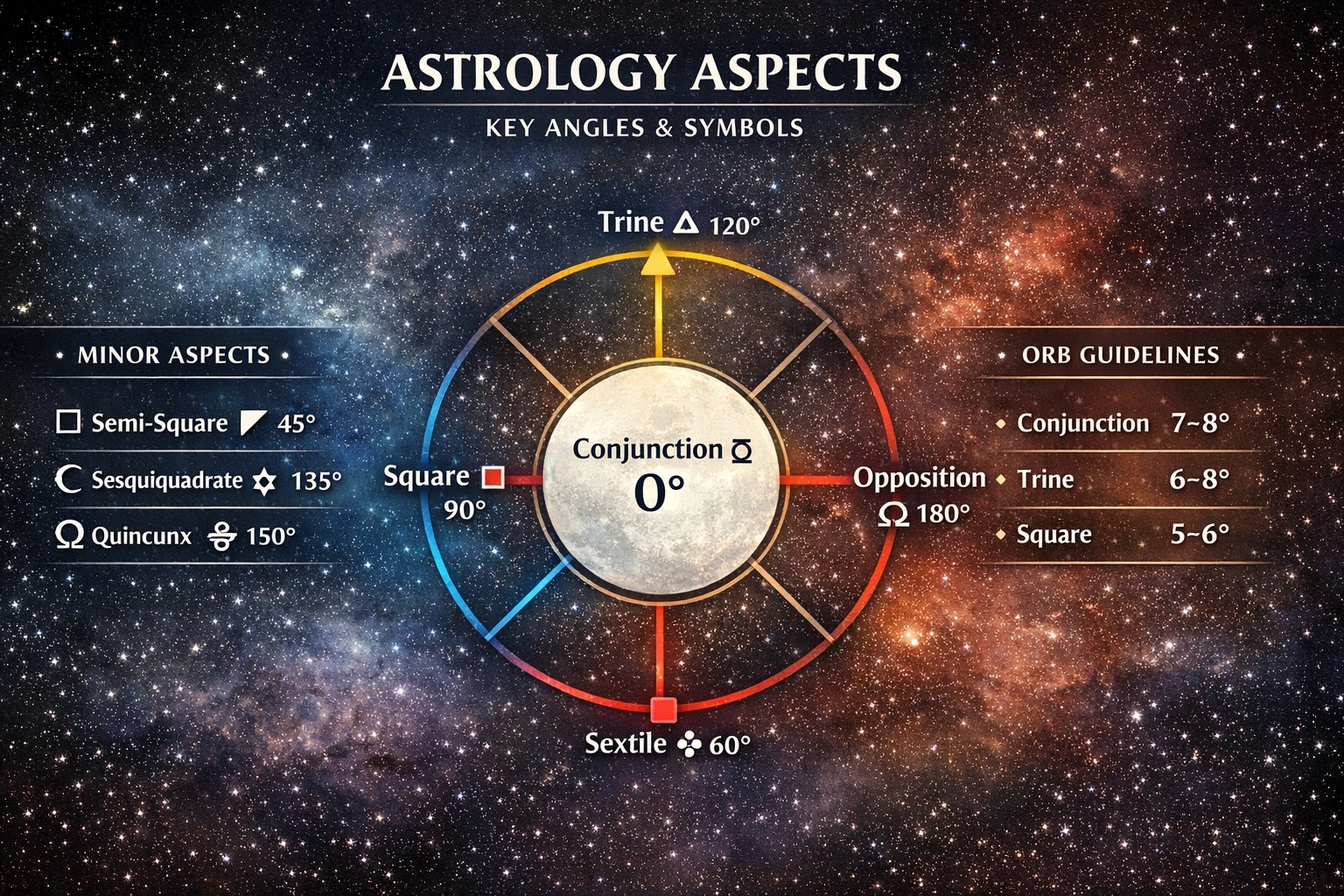
Quick Answer: The trine is a 120° soft aspect that indicates harmony, ease, and natural flow between two planets or chart points. The energies cooperate easily, but that ease can become either talent or complacency, depending on how consciously it is used.
The trine meaning in astrology is one of the most important foundations of aspect interpretation. A trine shows where energy moves smoothly, where two parts of the chart speak the same symbolic language, and where development happens with less friction. But this aspect should not be simplified into “good luck.” A trine often shows support, fluency, and confidence, yet it can also show underused ability: a gift that remains untrained because it comes too easily.
At ZodiacRoots, we read the trine aspect in astrology as a channel of natural coherence. It shows where the chart already has inner agreement. The real interpretive question is whether that ease becomes expression, skill, and contribution, or whether it stays dormant as unrealised potential.
Core principle: the trine is not just “easy energy.” It is aligned energy. It creates flow because the two points involved cooperate naturally. The result can be grace, talent, confidence, and recovery, but also inertia if the gift is never consciously developed.
Table of Contents
- What Is a Trine in Astrology?
- Trine at a Glance
- Why the Trine Is a Soft Aspect
- The Geometric Logic of the Trine
- How Modality Changes the Trine
- Elemental Harmony in Trine Aspects
- Gift vs Complacency
- The Risk of Stagnation in a Trine
- Trine Meaning in the Natal Chart
- How Houses Change the Meaning of a Trine
- Common Planetary Trine Combinations
- Out-of-Sign Trines
- Trine Meaning in Synastry
- Trine Meaning in Transits
- Applying vs Separating Trines
- Orb Theory for Trines
- Grand Trine and Other Patterns
- Trine vs Sextile, Square and Opposition
- Real-World Examples
- Trine Meaning in Astrology in the 8 Roots Method
- Related Guides and External References
What Is a Trine in Astrology?
A trine is a 120° angular relationship between two planets, angles, or sensitive points. In most astrological traditions, it is treated as a soft aspect because it describes ease, resonance, cooperation, and flow rather than friction or direct confrontation.
The trine meaning in astrology is not simply comfort. A trine shows that two parts of the chart can work together without much resistance. The exchange feels coherent, intelligible, and naturally compatible.
In practice, a trine often shows:
- natural talent
- ease of expression
- recovery and resilience
- supportive inner coherence
- an ability that may emerge without excessive struggle
This is why the trine aspect in astrology is so valued. It usually shows where life flows more easily. But serious interpretation also asks whether that flow is active and productive, or simply taken for granted.
Trine at a Glance
| Aspect | Angle | Type | What It Does | Lower Expression | Mastery Path |
|---|---|---|---|---|---|
| Trine | 120° | Soft aspect | Creates harmony and natural flow | Passivity, complacency, underused gifts | Refined talent, ease with purpose, graceful mastery |
Why the Trine Is a Soft Aspect
The trine is called a soft aspect because the energies involved usually cooperate easily. Instead of colliding, they reinforce each other. Instead of compressing, they circulate. Instead of forcing development through pain, they allow development through alignment.
That ease can appear as:
- confidence without strain
- skills that arrive naturally
- psychological recovery after difficulty
- supportive rapport between two parts of the chart
- an ability to move forward without constant internal resistance
But a soft aspect is not automatically superior. The trine meaning in astrology becomes more accurate when we recognise that soft aspects help things flow, but do not always force them to mature.
Common mistake: many beginners assume a trine is always more valuable than a square. In real chart work, a trine may show beautiful potential, but a square often creates the pressure that turns potential into output.
The Geometric Logic of the Trine
The trine usually connects signs of the same element. That is why it feels so internally coherent. The two signs already speak a similar symbolic language, so the exchange between them tends to feel natural.
Visually, the trine creates one of the most stable harmonic shapes in the zodiac circle. Where the square compresses and the opposition divides, the trine tends to suggest circulation, continuity, and an easier exchange of symbolic energy.
| Trine Type | Signs Involved | Typical Dynamic |
|---|---|---|
| Fire trine | Aries, Leo, Sagittarius | Confidence, drive, spontaneity, creative force |
| Earth trine | Taurus, Virgo, Capricorn | Practical stability, method, consistency, material competence |
| Air trine | Gemini, Libra, Aquarius | Mental ease, communication, social intelligence, conceptual fluency |
| Water trine | Cancer, Scorpio, Pisces | Emotional flow, sensitivity, intuition, psychic receptivity |
So the trine meaning in astrology is never just “120 degrees = good.” The angle matters, but the element explains what kind of flow is taking place.
How Modality Changes the Trine
Although the trine is primarily understood through element, modality still shapes how the ease is expressed. A fire trine involving cardinal, fixed, or mutable signs does not feel identical in lived experience.
Cardinal Trine Expression
When a trine strongly involves cardinal energy, the ease often helps initiative, leadership, response speed, and practical momentum. This is flow that likes movement and visible action.
Fixed Trine Expression
When a trine strongly involves fixed energy, the flow becomes more stable, loyal, enduring, and concentrated. This can produce deep consistency, but also comfort zones that are hard to leave.
Mutable Trine Expression
When a trine strongly involves mutable energy, the ease often appears as adaptability, interpretation, symbolic intelligence, flexible movement, or intuitive pattern recognition. The risk is drifting instead of directing.
Elemental Harmony in Trine Aspects
Because trines usually work within the same element, the form of harmony changes according to the element involved. This is where the trine meaning in astrology becomes much more precise.
| Element | Form of Harmony | Concrete Example | Developmental Risk |
|---|---|---|---|
| Fire | Enthusiasm, self-belief, expressive momentum | Taking initiative naturally without much hesitation | Overconfidence or lack of discipline |
| Earth | Practical competence, steadiness, reliable building power | Creating systems, routines, or tangible results with ease | Staying too comfortable in what already works |
| Air | Communication, abstraction, social and conceptual fluency | Explaining, connecting, learning, or networking effortlessly | Living in ideas without embodiment |
| Water | Intuition, emotional intelligence, inner receptivity | Reading emotional atmosphere instinctively | Staying in feeling without constructive direction |
This is why trine meaning astrology work should never stop at “it is easy.” The real question is: easy in what dimension of experience?
Gift vs Complacency
This is the turning point that many basic guides ignore. The trine is often called a gift, and that is true. But gifts can remain underdeveloped if they do not meet intention, discipline, or conscious use.
The trine meaning in astrology at its lower expression is effortless but passive functioning. At its higher expression, it becomes cultivated fluency, graceful competence, and contribution without strain.
How Fire Trines Mature
Fire trines mature when inspiration becomes sustained creation. Without direction, they may stay enthusiastic but inconsistent. With discipline, they become radiant, energising, and courageous.
How Earth Trines Mature
Earth trines mature when natural competence is pushed beyond routine. Without challenge, they may become conservative or stagnant. With conscious effort, they create stable excellence and durable results.
How Air Trines Mature
Air trines mature when intelligence becomes application. Without grounding, they can remain theoretical or overly detached. With intention, they become elegant thinkers, communicators, and connectors.
How Water Trines Mature
Water trines mature when emotional and intuitive ease is shaped into insight, care, art, or healing intelligence. Without boundaries, they may remain diffuse. With structure, they become deeply responsive and wise.
The deeper lesson: a trine becomes more valuable when the person stops asking, “What comes easily to me?” and starts asking, “What can I refine, strengthen, and actually do with this ease?” That shift turns gift into mastery.
The Risk of Stagnation in a Trine
A trine often works like a calm river. But a calm river only takes you somewhere if there is also direction, intention, and movement. Without conscious will, a trine can remain pleasant but unproductive.
In professional astrology, one of the most important nuances of the trine meaning in astrology is that too much ease can reduce friction, and reduced friction can reduce growth pressure. This does not make the trine weak. It means that the trine often needs conscious activation if it is to become tangible skill rather than background comfort.
Charts with many trines and few challenging aspects may show great natural coherence, but sometimes less training in conflict, resilience under stress, or response to crisis. In that sense, the trine is a gift that often benefits from being intentionally shaped.
Trine Meaning in the Natal Chart
In natal astrology, a trine describes a built-in line of support. It is part of the chart’s internal coherence and often shows where a person can act, feel, think, or create without excessive internal resistance.
Natal trines often indicate:
- natural aptitude
- psychological support between two functions
- ease of adaptation in a specific area
- talent that may feel “normal” to the person who has it
- a line of recovery that helps the chart stabilise itself
The trine meaning in astrology in the natal chart is therefore important not just because it shows strength, but because it shows where life may flow without constant struggle.
Examples of Natal Trines
Sun trine Jupiter: confidence, generosity, optimism, and a broader sense of possibility. Matured well, it supports leadership, faith, and expansive presence.
Moon trine Venus: emotional ease, warmth, receptivity, and relational softness. Matured well, it supports emotional intelligence, affection, and aesthetic sensitivity.
Mercury trine Uranus: quick insight, original thought, conceptual agility, and unusual mental clarity. Matured well, it supports invention and intellectual brilliance.
Venus trine Neptune: idealism, beauty, tenderness, and imaginative sensitivity in love or art. Matured well, it becomes refined aesthetic or spiritual expression.
Mars trine Saturn: disciplined action, controlled force, reliable stamina, and effective effort. Matured well, it supports strategic strength and patient execution.
How Houses Change the Meaning of a Trine
A trine does not exist only between planets. The houses involved show where in life the supportive flow is expressed. The same planets can feel very different depending on the houses they connect.
| House Flow | Typical Life Theme |
|---|---|
| 1st and 5th | Identity and self-expression support each other naturally |
| 2nd and 6th | Resources, routines, work habits, and practical management cooperate well |
| 3rd and 7th | Communication supports relationships and social intelligence |
| 4th and 8th | Emotional depth and psychological bonding flow more naturally |
| 5th and 9th | Creativity, joy, meaning, teaching, and expressive vision reinforce each other |
| 6th and 10th | Daily work supports achievement and public contribution |
For example, a Sun trine Saturn between the 1st and 10th houses may show identity supported by discipline, credibility, and public structure. The same aspect between the 5th and 9th houses may support teaching, artistic seriousness, or meaningful creative expression.
This is why serious trine meaning in astrology work always asks not only which planets? but also where does the ease actually operate?
For house-based context, see Astrology Houses Meaning.
Common Planetary Trine Combinations
Many readers arrive on a trine page because they want to understand a specific planetary combination. The table below gives a strong reference framework for some of the most common trine aspects.
| Trine Combination | Typical Gift | Developmental Risk |
|---|---|---|
| Sun trine Moon | Inner coherence between will and feeling | Comfort without enough challenge |
| Sun trine Jupiter | Confidence, optimism, broad outlook | Taking good fortune for granted |
| Sun trine Saturn | Steady authority, self-command, mature discipline | Over-reliance on what already works |
| Moon trine Venus | Emotional softness, charm, relational ease | Avoiding conflict too readily |
| Moon trine Neptune | Intuition, sensitivity, imagination, emotional attunement | Drifting in feeling without structure |
| Mercury trine Jupiter | Big-picture thinking, verbal confidence, teaching ability | Broad vision without precision |
| Mercury trine Uranus | Original thought, brilliance, rapid pattern recognition | Relying on insight without disciplined execution |
| Venus trine Mars | Natural attraction, relational ease, integrated affection and desire | Assuming chemistry is enough |
| Venus trine Jupiter | Warmth, generosity, social grace, pleasure | Overindulgence or excess ease |
| Venus trine Neptune | Beauty, romance, artistic imagination, tenderness | Idealisation without discernment |
| Mars trine Saturn | Controlled effort, endurance, practical strength | Remaining too comfortable inside competence |
| Mars trine Pluto | Focused force, powerful will, effective intensity | Using strength without enough reflection |
| Jupiter trine Saturn | Balanced expansion and structure, sustainable growth | Becoming overly self-satisfied with stability |
| Saturn trine Neptune | Vision with structure, realism supporting imagination | Preferring elegant possibility over actual embodiment |
These combinations should always be refined by sign, house, dignity, orb, and larger chart context. But as a structured reference, they help show why the trine aspect in astrology is much more than a vague symbol of luck.
Out-of-Sign Trines
Although most trines occur between signs of the same element, some trines are technically valid by degree while falling across sign boundaries that do not match the expected elemental logic.
For example, a planet at 29° Aries and another at 1° Virgo can still be close enough by angle to form a technical trine. In such cases, the geometry remains harmonious, but the symbolic communication is more complex because the signs do not share the same elemental language in a straightforward way.
These out-of-sign trines are a more advanced interpretive detail. They remind us that the trine meaning in astrology is grounded first in degree relationship, but modified by sign logic. In practice, this can describe a flow that exists, but requires more conscious adaptation than a pure same-element trine.
Trine Meaning in Synastry
In synastry, trines are often the aspects of ease, affinity, and natural compatibility. They help two people understand each other more intuitively and reduce unnecessary friction.
The trine meaning in astrology in relationships often includes:
- natural rapport
- compatible style or temperament
- ease of affection or communication
- supportive emotional or creative flow
- a feeling of familiarity without strain
Examples include:
- Moon trine Venus: emotional warmth, mutual softness, and affection that flows easily
- Mercury trine Mercury: easy communication, shared rhythm of thought, fewer misunderstandings
- Venus trine Mars: attraction with less friction than harder Venus–Mars contacts
- Sun trine Moon: basic support between identity and emotional needs
Trines in synastry are often very helpful, but they are not enough by themselves to guarantee depth or endurance. Ease supports a relationship, but it does not automatically create growth.
For broader relationship context, see Zodiac Compatibility and Can Compatibility Be Judged Only by Sun Sign?.
Trine Meaning in Transits
In transit work, a trine often corresponds to periods of support, timing ease, flow, recovery, or opportunity. Things may not happen automatically, but the environment tends to offer less resistance.
Transit trines frequently coincide with:
- smoother progress
- helpful circumstances
- recovery after pressure
- productive timing windows
- greater cooperation between inner and outer conditions
A trine transit meaning depends on the transiting planet:
- Jupiter trine: expansion, opportunity, generosity, easier movement
- Saturn trine: stabilisation, structure, practical consolidation
- Uranus trine: refreshing change, innovation that integrates well
- Neptune trine: inspiration, spiritual sensitivity, subtle creative flow
- Pluto trine: deep empowerment and constructive transformation
Transit trines can be highly productive, but only if the person actually uses the open channel. This is one of the most important truths in the trine meaning in astrology: ease creates opportunity, not guaranteed outcome.
Applying vs Separating Trines
An applying trine is moving toward exactness. A separating trine has already passed exactness. This distinction can refine interpretation considerably.
In natal work, an applying trine may feel more alive, emergent, or still-developing. The person may be growing into the gift. A separating trine can still be powerful, but it may feel more established, habitual, or already integrated into the personality.
In transit work, the distinction is especially useful:
- Applying transit trine: opening path, support building, conditions becoming favourable
- Exact trine: peak alignment, clean flow, strongest timing support
- Separating transit trine: integration phase, benefit already available, opportunity moving into outcome
So a trine is not only about support. It is also about when that support is strengthening, peaking, or fading.
Orb Theory for Trines
A serious reading of the trine aspect in astrology must include orb. Not all trines operate with the same intensity.
| Trine Type | Suggested Orb | Interpretive Note |
|---|---|---|
| Sun or Moon trine | up to 8–10° | Larger orbs often remain meaningful because the luminaries illuminate broader chart coherence |
| Planet-to-planet natal trine | about 6–8° | Still meaningful when somewhat wide, but clearer when tighter |
| Transit trine | often strongest within 1–2° | Usually most effective near exactness |
| Angle trine (ASC/MC) | about 2–3° | Very noticeable when exact or near exact |
An exact trine often feels more obviously available and usable. A wide trine may still matter, but it may act more as background support than as a dominant feature.
For broader technical context, see Astrology Aspects Explained.
Grand Trine and Other Patterns
Authority-level interpretation cannot stop at isolated trines. Some of the most searched trine formations are actually configurations.
| Pattern | Structure | Meaning |
|---|---|---|
| Grand Trine | Three trines forming a triangle | Large flow circuit, innate talent, ease, but risk of inertia |
| Kite | Grand Trine plus opposition/sextile structure | Talent given direction and activation |
| Trine to a Stellium | One planet trining a concentrated cluster | Easy support flowing into a major concentration of energy |
Grand Trine
A Grand Trine is one of the most famous soft-aspect patterns in astrology. It often indicates natural coherence, ease of functioning, inherited talent, or powerful inner support. But it also carries a serious interpretive warning: too much ease can reduce initiative.
Kite Pattern
The Kite pattern is often more productive than a pure Grand Trine because it introduces an axis of activation. In simple terms, it gives the trine structure a direction and a reason to move.
These patterns are some of the most searched trine formations because they show how harmony can become either a gift circuit or a comfort trap.
Trine vs Sextile, Square and Opposition
Comparative framing helps refine the trine meaning in astrology. Not all flowing or challenging aspects operate in the same way.
| Aspect | Angle | General Feel | Typical Effect |
|---|---|---|---|
| Sextile | 60° | Opportunity and support | Potential that usually needs activation |
| Trine | 120° | Ease and harmony | Natural flow, talent, reduced resistance |
| Square | 90° | Conflict and compression | Challenge, pressure, forced development |
| Opposition | 180° | Polarity and contrast | Awareness through balance, tension, or projection |
The sextile offers opportunity. The trine offers stronger ease. The square offers challenge. The opposition offers perspective through polarity. None of them is “better” in absolute terms. Each one develops life differently.
Real-World Examples
Public-chart examples can help anchor theory, but they should be used carefully. No serious astrologer should reduce a life to one aspect. The value of public examples is to illustrate a structural principle, not to claim total explanation.
Artists with Venus–Neptune harmony: one of the most commonly discussed trine themes in astrology is aesthetic or emotional refinement expressed through Venus and Neptune. These charts are often cited in discussions of beauty, tenderness, and imaginative sensitivity.
Leaders with Sun–Jupiter support: public figures often discussed under Sun–Jupiter trine themes show confidence, scale, visibility, or a strong sense of personal permission to act.
Mars–Saturn harmony in public performance: one of the most respected examples of disciplined soft-aspect logic is a supportive Mars–Saturn link, where effort becomes structured rather than blocked, and will is channelled rather than scattered.
Interpretive caution: if you use public figures as trine examples, always source the chart carefully and keep the claim measured. Authority comes from precision and restraint, not from forcing biography to fit a single aspect.
Trine Meaning in Astrology in the 8 Roots Method
At ZodiacRoots, the trine meaning in astrology begins with a technical fact: a 120° relationship creates resonance, support, and aligned movement. But the 8 Roots method does not stop at naming that ease. It asks what layer of the person flows naturally, how that harmony is experienced, and which symbolic systems confirm or deepen the same supportive pattern.
This is what makes the 8 Roots method different from a one-layer reading. A standard interpretation may say that a trine shows talent or harmony. The 8 Roots framework asks a more exact question: is this talent operating in identity, emotional life, outward behaviour, karmic patterning, instinctive style, symbolic timing, or relational mythology? The trine stays the same, but the interpretive depth becomes more precise.
How the 8 Roots method reads a trine
- Start with the Western technical structure. Identify the trine by planet, degree, orb, sign, house, and whether it is applying or separating. This establishes the factual framework of the aspect.
- Locate the flow in the Core Triad. If the trine involves the Sun, Moon, or Ascendant, the harmony affects identity, emotional regulation, or outward behaviour at a foundational level.
- Check whether the Vedic layer confirms or refines the meaning. A trine that looks like ease in Western astrology may also show dharmic support, inner coherence, or a smoother karmic channel through the Vedic layer.
- Read the symbolic temperament layers. Chinese, Mayan, Celtic, and Egyptian correspondences do not replace the trine. They refine the flavour of the gift, showing whether the ease acts like courage, nurturance, loyalty, intuition, elegance, or strategic intelligence.
- Synthesise the result into one practical interpretation. The goal is not just to say “this is easy,” but to show how this specific trine supports the person across multiple symbolic layers.
What the 8 Roots method adds to trine interpretation
| Reading Layer | What It Adds to the Trine |
|---|---|
| Western chart structure | Shows the exact aspect, orb, houses, signs, and technical flow pattern |
| Sun / Moon / Rising triad | Shows whether the harmony supports identity, emotional ease, or outer behaviour most strongly |
| Vedic layer | Adds karmic support, dharmic coherence, or smoother internal patterning |
| Chinese symbolic layer | Refines instinctive temperament, response style, and behavioural tone |
| Mayan / Celtic / Egyptian layers | Add symbolic timing, mythic pattern, archetypal support, and deeper narrative texture |
So in the 8 Roots method, the trine meaning in astrology is never reduced to a generic sentence like “you have a gift.” Instead, the trine is treated as a structured channel of support that can be tracked across multiple symbolic systems. This makes the reading more precise, more layered, and more usable.
For example, a Venus–Neptune trine may be read in standard Western terms as romantic imagination, beauty, and artistic sensitivity. In the 8 Roots method, that same trine can be analysed as emotional ease in the natal chart, a gentler karmic current in the Vedic layer, and a wider symbolic pattern of refinement, receptivity, or mythic imagination in the other roots. The result is not looser. It is more specific.
8 Roots interpretation key: in ZodiacRoots, the trine meaning in astrology is read first as a technical 120° aspect, then as a supportive pattern distributed across identity, emotion, behaviour, karmic emphasis, and symbolic temperament. That layered reading is what distinguishes the 8 Roots method from a standard one-system interpretation.
Quick Glossary
| Term | Meaning |
|---|---|
| Soft aspect | An aspect that tends to produce harmony, ease, support, or cooperative flow |
| Orb | The distance from exactness within which an aspect is considered active |
| Applying aspect | An aspect moving toward exactness |
| Separating aspect | An aspect that has already passed exactness |
| Element | The elemental quality: fire, earth, air, or water |
| Dignity | The strength or condition of a planet by sign placement and traditional rules |
Related Guides and External References
- Astrology Aspects Explained
- How to Interpret a Birth Chart
- Astrology Houses Meaning
- Birth Time Uncertainty
- Zodiac Compatibility
- Can Compatibility Be Judged Only by Sun Sign?
- Astro.com — widely used chart calculation and aspect tables
- Astrotheme — public chart database and aspect references
- Robert Hand — respected astrological author and technical reference point
- Planets in Aspect by Robert Pelletier — classic reference work on aspect interpretation
If you want to understand the trine meaning in astrology properly, do not ask only whether the aspect feels good. Ask what kind of support it creates, where it shows up, how exact it is, and whether that ease is already being used consciously.
Final Insight
The trine meaning in astrology is not only comfort, sweetness, or luck. It is aligned movement, inner coherence, and support with low resistance. But precisely because it is easier, it can also remain unformed unless it is used intentionally.
The trine is where life says: this can flow. The deeper question is whether you let that flow become craft, character, and contribution.
Frequently Asked Questions
What does a trine mean in astrology?
A trine is a 120° aspect that usually indicates harmony, ease, natural compatibility, and supportive flow between two planets or chart points.
Is a trine always good in astrology?
A trine is usually supportive, but it is not automatically better than every hard aspect. It can show talent and flow, but also passivity or underused ability.
Why is the trine called a soft aspect?
It is called a soft aspect because the energies involved tend to cooperate easily instead of creating friction or conflict.
What is the difference between a trine and a sextile?
A sextile usually indicates opportunity that needs activation, while a trine indicates stronger natural flow and less resistance.
What is the difference between a trine and a square?
A trine creates ease and coherence, while a square creates friction and forced development through tension.
Do trines matter in synastry?
Yes. Trines in synastry often create natural rapport, compatibility, emotional ease, and smoother interaction between two people.
Do trine transits matter?
Yes. Trine transits often mark periods of smoother progress, better timing, reduced resistance, and supportive opportunities.
How wide can a trine orb be?
That depends on the planets involved, but many astrologers use about 6–8° for most natal trines, with wider orbs sometimes allowed for the Sun and Moon.
What is a Grand Trine in astrology?
A Grand Trine is a configuration formed by three trines in the same element. It often indicates strong internal harmony, talent, and ease, but also a risk of inertia.
Can a trine become lazy or passive?
Yes. A trine can become underdeveloped if the person never challenges or refines the gift it represents.
What is an out-of-sign trine?
An out-of-sign trine is a technically valid trine by degree that occurs across sign boundaries that do not follow the expected same-element pattern. The angle is still harmonious, but the symbolic expression is more complex.
How do I know if my trine is actually working?
A trine is working when the ease it represents becomes expression, skill, or contribution. It is underused when the ability is present but remains passive, untrained, or taken for granted.
T