Mayan Seal Names Explained: Cimi or Kimi? Ahau or Ajaw?
A clear guide to the alternative names of the 20 Mayan seals, why different spellings exist, and what the four Tzolk’in colour families represent.
Mayan Seal Names Explained: Why Different Names Exist
If you have seen both Cimi and Kimi, or both Ahau and Ajaw, you are not looking at two unrelated signs. You are usually seeing different spellings, language traditions or modern systems describing the same sacred seal.
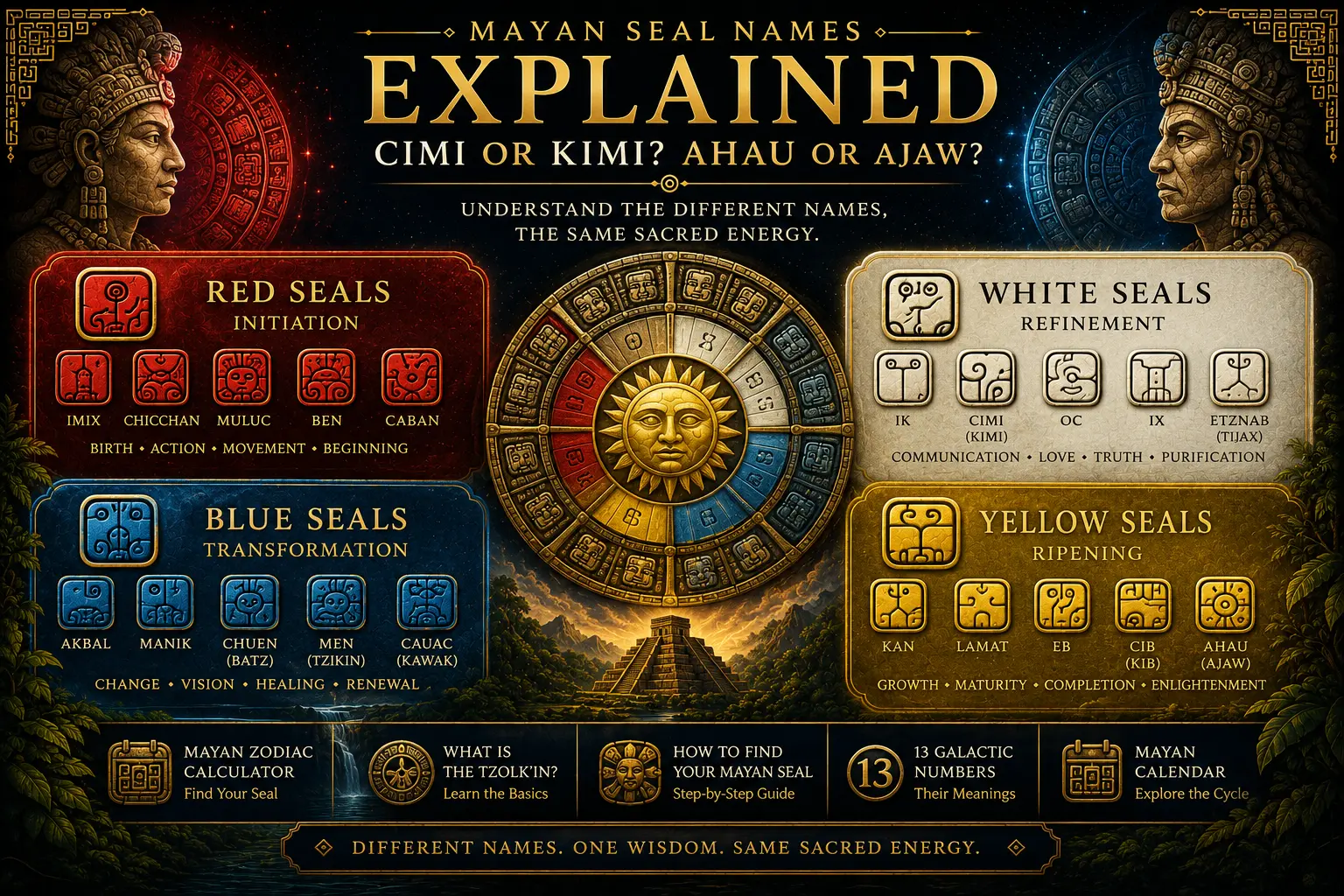
Mayan Seal Names Explained is one of the most common questions among students of the Tzolk’in calendar. People frequently encounter names such as Cimi and Kimi, Ahau and Ajaw, Men and Tzikin, then wonder whether they are looking at different signs. In most cases, they are simply seeing different spellings or linguistic traditions describing the same sacred seal.
The Tzolk’in is older than modern English spelling. Its names moved through different Maya languages, Spanish transcriptions, academic conventions and modern spiritual systems such as Dreamspell. That is why one seal can appear under more than one name.
ZodiacRoots uses a clear, reader-friendly naming system for navigation, while also showing the most important alternative spellings so you can recognise the same energy across different calendars, books and websites.
Quick Answer: Is Cimi the Same as Kimi?
Yes. In this Mayan Seal Names Explained guide, Cimi and Kimi usually refer to the same seal: White Worldbridger. The same pattern appears with other names: Ahau and Ajaw both point to Yellow Sun, while Etznab and Tijax are used for White Mirror.
The meaning does not disappear when the spelling changes. What changes is the linguistic or interpretive lens. On this page, you can compare the main ZodiacRoots names with common alternative names and then explore each of the 20 seal pages.
Essential Mayan Astrology Resources
Use this page as a hub, then move into the practical guides and calculator pages that explain how your seal is found and how the Tzolk’in cycle works.
For the number side of the system, see the 13 Galactic Numbers Meaning guide. For the wider ZodiacRoots method, start with Calculate Your 8 Roots.
Mayan Seal Names Explained Comparison Table
This Mayan Seal Names Explained table compares the main ZodiacRoots / Dreamspell-style names with common alternative spellings. The alternatives are useful for SEO, research and recognising the same seal in different traditions.
| ZodiacRoots Seal | Main Name | Alternative Names | Core Meaning |
|---|---|---|---|
| Red Dragon | Imix | Imox | The birth force, nourishment and primal beginning. |
| White Wind | Ik | Iq | Spirit, breath, word and sacred communication. |
| Blue Night | Akbal | Aqabal | Dreams, intuition, abundance and the inner world. |
| Yellow Seed | Kan | K’an | Growth, targeting, awareness and potential. |
| Red Serpent | Chicchan | Chikchan | Life force, instinct, vitality and embodied survival. |
| White Worldbridger | Cimi | Kimi | Release, surrender, transition and bridging worlds. |
| Blue Hand | Manik | Manik’ | Healing, knowledge, accomplishment and the power of touch. |
| Yellow Star | Lamat | Lamat | Beauty, harmony, art and elegant order. |
| Red Moon | Muluc | Muluk | Flow, purification, emotion and sacred water. |
| White Dog | Oc | Ok | Love, loyalty, heart and faithful devotion. |
| Blue Monkey | Chuen | Batz / Chuwen | Play, magic, innocence and creative disruption. |
| Yellow Human | Eb | Eb’ | Free will, influence, wisdom and human choice. |
| Red Skywalker | Ben | Aj | Exploration, growth, space and spiritual expansion. |
| White Wizard | Ix | Ix | Receptivity, enchantment, presence and timeless wisdom. |
| Blue Eagle | Men | Tzikin | Vision, mind, perspective and higher seeing. |
| Yellow Warrior | Cib | Kib | Intelligence, questioning, courage and fearless inquiry. |
| Red Earth | Caban | No’j | Navigation, synchronicity, evolution and earth wisdom. |
| White Mirror | Etznab | Tijax | Truth, reflection, order and spiritual clarity. |
| Blue Storm | Cauac | Kawak | Catalysis, renewal, energy and self-generation. |
| Yellow Sun | Ahau | Ajaw | Enlightenment, universal fire, wholeness and completion. |
Mayan Seal Names Explained Through the Four Colours
The 20 seals are grouped into four colour families. These colours are not decoration; they describe the rhythm of the cycle: energy begins, is refined, transforms, and then ripens into completion.
Initiation
Red seals begin movement. They carry birth, impulse, embodiment, action and the first spark of a new cycle.
Refinement
White seals clarify and purify. They bring communication, surrender, love, receptivity, truth and spiritual discipline.
Transformation
Blue seals change the field. They bring dreams, healing, play, vision, storm energy, catalysis and creative renewal.
Ripening
Yellow seals mature and complete. They bring growth, beauty, wisdom, questioning, enlightenment and solar fulfilment.
Mayan Seal Names Explained Across the 20 Sacred Seals
This hub links the full seal cluster together. Use it to move from name confusion into the actual symbolic meaning of each seal.
Red Seals
White Seals
Blue Seals
Yellow Seals
Historical and Linguistic Context
ZodiacRoots treats these seals as a symbolic and interpretive framework. Historical Maya calendar systems and modern Dreamspell-style spiritual systems are related in language and inspiration, but they are not identical.
For background context, compare this guide with external references on the Maya calendar, the Tzolk’in cycle, and broader documentation of Mesoamerican writing and calendar traditions.
Mayan Seal Names Explained: Dreamspell vs Traditional Maya Names
The phrase Mayan Seal Names Explained often refers to understanding why different books, teachers and websites use different names for the same Tzolk’in signs.
The ancient Maya civilisation was not a single unified culture using one language. Instead, numerous Maya languages developed across different regions of Mesoamerica. As the Tzolk’in calendar was preserved, translated and studied, multiple spellings emerged.
Modern spiritual systems such as Dreamspell popularised names including Cimi, Ahau, Etznab, Men and Cauac. Traditional Maya communities, linguistic sources and regional calendar traditions may instead use Kimi, Ajaw, Tijax, Tzikin and Kawak.
For someone exploring Mayan astrology for the first time, these differences can appear confusing. However, they usually describe the same sacred energies rather than completely different signs.
Some of the most common examples include:
Understanding these variations allows students of the Tzolk’in to compare teachings across traditions while recognising the same underlying symbolism. That is why this Mayan Seal Names Explained page keeps the familiar ZodiacRoots names while also showing the most searched alternative spellings.
Mayan Seal Names Explained FAQ
What does Mayan Seal Names Explained mean?
Mayan Seal Names Explained refers to understanding why the same Tzolk’in seal can appear under different names such as Cimi and Kimi, Ahau and Ajaw, Men and Tzikin or Etznab and Tijax. These variations usually reflect different linguistic, regional and cultural traditions.
Is Cimi the same as Kimi?
Yes. Cimi and Kimi are alternative spellings used for the same seal commonly called White Worldbridger in Dreamspell-style systems. ZodiacRoots uses Cimi as the main page name and mentions Kimi as an important alternative spelling.
Is Ahau the same as Ajaw?
Yes. Ahau and Ajaw refer to the same solar seal, Yellow Sun. Ahau is widely used in older and Dreamspell-influenced material, while Ajaw is often closer to modern Mayan linguistic spelling.
Is Etznab the same as Tijax?
They are closely related naming equivalents across different systems. Etznab is common in Dreamspell and many English-language Tzolk’in resources, while Tijax appears in other Maya calendar traditions, especially K’iche’-based contexts.
Is Men the same as Tzikin?
Yes, Men and Tzikin are commonly treated as equivalent names for the Blue Eagle seal. Both point toward vision, higher perspective, mind and the ability to see from above.
Is Chuen the same as Batz?
Chuen, Chuwen and Batz are related names used across different traditions for the Blue Monkey seal. ZodiacRoots uses Chuen as the main spelling while acknowledging Batz as a major alternative.
Is Cauac the same as Kawak?
Yes. Cauac and Kawak refer to the Blue Storm seal. Both names point to storm, catalysis, renewal, energy and rapid transformation.
Is Cib the same as Kib?
Yes. Cib and Kib are alternate spellings for the Yellow Warrior seal, associated with intelligence, inquiry, courage and questioning.
Why do Mayan seals have different names?
The Tzolk’in has been transmitted through different Maya languages, regional traditions, Spanish and English transliterations, academic conventions and modern spiritual systems such as Dreamspell. Different spellings are therefore normal.
Which naming system does ZodiacRoots use?
ZodiacRoots mainly uses the Dreamspell-friendly English names, such as White Worldbridger (Cimi) and Yellow Sun (Ahau), while also listing important alternatives such as Kimi, Ajaw, Tijax, Tzikin and Kawak.
Do different spellings change the meaning of a seal?
Usually no. The core symbolic meaning remains broadly the same, although each tradition may frame the seal with its own language, cosmology and ritual emphasis.
What do the four Mayan seal colours mean?
The four colours describe a symbolic rhythm: Red initiates, White refines, Blue transforms and Yellow ripens. Together they show how energy begins, clarifies, changes and reaches completion.
Which spelling should I use?
Use the spelling that matches the system you are working with. On ZodiacRoots, use the main page spelling for navigation and SEO, but include alternative spellings in the text so readers can recognise the same seal across traditions.
Names Are the Doorway. Your Kin Is the Map.
Once you understand the alternative spellings, the next step is to calculate your own Mayan seal and galactic tone.
Explore More Mayan Wisdom
Go deeper into your Mayan sign, sacred seal, galactic tone and Tzolkin path.