Venus Astrology: What Venus Really Means — and Why One Tradition Only Tells Half the Story
A complete guide to venus astrology across eight traditions
Most astrology tells you your Venus sign and stops there. But across eight ancient traditions, Venus — and its equivalent forces — reveal your love language, your karmic emotional pattern, your relational energy exchange, and your mythic archetype of desire. This is venus astrology as it was never meant to be reduced to a single label.
In This Article
What Is Venus in Astrology?
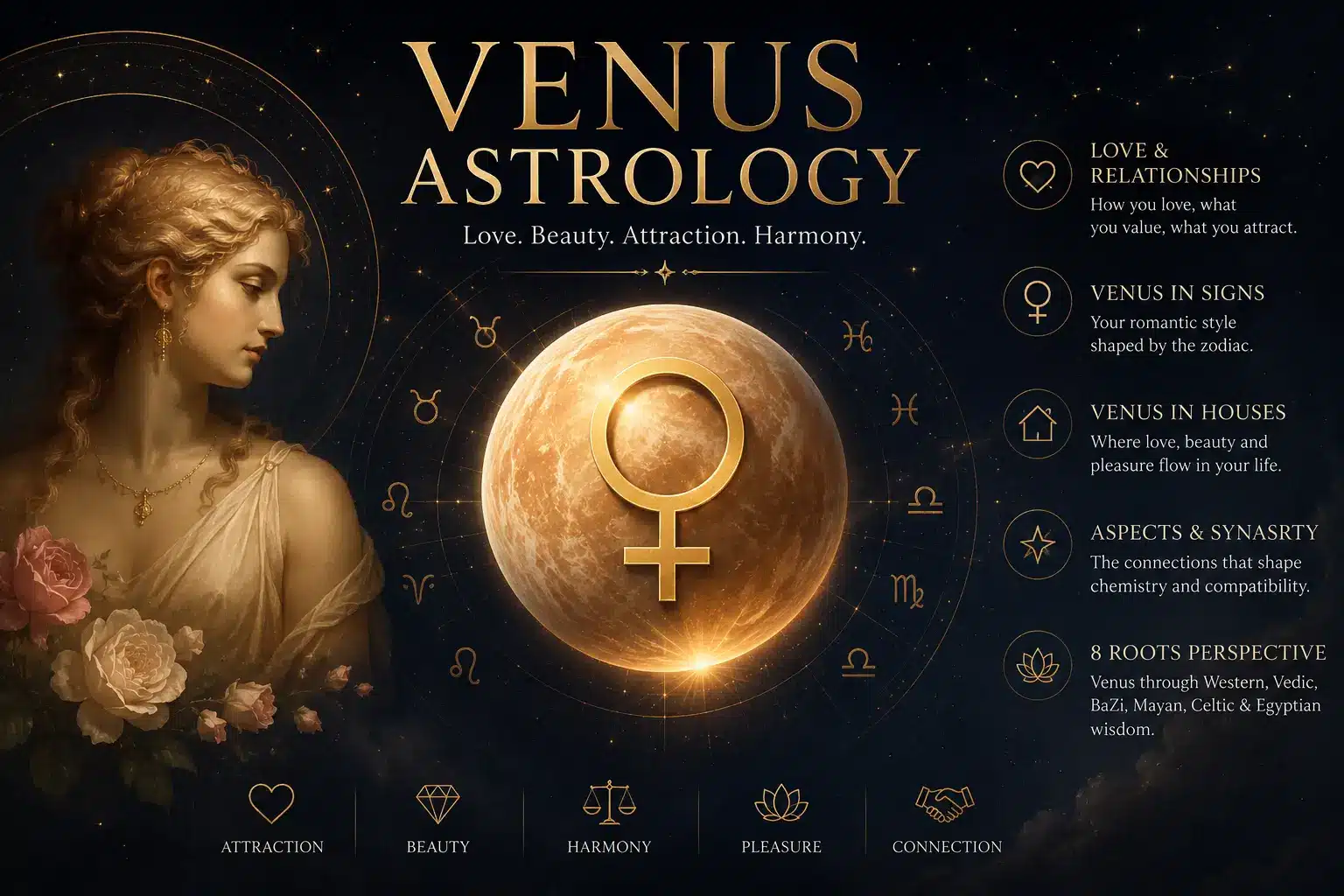
In venus astrology, this planet governs love, beauty, attraction, pleasure, values and the way a person relates to others. It is the second planet from the Sun, the brightest natural object in the night sky after the Moon, and in symbolic terms one of the most powerful forces in any birth chart.
Venus rules two signs in Western astrology: Taurus (how you value security, sensory pleasure and material love) and Libra (how you value balance, partnership and aesthetic harmony). It moves through the zodiac in approximately 225 days and spends roughly 3–5 weeks in each sign under normal conditions — slightly longer during its retrograde cycle.
In classical astrology, Venus was considered a benefic — a planet that brings ease, attraction and favorable conditions. But the full symbolic picture is more nuanced: Venus also rules what you desire at the cost of what you need, what you attract that reflects your unresolved patterns, and the gap between idealized love and embodied relationship.
Understanding venus astrology means understanding how you love, what you find beautiful, what you need to feel valued, and — crucially across traditions — what relational patterns you carry beneath the surface of conscious attraction.
Want to know what your Venus sign reveals about how you love — alongside your Vedic, Chinese, Mayan, Celtic and Egyptian relational patterns?
Venus in the Signs
In venus astrology, your Venus sign describes your love language — not in the popular self-help sense, but at a deeper symbolic level. It shows the register in which you experience beauty, how you approach intimacy, and what you instinctively offer and seek in close relationships. Each sign filters Venus through a distinct element and mode, and the venus astrology of each placement carries its own flavor of attraction.
♈ Venus in Aries
Love through initiation and pursuit. Passionate, direct, prone to falling fast and needing intensity to stay engaged. Attraction begins with the chase.
♉ Venus in Taurus
Love through stability and sensory presence. Venus is at home here — loyal, consistent, deeply physical. Values longevity over excitement.
♊ Venus in Gemini
Love through conversation and mental connection. Variety is essential. Boredom is the real relationship risk — not conflict.
♋ Venus in Cancer
Love through nurturing and emotional safety. Deeply protective, memory-oriented. Needs to feel at home in a relationship before truly opening.
♌ Venus in Leo
Love through generosity and theatrical devotion. Wants to be adored — and gives lavishly in return. Romance must feel grand to feel real.
♍ Venus in Virgo
Love through service and attentive detail. Expresses care in practical acts. Struggles when affection isn’t reciprocated through attention to what matters.
♎ Venus in Libra
Love through balance and aesthetic harmony. Venus’s other home sign — refined, partnership-oriented, alert to fairness and beauty in all forms.
♏ Venus in Scorpio
Love through depth and transformation. Intensity over surface. Drawn to what is hidden. Relationships become initiations — never just companionship.
♐ Venus in Sagittarius
Love through freedom and shared adventure. Commitment feels natural when the relationship expands — not contracts — life’s horizons.
♑ Venus in Capricorn
Love through commitment and earned trust. Slow to open, deeply loyal once committed. Values demonstrated reliability over declared feeling.
♒ Venus in Aquarius
Love through friendship and shared ideals. Drawn to what is unconventional, independent, future-oriented. Intimacy through intellectual alignment.
♓ Venus in Pisces
Love through dissolution and spiritual merger. Venus is exalted here — boundless, compassionate, prone to idealization. The heart that loves everyone and belongs to one.
Each Venus sign has its own dedicated ZodiacRoots reading page. The links above will be updated as those pages go live.
Venus in the Houses
While the Venus sign describes how you love, in venus astrology the house position describes where love plays out in your life — which sphere of experience becomes charged with venusian energy, desire and relational meaning.
Venus Retrograde
In venus astrology, Venus turns retrograde approximately every 18 months, for around 40 days. This cycle is among the most emotionally disorienting — not because it causes external chaos, but because it turns the venusian gaze inward.
During a Venus retrograde, ex-partners reappear. Aesthetic choices shift. Relationships that seemed stable suddenly feel ambiguous. Long-held values about beauty, love and self-worth rise to the surface for re-examination — not to be destroyed, but to be refined.
Venus retrograde in the natal chart — when a person is born with Venus retrograde — describes a more internalized relationship to love and beauty. The person may be slow to express affection openly, may have delayed awareness of their own relational needs, or may process attraction through a longer, more private cycle than the external world can easily see.
Venus and Love
In venus astrology, love is not a single phenomenon. The planet governs multiple dimensions of the relational experience, each shaped differently depending on its sign, house and aspects:
Attraction
What instinctively draws you in — physical type, energy, aesthetic. Venus filters the field of possible attraction before conscious preference can intervene.
Self-Worth in Love
What you believe you deserve. The shadow of Venus is often not “I can’t attract love” but “I unconsciously choose what matches my self-image, not my potential.”
Expression of Affection
How you show love — through words, touch, acts, gifts or presence. The sign modifies the form; the house suggests the context.
Aesthetic Sense
Your relationship to beauty, art and sensory pleasure. Venus is the planet of the artist as much as the lover — these are not separate impulses.
Where Venus meets Mars in the chart, love meets desire — and the interplay between these two planets reveals whether a person’s romantic and erotic impulses reinforce or contradict each other. Where Venus meets Saturn, love becomes a lesson in earned trust and delayed satisfaction. Where it meets Neptune, love risks dissolving into idealization. These planetary contacts are the heart of how venus astrology reads the texture of a person’s love life.
Venus and Compatibility
Popular astrology often reduces compatibility to Sun sign matching. In venus astrology, the more revealing question is: do two people’s Venus placements speak the same relational language? This is where venus astrology becomes a genuine tool for understanding a relationship rather than a horoscope cliché.
Two Venus signs in compatible elements — fire with air, earth with water — tend to find each other’s approaches to love intuitive and resonant. In venus astrology, two Venus signs in tense aspect — such as square or opposition — can create powerful attraction layered with chronic friction around needs and values.
But even this is only part of the picture. The ZodiacRoots Synastry method goes further: it reads Venus alongside the Moon (emotional pattern), Mars (desire), and the relational house overlays — and then cross-references these against the Vedic, Chinese and ancestral layers to identify where two people’s love patterns genuinely align and where hidden friction exists beneath surface attraction.
Venus in Synastry
Synastry is the branch of venus astrology that examines how two birth charts interact. Venus aspects between charts are among the most important indicators of romantic attraction, ease and long-term relational chemistry.
In venus astrology, the key Venus synastry contacts and what they suggest:
| Aspect | Character | What it brings |
|---|---|---|
| Venus conjunct Venus | Harmonious | Shared aesthetic and relational values. Natural understanding of what love should feel like. |
| Venus trine Venus | Easeful | Affection flows without effort. Complementary love languages. |
| Venus opposite Venus | Magnetic tension | Powerful attraction through contrast. Different relational needs that can complete or frustrate. |
| Venus square Venus | Friction | Different definitions of love in direct tension. Growth possible, but requires active navigation. |
| Venus conjunct Mars | High charge | Strong erotic and romantic pull. The classic attraction aspect — intense but not always stable. |
| Venus conjunct Moon | Emotional warmth | Deep emotional resonance. One person’s Venus meets the other’s emotional core directly. |
| Venus conjunct Saturn | Serious, stabilizing | Longevity, commitment and structure — but can feel cold or conditional until trust is fully earned. |
The ZodiacRoots Synastry Report reads Venus aspects in the context of the full 8-layer relational profile — including the Vedic, Chinese and ancestral compatibility layers that western synastry typically omits.
Curious how your Venus placement interacts with a partner’s chart across all eight traditions?
Venus Through the 8 Roots Lens
The ZodiacRoots Synthesis
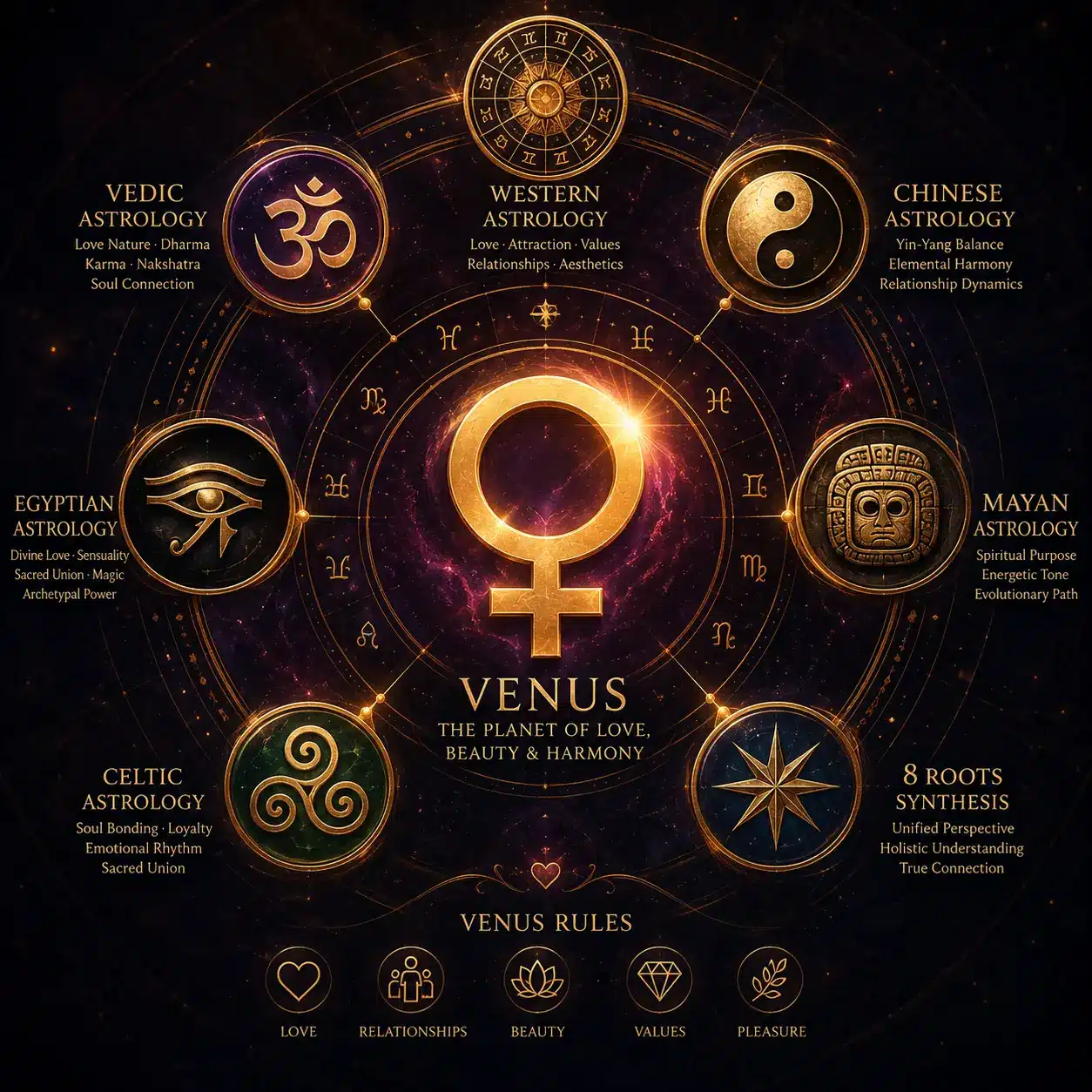
This is where venus astrology becomes something else entirely. Most venus astrology stops at your Western Venus sign — but the ZodiacRoots method does not. It reads six distinct relational layers from six traditions, each asking a different question about how you love, bond and grow through relationship.
The result is not six separate readings stacked on top of each other. It is a multi-tradition synthesis — a coherent portrait of your full relational architecture, including patterns that one tradition alone would never reveal.
Western Venus — How You Love
Tradition: Western Astrology
Your Venus sign in Western astrology is the foundation of the 8 Roots relational reading. It describes your primary love language: how you express affection, what you find beautiful, and what you instinctively seek in a partner. It is the conscious layer — the face of your love that you (and others) can most easily recognize. Venus in Libra seeks beauty and balance. Venus in Scorpio seeks depth and surrender. Venus in Sagittarius seeks meaning and freedom. In conventional venus astrology, the sign is where the reading ends — but here it is only the entrance.
Vedic Layer — Your Karmic Emotional Pattern
Tradition: Vedic Jyotish
In Vedic astrology, Venus (Shukra) governs desire, material pleasure and relationship karma. The Vedic layer — specifically the nakshatra in which your Moon or Venus falls — reveals not just how you love, but why you repeat the patterns you do. A Moon in Rohini (nakshatra of the beloved) creates magnetic, sensuous attachment. A Moon in Jyeshta (nakshatra of the elder) creates protective, sometimes possessive bonding. The Vedic layer surfaces the deeper karmic blueprint beneath the visible love style — the pattern that keeps recurring until it is understood.
Chinese / BaZi Layer — How You Exchange Energy in Relationship
Tradition: Chinese Zodiac · BaZi Five Elements
The Chinese layer — particularly the element of your birth year animal — describes the quality and direction of your relational energy. Fire types bring warmth, passion and visibility to relationships but can exhaust their partners. Water types flow with emotional intelligence but may be elusive. Earth types offer stability and nurturing but risk emotional stagnation. Metal types bring loyalty and clarity but may be inflexible. Wood types grow toward connection but need space to expand. In a compatibility reading, the elemental interaction between two people reveals whether they nourish, control or exhaust each other — a dimension that Western astrology has no equivalent framework for.
Egyptian Layer — Your Love Archetype
Tradition: Egyptian Guardian Deities
The Egyptian tradition assigns a guardian deity based on birth date. Each guardian carries a mythic personality that surfaces most powerfully in intimate life. Isis (Oct 28 – Nov 26) is the archetype of devotion and magical regeneration in love — the partner who holds the relationship together across destruction. Hathor (May 1 – Jun 15 / Sep 9 – Sep 27) is the goddess of love, beauty and sensory pleasure herself — the archetype of Venusian joy. Osiris represents the partner who transforms through vulnerability. The Egyptian layer names the mythic role you play in love — the archetypal story running beneath the surface of every relationship you enter.
Celtic Layer — Your Emotional Rhythm
Tradition: Celtic Tree Astrology
Celtic Tree Astrology assigns a tree based on birth date — each with a distinct symbolic personality rooted in the seasonal and natural cycle. In the relational context, the Celtic layer reveals your emotional rhythm: the pace at which you open, the conditions under which you flourish, and the seasonal quality of your love. The Oak (Jun 10 – Jul 7) brings enduring, patient love — the partner who remains. The Willow (Apr 15 – May 12) flows with emotional depth and lunar sensitivity. The Ivy (Sep 30 – Oct 27) wraps around what it loves with quiet persistence. The Celtic layer asks: at what pace and through what seasonal quality does your love grow?
Mayan Layer — How You Grow Through Relationships
Tradition: Mayan Tzolk’in
The Mayan Tzolk’in does not describe personality in the Western sense — it describes sacred mission and the quality of growth through experience. In the relational context, your Mayan Seal reveals the way relationship itself becomes a vehicle for your soul’s evolution. The Red Dragon seal (Imix) creates and nurtures — relationships are generative fields for this person. The White Wind (Ik’) communicates spirit through connection — the partner who transforms through presence and breath. The Blue Hand (Manik) heals through relationship — the experience of love as medicine. The Mayan layer asks not “how do you love?” but “what are you meant to learn — and give — through the people you love?”
Venus Through the 8 Roots — At a Glance
This summary shows how each tradition extends venus astrology beyond a single love-style label into a complete relational portrait:
| Tradition | Relational Question | What It Reveals |
|---|---|---|
| Western | How do you love? | Your conscious love language and attraction style |
| Vedic | Why do you repeat what you repeat? | Your karmic relational blueprint and hidden emotional pattern |
| Chinese / BaZi | How do you exchange energy with a partner? | Your elemental compatibility and relational energy dynamic |
| Egyptian | What mythic role do you play in love? | Your archetypal identity in relationship — the story you live |
| Celtic | At what pace and rhythm do you love? | Your seasonal emotional rhythm and the conditions for flourishing |
| Mayan | What are you meant to learn through love? | Your relational purpose and the growth your soul seeks through connection |
Explore More ZodiacRoots Readings
- Synastry Compatibility Explained — how the full 8 Roots method reads two charts together.
- Sun Sign Meaning — why the Sun sign is only the entrance to your full profile.
- Celtic Tree Astrology — the seasonal layer behind your emotional rhythm.
- Egyptian Guardians — the mythic archetype layer, including Isis, Hathor and Osiris.
- Mayan Seal Names Explained — the 20 sacred seals and your relational mission.
- The ZodiacRoots 8 Roots Method — how all six traditions are synthesized into one reading.
FAQ: Venus Astrology and the 8 Roots Method
What does Venus mean in astrology?
In venus astrology, the planet governs love, beauty, attraction, pleasure and values. It describes how you express and receive affection, what you find beautiful, and what you need to feel valued in relationships. It rules Taurus and Libra and moves through the zodiac in approximately 225 days.
What is my Venus sign and how do I find it?
In venus astrology, your Venus sign is determined by the position of Venus at the moment of your birth. Unlike the Sun sign, Venus moves independently and may be in a different sign than your Sun. To find your Venus sign, use the free calculator at ZodiacRoots, which returns your Venus placement as part of your full 8 Roots profile.
What is the most compatible Venus sign?
There is no single “most compatible” Venus sign. In venus astrology, compatibility depends on the interaction between two Venus signs (and many other factors). Same-element Venus signs — e.g., two earth signs or two fire signs — tend to share similar love languages. But strong cross-element attraction is also common. The ZodiacRoots Synastry Report reads the full relational pattern across six traditions, not just the Venus sign pairing.
What does Venus retrograde mean?
Venus retrograde occurs approximately every 18 months for around 40 days. During this period, matters of love, beauty and values turn inward. Past relationships may resurface. Aesthetic preferences may shift. In the natal chart, a retrograde Venus describes a more internalized, private relationship to love and self-worth — often expressed through deeper reflection rather than open declaration.
What is Venus in Vedic astrology?
In Vedic astrology (Jyotish), Venus is known as Shukra — the planet of desire, pleasure, luxury and relational karma. Vedic venus astrology places particular emphasis on the nakshatra (lunar mansion) in which Venus or the Moon falls, revealing the deeper karmic emotional pattern beneath the visible love style. This is the layer ZodiacRoots identifies as “why you repeat what you repeat” in relationships.
Does Chinese astrology have a Venus equivalent?
Chinese astrology does not use planets in the same way as Western or Vedic systems. Instead, the relational equivalent comes through the Five Elements associated with your birth year animal and the BaZi four pillars. The element describes your energy quality in relationship — whether you nourish, control or exhaust a partner’s elemental nature. ZodiacRoots uses this layer to answer how you exchange relational energy with another person.
Who is the Egyptian goddess of love?
In the Egyptian tradition, Hathor is the closest equivalent to Venus — the goddess of love, beauty, music and sensory pleasure. In the ZodiacRoots Egyptian layer, people born under Hathor’s dates (May 1 – Jun 15 and Sep 9 – Sep 27) carry her archetype into their relational life: an orientation toward beauty, joy and generous affection. Isis, Osiris and other guardians carry different relational archetypes — each one the mythic role the person plays in love.
What does my Mayan seal reveal about love?
Your Mayan Tzolk’in seal in the ZodiacRoots system reveals your soul’s purpose through relationship — specifically, what you are meant to learn, heal or offer through the connections you form. The Mayan layer does not describe how you love, but why love appears in your life as a vehicle for growth. Each of the 20 seals carries a distinct relational mission: Red Dragon nurtures and creates; White Wind communicates spirit; Blue Eagle sees the larger pattern in every bond.
What is the difference between Venus sign and Venus house?
The Venus sign describes how you love — the style, tone and language of your affection. The Venus house describes where in your life love becomes most active — which sphere of experience carries venusian energy. Venus in Scorpio in the 7th House combines deep, intense love style with a focus on committed one-to-one partnership. Venus in Scorpio in the 12th House combines the same depth with a more hidden, spiritually oriented relational life.
What is Venus in Pisces and why is it considered exalted?
Venus is said to be exalted in Pisces in Western astrology — meaning the planet expresses its highest potential in this sign. Pisces dissolves boundaries, emphasizes compassion and spiritual connection, and allows Venus’s capacity for love to expand beyond ego and preference. The result is a profound, boundless quality of affection — though it also carries the risk of idealization and loss of self through merger with another.
How does the ZodiacRoots 8 Roots method read Venus differently from other astrology sites?
Most astrology sites read your Venus sign in one tradition. ZodiacRoots reads six relational layers simultaneously — Western Venus sign, Vedic karmic pattern, Chinese elemental energy exchange, Egyptian love archetype, Celtic emotional rhythm and Mayan relational purpose — and synthesizes them into a single coherent portrait of how you love and what love is meant to teach you. This is the core difference of the 8 Roots method: synthesis over reduction. Discover your own at zodiacroots.com.
What is Celtic tree astrology and how does it relate to love?
Celtic Tree Astrology assigns a sacred tree based on birth date, each carrying a distinct personality rooted in the natural and seasonal cycle. In the relational context, your Celtic tree reveals your emotional rhythm — the pace at which you open to love, the conditions under which you flourish in relationship, and the natural season of your heart. The Oak loves with endurance and patience; the Willow with emotional depth and lunar sensitivity; the Ivy with quiet, persistent devotion.
Your Venus Sign Is Only the Beginning
If venus astrology across six traditions reveals this much complexity, your own relational portrait holds layers that a single sign was never designed to carry. The ZodiacRoots 8 Roots method reads your full love pattern through this expanded venus astrology — how you love, why you repeat what you repeat, and what you are meant to learn through every relationship you enter.
Published by ZodiacRoots. This article represents an editorial synthesis of symbolic traditions and does not constitute personal astrological advice.