The 3 Maya Calendars Explained: Tzolk’in, Haab’, and the Long Count
Understand how the three Maya calendars worked together — and why they were far more sophisticated than the 2012 myth suggests.
The three Maya calendars — the Tzolk’in, the Haab’, and the Long Count — formed one of the most sophisticated systems of timekeeping in the ancient world. Rather than a single “Maya calendar,” these interlocking cycles helped Maya civilization organise ritual life, agricultural timing, civic order, and historical memory through a refined architecture of sacred, solar, and linear time.
Quick Comparison of the Maya Calendar System
Before going deeper, here is the clearest way to understand how the Tzolk’in, Haab’, Calendar Round, and Long Count fit together.
1. Introduction: Understanding the Three Maya Calendars Beyond the 2012 Myth
When many people hear the phrase “Maya calendar,” they think of the 2012 phenomenon and imagine one mysterious system predicting apocalypse. In reality, the Maya developed a layered calendrical framework in which different cycles served different functions. The three Maya calendars worked together to track sacred days, solar seasons, and vast historical spans with remarkable precision.
Rather than seeing time as a flat linear track, the Maya approached it as a living structure of interlocking cycles. In that sense, Maya time worked less like a single line and more like a set of coordinated gears turning together. This allowed sacred observance, seasonal timing, and dynastic history to be held inside one of the most intellectually elegant time systems of the ancient world.
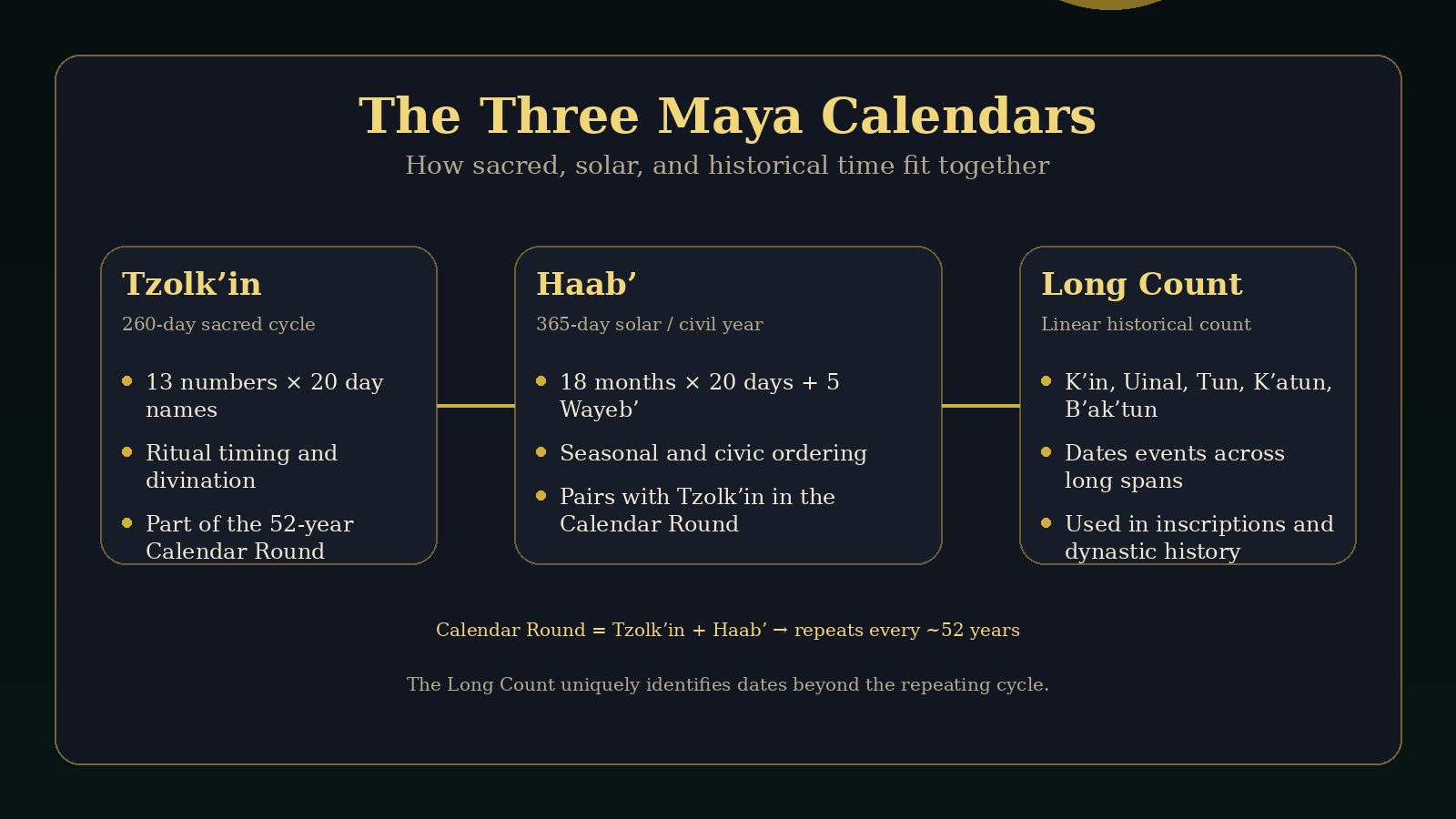
Overview of the three main Maya calendrical systems and how they relate to one another.
2. Why the Maya Became Masters of Time and Observation
Maya civilization flourished across Mesoamerica through deep attention to celestial motion, seasonal rhythm, and symbolic order. Their systems of timekeeping were not isolated curiosities. They were woven into mathematics, writing, ritual life, dynastic memory, and close observation of the sky.
This is one reason the three Maya calendars continue to fascinate historians, symbolists, and astrology-minded readers today. They reveal a culture in which number, myth, ritual, and astronomy were integrated into one coherent science of time.
The Maya were among the earliest civilizations known to use zero in a positional number system, often represented with a shell glyph.
By combining number, inscription, and long-term observation, the Maya created a refined framework linking ritual, seasonal cycles, and historical chronology.
If you want broader symbolic context for ancient cycles and archetypes, explore our
Mayan Calendar guide
and discover how these time systems connect with the deeper logic of identity, pattern, and meaning.
Maya Mathematics: How the Cycles Worked Together
The three Maya calendars were not merely observational. They were built on elegant repeating structures. The Tzolk’in cycles through 13 numbers and 20 day signs, producing 13 × 20 = 260 unique combinations before the exact same number-sign pairing returns. This is one reason the Tzolk’in is such a strong example of patterned calendar logic.
The Haab’ follows a different structure: 18 months of 20 days plus a final 5-day Wayeb’ period, giving 18 × 20 + 5 = 365 days. When the 260-day Tzolk’in and the 365-day Haab’ are combined, the full date pairing repeats only after 18,980 days, creating what is known as the Calendar Round.
In mathematical terms, that long repetition cycle reflects the least common multiple of 260 and 365. In ritual terms, it meant a person’s combined sacred and solar date would realign only once in about 52 years, giving the cycle lasting symbolic importance.
Maya Mathematics Highlight:
The Maya were among the first civilizations to develop and use zero as a positional placeholder, represented by a shell glyph. This breakthrough enabled the precise calculations behind the Long Count’s place-value system — k’in, uinal, tun, k’atun, and b’ak’tun — and supported the calendar logic behind the Calendar Round.
3. The First of the Three Maya Calendars: Tzolk’in
3.1 Structure of the Tzolk’in Calendar
The Tzolk’in is the sacred and ritual cycle of 260 days. It works through the interaction of two repeating sequences:
- Gear 1: a cycle of 13 numbers
- Gear 2: a cycle of 20 named days
Because these sequences rotate together, each numbered day name appears only once before the full cycle repeats after 260 unique combinations. This makes the Tzolk’in one of the most distinctive components of the three Maya calendars.
The 20 day names of the Tzolk’in are:
Imix, Ik, Akbal, Kan, Chicchan, Cimi, Manik, Lamat, Muluc, Oc, Chuen, Eb, Ben, Ix, Men, Cib, Caban, Etznab, Cauac, Ahau.
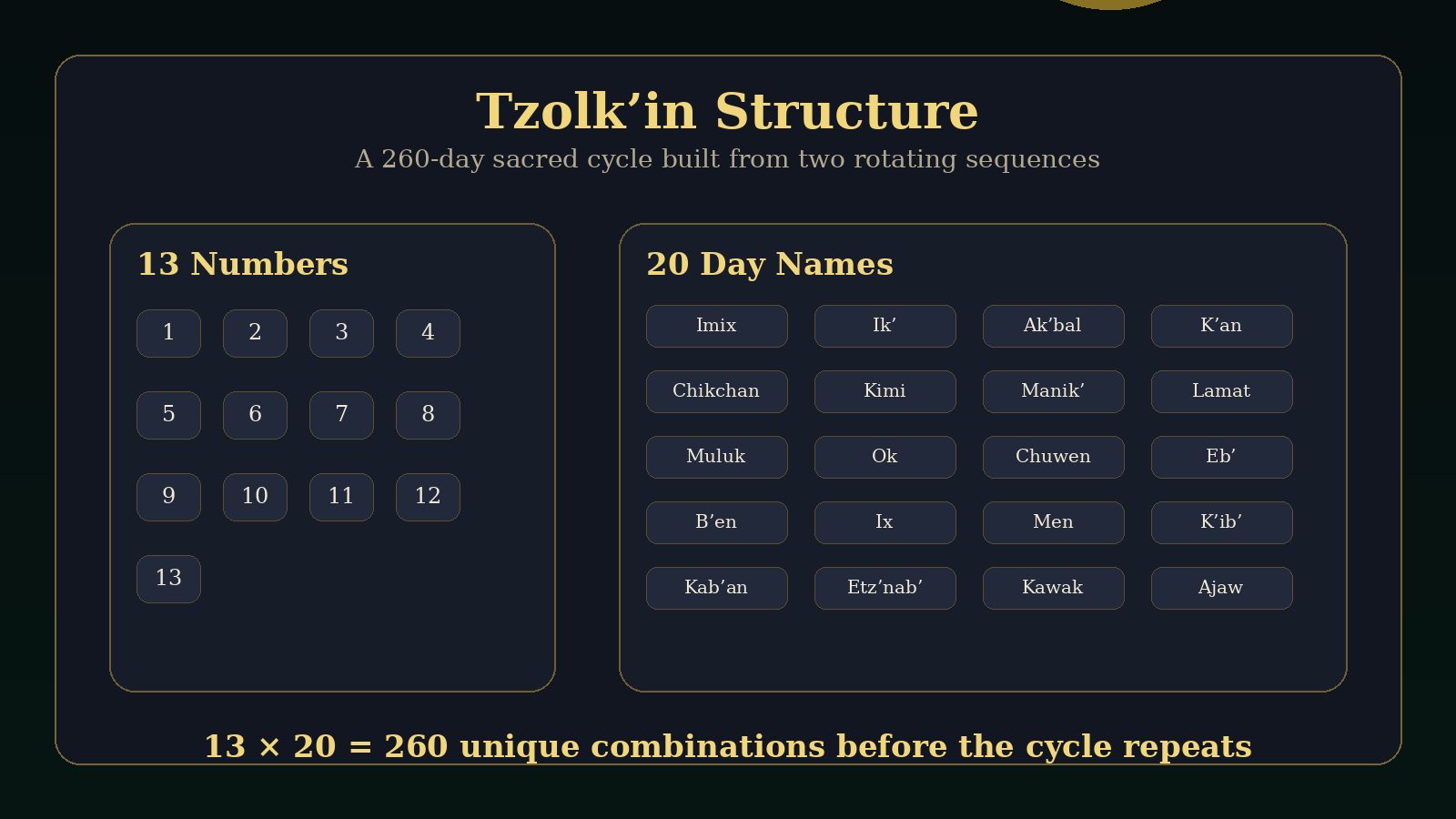
The Tzolk’in combines 13 numbers and 20 day names to generate a 260-day sacred cycle.
3.2 Why Did the Tzolk’in Have 260 Days?
The exact origin of the 260-day cycle remains debated. Scholars have proposed links to human gestation, agricultural timing, ritual sequencing, and astronomical observation. What is clear is that the Tzolk’in was not arbitrary: it held a central place in sacred and ceremonial life.
Maya astronomical records — especially those associated with Venus observation — also reveal a remarkable level of sophistication. Rather than reducing the Tzolk’in to a single cause, it is more accurate to see it as a sacred cycle with multiple layers of significance.
In symbolic terms, the Tzolk’in remains one of the most fascinating examples of how ancient civilizations merged astronomy, ritual logic, and human meaning into one living system of time.
4. The Second of the Three Maya Calendars: Haab’
4.1 Structure of the Haab’ and the Vague Year
The Haab’ is the 365-day civil and solar calendar. It consists of:
- 18 months of 20 days each = 360 days
- Wayeb’, a final 5-day period = 365 days total
The 19 month names are:
Pop, Uo, Zip, Zotz, Tzec, Xul, Yaxkin, Mol, Chen, Yax, Zac, Ceh, Mac, Kankin, Muan, Pax, Kayab, Cumku, and Wayeb’.
The Haab’ is often called a “vague year” because it does not use leap-day correction. Its role was not to replicate the tropical year perfectly, but to organise civic and seasonal time in a stable and practical way.
This structure also reflects the broader vigesimal logic often seen in Maya mathematics, even though the calendar was adapted for solar usefulness rather than exact astronomical correction through leap years.
4.2 The Role of Zero and the Meaning of Wayeb’
Maya calendrical notation reflects broader mathematical sophistication, including the use of zero as a positional marker. In the Haab’, the final 5-day period, Wayeb’, held special symbolic weight and was often treated as a liminal interval between one yearly cycle and the next.
In this sense, the Haab’ was not merely administrative. It also carried ritual and symbolic importance, showing again how the three Maya calendars combined practical order with sacred significance.
5. The Third of the Three Maya Calendars: The Long Count
5.1 Units of the Long Count Calendar
To record events across much longer spans of time, the Maya used the Long Count, a linear count of days from a mythic starting point commonly correlated to August 11, 3114 BCE. This made it possible to place events within a historical and cosmological framework that extended far beyond one human lifetime.
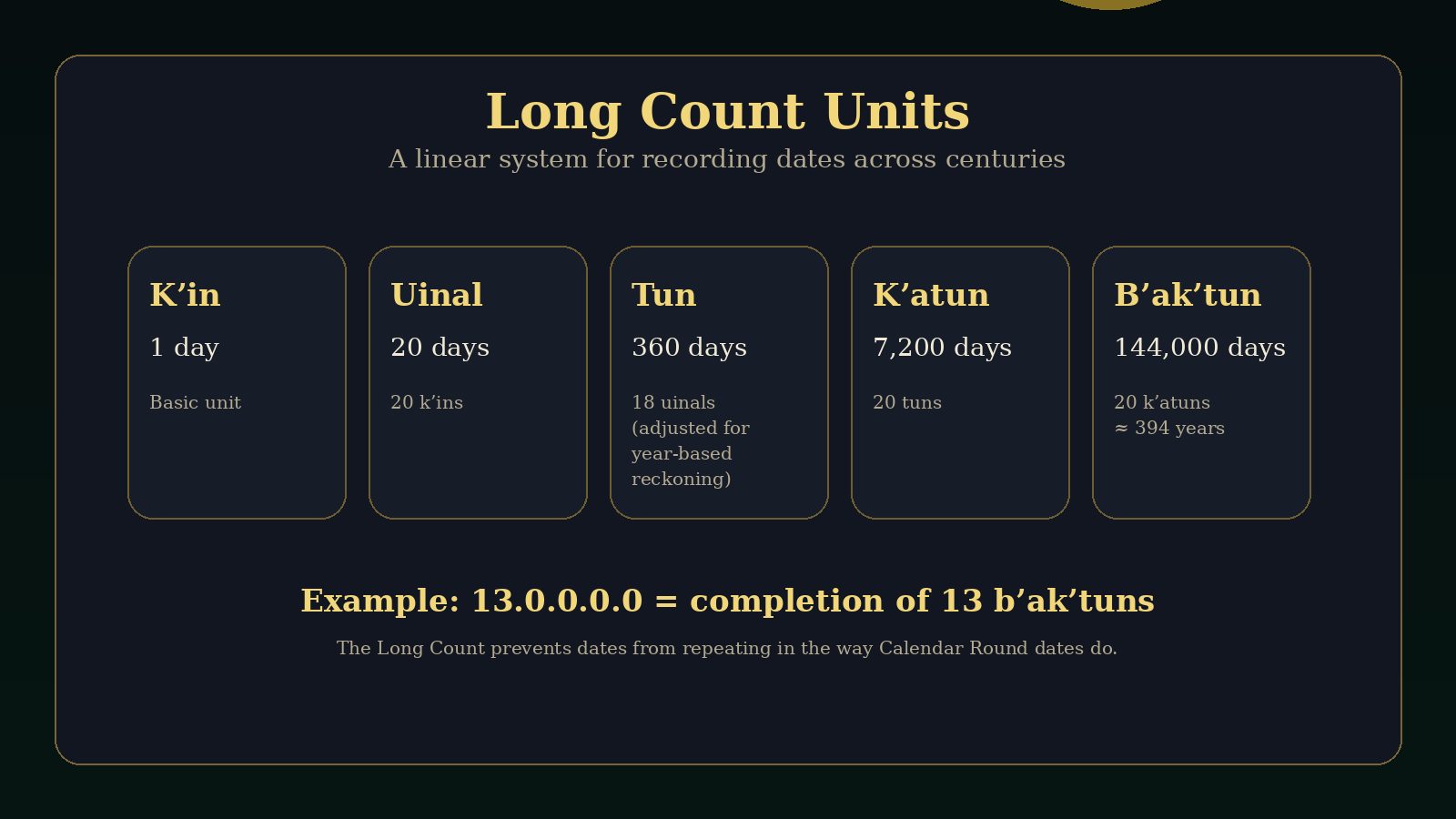
The Long Count made it possible to date events across dynastic and cosmological timescales.
| Unit | Days | Equivalent |
|---|---|---|
| K’in | 1 | 1 day |
| Uinal | 20 | 20 k’ins |
| Tun | 360 | 18 uinals |
| K’atun | 7,200 | 20 tuns |
| B’ak’tun | 144,000 | 20 k’atuns (~394 years) |
The Long Count followed a mostly base-20 structure, with one important calendrical adjustment: the tun contained 18 uinals rather than 20, bringing it closer to the solar year. This gave the system both mathematical elegance and practical value for historical reckoning.
A cycle of 13 B’ak’tuns spans roughly 5,125 years, which is why the completion of 13.0.0.0.0 in 2012 attracted such modern attention.
5.2 What Happened in 2012?
The date December 21, 2012 corresponded to 13.0.0.0.0 in the Long Count. In Maya calendrical terms, this marked the completion of a major cycle of 13 B’ak’tuns.
It did not signify the end of the world. Rather, it marked the closing of one great chronological period and the opening of another. Modern doomsday readings were largely external projections, not faithful expressions of Maya calendrical thought.
For a broader academic summary of Maya civilization, you can consult
Encyclopaedia Britannica’s overview of the Maya.
6. How the Three Maya Calendars Worked Together: The Calendar Round
When the Tzolk’in and Haab’ are combined, they generate the Calendar Round. The same full date combination repeats only after 18,980 days, or approximately 52 Haab’ years.
In practical terms, this means the Calendar Round functions as the long repetition point where the sacred 260-day cycle and the solar 365-day cycle realign. In mathematical language, it is the least common multiple of the Tzolk’in and Haab’. In cultural language, it gave a rare date recurrence real significance within a lifetime.
This interlocking structure is one of the clearest demonstrations of how the three Maya calendars were not separate inventions, but coordinated layers within a larger philosophy of time.
Want to go beyond historical systems and explore your own symbolic pattern? Use the
8 Roots calculator
to reveal your Mayan Seal alongside your Sun, Moon, Rising, Vedic, Chinese, Celtic, and Egyptian layers in one integrated reading.
7. Why the Three Maya Calendars Still Matter Today
One reason the three Maya calendars continue to fascinate modern readers is that they offer more than chronology. They present time as a layered structure in which ritual, seasonality, memory, and symbolic pattern interact. This makes them deeply relevant to people seeking more than flat, one-dimensional astrology.
At ZodiacRoots, this philosophy of layered time resonates with our own approach. Rather than reducing a person to a single label, we explore multiple symbolic roots — including the 8 Roots framework — to create a richer map of identity and life patterning.
For readers interested in archaeological context, the
Smithsonian’s discussion of the Maya calendar
offers another useful historical perspective.
Explore Your Place in a Larger Symbolic Timeline
Maya calendrical thought shows that identity unfolds through sacred, seasonal, and historical cycles. If you want to explore your own symbolic profile through a broader astrological lens, begin with your 8 Roots and then go deeper with a full premium reading.
8. Frequently Asked Questions About the Three Maya Calendars
Did the Maya invent zero?
The Maya were among the earliest civilizations known to use zero in a positional number system. This mathematical breakthrough supported the precision of their calendrical calculations and historical recording.
Were there really three Maya calendars?
Yes. The most important systems were the Tzolk’in, the Haab’, and the Long Count. Together, these three Maya calendars organised sacred cycles, solar time, and long historical chronology.
What is the Calendar Round?
The Calendar Round is the combined cycle created when the Tzolk’in and Haab’ work together. A full date combination repeats only every 18,980 days, or about 52 years.
Was 2012 the end of the Maya calendar?
No. It marked the completion of a major Long Count cycle of 13 B’ak’tuns, not an apocalypse. In Maya thought, endings are better understood as thresholds within recurring cycles.
Why is Maya timekeeping more complex than modern Sun-sign systems?
Most popular astrology systems focus on a single symbolic layer. Maya calendrics worked with multiple layers at once — ritual, seasonal, and historical — creating a much richer structure of meaning.
Why does the Long Count matter?
The Long Count allowed the Maya to date events across spans far longer than a single lifetime, giving them a historical and cosmological framework that went beyond repeating ritual cycles.
Can I explore Maya symbolism in my own reading?
Yes. In ZodiacRoots, your Mayan Seal appears as one of the symbolic layers inside the 8 Roots reading, giving you a personal bridge between ancient calendrical symbolism and modern self-understanding.
9. Continue Exploring
10. Conclusion: The Three Maya Calendars as a Language of Time
The three Maya calendars — Tzolk’in, Haab’, and Long Count — reveal a civilization that understood time as structure, pattern, and meaning. These were not merely ways of counting days, but systems for linking the human world to ritual order, seasonal rhythm, and historical memory.
For modern readers, the enduring fascination of Maya calendrics does not come from apocalyptic myth. It comes from the elegance of their design, the intelligence of their mathematics, and the extraordinary imagination that turned time itself into a living language.
Discover More Astrology Articles You May Like
Explore related ZodiacRoots articles selected by topic first, then completed with fresh astrology reads.