
Astro.com vs Astro-Seek: 7 Reasons Your Birth Charts Look Different
The same birth data should produce almost identical planetary positions—but different settings can change houses, angles, nodes, aspects and even zodiac signs. This guide shows exactly what to check.
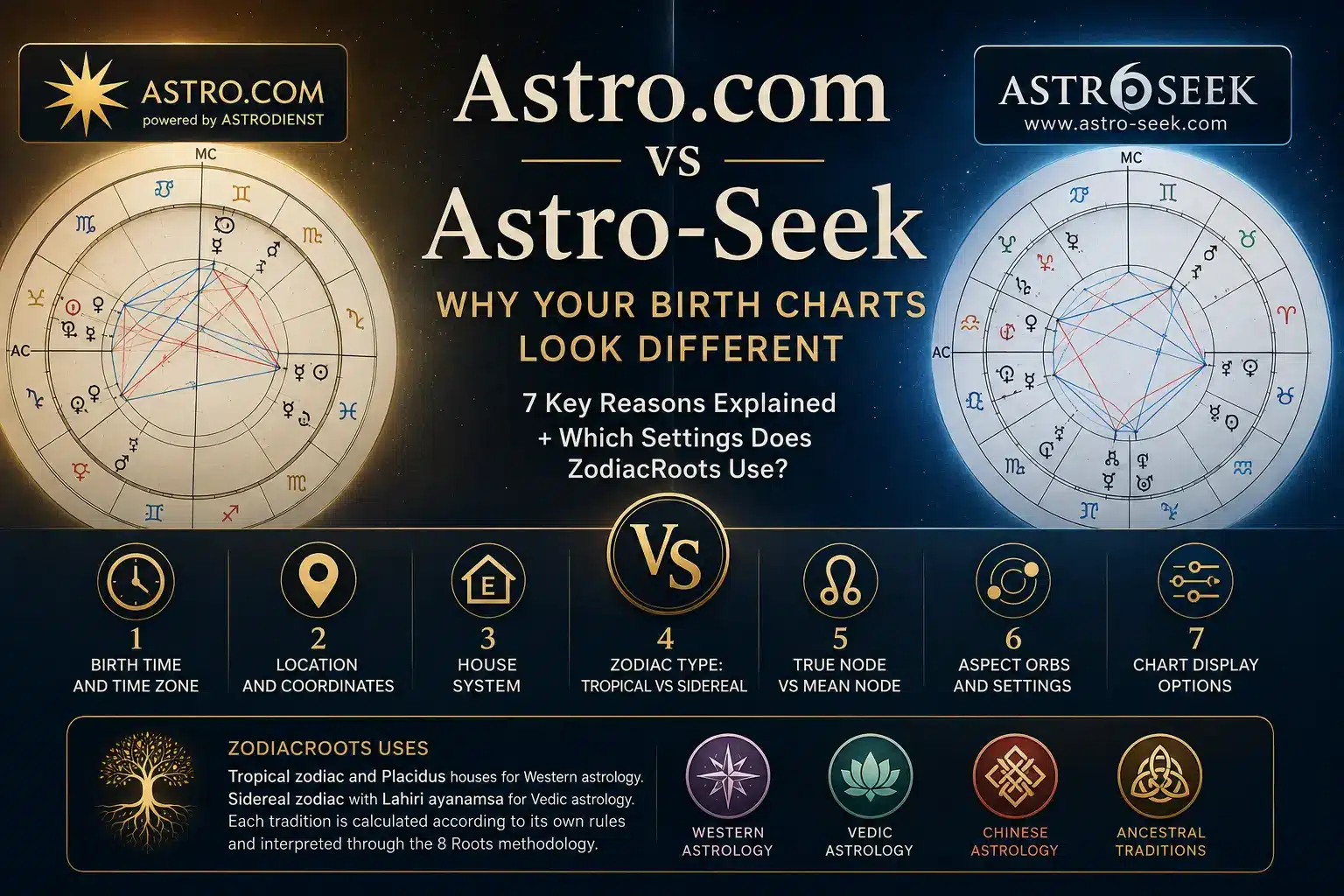
Quick Answer: Why Are Astro.com and Astro-Seek Charts Different?
Astro.com and Astro-Seek should normally show nearly identical planetary degrees when the same birth date, exact time, location, zodiac type and calculation settings are used.
When the charts look different, the cause is usually one of seven settings: the house system, birth time, time-zone conversion, coordinates, tropical or sidereal zodiac, lunar node type, or aspect and display options. The chart may therefore be mathematically compatible even when the wheel looks noticeably different.
Astro.com vs Astro-Seek at a Glance
Astro.com, operated by Astrodienst, and Astro-Seek are two of the most widely used online astrology platforms. Both can calculate natal charts, transits, synastry and specialist chart types. Their main difference is not that one uses a completely different sky. It is that each platform offers its own interface, defaults, specialist tools and presentation choices.
| Feature | Astro.com | Astro-Seek | ZodiacRoots |
|---|---|---|---|
| Standard Western zodiac | Tropical | Tropical | Tropical |
| Standard natal house system | Placidus | Placidus in the main natal calculator | Placidus |
| Alternative house systems | Many options | Many options and comparison tools | Used when a specific method or article requires them |
| Traditional astrology tools | Available through chart options and specialist material | Extensive dedicated calculators | Integrated into selected traditional interpretations |
| Vedic framework | Sidereal options available | Dedicated sidereal calculators | Sidereal zodiac with Lahiri ayanamsa |
| Primary strength | Established chart calculation, reports and professional use | Flexible calculators, filters and research tools | Cross-tradition interpretation and the 8 Roots framework |
What Should Remain the Same Between Astro.com and Astro-Seek?
When all core inputs match, the following information should normally be identical or extremely close:
Planetary signs
The Sun, Moon and planets should occupy the same zodiac signs when both charts use the same zodiac type.
Planetary degrees
Longitudes should usually match to within minor rounding differences.
Major aspects
The underlying angular relationships remain the same, even if different orbs change which lines are displayed.
The Ascendant, Midheaven and houses should also be very close when the same birth time, geographical coordinates and house system are used. A large difference is a diagnostic signal: one of the inputs or settings is not equivalent.
1. Astro.com vs Astro-Seek House Systems
The house system is the most common reason two birth-chart wheels look different. It changes the boundaries of the twelve houses without changing the zodiacal position of the planets.
Placidus
Placidus is the standard setting for the ordinary natal-chart wheel on Astro.com. It is also the initial house-system choice in Astro-Seek’s principal natal calculator. Placidus produces houses of unequal size using time and latitude.
Whole Sign
Whole Sign makes the entire zodiac sign containing the Ascendant the 1st house. Every following sign becomes the next house. Astro-Seek uses this structure in its dedicated traditional astrology calculator, and both platforms allow it as a selectable option.
A planet can therefore appear in the 12th house in Placidus and the 1st house in Whole Sign while remaining at exactly the same zodiac degree. This is not a planetary-calculation error. It is a different method of assigning life topics to chart space.
Diagnostic clue: if the signs and degrees match but several house numbers change, compare the selected house systems first.
For a full technical and interpretive comparison, read Placidus vs Whole Sign Astrology.
2. The Birth Time Was Entered Differently
The birth time controls the rotation of the chart relative to the local horizon. It is therefore essential for the Ascendant, Midheaven and houses.
Common birth-time entry errors
- Entering 2:23 instead of 14:23.
- Selecting AM instead of PM.
- Using an estimated time on one site and an exact time on the other.
- Entering 12:00 automatically when the time is unknown.
- Rounding a recorded time from 08:47 to 09:00.
- Using the time printed on a document without checking whether it is local civil time.
The Ascendant can move substantially over a relatively short period. Its speed is not perfectly uniform, but an average rule of thumb is roughly one zodiac sign every two hours. A difference of only a few minutes can also move a planet across a nearby house cusp.
3. Historical Time Zones and Daylight Saving Time
You normally enter the local clock time shown on the birth record. The calculator then converts it to Universal Time using the time-zone rules that applied to that location and date.
This becomes complicated because governments have changed time zones, daylight-saving rules and legal clock standards many times. The same country may have used different offsets in different years, and historical transitions were not always nationally uniform.
Why the same clock time can produce a different chart
- One location record may apply daylight saving while another does not.
- The selected city may belong to a different historical administrative zone.
- An older birth location may have changed its official name or jurisdiction.
- A manually selected UTC offset may override an automatic historical database.
- The birth occurred close to a clock-change transition.
A one-hour conversion difference can move the Ascendant dramatically and may change the Rising sign entirely. The Moon can also move enough to alter its exact degree, especially when a birth occurs close to a sign boundary.
4. Different Coordinates for the Birthplace
Astrology charts use latitude and longitude, not simply the name of a city. Two databases may associate a city with slightly different coordinates, such as the municipal centre, hospital district or metropolitan reference point.
Small coordinate differences usually have little effect on the planets, because planetary longitudes are calculated for the same moment. They can, however, shift the Ascendant, Midheaven and house cusps—particularly at high latitudes or when a placement sits very close to a cusp.
Check for duplicate place names
Many countries contain towns with identical or similar names. Confirm the country, region and coordinates rather than selecting the first result in the location list.
5. Tropical vs Sidereal Zodiac Settings
A chart that differs by approximately 23–24 degrees is usually not showing a house-system problem. It is probably comparing the tropical and sidereal zodiacs.
Tropical zodiac
The tropical zodiac begins Aries at the March equinox. It is the standard framework used in most modern Western natal charts on both Astro.com and Astro-Seek.
Sidereal zodiac
The sidereal zodiac applies an ayanamsa to align the zodiac with a stellar reference framework. Different ayanamsas can produce slightly different sidereal degrees.
Someone with a tropical Aries Sun may therefore have a sidereal Pisces Sun. Neither site has necessarily made an error; the charts are answering the calculation through different zodiac frameworks.
6. True Node vs Mean Node
The lunar nodes are mathematical points where the Moon’s orbit intersects the ecliptic. They can be calculated in more than one way.
| Node setting | What it represents | Typical result |
|---|---|---|
| True Node | Includes short-term oscillation in the node’s apparent motion | A more variable exact degree |
| Mean Node | Uses an averaged, smoother retrograde path | A slightly different but stable degree |
The difference is usually modest, but it can matter near a sign boundary, house cusp or exact aspect. Astro-Seek’s own FAQ explicitly identifies node settings as a reason its node position may differ from other sites or software.
7. Aspect Orbs, Objects and Display Settings
Sometimes the underlying chart is the same, but the visual result looks different because the platforms draw different objects and aspect lines.
Settings that change the appearance
- Different maximum orbs for conjunctions, oppositions, squares, trines and sextiles.
- Minor aspects enabled on one chart but disabled on the other.
- Chiron, Lilith, asteroids or hypothetical points added to one wheel.
- Aspect lines to the Ascendant or Midheaven included or excluded.
- Different chart styles, colours, glyphs or wheel orientation.
- Different rounding rules in the visible table.
An aspect exists mathematically as an angular relationship. Whether it appears as a line depends on the orb threshold and display rules. Two platforms can therefore agree on the planetary positions while showing a different number of aspects.
Why Is My Rising Sign Different on Astro.com and Astro-Seek?
A different Rising sign is more significant than a different aspect line. It normally indicates a discrepancy in one of four inputs:
- The birth time.
- The AM/PM format.
- The historical time-zone or daylight-saving conversion.
- The selected birthplace or coordinates.
The house system does not normally change the Ascendant’s zodiac degree. Placidus and Whole Sign use the same Ascendant point when the underlying time and location are identical. They differ in how that degree relates to the 1st-house boundary.
If the Ascendant degree itself differs, do not begin by blaming Placidus or Whole Sign.
Recheck the birth time, time-zone conversion and coordinates first.
Astro.com vs Astro-Seek: Which Is More Accurate?
Neither platform is automatically more accurate in every chart or every specialist technique. When identical birth data and equivalent settings are used, the principal planetary positions should be extremely close.
The more useful question is whether the chart uses the correct source data and the intended settings. A technically sophisticated calculator cannot correct an inaccurate birth time, a wrong location or an accidental sidereal selection.
Astro.com strengths
- Long-established professional use.
- Extensive chart-selection options.
- Clear documented default of Placidus for the ordinary natal wheel.
- Published interpretive material and reports.
Astro-Seek strengths
- Large range of specialist calculators.
- Flexible house-system comparison tools.
- Dedicated traditional and sidereal calculators.
- Detailed filters, tables and search functions.
The best practical approach is to use one platform consistently, understand its settings and verify sensitive placements with a second calculator when the birth occurs near a sign, angle or house boundary.
Astro.com vs Astro-Seek Chart Comparison Checklist
Use this sequence before concluding that one chart is wrong.
| Check | What must match | What a mismatch changes |
|---|---|---|
| 1. Birth date | Day, month and year | Potentially every planetary placement |
| 2. Birth time | Hour, minutes and AM/PM | Ascendant, MC and houses |
| 3. Birthplace | Correct city, country and region | Angles and house cusps |
| 4. Zodiac type | Tropical or the same sidereal ayanamsa | Signs and degrees |
| 5. House system | Placidus, Whole Sign, Equal or another identical choice | House placement |
| 6. Node setting | True or Mean Node | Node degree and some aspects |
| 7. Aspect settings | Same objects, aspect types and orbs | Visible lines and aspect list |
Fast diagnostic rules
Signs match, houses differ
Check the house system and cusp settings.
Most signs shift backward
Check tropical versus sidereal zodiac.
Ascendant differs substantially
Check time, AM/PM, time zone and location.
Which Astrology Systems Does ZodiacRoots Use?
ZodiacRoots combines several astrological traditions, but each tradition is calculated and interpreted according to its own internal rules. The systems are not blended at the calculation stage.
Western Astrology
- Zodiac: Tropical zodiac
- House system: Placidus
- Primary angles: Ascendant and Midheaven
- Chart structure: Planets, houses, signs and aspects
Vedic Astrology
- Zodiac: Sidereal zodiac
- Ayanamsa: Lahiri
- Interpretive framework: Sign-based
- Core elements: Rashi, Nakshatra and planetary placements
Chinese Astrology
- System: Chinese zodiac and Four Pillars framework
- Core structure: Year, month, day and hour pillars
- Primary elements: Animals, elements, stems and branches
Additional Ancestral Traditions
- Mayan symbolic calendar
- Celtic tree tradition
- Egyptian archetypal tradition
- Cross-tradition synthesis through the 8 Roots method
For standard Western birth charts, ZodiacRoots uses the tropical zodiac with Placidus houses.
For Vedic calculations, ZodiacRoots uses the sidereal zodiac with Lahiri ayanamsa. Each tradition is first calculated independently and is only compared later during the interpretive synthesis.
Frequently Asked Questions
Why is my Astro-Seek chart different from Astro.com?
The most common causes are a different house system, birth time, time-zone conversion, location, zodiac type, node option or aspect-orb setting.
Does Astro-Seek use Whole Sign or Placidus?
Astro-Seek’s main natal-chart calculator begins with Placidus as the house-system option, while its dedicated traditional astrology calculator uses Whole Sign houses. The selected calculator and settings therefore matter.
What house system does Astro.com use?
Astro.com documents Placidus as the default house system for its ordinary natal-chart wheel, while also offering Whole Sign, Koch, Campanus, Regiomontanus, Equal and several other systems.
What house system does ZodiacRoots use?
ZodiacRoots uses the tropical zodiac with Placidus houses for standard Western natal charts. Its Vedic layer uses the sidereal zodiac with Lahiri ayanamsa.
Can a house system change my Rising sign?
Normally, no. Different house systems can change where the 1st house begins conceptually, but they use the same Ascendant degree when the birth time and location are identical. A different Rising sign usually points to a time, time-zone or location discrepancy.
Why did my Moon change houses but not signs?
The planetary longitude remained the same, but a different house system placed the house boundary elsewhere. This frequently occurs when comparing Placidus and Whole Sign.
Why are the aspect lines different?
The platforms may be using different aspect orbs, minor aspects or additional objects. The underlying planet positions can still match.
Which astrology calculator should I trust?
Use a reputable calculator with verified birth data and clearly selected settings. Consistency and transparent inputs are more important than choosing a platform solely by reputation.
Is Astro.com tropical or sidereal?
Its standard Western chart is tropical, but sidereal options are available in the extended chart settings.
Can two accurate astrology charts look different?
Yes. Two charts can contain the same planets and angles while using different house systems, aspect orbs, objects or visual styles.
Continue Exploring
Sources and Methodology
- Astrodienst — Overview of Chart Types: documents Placidus houses in the default natal-chart settings.
- Astrodienst — Overview of House Systems: official explanations of available house systems.
- Astrodienst — Extended Chart Selection: lists selectable zodiac and house-system options.
- Astro-Seek — Birth Chart Calculator: principal natal-chart calculator and settings.
- Astro-Seek — House Systems Calculator: comparison of Placidus, Whole Sign, Equal and other systems.
- Astro-Seek — Traditional Astrology Calculator: specialist calculator using Whole Sign houses.
- Astro-Seek FAQ: official notes on daylight saving, lunar nodes and calculation differences.
See Your Astrology Through Eight Traditions
A standard birth chart explains one symbolic framework. ZodiacRoots connects Western, Vedic and ancestral traditions to show where the same themes repeat across your complete 8 Roots profile.
Discover More Astrology Articles You May Like
Explore related ZodiacRoots articles selected by topic first, then completed with fresh astrology reads.