Placidus vs Whole Sign Astrology: Which House System Is More Accurate?
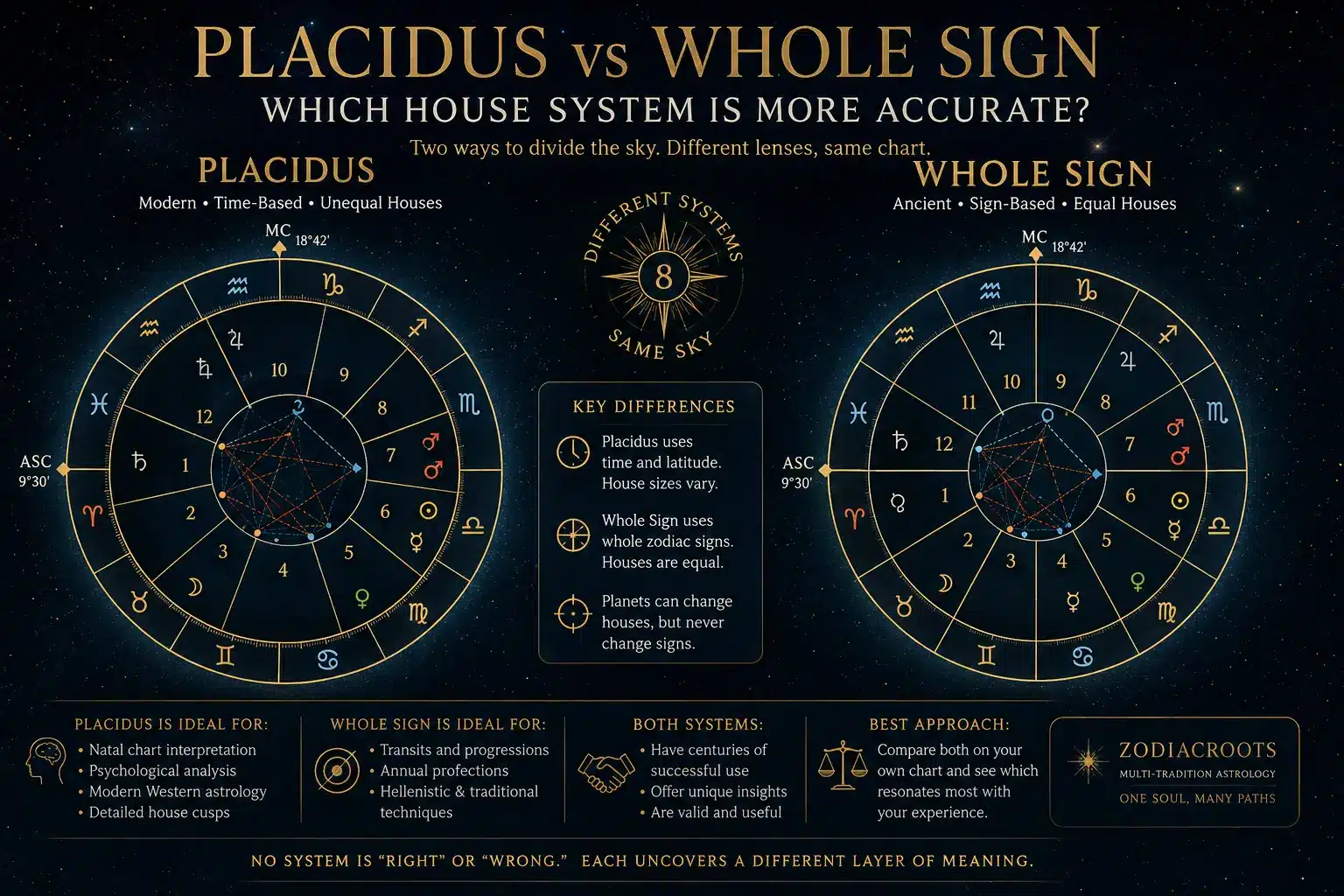
Placidus divides the chart through time and local latitude. Whole Sign assigns one complete zodiac sign to each house. They can move planets into different houses without changing a single planet’s sign.
Quick Answer
Placidus and Whole Sign are different methods of dividing an astrological chart. Placidus uses time and geographical latitude to produce houses of unequal size; Whole Sign makes the Ascendant’s entire zodiac sign the 1st house and assigns each following sign to the next house.
Neither system is automatically “right” or “wrong.” Placidus is widely used in modern Western and psychological astrology, while Whole Sign is central to much contemporary Hellenistic practice and works naturally with traditional techniques such as annual profections. The better choice depends on the method you are using, the reliability of the birth time, and the interpretive question being asked.
Placidus vs Whole Sign Astrology: What Is a House System?
Understanding Placidus vs Whole Sign Astrology begins with a simple distinction: a house system is a mathematical or symbolic method for dividing the birth chart into twelve sectors called houses. The planets describe what is operating, zodiac signs describe how it operates, and houses describe where that symbolism is expressed in life.
The 1st house is traditionally associated with identity, embodiment and approach to life. The 4th relates to home, roots and private foundations. The 7th concerns partnership and significant one-to-one relationships. The 10th is associated with public direction, vocation and reputation. The remaining houses cover resources, communication, creativity, work, shared obligations, belief, community and retreat.
For a full explanation of the twelve life areas, read the ZodiacRoots guide to astrology houses and their meanings. The important point here is that the meanings of the houses do not disappear when the house system changes. What changes is the way their boundaries are calculated.
Why Do Astrologers Use Different House Systems?
Astrological practice developed across different periods, languages and mathematical traditions. Some systems divide the zodiac into equal 30-degree sectors. Others divide the celestial sphere spatially. Quadrant systems anchor the chart to the Ascendant–Descendant and Midheaven–IC axes, then calculate intermediate cusps by different methods.
These are not cosmetic settings. A different system can move a planet from one house to another, change whether a sign is intercepted, and alter the relationship between the Midheaven and the 10th house. This is why two astrologers can begin with identical birth data but emphasise different life areas.
What Is the Placidus House System?
In the Placidus vs Whole Sign Astrology debate, Placidus represents the time-based quadrant approach. It is named after the seventeenth-century Italian astrologer and monk Placidus de Titis. It became highly influential in modern Western astrology and remains the most commonly used house system according to the Astrodienst house-system overview.
Its central logic is time-based. Rather than giving every house exactly 30 degrees, Placidus divides arcs according to the time required for points on the ecliptic to move through stages of their daily motion between the horizon and meridian. Because local latitude affects rising times, the resulting houses are usually unequal.
What Placidus Preserves
- The Ascendant as the 1st-house cusp.
- The Descendant as the 7th-house cusp.
- The Midheaven as the 10th-house cusp.
- The IC as the 4th-house cusp.
- Intermediate cusps calculated through time-based division.
What the Chart Looks Like
- Houses vary in size.
- Some signs can occupy more than one cusp.
- Some signs may be intercepted between cusps.
- Planets near cusps can change houses with a small birth-time adjustment.
Why Many Modern Astrologers Prefer Placidus
Placidus offers fine-grained house cusps and an angular structure that many astrologers find useful for natal analysis. In psychological astrology, unequal houses are often read as part of the chart’s individual architecture rather than as a problem to be corrected.
It is also deeply embedded in modern chart practice. Many astrology students first encounter birth charts in Placidus, and a large body of twentieth- and twenty-first-century interpretive literature assumes a quadrant framework.
Strengths of Placidus
- Detailed cusp structure: every house begins at a specific degree, allowing close analysis of planets near house boundaries.
- Strong angular emphasis: the MC is structurally tied to the 10th-house cusp and the IC to the 4th.
- Familiar modern convention: it is widely used in contemporary Western natal practice.
- Latitude-sensitive architecture: houses reflect local rising conditions rather than remaining equal everywhere.
- Useful for psychological interpretation: practitioners often use the unequal distribution to describe where life feels concentrated, expanded or compressed.
Limitations of Placidus
- It cannot be calculated conventionally beyond the polar circles. Astrodienst states that Placidus houses cannot be calculated for regions beyond approximately 66°33′ north or south for mathematical reasons.
- It is highly sensitive to birth time. A small error can shift cusps and move planets near them.
- Unequal houses can become extreme at high latitudes. This may produce very large and very small houses.
- Its mathematics are harder to explain. Beginners can use it, but Whole Sign is conceptually simpler.
- Intercepted signs require additional interpretive choices. Not every school agrees on their importance.
What Is the Whole Sign House System?
Within Placidus vs Whole Sign Astrology, Whole Sign represents the sign-based approach: the complete zodiac sign containing the Ascendant becomes the 1st house. The next sign becomes the 2nd house, the following sign becomes the 3rd, and the sequence continues around the chart.
For example, if the Ascendant is at 24° Gemini, all of Gemini is the 1st house, all of Cancer is the 2nd, all of Leo is the 3rd, and so forth. The exact Ascendant degree remains important as an angle, but it is not the starting boundary of the 1st house.
Whole Sign is strongly associated with the reconstruction and revival of Hellenistic astrology. Historical discussions of ancient astrology commonly identify it as the principal early house framework, although the surviving tradition is complex and ancient astrologers also used angular and quadrant concepts alongside sign-based places.
What Whole Sign Preserves
- The exact Ascendant degree as a powerful angle.
- The rising sign as the complete 1st house.
- Twelve houses of exactly 30 degrees each.
- A direct sign-to-house sequence.
What Changes
- The MC may fall in the 9th, 10th or 11th whole-sign house.
- The Ascendant is not necessarily the 1st-house boundary.
- Intermediate quadrant cusps are not used as house beginnings.
- Intercepted signs do not occur.
Strengths of Whole Sign
- Clarity: one sign equals one house, creating an immediately readable structure.
- Historical relevance: it is fundamental to much modern Hellenistic practice.
- Works at all latitudes: it does not depend on time-based intermediate cusps.
- Natural fit for traditional techniques: annual profections, planetary rulers and sign-based timing work cleanly within it.
- No intercepted signs: every sign governs one complete house.
- Clear ingress timing: when a transiting planet changes signs, it also changes whole-sign houses.
Limitations of Whole Sign
- It can move many planets at once: readers accustomed to Placidus may find the reinterpretation dramatic.
- The MC is not always in the 10th house: this requires understanding the MC as a distinct point rather than equating it automatically with the 10th.
- It offers fewer intermediate cusp degrees: astrologers who rely heavily on precise cusp contacts may prefer a quadrant system.
- Simplicity does not guarantee accuracy: a cleaner chart is not automatically a truer chart.
- It still requires a reliable Ascendant: a wrong rising sign shifts the entire house sequence.
Placidus vs Whole Sign Astrology: How the Calculations Work
Placidus and Whole Sign do not merely draw the same twelve lines in different places. They begin from different definitions of what an astrological house represents. Placidus derives intermediate cusps from apparent daily motion through time; Whole Sign derives houses directly from complete zodiac signs.
Placidus: Simplified Calculation
- Calculate the local horizon, Ascendant, meridian and Midheaven from the birth time and place.
- Consider the apparent daily motion of zodiacal degrees above and below the horizon.
- Divide the semi-diurnal and semi-nocturnal arcs into temporal thirds.
- Identify the ecliptic degrees corresponding to those temporal divisions.
- Use those degrees as the intermediate house cusps.
Because rising and setting times vary by latitude, Placidus houses are usually unequal. The difference becomes increasingly pronounced at high latitudes.
Whole Sign: Simplified Calculation
- Calculate the exact Ascendant and identify its zodiac sign.
- Assign that entire sign to the 1st house.
- Assign the next zodiac sign to the 2nd house.
- Continue in zodiacal order through all twelve signs.
- Retain the exact Ascendant and Midheaven as sensitive angles inside the sign-based houses.
Every house contains exactly 30 degrees. No intermediate quadrant cusps are required, so the method remains usable at all terrestrial latitudes.
Core mathematical difference: Placidus divides apparent daily motion through time; Whole Sign divides the zodiac directly through complete signs.
Why This Difference Matters in Interpretation
In Placidus, a house boundary is an individually calculated degree. A planet can therefore sit close to a cusp and may change houses when the recorded birth time changes by only a few minutes. In Whole Sign, house boundaries always occur at 0° of each sign, so the exact Ascendant degree remains important as an angle but does not define the beginning of the 1st house.
Neither construction is a more detailed version of the other. They describe chart space through different mathematical models, which is why the same planet can receive a different house topic while keeping the same sign, degree and aspects.
Placidus vs Whole Sign Astrology: Complete Comparison
| Feature | Placidus | Whole Sign |
|---|---|---|
| Basic method | Time-based quadrant division | One complete zodiac sign per house |
| House size | Unequal | Exactly 30° |
| 1st house begins | At the exact Ascendant degree | At 0° of the rising sign |
| MC placement | 10th-house cusp | Can fall in the 9th, 10th or 11th house |
| Latitude sensitivity | High | Low |
| Polar-circle calculation | Conventionally unavailable beyond the polar circles | Available |
| Intercepted signs | Possible | Not possible |
| Birth-time sensitivity | Very high for cusps | Very high near a rising-sign boundary |
| Modern Western natal use | Very common | Increasingly common |
| Hellenistic techniques | Not usually the primary house framework | Commonly preferred |
| Annual profections | Possible to reference, but not the standard framework | Natural fit |
| Transit-house entry | Occurs at the individual cusp degree | Occurs when the planet changes signs |
| Beginner readability | Moderate | High |
| Main interpretive appeal | Fine-grained cusps and angular architecture | Sign rulers, topics and traditional timing |
Placidus vs Whole Sign Astrology: A Step-by-Step Chart Example
To isolate the difference between the systems, consider an illustrative chart rather than a real person. The chart contains a Gemini Ascendant at 24°, the Moon at 8° Gemini, Venus at 12° Gemini and the Midheaven at 10° Pisces. The planetary signs and degrees remain unchanged in both versions.
Placidus Version
- Ascendant: 24° Gemini — exact 1st-house cusp.
- Moon: 8° Gemini — 12th house.
- Venus: 12° Gemini — 12th house.
- Midheaven: 10° Pisces — exact 10th-house cusp.
Whole Sign Version
- Ascendant: 24° Gemini — sensitive degree within the 1st house.
- Gemini: the complete sign becomes the 1st house.
- Moon: 8° Gemini — 1st house.
- Venus: 12° Gemini — 1st house.
- Midheaven: 10° Pisces — 10th whole-sign house.
Step 1: Identify What Does Not Change
The Moon remains at 8° Gemini and Venus remains at 12° Gemini. Their aspects, sign rulers and relationship to the Ascendant degree remain the same. The MC also remains at 10° Pisces. Only the house boundaries have changed.
Step 2: Interpret the Placidus Placement
In Placidus, the Moon and Venus fall behind the Ascendant in the 12th house. Their Gemini qualities—curiosity, verbal responsiveness, social observation and mental movement—may therefore operate more privately or indirectly. The person could appear less emotionally expressive or openly Venusian than the signs alone suggest.
The 12th-house emphasis can point toward private emotional processing, relationships that require discretion, a rich inner dialogue, creative work developed away from public attention, or patterns that are not immediately visible to the person.
Step 3: Interpret the Whole Sign Placement
In Whole Sign, the entire sign of Gemini becomes the 1st house. The Moon and Venus therefore become part of the visible presentation of self. Curiosity, adaptability, conversational instinct, charm and responsiveness are more immediately connected with identity, manner and appearance.
The person may be experienced by others as emotionally alert, socially receptive and strongly identified with words, ideas or relational exchange.
Step 4: Compare the Interpretive Emphasis
| Question | Placidus Emphasis | Whole Sign Emphasis |
|---|---|---|
| Where are Moon and Venus expressed? | Privately, unconsciously or behind the scenes | Through visible identity and personal style |
| What does Gemini describe? | An internal or protected mental-relational world | An immediately recognisable way of meeting life |
| What remains stable? | Gemini symbolism, exact degrees, aspects and angular distances | |
What changed? Not the planets or angles. Placidus emphasises a private 12th-house expression; Whole Sign emphasises visible 1st-house embodiment.
This example also corrects a common mistake: with Gemini rising, Pisces is the 10th whole-sign house, not the 9th. The MC can fall outside the 10th in Whole Sign, but that requires a different Ascendant–MC combination.
Placidus vs Whole Sign Astrology: How to Choose the Right System
Choose the house system that matches the tradition and technique you are using. Do not switch systems simply because one placement feels more flattering or because a single chart appears to fit better.
| If You… | Consider Using… | Why |
|---|---|---|
| Are learning houses for the first time | Whole Sign | One sign equals one house, making the structure easier to follow. |
| Use Hellenistic techniques | Whole Sign | It integrates naturally with sign rulers, annual profections and traditional house topics. |
| Practise modern psychological astrology | Placidus | It is deeply embedded in modern natal and psychological literature. |
| Practise traditional horary astrology | Regiomontanus | It is the conventional choice in many influential horary lineages. |
| Were born beyond the polar circles | Whole Sign or Equal House | Conventional Placidus intermediate cusps cannot be calculated there. |
| Work with exact quadrant cusps | Placidus | Every intermediate house cusp receives a specific degree. |
| Use annual profections | Whole Sign | The method advances through complete sign-houses. |
| Analyse synastry house overlays | Your established natal system | Consistency is more useful than changing systems for each relationship. |
| Focus mainly on planetary aspects in synastry | Either system | Planet-to-planet aspects do not change when house systems change. |
| Use several astrological traditions | Declare the system for each method | A transparent hybrid framework is stronger than an unexplained mixture. |
A Five-Question Decision Test
- Which astrological tradition are you practising?
- Was the technique developed for sign-based or quadrant houses?
- How reliable is the recorded birth time?
- Do you need exact intermediate cusp degrees?
- Can you apply the same framework consistently across many charts?
Placidus vs Whole Sign Astrology: Key Difference in One Sentence
Placidus calculates unequal houses through time and latitude, while Whole Sign assigns one complete zodiac sign to each house. The planets do not change signs; only the life area assigned to them may change.
Why Do Planets Change Houses Between Placidus and Whole Sign?
One of the most searched questions about Placidus vs Whole Sign Astrology is why planets move between houses. A planet changes houses because the two systems draw house boundaries in different places. The planet itself has not moved. Its zodiac sign, degree, aspects and astronomical position remain exactly the same.
Imagine an Ascendant at 24° Gemini and a Venus at 8° Gemini. In Whole Sign, all of Gemini is the 1st house, so Venus is in the 1st. In Placidus, the 1st house begins at 24° Gemini. Venus at 8° Gemini may therefore fall in the 12th house.
This produces two different symbolic emphases:
Venus in the 1st House
Relational style, aesthetics and attraction become visible parts of identity and presentation.
Venus in the 12th House
Relational patterns may be more private, unconscious, sacrificial, hidden or connected with retreat and inner life.
These readings are not interchangeable, but they can describe different layers of experience. The key is not to blend every interpretation indiscriminately. Read each chart according to the logic of the system being used.
Does Your Ascendant Change? What About the Midheaven?
Your Ascendant degree does not change merely because you switch house systems. It is calculated from the birth time, birthplace and local horizon. The same is true of the Midheaven as an astronomical angle.
What changes is the role those angles play in the house structure.
The Ascendant
In Placidus, the exact Ascendant degree is the cusp of the 1st house. In Whole Sign, the entire sign containing the Ascendant becomes the 1st house, while the exact Ascendant remains a sensitive degree within that house.
Explore this point in greater depth in the ZodiacRoots guide to Ascendant meaning and the Birth Chart Visualizer.
The Midheaven
In Placidus, the MC is the 10th-house cusp. In Whole Sign, the MC floats independently and may fall in the 9th, 10th or 11th house. Traditional astrologers can then interpret both the 10th whole-sign house and the actual MC degree.
For example, an MC in the 9th whole-sign house may connect public visibility with teaching, publishing, travel, philosophy or specialised knowledge. An MC in the 11th may connect reputation with groups, networks, patrons or collective projects.
House Cusps
A cusp is the exact degree at which a house begins. Placidus uses twelve degree-specific cusps. Whole Sign uses 0° of each sign as the house boundary, while treating the Ascendant and MC as important angles within the sign-based structure. Read the dedicated ZodiacRoots guide to house cusps in astrology for a fuller explanation.
Why Accurate Birth Time Matters in Both Systems
House interpretation is only as secure as the birth data used to calculate the chart. The Ascendant advances through the zodiac during the day, and its speed is not perfectly uniform. A difference of minutes may alter cusp degrees; a larger error can change the rising sign altogether.
Placidus
All intermediate cusps depend directly on time and place. Even when the rising sign remains unchanged, planets close to cusps may switch houses.
Whole Sign
The exact cusp grid is simpler, but if the estimated time places the Ascendant in the wrong sign, every house shifts by one sign.
Angles and Timing
Transits to the Ascendant, MC and house cusps require accurate degrees. An uncertain time weakens exact predictive claims.
When birth time is unconfirmed, ZodiacRoots treats the Sun, many planetary signs and major aspects with greater confidence than the Ascendant, MC and houses. Read our full editorial policy on birth-time uncertainty in astrology.
Placidus vs Whole Sign Astrology for Natal Charts
There is no universally accepted winner in Placidus vs Whole Sign Astrology. The best system is the one that belongs to the interpretive tradition you are actually practising and that you apply consistently.
Placidus for Natal Interpretation
Placidus is often chosen by modern psychological astrologers because it provides exact intermediate cusps, unequal house sizes and a fixed MC–10th-house relationship. This supports detailed interpretation of planets near boundaries and concepts such as intercepted signs.
It can be especially useful when the analysis focuses on personal development, angularity, cusp emphasis and the distribution of planets through a highly individualised house structure.
Whole Sign for Natal Interpretation
Whole Sign is not merely a simplified beginner system. In traditional practice, it provides a rigorous structure centred on house topics, planetary rulers, aspects by sign, angularity and the condition of each house ruler.
Its clarity can reveal chart architecture that is harder to see in a wheel with highly unequal houses. It also separates the 10th house from the MC, giving the astrologer two related but distinct vocational indicators.
A Better Question Than “Which Feels More Accurate?”
Personal resonance is useful, but it can also be selective. A reader may prefer whichever system places a planet in the more flattering house. A stronger test is methodological:
- Confirm the birth time as closely as possible.
- Interpret the complete chart in one system.
- Use that system’s own techniques rather than importing assumptions from another.
- Test the same method across several known life events and multiple charts.
- Record where each framework consistently adds explanatory value.
Placidus vs Whole Sign Astrology for Transits and Predictive Astrology
Both sides of the Placidus vs Whole Sign Astrology comparison can be used for transits, but they mark house entry differently. In Placidus, a transiting planet enters a house when it crosses that house’s specific cusp degree. In Whole Sign, it enters a new house when it enters a new zodiac sign.
Whole Sign and Traditional Timing
Whole Sign is particularly natural for annual profections because each birthday activates the next whole-sign house in sequence. It also integrates cleanly with sign rulers and many Hellenistic techniques. A profected house is judged through its sign, ruler and the condition of that ruler.
Placidus and Degree-Specific Activation
Astrologers using Placidus may give special attention to transits over exact cusps, particularly the Ascendant, Descendant, MC and IC. This can create more specific timing windows, but the reliability of the result depends heavily on birth-time accuracy.
Can You Use Whole Sign for Transits and Placidus for the Natal Chart?
Some practising astrologers do. However, this should be a deliberate hybrid method rather than an improvised switch. If you use different systems for different tasks, define why each is being used and avoid treating contradictory house placements as equally literal at the same moment.
For readers learning the wheel itself, begin with our guide to the natal chart wheel before comparing predictive layers.
Why Placidus Has Problems Near the Poles
The Arctic and Antarctic Circles lie at approximately 66°33′ north and south. Beyond these latitudes, there are periods when parts of the zodiac do not rise or set in the usual way. Because Placidus depends on dividing time-based semi-arcs, its conventional intermediate house calculations become mathematically unavailable.
Astrodienst explicitly notes that Placidus houses cannot be calculated beyond the polar circles. This is more precise than saying the system merely “becomes inaccurate near the poles.” The conventional calculation itself breaks down.
Whole Sign and Equal House do not face the same problem because their boundaries are created directly from zodiacal signs or 30-degree divisions rather than by trisecting semi-diurnal and semi-nocturnal arcs.
What Other Astrological House Systems Exist?
Placidus and Whole Sign are the best-known comparison today, but they are only two among many systems. The existing ZodiacRoots overview of house systems in astrology introduces several of the major alternatives.
| System | Basic Logic | Why It Matters |
|---|---|---|
| Equal House | Twelve 30° houses beginning at the exact Ascendant degree | Simple, works across latitudes, but differs from Whole Sign |
| Porphyry | Divides each quadrant between angles into three equal parts | One of the simplest quadrant systems |
| Alcabitius | Time-based division associated with medieval astrology | Historically important in Arabic and Latin traditions |
| Regiomontanus | Divides the celestial equator and projects divisions to the ecliptic | Common in traditional horary astrology |
| Campanus | Divides the prime vertical into equal arcs | Spatial system with strong local-horizon geometry |
| Koch | A time-based quadrant method related to birthplace latitude | Gained particular popularity in parts of Europe |
| Topocentric | Uses a topocentric mathematical model based on the observer’s location | Often produces cusps close to Placidus at ordinary latitudes |
| Meridian | Divides the celestial equator into equal sections from the MC | Emphasises meridian-based structure |
| Morinus | Divides the celestial equator into twelve equal sections | Does not use the horizon as the fundamental starting point |
| Sripati Bhava | Divides arcs between angular house centres into three parts | Used in some Indian astrological approaches |
Whole Sign Is Not the Same as Equal House
This is one of the most common errors. If the Ascendant is at 24° Gemini:
- Whole Sign: the 1st house begins at 0° Gemini.
- Equal House: the 1st house begins at 24° Gemini, the 2nd at 24° Cancer, and so on.
Both systems produce 30-degree houses, but their boundaries differ by the Ascendant’s degree within its sign.
Is Whole Sign Used in Vedic Astrology?
Many Vedic charts use a sign-equals-house structure, especially the Rāśi chart read with the rising sign as the 1st house. This visually resembles Whole Sign houses, but Western Hellenistic astrology and Jyotiṣa should not be treated as interchangeable traditions.
Vedic practice also includes bhava calculations and methods such as Bhava Chalit or Sripati, which can shift the house emphasis without changing a planet’s Rāśi. Different schools vary in how strongly they prioritise sign placement, bhava position and divisional charts.
This distinction creates a useful bridge between Western and Vedic study. Explore the ZodiacRoots guide to the Vedic astrology chart and our reference article on the 27 Nakshatras.
Common Misconceptions About Placidus vs Whole Sign Astrology
No. Your planets remain in the same signs and degrees. Only their house placement may change.
No. The Ascendant determines the 1st-house sign and remains a major degree within that house.
Historical recency does not prove interpretive superiority. The systems answer different structural questions.
Its geometry is simple, but its traditional application can be technically demanding.
No. The strict mathematical problem occurs beyond the polar circles. Below them, the system can still calculate, although houses may become highly unequal.
Personal resonance is not a complete test. Consistency across methods, charts and timed events is more informative.
It has one house position within each selected framework. Saying it is in both without naming the systems creates confusion.
Which House System Does ZodiacRoots Use?
The ZodiacRoots position on Placidus vs Whole Sign Astrology is transparent: ZodiacRoots uses Placidus as the principal house system for Western natal-chart calculations. This keeps the Western layer aligned with a widely recognised modern standard and preserves degree-specific house cusps, the angular axes and familiar natal-chart presentation.
That choice does not imply that Whole Sign is invalid. ZodiacRoots recognises Whole Sign as historically and methodologically important, especially in Hellenistic astrology and traditional timing. When an article discusses annual profections, sign-based places or reconstructed Hellenistic methods, the house framework should be stated explicitly.
The wider ZodiacRoots method also avoids reducing a person to one house system. Western houses form one technical layer inside the 8 Roots Method, which combines the Western Sun, Moon and Ascendant with Vedic, Chinese, Mayan, Celtic and Egyptian symbolic roots.
The ZodiacRoots Editorial Position
- State the house system whenever it materially affects the interpretation.
- Do not present uncertain house data as certain when birth time is unconfirmed.
- Do not change systems selectively to produce a preferred result.
- Keep Hellenistic, modern Western and Vedic methods historically distinct.
- Treat astrology as a symbolic interpretive framework, not scientifically proven prediction.
How to Compare Both Systems on Your Own Chart
- Verify your birth time. Prefer a birth record or another reliable source.
- Generate the Placidus chart. Record planets within about 5° of a house cusp.
- Generate the Whole Sign chart. Note which planets move houses and where the MC falls.
- Keep the signs and aspects fixed. Do not reinterpret everything—focus on the house changes.
- Compare house rulers. Whole Sign depends heavily on the ruler of each complete sign-house.
- Review timed events. Test major transits, profections or angle contacts using the correct framework.
- Write conclusions before choosing a favourite. Look for repeated explanatory value rather than one striking coincidence.
The ZodiacRoots Birth Chart Visualizer is useful for understanding why minutes can change the Ascendant, angles and houses. For the wider structure of a chart, see Astrology Fundamentals.
Frequently Asked Questions
Is Placidus more accurate than Whole Sign?
No house system has been universally established as more accurate. Placidus gives time- and latitude-based quadrant cusps, while Whole Sign gives one complete sign to each house. Their usefulness depends on the astrological technique and interpretive tradition being applied.
Why does my chart look different in Whole Sign?
Whole Sign begins the 1st house at 0° of the rising sign rather than at the exact Ascendant degree. This can move planets into neighbouring houses, eliminate intercepted signs and place the MC outside the 10th house.
Do planets change zodiac signs when I change house systems?
No. Their signs, degrees and aspects remain unchanged. Only the house boundaries change.
Does my Rising sign change between Placidus and Whole Sign?
No. The Ascendant is calculated from the same birth data. In Placidus it is the 1st-house cusp; in Whole Sign its entire sign becomes the 1st house.
Which house system is older?
Whole Sign is generally identified as the earliest widely attested house framework in Hellenistic astrology. Placidus became influential much later, particularly in modern Western practice.
Which system is better for beginners?
Whole Sign is easier to understand because every sign corresponds to one house. Placidus is also suitable for beginners, but its unequal cusps, interceptions and high-latitude behaviour require more explanation.
Which system is better for transits?
Whole Sign provides clear sign-based house entry and integrates naturally with traditional timing. Placidus provides degree-specific cusp crossings. The preferred system should match the predictive method being used.
Can I use Placidus and Whole Sign together?
Yes, but use a defined method. Some astrologers use one as the primary natal framework and the other as a supplementary lens. Avoid treating every conflicting house placement as simultaneously literal.
Does Whole Sign work without a birth time?
Not reliably. Whole Sign requires the correct rising sign. If the birth time is unknown, the Ascendant—and therefore the complete house sequence—may be wrong.
Why can Placidus not be calculated beyond the polar circles?
Placidus divides time-based arcs connected with rising and setting. Beyond approximately 66°33′ north or south, some zodiac degrees do not rise or set conventionally, so the standard intermediate-cusp calculation becomes mathematically unavailable.
Is Whole Sign the same as Equal House?
No. Whole Sign begins each house at 0° of a zodiac sign. Equal House begins the 1st house at the exact Ascendant degree and creates each following cusp exactly 30° later.
What is the mathematical difference between Placidus and Whole Sign?
Placidus derives intermediate cusps from divisions of apparent daily motion through time. Whole Sign assigns one complete zodiac sign to each house, beginning with the sign containing the Ascendant.
Should I use Regiomontanus for horary astrology?
Regiomontanus is the conventional choice in many traditional horary lineages, especially those influenced by William Lilly. Other schools may use different systems, so the method should remain internally consistent.
Which house system does ZodiacRoots use?
ZodiacRoots uses Placidus as the principal house framework for Western natal calculations, while recognising Whole Sign when discussing Hellenistic and sign-based traditional techniques.
Continue Learning
Western Astrology Foundations
How Influential Astrologers Approach House Systems
Astrologers do not agree on one universal house system. Their choices are usually connected to the historical school, interpretive method and predictive techniques they practise. The examples below describe documented approaches; they are not proof that one system is objectively superior.
| Astrologer | Known Approach | Relevant Position |
|---|---|---|
| Chris Brennan | Whole Sign and Hellenistic astrology | Argues that Whole Sign was the original and dominant house framework during the first millennium of Western astrology. |
| Robert Hand | Multiple frameworks | Has discussed both Whole Sign and quadrant systems, including the difficulty of determining how each should be applied. |
| Liz Greene | Placidus in psychological astrology | Uses Placidus in Astrodienst chart work while explicitly recognising that several different house systems can be valid within their own methods. |
| Deborah Houlding | Traditional quadrant approach | Represents a more sceptical position toward some modern historical claims made for Whole Sign houses. |
| Demetra George | Whole Sign and traditional techniques | Uses sign-based houses within a reconstructed Hellenistic framework that emphasises planetary condition, rulers and traditional topics. |
Why Direct Quotations Require Care
Statements about preferred house systems are often repeated online without a traceable source. ZodiacRoots therefore distinguishes between a verified quotation and an editorial paraphrase. A paraphrase should never be placed inside quotation marks.
Verified and Defensible Examples
- Chris Brennan: may be paraphrased as arguing that Whole Sign was the original and dominant framework during the first millennium of Western astrology.
- Robert Hand: should be described cautiously as having worked with and discussed multiple house systems; the frequently repeated sentence about using Whole Sign for traditional work and Placidus for modern work should not be presented as a direct quotation without a primary source.
- Liz Greene: can be cited through Astrodienst as using Placidus while acknowledging that it is only one among several valid house systems.
- Richard Tarnas: should not be assigned a preferred house system without a direct primary source establishing that preference.
External References and Further Reading
- Astrodienst — Overview of House Systems: technical overview, including the limitation of Placidus beyond the polar circles.
- Astrodienst Astrowiki — House System: reference summary of major systems and their historical use.
- Kepler College Library — Features of Hellenistic Astrological Techniques: contextual discussion of Whole Sign houses within Hellenistic practice.
- The Astrology Podcast — Whole Sign Houses: detailed advocacy and historical discussion from a contemporary Hellenistic perspective.
- The Astrology Podcast — Reconciling Modern and Traditional Astrology: discussion involving Robert Hand and the use of more than one framework.
- Astrodienst — Liz Greene and the Placidus Framework: an example of Placidus use alongside explicit recognition of alternative valid systems.
- Skyscript — The Problems of House Division: Deborah Houlding’s historical and technical perspective on the house-system debate.
- Wikipedia — House (Astrology): secondary overview of Whole Sign, Equal House and quadrant systems; useful as a navigation source, not the sole authority.
See Where the Houses Fit Within Your Full Symbolic Profile
A house system describes the Western chart’s fields of life. ZodiacRoots places that layer beside your Moon, Ascendant, Vedic Rāśi, Chinese Zodiac, Mayan Seal, Celtic Tree and Egyptian Guardian.
Discover More Astrology Articles You May Like
Explore related ZodiacRoots articles selected by topic first, then completed with fresh astrology reads.