Chinese Zodiac Origins: The Mythology, the Race, and the Symbolic Roots
Behind every animal in the Chinese Zodiac lies a story older than most written records — a cosmic race called by a heavenly emperor, a sequence that encodes personality, fate, and an entire philosophy of time into twelve recurring archetypes.
Quick Answer: What Are the Chinese Zodiac Origins?
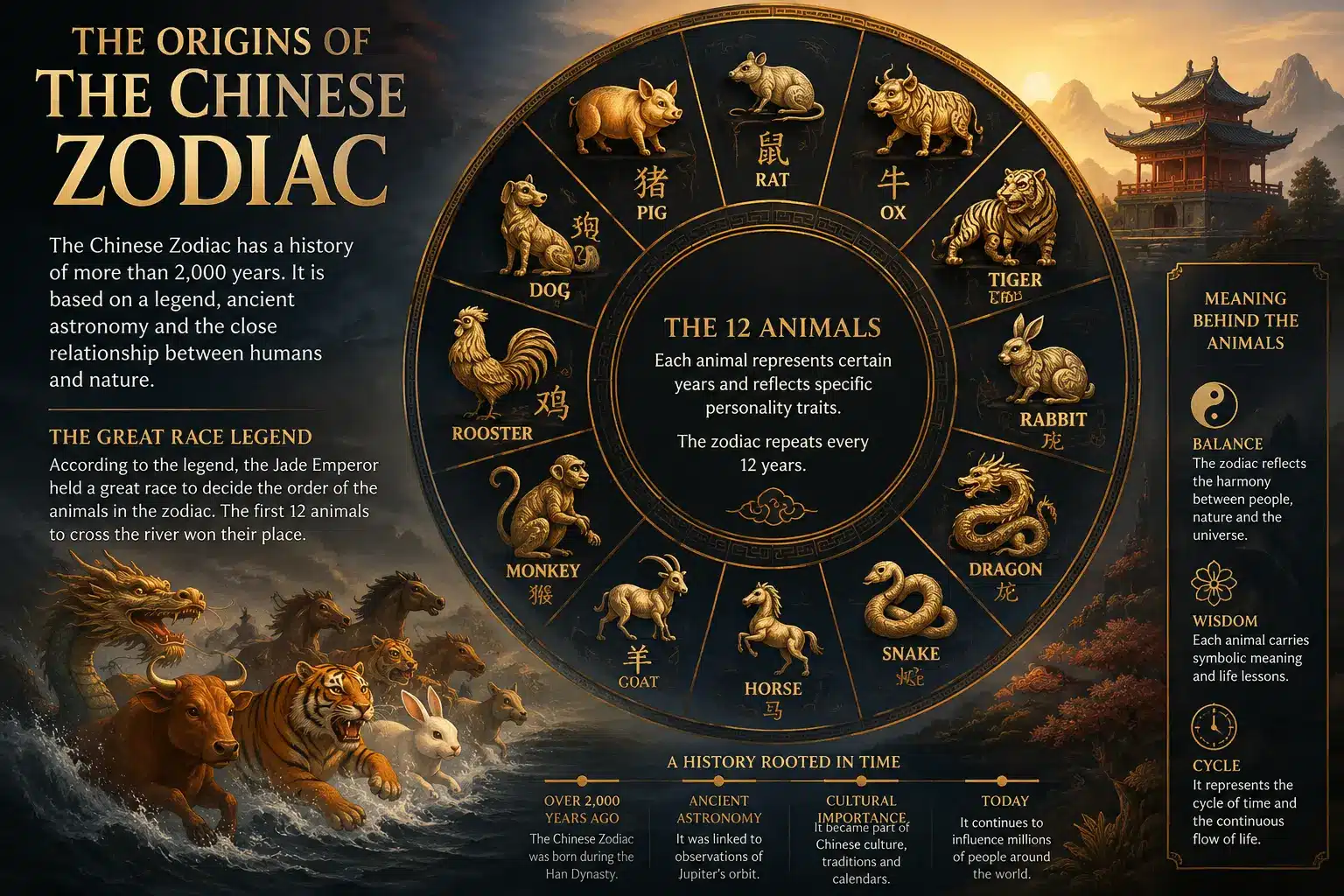
The Chinese Zodiac origins trace back to ancient Han Dynasty cosmology, developed over more than two thousand years and rooted in a mythological story known as the Great Race. According to legend, the Jade Emperor — the supreme ruler of the heavens — summoned all the animals of the world and decreed that the first twelve to cross a great river would each receive a year in their honour, in the order they arrived.
The story explains not only the sequence of the twelve animals — from Rat to Pig — but encodes within each animal’s arrival a set of symbolic traits, psychological tendencies, and elemental associations that form the basis of Chinese astrological personality readings.
This article traces those origins in full: the mythology, the calendar system, the five elements, and why the Chinese Zodiac remains one of the most psychologically precise symbolic systems in the world — and one of the eight ancestral traditions used in the ZodiacRoots 8 Roots method.
Curious which Chinese Zodiac animal you are — and how it combines with your Western sign, Moon, and six other traditions?
How Old Are the Chinese Zodiac Origins?
The Chinese Zodiac as a formal astrological system began taking recognisable shape during the Han Dynasty (206 BCE – 220 CE), though its roots reach deeper into the Shang and Zhou dynasties. Archaeological evidence from oracle bones dated to around 1250 BCE shows early use of the twelve Earthly Branches — the foundational cycle upon which the zodiac animals were later mapped.
The twelve animals themselves were firmly established and widely recorded by the Eastern Han period (25–220 CE), appearing in texts such as the Lunheng by Wang Chong (27–97 CE), which explicitly links each of the twelve Earthly Branches to a specific animal.
This makes the Chinese Zodiac one of the oldest continuously used symbolic personality systems in human history — predating most Western astrological codifications and running alongside parallel traditions in Vedic India, Mesoamerica, and the ancient Near East.
The Jade Emperor and the Cosmic Decree
At the heart of the Chinese Zodiac mythology stands the Jade Emperor (玉皇大帝, Yù Huáng Dàdì) — the supreme ruler of heaven in Chinese cosmology, equivalent in stature to Zeus in the Greek tradition or Odin in the Norse. He governs both heaven and earth, oversees all deities, and maintains the cosmic order.
According to the foundational myth, the Jade Emperor grew curious about the diversity of the animal kingdom and wished to find a way to mark time in a manner that reflected the personality of the natural world. He decreed that a great race would be held across a fast-flowing river, and that the first twelve animals to reach the far bank would each be honoured with a year in the sixty-year calendar cycle — in the exact order of their arrival.
The Jade Emperor’s role is central because it places the entire system within a framework of heavenly order and divine intention. Each animal is not simply a personality archetype invented by humans — it is a heavenly-assigned role, a position in cosmic sequence, a fixed point in the eternal cycle of time.
The Great Race: How Each Animal Crossed the River
The story of the Great Race is far more than folklore. Every animal’s strategy for crossing the river is a precise symbolic description of the personality traits that tradition assigns to people born in that year. The sequence is not arbitrary — it is a mythologically encoded personality map.
1. Rat 🐀
The Rat hitched a ride on the Ox’s back and leapt to the bank at the last moment to arrive first. Cunning, opportunistic, resourceful — the Rat wins not through force but through intelligence and timing.
2. Ox 🐂
The Ox would have arrived first but carried the Rat without suspicion. Diligent, patient, generous to a fault — the Ox earns everything slowly and loses nothing easily.
3. Tiger 🐅
The Tiger struggled fiercely against the current and arrived third, exhausted but proud. Courageous, competitive, intense — the Tiger does not ask for help and does not yield.
4. Rabbit 🐇
The Rabbit used stepping stones and a floating log, arriving fourth. Graceful, diplomatic, careful — the Rabbit finds the elegant path where others see only obstacles.
5. Dragon 🐉
The Dragon could fly and arrived fifth — but stopped to bring rain to a drought-stricken village on the way. Powerful, generous, visionary — the Dragon delays personal gain for greater purpose.
6. Snake 🐍
The Snake coiled around the Horse’s hoof and startled it at the bank, arriving sixth. Wise, intuitive, quietly strategic — the Snake moves without announcing itself and arrives precisely when needed.
7. Horse 🐎
The Horse was startled by the Snake and lost a place, arriving seventh. Energetic, free-spirited, enthusiastic — the Horse runs fast and wide but can be unsettled by what it didn’t see coming.
8. Goat 🐐
The Goat, Monkey, and Rooster crossed together on a raft; the Goat arrived eighth after helping coordinate the group. Gentle, harmonious, creative — the Goat thrives through cooperation, not competition.
9. Monkey 🐒
The Monkey found the raft solution and built the coalition to cross. Inventive, playful, adaptable — the Monkey solves problems that others haven’t yet identified as problems.
10. Rooster 🐓
The Rooster found the raft but let others steer, arriving tenth. Observant, precise, hardworking — the Rooster sees what needs doing and insists on doing it correctly.
11. Dog 🐕
The Dog arrived eleventh — despite being an excellent swimmer, it had stopped to play in the river. Loyal, protective, honest — the Dog’s delay reveals a nature that prioritises joy and connection over rank.
12. Pig 🐖
The Pig stopped to eat and rest mid-race, arriving last. Generous, sincere, comfort-seeking — the Pig never hurries what it considers worth savouring. Last in the race, but never diminished in value.
What makes this myth astrologically powerful is that each crossing strategy is a personality blueprint. The Rat’s cunning, the Ox’s endurance, the Dragon’s generosity, the Snake’s stealth — these are not random assignations. They are symbolic encodings of recognisable psychological archetypes that have been observed and refined across thousands of years of human experience.
Why Is the Cat Not in the Chinese Zodiac?
One of the most frequently asked questions about the Chinese Zodiac origins is the absence of the cat. The answer lies in a second layer of the Great Race myth.
In the original story, the Cat and the Rat were close friends who agreed to cross the river together by riding the Ox. The Rat, however, pushed the Cat into the water mid-crossing. The Cat did not make it to the bank in time and was excluded from the twelve. From that moment forward, cats and rats became natural enemies — and the cat was left out of the cosmic calendar.
This detail is symbolically rich: it encodes betrayal, survival instinct, and the cost of cunning into the very foundation of the zodiac sequence. The Rat’s position at the top of the cycle is inseparable from the question of how it got there.
The Twelve Earthly Branches: The Astrological Foundation
Behind the mythological story lies a precise astronomical and calendrical system. The twelve animals were mapped onto a pre-existing framework called the Twelve Earthly Branches (十二地支, Shí’èr Dìzhī) — a system used in China since at least the Shang Dynasty to mark hours of the day, months of the year, and years in a twelve-year cycle.
Each branch corresponds to a two-hour period of the day, a month, a compass direction, a season, and a year. When the twelve animals were assigned to the branches, they inherited all of these temporal and spatial correspondences, creating a system that is simultaneously a clock, a calendar, a compass, and a personality map.
The Five Elements: The Hidden Layer of Chinese Zodiac Origins
The twelve animals alone form only the outer layer of the system. The deeper layer is the Five Elements (五行, Wǔ Xíng) — Wood, Fire, Earth, Metal, and Water — each of which cycles through the twelve animals in both Yin and Yang expression, creating a sixty-year master cycle in which no two years are ever truly identical.
This is why a person born in 1946 (Yang Fire Dog) has a fundamentally different personality reading from a person born in 1994 (Yang Wood Dog), even though both share the Dog archetype. The element refines and modifies the animal’s core psychology.
Wood
Growth, creativity, idealism, expansive vision. The element of new beginnings and strong principles.
Fire
Passion, charisma, leadership, intensity. The element of transformation and magnetic presence.
Earth
Stability, reliability, patience, practicality. The element of groundedness and long-term foundations.
Metal
Discipline, precision, ambition, structure. The element of refinement, boundaries, and enduring strength.
Water
Intuition, flexibility, depth, emotional intelligence. The element of flow, wisdom, and inner knowing.
The Five Elements are also linked to the Ten Heavenly Stems (天干, Tiāngān) — a second cycle of ten that, combined with the twelve Earthly Branches, produces the sixty-year calendar known as the Sexagenary Cycle. This is the true calendrical engine behind Chinese astrology, one of the most sophisticated cyclical timekeeping systems ever developed.
Yin, Yang, and the Polarity of the Chinese Zodiac
Every year in the Chinese Zodiac carries either a Yin or Yang polarity, alternating in sequence. This polarity is not assigned arbitrarily — it reflects a deeper cosmological principle that runs through all Chinese thought: the universe is held in dynamic balance between two complementary forces.
Yang years carry the energy of outward expression, assertiveness, movement, and visibility. Yin years carry the energy of inward development, receptivity, depth, and consolidation. A Yang Fire Tiger (1926, 1986) expresses the Tiger’s ferocity in a more outwardly dramatic form. A Yin Water Tiger (1902, 1962) expresses the same core archetype with more emotional depth and strategic patience.
This is what separates the Chinese Zodiac from a simple horoscope. It is a three-variable symbolic system — animal, element, polarity — producing sixty distinct personality profiles within a single cycle, not twelve.
Want to see your Chinese Zodiac animal combined with your Western sign, Moon, Vedic Rashi, Mayan Seal, and four other ancestral traditions?
Why the Chinese Zodiac Origins Produce Such Enduring Psychology
The longevity of the Chinese Zodiac as a personality system is not accidental. It reflects several thousand years of systematic observation of human behaviour, refined by scholars, court astrologers, and philosophical traditions including Taoism, Confucianism, and Buddhism — each of which contributed conceptual layers to the system. The result is one of the most enduring and symbolically rich personality systems in the world.
Taoist thought contributed the fundamental framework of Yin/Yang polarity and the Five Elements. Confucian thought contributed the emphasis on social role, hierarchy, and the ethical weight of personality. Buddhist thought contributed the karmic dimension — the idea that the year of one’s birth reflects not only personality tendencies but the accumulated weight of past lives expressing through a particular symbolic vehicle.
The result is a system that operates simultaneously as a temporal map (your place in the sixty-year cycle), a personality blueprint (your animal’s core archetype and elemental modification), and a relational guide (compatibility, conflict, and complementarity between different animals) — something no other single symbolic tradition achieves quite so efficiently.
Chinese Zodiac Origins and the ZodiacRoots 8 Roots System
The ZodiacRoots method uses the Chinese Zodiac — specifically the animal sign with its elemental modifier — as the fourth of eight ancestral traditions in a unified symbolic reading. Rather than reading the Chinese animal in isolation, the ZodiacRoots system places it in dialogue with a person’s Western Sun sign, Moon sign, Ascendant, Vedic Rashi, Mayan Seal, Celtic Tree, and Egyptian Guardian.
This cross-tradition approach reveals patterns that no single system can surface alone. A Yang Fire Dog (born 1946, 2006) with a Leo Ascendant and a Scorpio Vedic Moon reads very differently from a Yang Fire Dog with a Pisces Ascendant and a Gemini Moon — the Chinese layer adds a consistent thread of loyalty, territorial awareness, and principled behaviour that runs across both profiles, but its expression is shaped by every other root in the chart. A detailed example of this in action is the Donald Trump 8 Roots reading, where the Yang Fire Dog combines with Gemini, Leo Rising, and Scorpio Vedic to produce an unusually coherent symbolic portrait.
The Chinese Zodiac’s origins in cyclical time, elemental philosophy, and mythological archetype make it one of the most structurally compatible traditions for multi-system synthesis — which is precisely why ZodiacRoots uses it as a foundational root rather than a standalone reading.
Chinese Zodiac Origins: Common Misconceptions
| What people believe | What the origins actually show |
|---|---|
| “The Chinese Zodiac is just a folk story with twelve animals.” | The twelve animals were mapped onto a pre-existing astronomical system of Earthly Branches used in China since the Shang Dynasty. The mythology came after the calendar, not before it. |
| “There are only twelve Chinese Zodiac types.” | There are sixty distinct year-types in a full cycle, produced by combining twelve animals with five elements in both Yin and Yang expression. No two consecutive cycles share the same profile. |
| “The Chinese New Year always starts on the same date.” | The Chinese calendar is lunisolar, meaning the New Year falls on a different date each year — typically between January 21 and February 20. People born in January or early February may belong to the previous year’s animal. |
| “The Dragon is just a mythological animal added for luck.” | The Dragon is the only mythological creature in the zodiac, but it is not decorative — it represents the divine axis between heaven and earth in Chinese cosmology, making it the most auspicious and cosmologically significant of the twelve. |
Explore More ZodiacRoots Readings
- Chinese Zodiac — explore all twelve animals and their elemental modifiers in the ZodiacRoots system.
- The ZodiacRoots 8 Roots Method — see how the Chinese animal combines with seven other ancestral traditions.
- Egyptian Guardians — discover the mythological layer from ancient Egyptian astrological tradition.
- Celtic Tree Astrology — another ancestral tradition with deep symbolic roots and seasonal psychology.
- Sun Sign Meaning — understand why the Western Sun sign is the entrance, not the whole story.
- Calculate Your 8 Roots — find your Chinese Zodiac sign alongside your full multi-tradition profile.
FAQ: Chinese Zodiac Origins
What are the chinese zodiac origins?
The Chinese Zodiac origins trace to Han Dynasty cosmology (206 BCE – 220 CE), built on the Twelve Earthly Branches system used since the Shang Dynasty (c. 1250 BCE). The twelve animals were assigned to this pre-existing astronomical cycle, and their order was explained through the mythology of the Great Race called by the Jade Emperor.
What is the story of the Chinese Zodiac Great Race?
The Jade Emperor summoned all animals to cross a great river. The first twelve to arrive would each receive a year. The Rat arrived first by riding the Ox and leaping to the bank at the last moment. The Pig arrived last after stopping to eat. Each animal’s crossing strategy encodes the symbolic personality traits associated with that sign.
Why is there no cat in the Chinese Zodiac?
According to the Great Race myth, the Rat and the Cat agreed to cross together on the Ox’s back, but the Rat pushed the Cat into the river mid-crossing. The Cat did not arrive in time and was excluded from the twelve. This is why cats and rats are traditionally considered natural enemies.
What are the Five Elements in the Chinese Zodiac?
The Five Elements are Wood, Fire, Earth, Metal, and Water. Each cycles through the twelve animals in both Yin and Yang form, producing a sixty-year master cycle. Your element modifies and refines your animal’s core personality — a Fire Rat is more intense and charismatic than a Water Rat, which is more intuitive and emotionally deep.
Who is the Jade Emperor in Chinese mythology?
The Jade Emperor (玉皇大帝) is the supreme ruler of heaven in Chinese cosmology, governing both the divine and mortal realms. He is the central figure in the Great Race mythology and represents divine order, cosmic structure, and the heavenly mandate that assigns symbolic meaning to natural cycles.
What are the Twelve Earthly Branches?
The Twelve Earthly Branches (十二地支) are an ancient Chinese system used to mark time — hours of the day, months, compass directions, and years. The twelve zodiac animals were mapped onto these branches, inheriting their temporal and spatial correspondences. The system predates the animal mythology and forms the true astronomical foundation of the Chinese Zodiac.
How many types are there in the Chinese Zodiac?
There are sixty distinct types in a full Chinese Zodiac cycle, not twelve. The sixty types are produced by combining twelve animals with five elements in both Yin and Yang polarity. The full sixty-year cycle (the Sexagenary Cycle) means that a truly identical birth year does not repeat within most human lifetimes.
When does the Chinese Zodiac year start?
The Chinese Zodiac year begins with the Chinese New Year, which follows the lunisolar calendar and falls between January 21 and February 20 each year. People born in January or early February should verify whether they fall before or after that year’s New Year date to confirm their correct animal sign.
Why is the Dragon special in the Chinese Zodiac?
The Dragon is the only mythological creature in the twelve-animal zodiac and represents the divine connection between heaven and earth in Chinese cosmology. Dragon years are considered the most auspicious in the cycle, and the Dragon archetype carries associations with power, vision, generosity, and transformative force that no purely earthly animal can match.
How does the Chinese Zodiac relate to Yin and Yang?
Every year in the Chinese Zodiac alternates between Yang (outward, assertive, visible) and Yin (inward, receptive, deep) polarity. This polarity combines with the animal and element to produce the full personality reading. A Yang year of a given animal expresses that archetype more dramatically and outwardly; a Yin year expresses it with more interiority and strategic depth.
How does ZodiacRoots use the Chinese Zodiac?
ZodiacRoots uses the Chinese Zodiac animal with its elemental modifier as the fourth of eight ancestral traditions in a unified symbolic reading. Rather than reading the Chinese sign in isolation, the ZodiacRoots system places it alongside a person’s Western Sun, Moon, Ascendant, Vedic Rashi, Mayan Seal, Celtic Tree, and Egyptian Guardian to reveal patterns no single tradition can surface alone. Discover your profile at zodiacroots.com.
Your Chinese Zodiac Sign Is Only One Root of Eight
The Chinese Zodiac origins show that your animal sign encodes a rich symbolic psychology developed over thousands of years — but it is still only one layer of your full symbolic identity. The ZodiacRoots method reads your Chinese animal alongside seven other ancestral traditions to reveal the complete picture.
Published by ZodiacRoots. This article is a symbolic and mythological overview of Chinese Zodiac origins for educational and astrological purposes.
Discover More Astrology Articles You May Like
Explore related ZodiacRoots articles selected by topic first, then completed with fresh astrology reads.