Quick Answer: What Are Planetary Cycles?
Planetary cycles are the repeating movements of planets through space and, in astrology, through the zodiac.
They are used to interpret timing: short cycles describe daily moods and decisions, medium cycles describe life development,
and long cycles describe generational or historical change.
Why Planetary Cycles Matter in Astrology
Astrology is not only about what a planet means. It is also about how long that meaning takes to unfold.
Mercury moves quickly, so its themes of thought, language and decisions can feel immediate.
Saturn moves slowly, so its themes of responsibility, discipline and maturity often develop over years.
This is why planetary cycles are the bridge between two important ZodiacRoots pages:
the Planets in Astrology
guide explains what each planet symbolises, while the
Astrology Calendar
shows when important movements happen.
Fast planets describe the weather of a moment. Slow planets describe the climate of a life.
Do Planets Really Affect Us?
Some celestial effects are directly observable. The Moon influences Earth’s tides through gravity:
tides rise and fall as Earth rotates through tidal bulges created mainly by the Moon’s gravitational pull.
NASA explains that tides are also shaped by continents, ocean depth and coastal geography.
The Moon is also connected with rhythms in many living organisms. Marine life, reproduction cycles,
nocturnal behaviour and biological timing have all been studied in relation to lunar phases.
The Sun, of course, is even more fundamental: it regulates light, seasons, climate and circadian rhythm.
For the other planets, astrology is not claiming a simple physical force acting on human behaviour.
Their astrological role is symbolic and cyclical. They are interpreted as timing markers:
recurring patterns that help describe phases of growth, pressure, change, release and renewal.
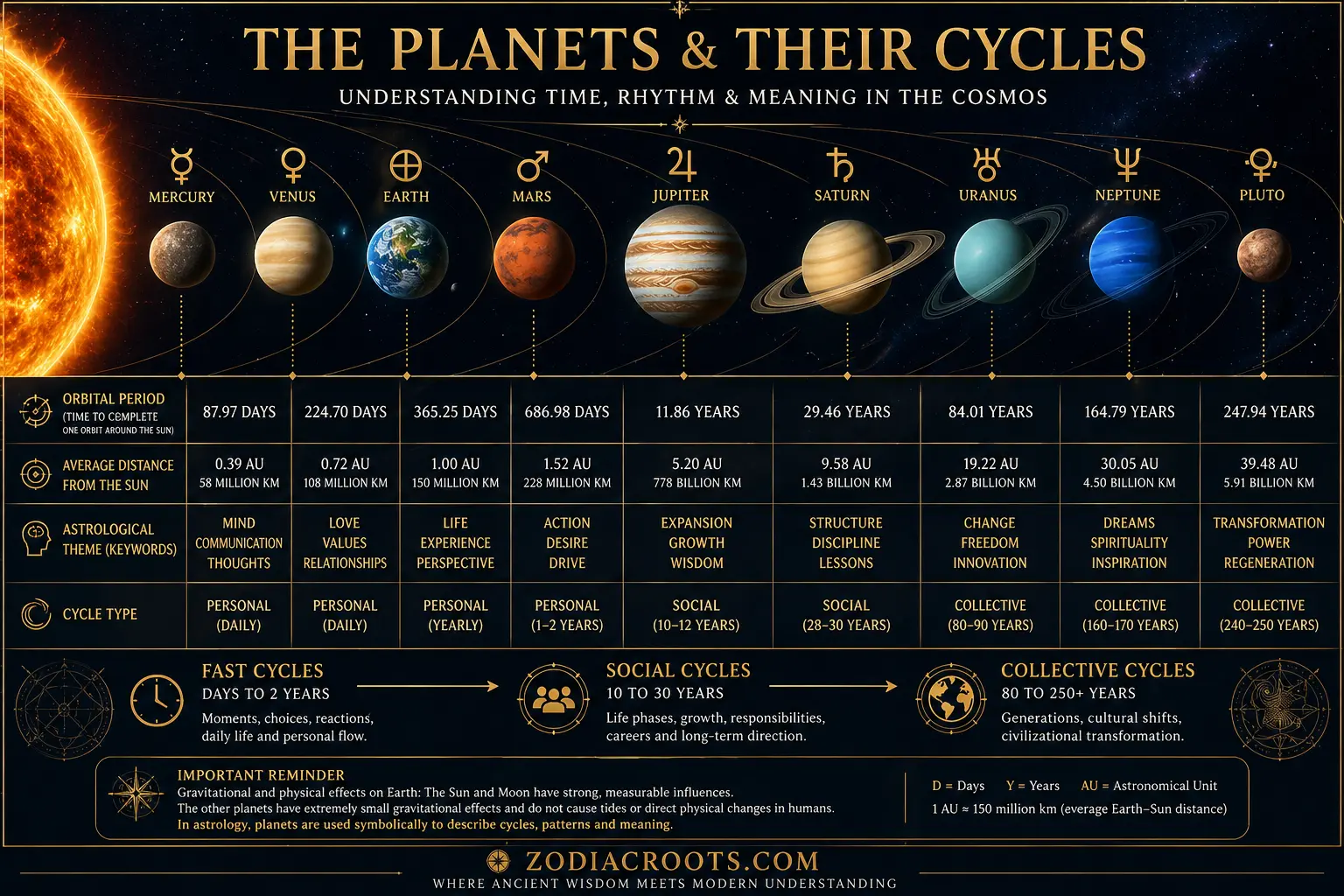
Astronomical Data: Planet Size, Mass, Distance and Cycle
The table below gives a practical reference. Distance from Earth changes constantly, so the Earth-distance column is approximate.
The astrological column does not claim physical causation; it summarises how each body is traditionally explored in astrology.
| Body | Astronomy status | Cycle | Avg. distance from Sun | Approx. distance from Earth | Mass vs Earth | Diameter vs Earth | Astrological theme |
|---|---|---|---|---|---|---|---|
| Moon | Natural satellite | 29.5 days | Orbits Earth | 384,400 km avg. | 0.0123 | 0.27 | Emotion, instinct, rhythm |
| Mercury | Planet | 88 days | 57.9 million km | 77–222 million km | 0.055 | 0.38 | Mind, speech, perception |
| Venus | Planet | 225 days | 108.2 million km | 38–261 million km | 0.82 | 0.95 | Love, value, attraction |
| Earth | Planet | 365.25 days | 149.6 million km | Reference point | 1.00 | 1.00 | Embodied experience |
| Mars | Planet | 687 days | 227.9 million km | 55–401 million km | 0.11 | 0.53 | Action, conflict, courage |
| Jupiter | Planet | 11.86 years | 778.5 million km | 588–968 million km | 318 | 11.2 | Expansion, faith, opportunity |
| Saturn | Planet | 29.46 years | 1.43 billion km | 1.2–1.7 billion km | 95 | 9.45 | Structure, time, maturity |
| Uranus | Planet | 84 years | 2.87 billion km | 2.6–3.2 billion km | 14.5 | 4.0 | Awakening, disruption, freedom |
| Neptune | Planet | 164.8 years | 4.50 billion km | 4.3–4.7 billion km | 17 | 3.9 | Dreams, ideals, dissolution |
| Pluto | Dwarf planet | 248 years | 5.91 billion km | 4.3–7.5 billion km | 0.0022 | 0.18 | Transformation, power, rebirth |
Is Pluto Still a Planet?
In astronomy, Pluto is currently classified as a dwarf planet, not one of the eight main planets.
The International Astronomical Union reclassified Pluto in 2006 because it has not cleared its orbital neighbourhood.
In astrology, Pluto is still widely used because symbolic meaning does not depend only on size or formal classification.
Pluto’s long cycle makes it one of the most powerful symbols of deep transformation, endings, renewal and collective change.
Retrograde Motion: The Optical Illusion of Going Backward
Retrograde motion is one of the most searched and misunderstood ideas in astrology.
Technically, planets do not reverse their actual orbit around the Sun.
Retrograde motion is an apparent reversal seen from Earth, caused by the different orbital speeds and positions of Earth and the other planet.
Astrologically, retrogrades are interpreted as review phases.
If a planet’s normal cycle is about movement, expression or development, the retrograde period asks for revision:
to rethink, rework, revisit or correct something before moving forward again.
- Mercury retrograde often highlights communication, planning, contracts and technology.
- Venus retrograde can reopen questions around love, value, beauty and attachment.
- Mars retrograde may redirect energy, anger, desire and initiative inward.
Slow-planet retrogrades work on a deeper scale. Saturn retrograde may ask you to review responsibility,
discipline and long-term commitments. Neptune retrograde can dissolve illusions more quietly.
Pluto retrograde often turns transformation inward, revealing what needs to be released before visible change can happen.
In other words, Mercury retrograde may ask you to reread the message. Pluto retrograde may ask you to reread an entire chapter of your life.
Return Cycles: Planetary Milestones in a Human Life
A planetary return happens when a planet comes back to the same position it occupied at birth.
These returns are some of the clearest ways to understand how astrology connects planetary cycles with life stages.
| Cycle | Approx. timing | Astrological interpretation |
|---|---|---|
| Jupiter Return | Every 12 years | Expansion, new opportunities, confidence and renewed vision. |
| Saturn Return | Around 28–30 years | A rite of passage into maturity, responsibility and real-life structure. |
| Uranus Opposition | Around 40–44 years | Midlife awakening, disruption, freedom and identity reorientation. |
| Neptune Square | Around early 40s | Questioning dreams, ideals, illusions and spiritual direction. |
These cycles are useful because they make astrology practical. A Saturn Return is not simply “a transit”.
Around age 29, someone may face the end of a relationship, a career change, becoming a parent,
losing a parent, moving country or finally confronting a responsibility they can no longer postpone.
The symbolism is not that Saturn “causes” the event, but that the Saturn cycle often coincides with a threshold:
life asks whether your structures are real enough to carry your future.
Great Cycles and Small Moments
Planetary cycles work at different scales. Some are short enough to describe a mood or conversation.
Others are long enough to describe a life chapter. A few are so vast that they belong to cultural, historical or mythic time.
Weeks / Months
Retrogrades invite review, reflection and correction.
Years / Decades
Returns and oppositions mark growth thresholds, maturity tests and identity awakenings.
Centuries / Millennia
Astrological ages and long calendars describe collective myths, cultural shifts and sacred time.
Astrological Ages and the Precession of the Equinoxes
Some cycles are much longer than a human lifetime. The precession of the equinoxes is linked to the slow wobble of Earth’s axis.
A full precessional cycle takes roughly 26,000 years, and this idea is often used in astrology to discuss long astrological ages.
This is where concepts such as the Age of Pisces or the Age of Aquarius come from.
There is no universal agreement on the exact start date of the Age of Aquarius, because astrologers use different reference points and symbolic methods.
What matters here is the scale: astrological ages are not personal cycles of weeks or years, but collective cycles measured in centuries and millennia.
A future ZodiacRoots guide can explore this in more depth: what the Age of Pisces means, why the Age of Aquarius is debated,
and how precession connects astrology with long historical symbolism.
Planetary Cycles and the Mayan Long Count
The idea of layered time also appears in Mesoamerican calendar systems.
The Mayan Long Count measures time across vast cycles and is part of a broader calendar tradition that includes the Tzolk’in and the Haab’.
To explore this more deeply, read our guide:
The Three Maya Calendars: Tzolk’in, Haab’ and Long Count.
This connection is important for the ZodiacRoots approach. Western astrology often focuses on planetary cycles.
Mayan timekeeping focuses on sacred numerical and calendrical rhythms. Both systems suggest the same underlying principle:
time has structure, repetition and symbolic meaning.
Planetary astrology tracks the movement of bodies. The Mayan calendars track the architecture of time.
Together, they reveal why ancient systems treated time as something meaningful, not merely mechanical.
Elements and Rhythms: The Terrain of a Cycle
A planet’s cycle does not happen in neutral space. It moves through signs, and signs act like terrain.
The same planet can feel fast, slow, sharp, emotional, practical or restless depending on the element it is moving through.
Mars in Aries, a Fire sign, is direct, hot and immediate. It wants action now.
Mars in Taurus, an Earth sign, is slower but harder to move once committed.
The planet is still Mars, but the rhythm changes from spark to endurance.
The same principle works with longer cycles. Jupiter in Fire signs tends to amplify courage,
vision and outward expansion. Jupiter in Water signs may expand emotional intelligence,
spiritual hunger, memory and belonging. Saturn in Air signs tests ideas, systems and communication,
while Saturn in Earth signs tests money, work, body, limits and tangible results.
The planet shows the function. The sign shows the terrain. The cycle shows the timing.
This is why planetary cycles must be read through planet, sign, aspect and chart context.
Timing alone is not enough; the quality of the timing matters.
The ZodiacRoots 8 Roots Perspective
At ZodiacRoots, planetary cycles are not interpreted in isolation.
They are part of the wider 8 Roots Method, which combines Western, Vedic, Chinese, Mayan,
Celtic and Egyptian symbolic traditions into one layered reading.
In this method, planetary cycles help explain timing. Mayan calendars help explain sacred rhythm.
Chinese cycles add year-based symbolic texture. Celtic and Egyptian roots add mythic and ancestral resonance.
The result is not a single-sign reading, but a multi-layered view of time, identity and transformation.
FAQ About Planetary Cycles
What are planetary cycles?
Planetary cycles are the repeating movements of planets through space and, in astrology, through the zodiac. They are used to interpret timing, from short emotional shifts to long-term life phases and collective change.
What is retrograde motion?
Retrograde motion is an apparent backward movement seen from Earth. Planets do not actually reverse their orbit. In astrology, retrogrades are interpreted as periods of review, reflection and correction.
What is a Saturn Return?
A Saturn Return happens when Saturn returns to the same position it occupied at birth, around age 28 to 30. It is often interpreted as a major threshold of maturity, responsibility and life structure.
What is the Uranus Opposition around age 40?
The Uranus Opposition happens around the early 40s and is often linked with midlife awakening, restlessness, freedom and identity change. It can feel like a need to break old patterns and live with more honesty.
How do zodiac signs and elements change planetary cycles?
Zodiac signs and elements describe the terrain through which a planet moves. A Mars cycle in a Fire sign may feel fast, direct and explosive, while Mars in an Earth sign may feel slower, more physical and more persistent.
Do planets physically affect humans?
The Moon and Sun have measurable physical effects on Earth. Other planets are interpreted astrologically through symbolism, cycles and timing rather than direct physical force.
How are planetary cycles connected to the Mayan Long Count?
Both planetary astrology and the Mayan Long Count treat time as layered and meaningful. Planetary cycles track celestial movement, while the Long Count measures vast historical and sacred time cycles.
Is Pluto still used in astrology?
Yes. Pluto is classified astronomically as a dwarf planet, but it remains widely used in astrology as a symbol of transformation, power, endings and renewal.
External references for astronomical context:
NASA: Tides,
NASA: Planet Sizes and Locations,
IAU: Pluto and Dwarf Planets,
NASA: Reference Systems and Precession.
Discover More Astrology Articles You May Like
Explore related ZodiacRoots articles selected by topic first, then completed with fresh astrology reads.