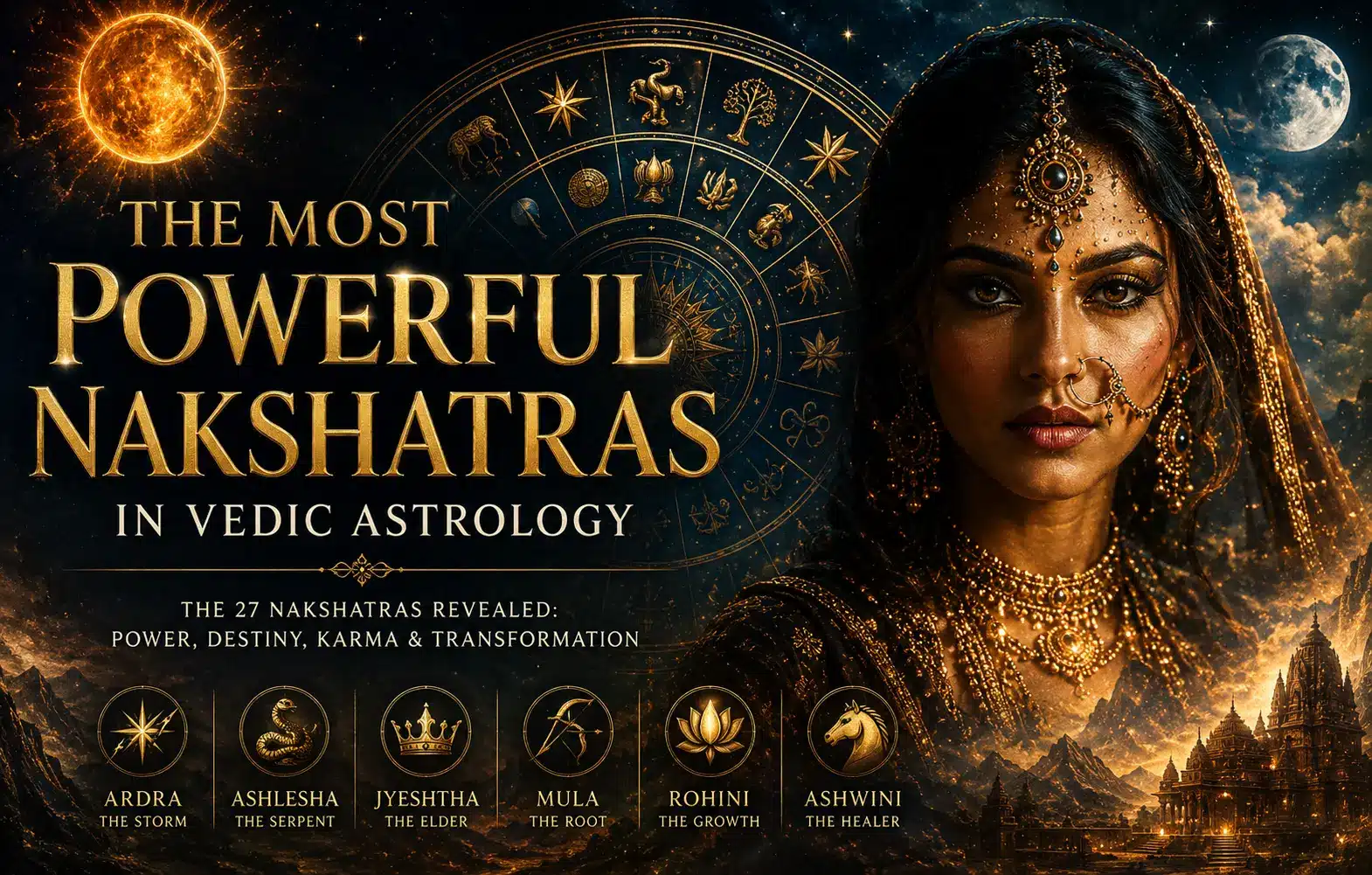
The Most Powerful Nakshatras in Vedic Astrology
The lunar mansions shaped by destiny, intensity, leadership, karma, spiritual force, emotional magnetism, and transformation.
Why the Most Powerful Nakshatras Feel Different
Western astrology often focuses on the Sun sign.
Vedic astrology begins somewhere deeper: the Moon.
And behind the Moon lies the nakshatra — the hidden lunar mansion shaping instinct, emotional memory, karmic repetition, spiritual gifts, attraction patterns, shadow traits, and psychological intensity.
Some nakshatras soothe. Some heal. Some attract. Some rule. And some destroy and rebuild reality itself.
What Is a Nakshatra in Vedic Astrology?
A nakshatra is one of the 27 lunar mansions used in Vedic astrology. Instead of dividing the sky only into familiar zodiac signs, the nakshatra system follows the Moon through a more refined symbolic map, with each mansion spanning 13°20′ of the ecliptic.
Each nakshatra carries a mythic atmosphere: a ruling planet, a presiding deity, a symbol, a psychological pattern, and a karmic tone. This is why two people with the same zodiac sign can feel completely different when their Moon falls in different nakshatras.
The zodiac sign describes the field. The nakshatra describes the instinct inside that field — how the person reacts, desires, protects, creates, destroys, heals, fears, loves, leads, and repeats old karmic patterns.
For wider context, the Moon has always shaped human calendars, rituals and symbolic timing; even modern lunar science, such as NASA’s Moon research, reflects how central the Moon remains to the way humans understand cycles, visibility and time.
The Different Types of Nakshatra Power
Not all most powerful nakshatras dominate in the same way. Some rule through destruction. Some through magnetism. Some through ancestry, leadership, healing, survival intelligence or psychological shadow.
Destructive Power
Ardra · Mula
Leadership Power
Jyeshta · Magha
Psychic & Shadow Power
Ashlesha · Shatabhisha
Creative & Magnetic Power
Rohini · Purva Ashadha
Initiating & Survival Power
Ashwini · Bharani
The 10 Most Powerful Nakshatras: Quick Reference
Before exploring each nakshatra in depth, here is the complete overview — ranked by psychological force, karmic intensity, spiritual depth, planetary ruler, deity and symbolic power.
| # | Nakshatra | Power Type | Planetary Ruler | Deity | Core Force |
|---|---|---|---|---|---|
| 1 | Jyeshta | Strategic | Mercury | Indra | Survival & hierarchy |
| 2 | Ashlesha | Psychic | Mercury | Nāgas | Serpent influence |
| 3 | Mula | Destructive | Ketu | Nirriti | Root destruction |
| 4 | Ardra | Chaotic | Rahu | Rudra | Storm transformation |
| 5 | Magha | Royal | Ketu | Pitrs | Ancestral authority |
| 6 | Rohini | Magnetic | Moon | Brahma / Prajapati | Attraction & creation |
| 7 | Bharani | Endurance | Venus | Yama | Life/death intensity |
| 8 | Purva Ashadha | Ideological | Venus | Apas | Invincibility |
| 9 | Shatabhisha | Occult | Rahu | Varuna | Hidden healing |
| 10 | Ashwini | Initiatory | Ketu | Ashvins | Speed & recovery |
The 10 Most Powerful Nakshatras Ranked
This ranking is not about “good” or “bad” nakshatras. Power in Vedic astrology appears in different forms: spiritual power, seductive power, destructive power, leadership power, psychic power, healing power and karmic force.
The following are among the most powerful nakshatras because they create unusually strong psychological signatures and often leave a visible mark on destiny, relationships, public presence, crisis, creativity or transformation.
The Survivor, Strategist, and Keeper of Power
Jyeshta is one of the most psychologically intense nakshatras in the entire system. It carries the signature of the elder, the protector, the strategist — the person who understands status, danger, loyalty and betrayal with unusual sharpness.
Its power is not soft. It comes through survival intelligence, emotional control and the ability to read hidden motives before others sense them. At its highest, Jyeshta protects, leads and takes responsibility in crisis.
At its shadow level, it can become suspicious, controlling or trapped in permanent power struggle. This is why Jyeshta is often counted among the most powerful nakshatras for leadership and survival.
The Serpent, Hypnotist, and Keeper of Hidden Influence
Ashlesha is one of the most feared and misunderstood nakshatras because its power is subtle. It does not dominate openly. It coils, observes, absorbs and influences from beneath the surface.
This nakshatra is associated with the serpent: wisdom, danger, healing, poison, secrecy and psychological penetration. At its highest, Ashlesha heals trauma, understands taboo emotions and exposes hidden patterns.
At its shadow level, it may become manipulative, possessive or emotionally invasive. Ashlesha power is magnetic because it touches what people hide from themselves.
The Root, Destroyer of Illusion, and Karmic Excavator
Mula is powerful because it does not decorate illusion. It pulls things out by the root. Governed by Ketu and linked with Nirriti, this nakshatra is associated with karmic excavation, endings, exposure and uncomfortable truth.
People with strong Mula energy often live through intense turning points — destroying false structures, leaving old identities behind or being drawn to research, spirituality, crisis work and hidden knowledge.
Mula can feel harsh from the outside. But its higher purpose is liberation. It removes what is false so that something truer can finally emerge.
The Storm, the Cry, and Transformation Through Chaos
Ardra is the nakshatra of the storm. Ruled by Rahu and associated with Rudra, it is connected with emotional rupture, mental intensity, grief, shock, brilliance and transformation through disruption.
This is not a calm placement. Ardra sees the fracture in things. It can bring technological insight, sharp perception and a capacity to survive chaos that others cannot endure.
Ardra becomes powerful when pain is transformed into insight. Its gift is not comfort. Its gift is awakening.
The Throne, the Ancestors, and Dynastic Authority
Magha carries one of the strongest authority signatures in Vedic astrology. Linked with the ancestral spirits, it embodies lineage, throne energy, tradition, honor and the invisible power of those who came before.
Strong Magha people often feel connected to legacy. They may be drawn to leadership, ceremony, public respect, family history, institutions or roles where dignity matters deeply.
At its highest, Magha leads with responsibility and ancestral awareness. At its shadow level, it can become prideful, status-driven or rigidly attached to hierarchy.
The Enchantress, Creator, and Magnetic Force of Desire
Rohini is powerful in a completely different way from Ardra or Mula. Its force is not destruction — it is attraction, beauty, fertility, growth, sensuality and creative manifestation.
The Moon is traditionally strong here, making Rohini one of the most celebrated nakshatras for beauty, emotional richness, growth and creative magnetism.
At its highest, Rohini creates life, art, comfort, loyalty and abundance. At its shadow level, it can become possessive, indulgent or consumed by desire.
The Gate of Life, Death, Endurance, and Taboo
Bharani is intense because it lives at the threshold between life and death, pleasure and consequence, desire and responsibility. Ruled by Venus and associated with Yama, it carries emotional and moral weight.
Its power lies in endurance. Bharani can carry pressure that would break weaker structures. It is linked with strong passions, moral tests, taboo subjects, sexuality, birth and transformation.
At its best, Bharani is courageous, fertile, loyal and resilient. At its shadow level, it can become excessive, trapped in desire or weighed down by emotional intensity.
The Invincible One and the Force of Belief
Purva Ashadha carries the energy of invincibility, momentum, belief and emotional persuasion. It can create people who feel genuinely difficult to defeat because they are sustained by conviction.
This nakshatra excels in public life, debate, teaching, performance, activism and any domain where belief must be projected with confidence and emotional weight.
At its highest, Purva Ashadha inspires and uplifts. At its shadow level, it can become dogmatic, inflated or dangerously unwilling to admit defeat.
The Veiled Healer, Mystic, and Watcher from the Edge
Shatabhisha means “the hundred healers” and is powerful because it operates through distance, secrecy, analysis and healing from the margins. Ruled by Rahu, it is linked with hidden knowledge, medicine, astrology, technology and systems.
This nakshatra creates outsiders, observers, healers, researchers, mystics and people who need space to understand the deeper pattern behind events before speaking.
At its highest, Shatabhisha heals through knowledge. At its shadow level, it can become emotionally detached, isolated or lost in private worlds of abstraction.
The Healer, Initiator, and Lightning-Speed Force
Ashwini is the first nakshatra and carries the force of initiation. Its power is quick, instinctive, healing and catalytic. It starts things before others are mentally ready to move.
Governed by the Ashvins, the divine physicians of the Vedas, this nakshatra is associated with medicine, rescue, movement, courage, freshness and the ability to revive stagnant situations.
At its highest, Ashwini heals and initiates. At its shadow level, it may rush through depth, avoid integration or move so quickly that the foundations it creates are unstable.
Nakshatra Power Matrix
The Nakshatra Power Matrix visualizes how different nakshatras express leadership, shadow intensity, spiritual force and emotional magnetism. This is an editorial-symbolic model designed to compare archetypal emphasis.
| Nakshatra | Leadership | Shadow | Spiritual | Magnetism |
|---|---|---|---|---|
| Jyeshta |
10
|
9
|
6
|
7
|
| Ashlesha |
6
|
10
|
8
|
9
|
| Mula |
7
|
10
|
9
|
5
|
| Ardra |
8
|
9
|
7
|
5
|
| Magha |
9
|
6
|
8
|
7
|
| Rohini |
7
|
4
|
7
|
10
|
Not All Powerful Nakshatras Look the Same
This is where the ranking becomes more interesting. Rohini is not powerful in the same way as Ardra. Magha is not powerful in the same way as Ashlesha. Mula does not dominate like Jyeshta. Shatabhisha does not seduce like Rohini. Bharani does not initiate like Ashwini.
Some nakshatras rule through attraction. Some through fear. Some through healing. Some through destruction. Some through spiritual isolation. Some through inheritance, memory and ancestral force. The form of power changes everything about how it is experienced — by the person who carries it, and by those around them.
Why Some Nakshatras Are Feared
Some nakshatras are feared not because they are “evil,” but because they deal with material most people avoid: power, poison, grief, shadow, survival, sexuality, collapse, obsession and the destruction of comfortable illusion.
Fear of psychological penetration, hidden emotional influence, poison and medicine.
Fear of power dynamics, hierarchy, emotional warfare and protective dominance.
Fear of collapse, root-level destruction, karmic exposure and truth.
Fear of chaos, grief intelligence, rupture and psychological awakening.
The Most Spiritually Powerful Nakshatras
Some nakshatras are powerful not because they dominate others, but because they carry spiritual intelligence, healing capacity, compassion, vision or the rare ability to guide people through invisible thresholds.
Spiritual protection, safe passage, compassion, gentle guidance and sacred completion.
Mystical fire, sacrifice, inner awakening and spiritual transformation.
Occult healing, hidden knowledge, isolation, medicine and cosmic law.
Creation, nourishment, beauty and the sacred power of making things grow.
Why Nakshatras Feel More Intense Than Zodiac Signs
Zodiac signs describe broad archetypal fields. Nakshatras feel more intimate because they are lunar. They speak to instinct rather than image, emotional memory rather than public persona, karmic repetition rather than surface identity.
This is why a person may not fully recognize themselves in a Sun sign description — but feel exposed when reading their Moon nakshatra. The nakshatra often describes the private pattern: how someone bonds, fears, desires, protects, reacts, repeats, heals and transforms.
In the ZodiacRoots method, this is one of the central reasons Vedic astrology adds such depth to the complete symbolic profile. It reveals the hidden emotional engine running beneath the visible zodiac sign.
Most Powerful Nakshatras: Final Reading
The most powerful nakshatras are not powerful for the same reason. Jyeshta dominates through strategy. Ashlesha influences through psychological depth. Mula destroys illusion. Ardra transforms through storms. Magha carries ancestral authority. Rohini creates attraction and growth. Bharani endures life’s heaviest thresholds. Purva Ashadha projects conviction. Shatabhisha heals from the edge. Ashwini initiates movement and recovery.
Together, they show why Vedic astrology cannot be reduced to simple zodiac labels. The nakshatra system reveals a deeper map — one where destiny, karma, instinct, mythology, emotional memory and spiritual force all speak through the position of the Moon at the moment of birth.
To understand your nakshatra is to understand the pattern you carry — and the power available when that pattern becomes conscious.
Frequently Asked Questions About the Most Powerful Nakshatras
What is the most powerful nakshatra in Vedic astrology?
Jyeshta is widely considered one of the most powerful nakshatras due to its intense psychological force, survival intelligence and strategic dominance. However, power takes many forms: Ashlesha commands through hidden psychological influence, Mula through karmic destruction and renewal, and Rohini through magnetic creative force.
Which nakshatra is feared in Vedic astrology?
Ashlesha, Jyeshta, Mula and Ardra are often considered the most feared nakshatras. They are feared not because they are evil, but because they deal with themes most people avoid: shadow psychology, power struggles, karmic destruction and transformation through chaos.
Which nakshatra is spiritually strongest?
Revati, Purva Bhadrapada and Shatabhisha are among the most spiritually powerful nakshatras. Revati carries spiritual protection and compassionate guidance. Purva Bhadrapada holds mystical fire and awakening. Shatabhisha embodies occult healing and hidden knowledge.
Which nakshatra is best for leadership?
Magha and Jyeshta are especially strong for leadership. Magha carries ancestral authority, dignity and status. Jyeshta carries survival intelligence, hierarchy awareness and strategic power under pressure.
Are nakshatras more accurate than zodiac signs?
Many people find nakshatras more psychologically precise because they are Moon-based and describe emotional instinct, karmic patterns, psychological shadow and spiritual gifts. A zodiac sign is broader; a nakshatra is more specific.
Why do nakshatras feel more intense?
Nakshatras feel more intense because they operate at the level of emotional memory, instinct, karmic repetition and unconscious reaction. They often describe what moves beneath the visible personality.
What is the rarest nakshatra?
No nakshatra is technically rare because the Moon passes through all 27 lunar mansions. However, Shatabhisha and Mula are often considered among the most enigmatic or unusual in psychological character because of their links with hidden knowledge, isolation, karmic roots and radical transformation.
Can the same nakshatra be both powerful and dangerous?
Yes. Power and danger often share the same source in Vedic astrology. Ashlesha’s psychological penetration can heal or manipulate. Mula’s truth-revealing force can liberate or devastate. Jyeshta’s survival intelligence can protect or dominate. Expression depends on awareness and development.
Your Zodiac Sign Is Only the Beginning
Most people know their zodiac sign.
Very few know the nakshatra governing their Moon — the hidden lunar mansion linked with emotional instinct, karmic repetition, attraction patterns, spiritual gifts and psychological intensity.
Discover your deeper Vedic profile through the ZodiacRoots Premium System.
Discover More Astrology Articles You May Like
Explore related ZodiacRoots articles selected by topic first, then completed with fresh astrology reads.