Saju Korean Astrology: The Four Pillars Birth Chart Explained
The Korean reading of destiny built from the moment of birth — year, month, day and hour woven into eight characters and five elements.
Eight Characters
Day Master
BaZi Connection
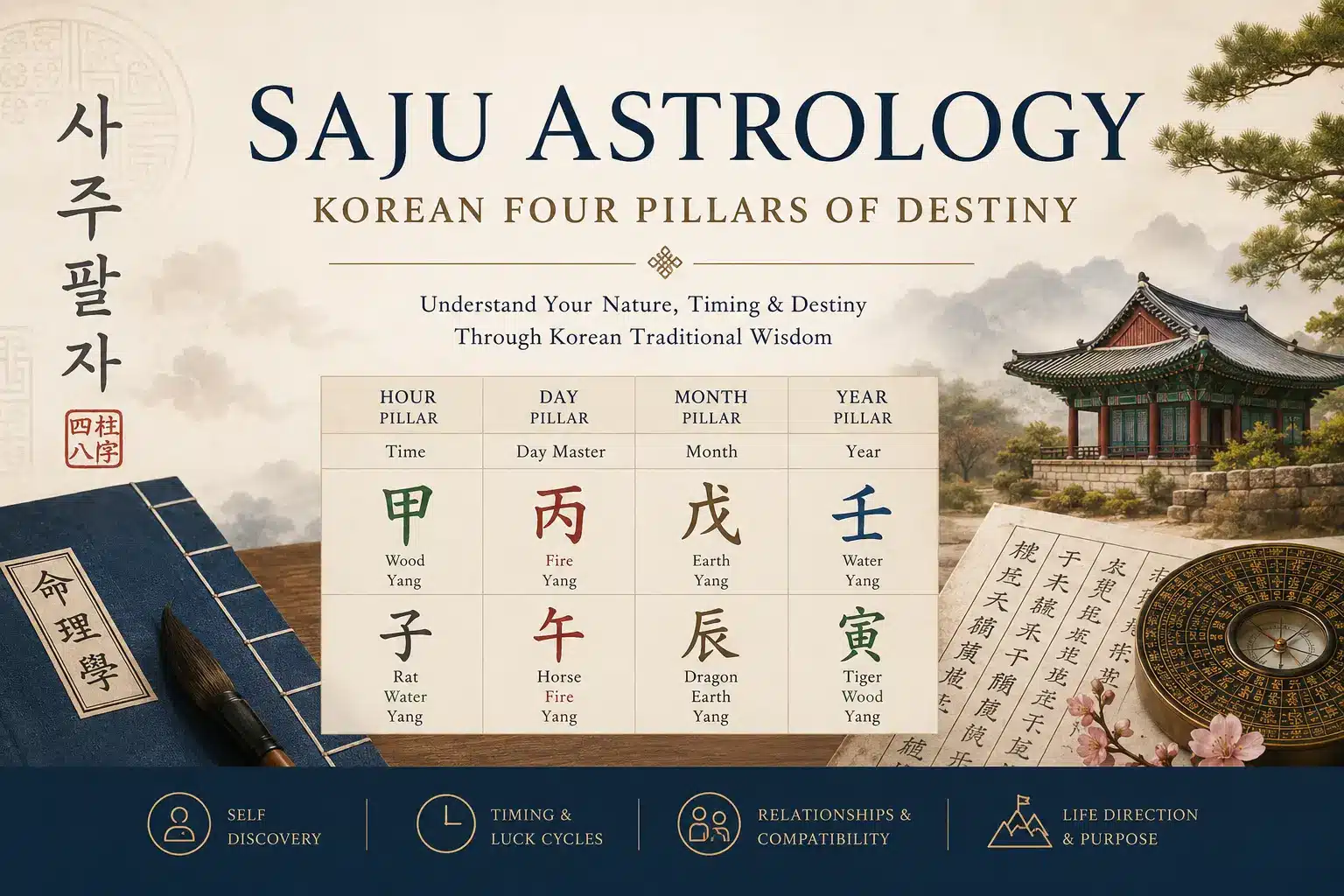
A Birth Chart Read as Four Pillars
Saju Korean Astrology is the Korean Four Pillars birth chart system that reads the year, month, day and hour of birth through eight characters and the Five Elements.
Most people meet astrology through a single zodiac sign. Saju begins from a different place: the exact moment of birth, broken into four columns of time.
Year, month, day and hour each become a pillar — and from those four pillars, a portrait of character, timing and destiny is read.
Quick Answer: What Is Saju Korean Astrology?
Saju is closely related to BaZi Four Pillars, the Chinese “eight characters” system. Both use the same birth-time structure, but Saju is the Korean cultural expression while BaZi is the more internationally standardised technical framework.
At ZodiacRoots, BaZi serves as the main Four Pillars layer inside the 8 Roots Method, while Saju is explained as the Korean doorway into the same East Asian symbolic family.
What Is Saju Korean Astrology?
Saju (사주, 四柱) is the Korean system of fortune reading whose name literally means “four pillars.” Those four pillars are the year, month, day and hour of birth. From them, a Saju reading interprets personality, strengths, life cycles, relationships and timing.
The fuller traditional term is Saju Palja (사주팔자, 四柱八字), meaning “four pillars, eight characters.” Each pillar is built from two symbolic components, so four pillars produce eight characters in total — the raw symbolic data of the chart.
Saju Korean Astrology shares its structure with the older Chinese system known as the Four Pillars of Destiny, but it has grown into its own distinctly Korean practice, with its own language, cultural meaning and interpretive style. In Korea, consulting a Saju reader remains a living tradition, often sought around marriage, career decisions and major life turning points.
Saju vs BaZi: Are They the Same?
This is one of the most common questions — and the honest answer is: yes and no. Saju and BaZi share the same underlying structure. Both are built on the Four Pillars of Destiny: year, month, day and hour, each expressed through Heavenly Stems and Earthly Branches and read through the Five Elements.
The difference is tradition and culture. BaZi (八字, “eight characters”) is the Chinese form of the system. Saju is the Korean form — using Korean terminology, embedded in Korean culture, and carrying its own interpretive emphasis and naming conventions. Think of them less as two different systems and more as one method spoken in two languages.
Saju
Korean Four Pillars
Saju is the Korean cultural expression of the Four Pillars. It is commonly used in Korean life for personality insight, timing, marriage compatibility and important decisions.
BaZi
Chinese Eight Characters
BaZi is the Chinese technical lineage of the same Four Pillars family. It is more widely standardised internationally and is often used in calculators and advanced chart analysis.
If you have already explored the Chinese Zodiac signs, Saju Korean Astrology will feel familiar — but it goes far deeper than a single birth-year animal. Where the popular zodiac assigns one animal to a whole year, Saju reads the precise hour of birth, giving each person a unique configuration of eight characters.
The Four Pillars in Saju
In Saju Korean Astrology, the birth moment is divided into four symbolic pillars. Each pillar describes a different layer of life — from ancestry and early environment to the inner self, relationships and future direction.
Year Pillar
Ancestral Field
The wider background: family roots, early environment, inherited patterns and the social world into which you were born.
Month Pillar
Seasonal Field
The developmental climate: upbringing, responsibility, career field and the seasonal strength that shapes the whole chart.
Day Pillar
Self & Partnership
The centre of the chart: your Day Master, close relationship pattern and the symbolic core around which the reading is organised.
Day Master
Hour Pillar
Future Direction
The birth-time layer: later life, ambitions, children, hidden potential and the direction that unfolds with maturity.
The Eight Characters: Heavenly Stems and Earthly Branches
Each pillar is made of two parts stacked together: a Heavenly Stem (천간, cheongan) on top and an Earthly Branch (지지, jiji) below. Four pillars multiplied by two parts create eight characters, which is exactly what “palja” means.
There are ten Heavenly Stems, each carrying one of the Five Elements in its yin or yang form. They describe the more visible, outward and “heavenly” qualities of each pillar.
There are twelve Earthly Branches, which correspond to the twelve animals familiar from the Chinese Zodiac — Rat, Ox, Tiger, Rabbit, Dragon, Snake, Horse, Goat, Monkey, Rooster, Dog and Pig. They describe the grounded, internal and “earthly” qualities of instinct and timing.
Heavenly Stems · 천간
Ten symbols, each a Five-Element energy in yin or yang form. The outward, expressive layer of the chart.
Earthly Branches · 지지
Twelve symbols, matching the twelve zodiac animals. The grounded, internal layer that anchors timing and instinct.
The Day Master is the reference point everything else is measured against. Every other character in the chart is read in relation to it: which elements support the Day Master, which drain it, and which create tension. This is why two people born on the same day can still receive very different readings once the full chart is built.
The Five Elements in Saju Korean Astrology
Every stem and branch carries one of the Five Elements (오행, ohaeng). A Saju reading studies the balance between them — which elements are abundant, which are missing, and how they support or control one another.
Wood · 목Growth, vision, kindness and the drive to expand.
Fire · 화Passion, visibility, expression and warmth.
Earth · 토Stability, trust, patience and grounding.
Metal · 금Discipline, structure, precision and resolve.
Water · 수Wisdom, adaptability, intuition and depth.
The elements interact in two great cycles: one of generation, where each element nourishes the next, and one of control, where each element restrains another. A skilled Saju reading uses these cycles to interpret how a person’s energies flow — and where balance may be needed.
How to Read a Saju Korean Astrology Chart
A Saju Korean Astrology chart is read by starting with the four pillars of birth: year, month, day and hour. Each pillar contains one Heavenly Stem and one Earthly Branch, creating the eight characters that form the symbolic structure of the chart. The reader then studies how these characters interact through the Five Elements, yin-yang polarity and seasonal strength.
The most important reference point is the Day Master, the Heavenly Stem of the Day Pillar. This symbol represents the person at the centre of the reading. The rest of the chart is interpreted in relation to it: which elements support the Day Master, which elements challenge it, which elements express its talents, and which elements create pressure or responsibility.
Build the pillars
Convert year, month, day and hour into their stem-and-branch structure.
Find the Day Master
Use the Day Stem as the central self-symbol around which the chart is read.
Read the elements
Study which elements support, drain, express, balance or pressure the Day Master.
This is why Saju is more detailed than a simple zodiac sign. A person is not reduced to one animal or one element. The whole pattern matters: the balance of elements, the strength of the Day Master, the role of the month pillar, the presence or absence of certain elements, and the way the hour pillar completes the structure.
Saju Korean Astrology Chart Example: What Each Pillar Reveals
In a practical Saju reading, the Four Pillars are not treated as four equal labels. Each pillar describes a different field of life. The Year Pillar shows the wider ancestral and social background. The Month Pillar describes the season of birth, early development and the conditions that shape work and responsibility. The Day Pillar shows the self and intimate partnership. The Hour Pillar refines the reading through birth time and often points toward later life, inner direction and long-term potential.
| Pillar | What it can reveal | Why it matters |
|---|---|---|
| Year Pillar | Ancestry, early background, public generational field and wider social identity. | It shows the larger symbolic climate into which the person was born. |
| Month Pillar | Seasonal strength, family formation, career field, responsibility and development. | It is one of the strongest pillars because it shows the season supporting or weakening the Day Master. |
| Day Pillar | The Day Master, close relationships, inner identity and partnership dynamics. | It is the centre of the chart and the point from which the rest of the reading is measured. |
| Hour Pillar | Birth-time refinement, later life, ambitions, children, future direction and hidden potential. | It completes the eight characters and is why accurate birth time matters so much. |
This is also why two people born in the same year can have completely different Saju charts. The year animal is only one layer. The month, day and hour can change the entire reading.
Why Birth Time Matters in Saju Korean Astrology
Of the four pillars, the Hour Pillar is the one that depends entirely on knowing the time of birth. Without an accurate birth time, two of the eight characters cannot be determined with confidence.
The year, month and day pillars can be calculated from the calendar date alone. But the hour pillar — which speaks to later life, inner direction and personal ambitions — shifts as the hours change. An unknown or uncertain birth time means a reading should lower its confidence on those later-life themes, rather than pretend to a precision it does not have.
This is why Korean tradition places such importance on recording birth time. The more accurate the time, the more complete the chart — and the more responsibly a Saju reading can speak about the hour pillar and the way the Day Master is supported across the day.
For the same reason, ZodiacRoots treats time-sensitive chart factors with care. You can read more about this principle in our guide to birth time uncertainty.
Saju and BaZi Compared Historically
Saju Korean Astrology and BaZi grew from the same root in East Asian calendrical and metaphysical thought. Both rest on the logic of the sexagenary cycle, the Heavenly Stems and Earthly Branches, and the symbolic reading of time itself. The Chinese Four Pillars tradition became one of the major ways of interpreting a birth from its year, month, day and hour.
In Korea, that same Four Pillars approach developed into what is now called Saju — becoming woven into Korean culture, family decisions, naming, marriage compatibility and personal guidance. It is not a copy of a Chinese system so much as a sibling branch of the same symbolic tree, grown in Korean soil. The twelve Earthly Branches it shares with the Chinese zodiac are one of the clearest signs of that common origin.
This is the honest way to frame the relationship. BaZi is the Chinese technical lineage, usually presented through the Day Master, the Ten Gods, luck cycles and classical metaphysics. Saju is the Korean cultural expression — the same Four Pillars worldview spoken in Korean language, custom and reading style. Neither is the “real” original and the other a derivative; they are two living branches of one ancestral method.
Saju, BaZi and the ZodiacRoots 8 Roots Method
At ZodiacRoots, Saju and its Chinese sibling BaZi are never read in isolation. They form one layer inside a larger symbolic portrait.
The ZodiacRoots 8 Roots Method reads a person across multiple ancestral traditions at once — Western, Vedic, Chinese/BaZi, Mayan, Celtic and Egyptian. The Four Pillars logic that powers Saju Korean Astrology sits naturally within the Chinese root of that system, alongside the familiar Chinese Zodiac animals that appear as the Earthly Branches.
Within that system, ZodiacRoots uses BaZi as the technical engine and explains Saju as the Korean doorway into the same Four Pillars family. Saju is respected and explained because it is what many readers are searching for; BaZi supplies the standardised vocabulary — Day Master, Five Elements, Ten Gods, hidden stems, pillar interaction — used for deeper cross-tradition synthesis. One tradition gives a reading. Several traditions, read together, reveal a pattern.
Why ZodiacRoots Uses BaZi as the Main Technical Layer
If Saju and BaZi are so closely related, why does ZodiacRoots build on BaZi rather than Saju? The reason is practical, not a judgement that one tradition is superior.
ZodiacRoots is designed for an international audience, and BaZi is the more widely recognised term across global Four Pillars literature, calculators and compatibility frameworks. It also offers a cleaner structure for consistent interpretation — Day Master, Ten Gods, Five Elements balance, hidden stems, luck cycles and pillar relationships — which makes it easier to standardise beside the other roots in the system.
Why BaZi works as the engine
It gives ZodiacRoots a stable vocabulary for Day Master, Ten Gods, hidden stems, elemental balance, luck cycles and compatibility work.
Why Saju still matters
It is the Korean expression many readers search for when they want Korean astrology, Saju compatibility or a Korean Four Pillars birth chart.
So the ZodiacRoots position is simple and transparent: Saju is respected and explained; BaZi is used as the main Four Pillars engine for interpretation and synthesis. The dedicated BaZi Four Pillars guide goes deeper into that technical layer — Day Master, Ten Gods, Five Elements balance and Luck Cycles.
Saju Korean Astrology Compatibility: What Gunghap Looks For
Yes, both Saju Korean Astrology and its Chinese sibling BaZi can be used for relationship compatibility — in Korea, Saju compatibility is traditionally known as gunghap (궁합). A Four Pillars comparison can reveal elemental support, friction, timing and differences in life rhythm between two people.
A Saju compatibility reading may look at whether one person’s elements support the other person’s Day Master, whether the two charts create balance or pressure, and whether certain branches combine, clash or activate important life themes. This can show where attraction feels natural, where communication may require effort, and where the relationship may become a catalyst for growth.
At ZodiacRoots, this compatibility layer connects naturally with BaZi Four Pillars, but it is never used alone. A complete relationship profile also needs Western synastry, Vedic compatibility and the wider symbolic patterns of the 8 Roots Method. Saju and BaZi can reveal elemental chemistry; other systems reveal emotional, karmic and archetypal dynamics.
Continue Exploring Four Pillars and the 8 Roots
If this guide introduced you to Saju Korean Astrology, the next step is to explore how the Four Pillars connect with the wider ZodiacRoots system. Saju explains the Korean doorway into this tradition; BaZi gives the technical structure used inside ZodiacRoots; the Chinese Zodiac explains the animal branches; and the 8 Roots Method connects this layer with Western, Vedic, Mayan, Celtic and Egyptian symbolism.
Saju Korean Astrology: Final Reading
Saju Korean Astrology is the Korean art of reading destiny through four pillars of time. It shares the Four Pillars of Destiny structure with the Chinese BaZi system, but speaks it in a Korean voice, shaped by Korean culture and custom.
From four pillars come eight characters; from those characters, the Five Elements; and at the centre of it all, the Day Master — the symbol of the self that the whole chart is read around. The hour of birth completes the picture, which is why Saju treats accurate birth time with such care.
Read alone, Saju is already a rich, time-based map of character and cycles. Inside the ZodiacRoots 8 Roots Method it becomes one voice in a wider chorus — explained as the Korean doorway into the Four Pillars, while BaZi serves as the technical engine that lets this layer speak the same language as every other root in your complete symbolic portrait.
Frequently Asked Questions About Saju Korean Astrology
Is Saju the same as BaZi?
Saju and BaZi share the same core structure — the Four Pillars of Destiny built from year, month, day and hour, expressed through Heavenly Stems, Earthly Branches and the Five Elements. The main difference is tradition: Saju is the Korean form of the system, with Korean terminology and cultural context, while BaZi is the Chinese form. They are best understood as one method spoken in two languages.
Is Saju Korean astrology?
Yes. Saju is the Korean tradition of reading a birth chart through the Four Pillars. The name means “four pillars,” and the fuller term Saju Palja means “four pillars, eight characters.” It is deeply rooted in Korean culture and is still commonly consulted around marriage, career and major life decisions.
Do I need my birth time for Saju?
Birth time is important because it determines the Hour Pillar, which accounts for two of the eight characters. The year, month and day pillars can be calculated from the date alone, but without an accurate birth time the hour pillar — linked to later life and inner direction — cannot be set with confidence. A reading is still possible, but it should lower its certainty on those themes rather than overstate precision.
What are the Four Pillars in Saju?
The Four Pillars are the year, month, day and hour of birth. The Year Pillar reflects ancestry and early environment; the Month Pillar reflects family, upbringing and career field; the Day Pillar reflects the self and close partnership; and the Hour Pillar reflects later life, ambitions and inner direction. The four are read together to describe both character and timing.
What is the Day Master in Saju?
The Day Master is the Heavenly Stem of the Day Pillar, and it represents the self at the centre of the chart. Every other character in the eight is interpreted in relation to it — which elements support the Day Master, which drain it, and which create tension. It is the single most important reference point in a Saju reading.
Can Saju be used for compatibility?
Yes. In Korea, Saju is widely used for relationship and marriage compatibility, traditionally known as gunghap. Two people’s charts are compared to see how their Day Masters and Five Elements interact — where they support and balance one another, and where there may be tension to navigate.
How does ZodiacRoots use Saju?
ZodiacRoots reads the Four Pillars logic behind Saju and BaZi as part of the Chinese root within its 8 Roots Method. Rather than treating Saju as a standalone report, ZodiacRoots cross-references it with Western, Vedic, Mayan, Celtic and Egyptian traditions, looking for where several systems point to the same theme. The result is a multi-tradition synthesis rather than a single isolated reading.
Why does ZodiacRoots use BaZi instead of Saju?
ZodiacRoots uses BaZi as the main technical layer because it is more widely recognised internationally and offers a clear framework for the Day Master, Five Elements, Ten Gods, hidden stems, pillar interaction and compatibility analysis. Saju is still explained as the Korean cultural expression of the same Four Pillars family — respected and described, while BaZi supplies the standardised vocabulary used for cross-tradition synthesis.
Does ZodiacRoots ignore Saju?
No. ZodiacRoots explains Saju because many readers are specifically searching for Korean astrology, Korean Four Pillars and Saju compatibility. For the technical interpretation inside the 8 Roots Method, however, BaZi terminology is used because it is more standardised for an international audience.
What does BaZi mean?
BaZi means “eight characters.” The eight characters come from the four pillars of birth — each pillar contains one Heavenly Stem and one Earthly Branch, and four pillars produce eight characters in total. It is the same structure Saju is built on, expressed in Chinese terms.
Is Saju the same as the Chinese Zodiac?
No. Saju is far more detailed than a single year-animal sign. The popular Chinese Zodiac usually reduces a person to one of twelve animals by birth year, while Saju uses four pillars and eight characters built from the exact year, month, day and hour of birth.
Is Saju more accurate than BaZi?
Not necessarily. Accuracy depends on the quality of the birth data, the calculation method and the skill of interpretation. Saju and BaZi are related systems with different cultural languages, and neither should be reduced to a simple “more accurate” or “less accurate” label.
Should I search for Saju, BaZi or Four Pillars?
Search for Saju if you want the Korean tradition specifically. Search for BaZi if you want the Chinese technical system. Search for Four Pillars if you want the broader umbrella term that connects both. At ZodiacRoots, all three lead to the same family of birth-chart logic.
One Sign Is Only the Beginning
Most people know a single zodiac sign. Saju reads your destiny through four pillars of time. The ZodiacRoots 8 Roots Method reads it through multiple traditions at once — Western, Vedic, Chinese/BaZi, Mayan, Celtic and Egyptian — to reveal the pattern beneath them all.
Discover More Astrology Articles You May Like
Explore related ZodiacRoots articles selected by topic first, then completed with fresh astrology reads.