Egyptian Zodiac Origins: The Gods, the Decans, and the Symbolic Roots
Before the Greeks named the constellations and before Rome built its calendar, Egyptian priests were already dividing the sky into 36 sacred segments — tracking time by stars, reading fate through gods, and mapping human personality onto a pantheon that has never fully lost its power.
Quick Answer: What Are the Egyptian Zodiac Origins?
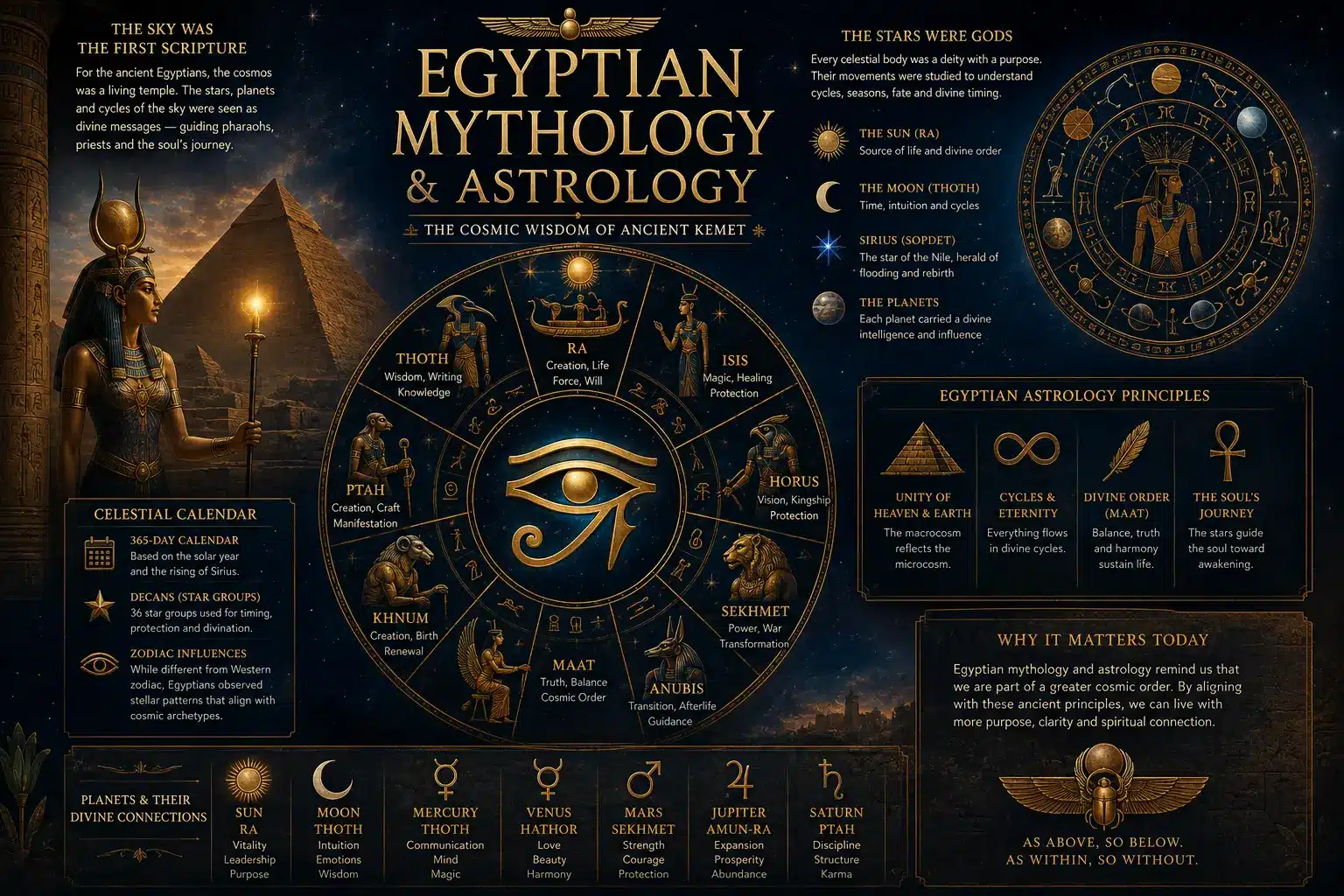
The Egyptian zodiac origins trace back more than four thousand years to the astronomical and religious traditions of ancient Egypt. Rather than a single unified zodiac system like the Western or Chinese traditions, Egyptian astrological thinking developed through two parallel but related structures: the 36 Decans — stellar divisions of the sky used to track sacred time — and the mythological pantheon of gods and goddesses whose attributes became a symbolic map of human personality and fate.
The modern ZodiacRoots Egyptian Guardian system draws from both traditions — assigning one of 12 divine archetypes (Nile, Amun-Ra, Mut, Geb, Osiris, Isis, Thoth, Horus, Anubis, Seth, Bastet, and Sekhmet) to birth date ranges, each carrying a distinct mythic psychology rooted in the original deity symbolism of the ancient Nile civilisation.
This article traces those origins in full: the astronomical history, the 36 Decans, the key deities and what they symbolise, and why the Egyptian tradition remains one of the most psychologically resonant of the eight ancestral systems used in the ZodiacRoots 8 Roots method.
Curious which Egyptian Guardian you are — and how it combines with your Western sign, Moon, and six other ancestral traditions?
How Old Are the Egyptian Zodiac Origins?
Egyptian astronomical tradition is among the oldest recorded in human history. Star catalogues inscribed on the lids of Middle Kingdom coffins — known as Diagonal Star Clocks — date to approximately 2100 BCE, making them the earliest known systematic attempt to track stellar time for religious and practical purposes.
The 36 Decans — the foundational structure behind the Egyptian zodiac — were developed during the Middle Kingdom period (c. 2055–1650 BCE) and refined through the New Kingdom. Each decan corresponded to a specific star or star cluster that rose heliacally (just before sunrise) for a ten-day period, dividing the 360-day sacred year into 36 segments of symbolic time.
Later, during the Ptolemaic period (332–30 BCE), Greek and Egyptian astronomical traditions merged — and the 36-decan structure began to influence what would eventually become Western horoscopic astrology. The Egyptian contribution to the broader astrological tradition is deeper and earlier than most people realise.
The 36 Decans: The Astronomical Engine Behind the Egyptian Zodiac
The 36 Decans (𓇳) are the true astronomical foundation of Egyptian sacred time. The word “decan” comes from the Greek dekanoi — a translation of the Egyptian concept of the “ten-day stars.” Each decan was a specific star or stellar group that marked the passage of ten days, and their sequential rising was used as a celestial clock by Egyptian priests.
The system worked as follows: at the moment of each new decan’s heliacal rising — its first appearance on the eastern horizon just before dawn — a new ten-day period of the sacred year began. Over 36 such risings, the full 360-day year was marked. The remaining five days of the Egyptian civil calendar were called the epagomenal days — intercalary days outside the cycle, considered sacred to five specific deities: Osiris, Horus the Elder, Set, Isis, and Nephthys. For a deeper institutional overview of how Egyptians tracked time through the stars, the Metropolitan Museum of Art provides an authoritative reference on Egyptian stellar timekeeping.
The most important of all the decan stars was Sopdet — the star we know as Sirius — whose annual heliacal rising signalled the beginning of the Egyptian New Year and the imminent flooding of the Nile. Sopdet was identified with the goddess Isis, and her rising was one of the most astrologically significant events in the entire Egyptian sacred calendar.
The Nile, the Flood, and the Sacred Calendar
Egyptian astronomy and Egyptian religion are inseparable from the Nile. The annual inundation of the river — which deposited the fertile black silt that made Egyptian agriculture possible — was the central event around which the entire sacred calendar was organised. When the Nile flooded, Egypt was reborn. When it receded, life followed.
This cyclical pattern of death, inundation, and renewal is not coincidental to the Egyptian pantheon — it is its structural core. Osiris dies and is reborn. Isis weeps and the Nile rises. Ra descends into the underworld each night and rises again at dawn. The gods are not separate from nature — they are nature, mythologised and given divine personality.
This is why the Egyptian zodiac origins are fundamentally different from the Greek or Chinese approaches to astrological time. In Egypt, the sky is not simply a backdrop — it is the body of the goddess Nut, who swallows the sun each evening and gives birth to it each morning. Every celestial event is simultaneously a mythological one.
The 12 Egyptian Guardians: Mythology and Symbolic Psychology
The ZodiacRoots Egyptian system assigns each person to one of 12 divine archetypes based on birth date ranges. Each guardian is drawn from the core Egyptian pantheon and carries a distinct mythological personality — not as superstition, but as a symbolically encoded psychological portrait shaped by millennia of myth, ritual, astronomy and symbolic interpretation.
🌊 Nile
Jan 1–7 · Jun 19–28 · Sep 1–7 · Nov 18–26
The river itself as archetype — flow, renewal, life force. Nile people are adaptive, restorative, and cyclically oriented. They rebuild what others abandon.
☀️ Amun-Ra
Jan 8–21 · Feb 1–11
The supreme solar deity — king of the gods, source of all creative authority. Amun-Ra carries charisma, leadership, and the radiance of sovereign purpose.
🕊️ Mut
Jan 22–31 · Sep 8–22
Mother of all things, divine queen and cosmic matrix. Mut embodies maternal strength, protection, and enduring dignity — the force that holds the world in form.
🌿 Geb
Feb 12–29 · Aug 20–31
God of the earth — the stable ground beneath all things. Geb people are grounded, practical, and deeply rooted, building foundations that last.
♻️ Osiris
Mar 1–10 · Nov 27–Dec 18
God of death, rebirth, and the afterlife. Osiris carries the great cycle of loss and regeneration — a profound, transformative psychology built on the capacity to rise again.
✨ Isis
Mar 11–31 · Oct 18–29 · Dec 19–31
Goddess of magic, healing, and devoted protection. Isis is intuitive, emotionally intelligent, and fiercely loyal — her tears caused the Nile to flood and bring life.
📜 Thoth
Apr 1–19 · Nov 8–17
God of wisdom, writing, and cosmic balance. Thoth invented hieroglyphs, recorded the weighing of the soul, and maintained the order of Ma’at — analytical, reflective, and deeply fair.
🦅 Horus
Apr 20–May 7 · Aug 12–19
God of the sky and divine kingship. Horus sees from above, acts with clarity, and reclaims what was taken — focused, strategic, and sovereign in purpose.
🖤 Anubis
May 8–27 · Jun 29–Jul 13
Guardian of the dead and keeper of the threshold. Anubis protects passage between worlds — watchful, boundary-aware, and attuned to what lies beneath the surface.
⚡ Seth
May 28–Jun 18 · Sep 28–Oct 2
God of chaos, storms, and necessary disruption. Seth unsettles what has become stagnant — catalytic, intense, and confrontational, but a guardian against the serpent Apep each night.
🐈 Bastet
Jul 14–28 · Sep 23–27 · Oct 3–17
Goddess of protection, sensuality, and domestic harmony. Bastet is graceful, warm, and self-possessed — fiercely protective of those she loves, deeply attuned to pleasure and balance.
🔥 Sekhmet
Jul 29–Aug 11 · Oct 30–Nov 7
Goddess of fierce healing and purifying fire. Sekhmet destroys what is diseased so the body — individual or collective — can regenerate. Courageous, intense, and transformative.
What makes this system symbolically powerful is that each guardian is not simply a label — it is a mythological blueprint: a set of psychological traits, shadow qualities, relational patterns, and life themes encoded in the deity’s original mythic role. Thoth’s analytical balance, Sekhmet’s purifying intensity, Anubis’s liminal awareness — these are not arbitrary assignations. They are thousands of years of human symbolic observation compressed into divine form.
The Weighing of the Soul: Egyptian Astrology as Ethical Map
One of the most distinctive features of Egyptian religious thought is that its cosmology is fundamentally ethical. At the heart of Egyptian spiritual life stands the concept of Ma’at — truth, justice, cosmic order — personified as a goddess whose single feather is weighed against the heart of the deceased in the Hall of Two Truths.
In the Book of the Dead, the soul of the deceased enters the afterlife and stands before 42 divine assessors. Thoth records the judgment. Anubis weighs the heart. Osiris presides. The heart is measured not against physical achievement but against the feather of Ma’at — truth lived, harm avoided, balance maintained.
This ethical dimension makes the Egyptian guardian system unique among the eight traditions in ZodiacRoots. Where the Chinese Zodiac encodes personality through temporal position and elemental force, and the Mayan Tzolk’in encodes it through cosmic energy and calendar resonance, the Egyptian tradition encodes it through divine purpose and moral architecture — each guardian representing not just who you are, but what you are called to uphold.
Egyptian Guardian Date Ranges — At a Glance
Unlike the Western or Chinese Zodiac, each Egyptian Guardian may span multiple non-consecutive date ranges across the year — reflecting the original multi-period structure of the decanal system and the sacred calendar’s relationship with seasonal cycles.
Want to see your Egyptian Guardian combined with your Western sign, Moon, Chinese Zodiac, Vedic Rashi, Mayan Seal, and three other ancestral traditions?
How Egyptian Zodiac Origins Shaped Western Astrology
The Egyptian contribution to what we now call Western astrology is profound and largely unacknowledged. When Alexander the Great conquered Egypt in 332 BCE, Greek and Egyptian intellectual traditions entered a centuries-long dialogue — one that produced some of the most significant astrological texts in the ancient world.
During the Ptolemaic and early Roman periods, the Egyptian 36-decan system was absorbed into Greek horoscopic astrology. Each of the twelve Western zodiac signs was divided into three decans of ten degrees each — a direct inheritance from the Egyptian ten-day decan structure. The decan rulers found in modern Western astrological texts (such as those in the Picatrix or the works of Firmicus Maternus) trace directly back to Egyptian stellar tradition.
The city of Alexandria was the crucible of this synthesis — home to one of the greatest libraries in the ancient world and the meeting point of Egyptian, Greek, Babylonian, and later Jewish astrological thought. Much of what modern Western astrology calls “tradition” was born in this Alexandrian synthesis, with Egyptian decanic structure as one of its foundational layers.
Egyptian Zodiac Origins and the ZodiacRoots 8 Roots System
The ZodiacRoots method uses the Egyptian Guardian as the fifth of eight ancestral traditions in a unified symbolic reading. Rather than reading the Egyptian archetype in isolation, it is placed in dialogue with a person’s Western Sun sign, Moon sign, Ascendant, Vedic Rashi, Chinese Zodiac, Mayan Seal, and Celtic Tree — revealing patterns that no single system surfaces alone.
A practical example: a person born under Seth (the disruptive guardian) with a Scorpio Sun, a Pluto-dominant chart, and a Yang Metal Tiger in the Chinese system presents a very different profile from a Seth guardian with a Libra Sun and a Yang Wood Rabbit. The Egyptian layer adds the mythic current of necessary disruption — but the degree and expression of that disruption is shaped by every other root in the reading. For a detailed real-world example, see the Donald Trump 8 Roots reading, where Seth appears alongside Gemini, Leo Rising, and Yang Fire Dog to create an unusually coherent portrait of disruption as structure.
The Egyptian tradition’s roots in ethical cosmology, divine purpose, and the deep structure of renewal make it one of the most philosophically rich layers in the ZodiacRoots system — and one of the most distinctive in cross-tradition synthesis.
Egyptian Zodiac Origins: Common Misconceptions
| What people believe | What the origins actually show |
|---|---|
| “The Egyptians didn’t have a zodiac.” | Egypt had one of the oldest astronomical time-tracking systems in the world — the 36 Decans — predating the Greek zodiac and directly influencing its development during the Ptolemaic period. |
| “Seth is purely evil.” | In Egyptian mythology, Seth was also the god who defended Ra’s solar barque from the serpent Apep each night. Disruption and chaos are necessary forces — Seth’s role is ambivalent, not simply negative. |
| “Egyptian astrology is the same as Western astrology.” | They share historical roots — particularly through the Alexandrian synthesis — but Egyptian sacred time was decan-based and Nile-tied, not zodiac-sign based. The guardian system reflects Egyptian mythic structure, not Greek horoscopy. |
| “The Egyptian gods are just stories.” | The Egyptian pantheon encodes thousands of years of observed patterns in human psychology, social structure, natural cycles, and ethical philosophy. As symbolic archetypes, they remain among the most symbolically coherent personality systems in ancient mythology. |
Explore More ZodiacRoots Readings
- Egyptian Guardians Hub — browse all 12 guardian signs, dates, and full profile pages.
- Egyptian Guardian Calculator — find your guardian directly from your birth date.
- The 36 Egyptian Decans — the full authority guide on Egyptian sacred time and stellar history.
- Egyptian Guardian Compatibility — compare two guardian archetypes in relationships.
- Chinese Zodiac Origins — discover the parallel mythological foundations of the Chinese system.
- The ZodiacRoots 8 Roots Method — see how the Egyptian layer combines with seven other ancestral traditions.
- Calculate Your 8 Roots — find your Egyptian Guardian alongside your full multi-tradition profile.
FAQ: Egyptian Zodiac Origins
What are the egyptian zodiac origins?
The Egyptian zodiac origins trace back over 4,000 years to the astronomical and religious traditions of ancient Egypt. The foundational structure is the 36 Decans — stellar divisions used to track sacred time since the Middle Kingdom (c. 2055–1650 BCE). The 12 Egyptian Guardian archetypes used in ZodiacRoots are drawn from the major deities of the Egyptian pantheon, each carrying a distinct mythological psychology.
What are the 36 Egyptian Decans?
The 36 Decans are stellar segments used by ancient Egyptian priests to divide the 360-day sacred year into 36 periods of ten days each. Each decan was marked by the heliacal rising of a specific star or star cluster. They were used as celestial clocks, appearing in astronomical coffin lid diagrams known as Diagonal Star Clocks from around 2100 BCE. The most important decan star was Sopdet (Sirius), associated with the goddess Isis.
Who are the 12 Egyptian Guardians in ZodiacRoots?
The 12 Egyptian Guardians are Nile, Amun-Ra, Mut, Geb, Osiris, Isis, Thoth, Horus, Anubis, Seth, Bastet, and Sekhmet. Each is assigned to specific birth date ranges and carries a distinct mythic psychology — from Amun-Ra’s solar leadership and Thoth’s analytical wisdom to Seth’s disruptive intensity and Sekhmet’s fierce healing power.
What is the role of the Nile in the Egyptian zodiac?
The Nile is the organisational centre of the entire Egyptian sacred calendar. Its annual inundation — signalled by the heliacal rising of Sirius (Sopdet/Isis) — marked the Egyptian New Year and the beginning of the agricultural cycle. The mythological themes of flood, renewal, death, and rebirth that run through the Egyptian pantheon are all rooted in the river’s cyclical relationship with life and time.
What is Ma’at and why is it important to the Egyptian zodiac?
Ma’at is the Egyptian concept of truth, justice, and cosmic order — personified as a goddess whose feather is weighed against the heart of the deceased in the afterlife judgment. Ma’at gives the Egyptian system its ethical dimension: each guardian carries not only personality traits but a set of moral responsibilities encoded in the deity’s mythic role. It is what makes the Egyptian tradition unique among the ZodiacRoots eight traditions.
Did ancient Egyptians have a zodiac like the Western one?
Not in the same form. Ancient Egyptians used a 36-decan system based on stellar heliacal risings, not a 12-sign zodiacal belt. During the Ptolemaic period, Greek and Egyptian traditions merged, and the decanal structure was absorbed into early Western horoscopic astrology. The 12-sign Western zodiac itself was largely a Babylonian-Greek development, though Egyptian astronomical thought was a major influence on its refinement.
Why does Seth have a positive role in Egyptian mythology?
Seth is often associated with chaos and disruption, but in Egyptian mythology he also defended Ra’s solar barque from the serpent Apep each night — preventing the destruction of the sun. His role is ambivalent: necessary disruption rather than pure evil. The ZodiacRoots Seth guardian reflects this duality: a catalytic, intense archetype whose function is to break what has calcified so renewal can follow.
Why do Egyptian Guardian date ranges span multiple periods in the year?
Unlike the Western zodiac’s twelve consecutive single-period signs, the Egyptian Guardian system assigns non-consecutive date ranges to each guardian. This reflects the original decanal calendar’s relationship with seasonal cycles and the multi-period recurrence of specific stellar and mythological themes across the Egyptian sacred year.
How does ZodiacRoots use the Egyptian Guardian system?
ZodiacRoots uses the Egyptian Guardian as one of eight ancestral traditions in a unified symbolic reading. The guardian adds a mythic current — divine purpose, ethical architecture, and a specific energy pattern — that interacts with the person’s Western, Vedic, Chinese, Mayan, and Celtic layers to reveal the full symbolic portrait. Discover yours at zodiacroots.com.
How did the Egyptian zodiac influence Western astrology?
The 36-decan system was absorbed into Greek horoscopic astrology during the Ptolemaic period. Each of the twelve Western zodiac signs came to be divided into three decans of ten degrees each — a direct structural inheritance from the Egyptian ten-day decan. The city of Alexandria was the crucible of this synthesis, merging Egyptian, Greek, and Babylonian astrological traditions into the foundation of what Western astrology still uses today.
Your Egyptian Guardian Is Only One Root of Eight
The Egyptian zodiac origins reveal a symbolic system built on divine purpose, ethical cosmology, and four thousand years of human observation. But your guardian is still only one layer of your full symbolic identity. The ZodiacRoots method reads your Egyptian archetype alongside seven other ancestral traditions to reveal the complete picture.
Published by ZodiacRoots. This article is a symbolic and mythological overview of Egyptian zodiac origins for educational and astrological purposes. The ZodiacRoots Egyptian Guardian system is a modern interpretive framework inspired by ancient Egyptian deity traditions.
Discover More Astrology Articles You May Like
Explore related ZodiacRoots articles selected by topic first, then completed with fresh astrology reads.