
Vedic Astrology Signs: The 12 Rashis Explained
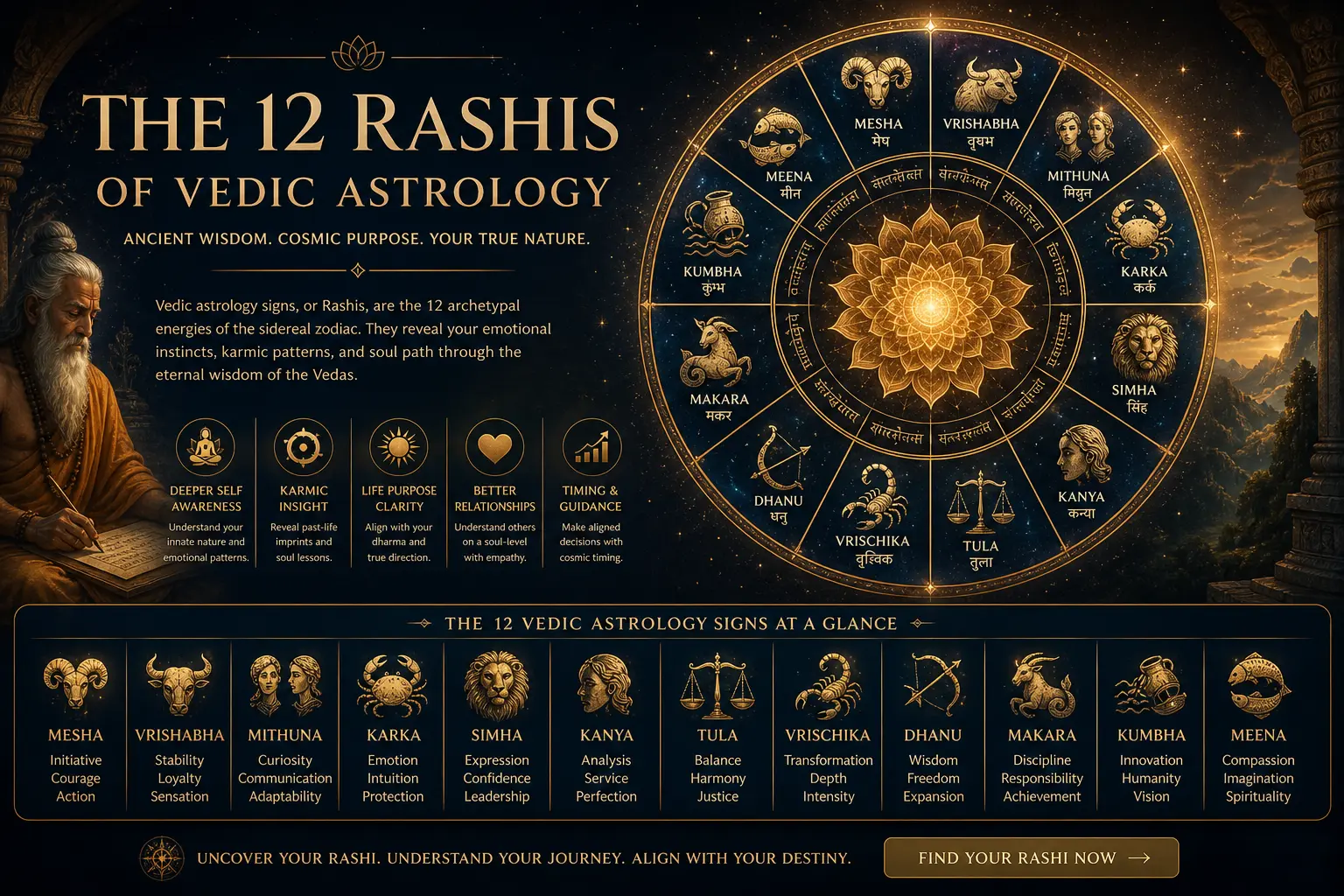
Vedic astrology signs are the 12 Rashis of the sidereal zodiac. Each Rashi reveals patterns of emotion, instinct, karma, spiritual development, and the way your inner nature responds to life.
In this guide, you will learn what the 12 Vedic astrology signs mean, how they differ from Western zodiac signs, why your Rashi may not match your Western Sun sign, and how to discover your own Vedic sign through the ZodiacRoots 8 Roots framework.
Direct Answer: What Are Vedic Astrology Signs?
Vedic astrology signs are the twelve Rashis used in Jyotisha, the traditional astrological system connected with Indian sacred and astronomical traditions. Unlike most modern Western astrology, which usually uses the tropical zodiac, Vedic astrology works with the sidereal zodiac, a zodiac framework linked to the fixed stars and constellational reference points. This is why your Vedic sign can be different from your Western zodiac sign.
What Are the Rashis?
Rashis are the twelve sign divisions used in Vedic astrology. Each Rashi carries a specific pattern of temperament, motivation, emotional instinct, life rhythm, and karmic development.
Why Your Vedic Sign Matters
Your Vedic sign is not only a personality label. It can reveal how you react, attach, seek security, make choices, and move through repeating life themes.
How to Find Your Rashi
To find your Rashi accurately, use your birth date, birth time, and birth place with a sidereal chart calculation. Start with Find Your Rashi or explore what your Vedic sign means.
Quick Traits of Vedic Astrology Signs
Vedic Astrology Signs vs Western Zodiac Signs
The main difference is the zodiac system. Western astrology usually uses the tropical zodiac, which is linked to the seasons. Vedic astrology uses the sidereal zodiac, which is aligned with fixed star reference points.
Because of this, your Vedic sign may differ from your Western Sun sign. To understand the Western layer of your chart, explore your Sun sign meaning, your Moon sign, and your Ascendant.
Why Vedic Astrology Feels Deeper
Vedic astrology often feels more spiritual because it focuses not only on personality but also on karma, dharma, timing, lunar mansions, and the soul’s developmental path.
To go deeper, explore karma and dharma in Vedic astrology, the Grahas, the Bhavas, the Nakshatras, and the meaning of Lagna.
A Note on Jyotisha, Nakshatras, and the Sidereal Zodiac
Vedic astrology is often called Jyotisha, a Sanskrit term associated with light, celestial bodies, timekeeping, ritual timing, and astrological interpretation. For background reading, see Britannica’s overview of Jyotisha.
One reason Vedic astrology signs differ from Western signs is the distinction between sidereal and tropical reference systems. NASA’s educational explanation of precession of the equinoxes helps explain why celestial reference points shift over long periods of time.
Vedic astrology also works with the Nakshatras, or lunar mansions, which add a more precise symbolic layer beyond the 12 Rashis.
The 12 Vedic Astrology Signs and Their Meanings
The 12 Vedic astrology signs each carry a different energetic signature. Together, the Rashis describe how people act, feel, attach, grow, protect themselves, and respond to life’s deeper lessons.
Mesha (Aries)
Bold, pioneering, energetic, and driven by action. Read more about Mesha.
Vrishabha (Taurus)
Grounded, loyal, sensual, and stability-oriented. Read more about Vrishabha.
Mithuna (Gemini)
Curious, verbal, adaptive, and mentally active. Read more about Mithuna.
Karka (Cancer)
Protective, intuitive, emotional, and family-centred. Read more about Karka.
Simha (Leo)
Radiant, proud, generous, and expressive. Read more about Simha.
Kanya (Virgo)
Analytical, practical, observant, and service-minded. Read more about Kanya.
Tula (Libra)
Balanced, relational, diplomatic, and harmony-seeking. Read more about Tula.
Vrischika (Scorpio)
Intense, private, transformative, and emotionally powerful. Read more about Vrischika.
Dhanu (Sagittarius)
Expansive, idealistic, philosophical, and freedom-loving. Read more about Dhanu.
Makara (Capricorn)
Disciplined, responsible, strategic, and resilient. Read more about Makara.
Kumbha (Aquarius)
Independent, original, future-facing, and idealistic. Read more about Kumbha.
Meena (Pisces)
Compassionate, imaginative, spiritual, and fluid. Read more about Meena.
What Your Rashi Reveals
Your Rashi can reveal how you process emotion, how you respond instinctively, and what kind of karmic themes may repeat in your life. It can also help explain relationship dynamics, inner motivations, and the lessons your soul is learning through experience.
In many Vedic readings, the Moon sign is especially important because it reflects the mind, emotional habits, needs, memory, and instinctive comfort zone. That is why two people with the same Western Sun sign can feel very different when their Vedic Moon signs are different.
At ZodiacRoots, we do not interpret Vedic astrology signs in isolation. We place your Rashi inside the broader 8 Roots system, alongside your Western Sun sign, Moon sign, Rising sign, Chinese Zodiac, Mayan Seal, Celtic Tree, and Egyptian Guardian.
Vedic Astrology Signs at a Glance
| Rashi | Western Equivalent | Elemental Tone | Core Theme |
|---|---|---|---|
| Mesha | Aries | Fire | Initiative and courage |
| Vrishabha | Taurus | Earth | Stability and loyalty |
| Mithuna | Gemini | Air | Curiosity and communication |
| Karka | Cancer | Water | Protection and emotional memory |
| Simha | Leo | Fire | Radiance and leadership |
| Kanya | Virgo | Earth | Refinement and service |
| Tula | Libra | Air | Balance and relationship |
| Vrischika | Scorpio | Water | Depth and transformation |
| Dhanu | Sagittarius | Fire | Truth and exploration |
| Makara | Capricorn | Earth | Discipline and endurance |
| Kumbha | Aquarius | Air | Vision and originality |
| Meena | Pisces | Water | Compassion and imagination |
FAQ About Vedic Astrology Signs
What are Vedic astrology signs?
Vedic astrology signs are the 12 Rashis of the sidereal zodiac. They are used in Vedic astrology to interpret personality, emotional patterns, karma, dharma, relationships, timing, and spiritual direction.
Are Vedic astrology signs different from Western zodiac signs?
Yes. Vedic astrology usually uses the sidereal zodiac, while most Western astrology uses the tropical zodiac. Because these systems use different reference points, your Vedic sign can be different from your Western Sun sign.
How do I find my Vedic sign?
You can find your Vedic sign by using your birth date, birth time, and birth place in a sidereal astrology calculator. For a deeper result, use the ZodiacRoots 8 Roots calculator, which includes your Vedic Rashi alongside seven other symbolic roots.
Is Rashi the same as Moon sign?
In many Vedic astrology contexts, Rashi often refers to the Moon sign because the Moon is central to emotional nature, mind, memory, and daily experience. However, Rashi can also refer more generally to a zodiac sign division in the chart.
What is the difference between Rashi and Lagna?
Rashi usually points to a sign placement, often the Moon sign in everyday Vedic astrology language. Lagna means the Ascendant or rising sign. Rashi describes inner emotional patterns, while Lagna describes embodiment, life direction, and how the chart expresses outwardly.
Why is my Vedic sign different from my Western sign?
Your Vedic sign may be different because Vedic astrology uses a sidereal zodiac, while Western astrology usually uses a tropical zodiac. The difference between these systems is linked to the precession of the equinoxes, which gradually changes the relationship between seasonal and stellar reference points.
Are Vedic astrology signs more accurate than Western signs?
They are not simply “more accurate” or “less accurate.” They belong to different symbolic systems. Vedic astrology often emphasizes karma, timing, the Moon, Nakshatras, and spiritual development, while Western astrology often emphasizes psychological identity, personal growth, and seasonal symbolism.
Do I need my birth time to know my Vedic sign?
For a basic Rashi or Moon sign, birth time can be important when the Moon changed signs near your birth. For Lagna, houses, and a full Vedic chart, birth time is essential because the Ascendant changes quickly throughout the day.
How does ZodiacRoots use Vedic astrology signs?
ZodiacRoots uses Vedic astrology signs as one layer of the 8 Roots method. Your Rashi is interpreted alongside your Western Sun sign, Moon sign, Rising sign, Chinese Zodiac, Mayan Seal, Celtic Tree, and Egyptian Guardian to create a broader symbolic profile.
Related Vedic Astrology Reading
Continue exploring the Vedic system through these core guides:
Discover Your Vedic Astrology Sign
Want to know your Rashi? Use ZodiacRoots to calculate your Vedic astrology sign and uncover a deeper layer of your cosmic identity.
ZodiacRoots goes beyond one zodiac sign by exploring your full symbolic profile through the 8 Roots, including your Western Sun sign, Moon sign, Rising sign, Vedic Rashi, Chinese Zodiac, Mayan Seal, Celtic Tree, and Egyptian Guardian.
Calculate Your 8 Roots